Dean N Onyambu
5.3K posts

@InfinitelyDean
Fund Leadership & Multi-Asset Trading | Global Macro & Capital Strategy | Canary Compass | Structure Before Sentiment | Not Investment Advice


UAE presidential advisor Anwar Gargash says Iran’s attacks on Gulf countries “cement the Iranian threat as a central pillar of Gulf strategic thinking” and will lead to the “strengthening of our security partnerships with Washington,” calling it the “price of Iran’s miscalculations.”


Why they dominate? Responsiveness, value for money, customer service. Chinese contractors engage us as valued customers. Western ones engage us as aid recipients.

Bloomberg reports African governments are approaching Dangote to secure fuel supplies after the Iran war disrupted flows. Good reporting. A few layers underneath are worth examining. The article says 25 per cent of Dangote's 650,000 bpd capacity is available for export. That is nameplate capacity. Dangote receives roughly five crude cargoes per month from NNPC against the thirteen it needs to run at full utilisation. It sources the remainder internationally, with Nigerian grades running USD3 to 6 above Brent. The constraint is feedstock. Export capacity that cannot be fed is not export capacity. Bloomberg also notes South Africa holds 8 million barrels of strategic crude stocks, then acknowledges the country has virtually no dedicated fuel reserves. That distinction matters more than either sentence alone. Crude stocks without refining capacity is inventory you cannot deploy. South Africa has lost about half its refining capacity in recent years. The wider story is the downstream cascade most commentary has not yet reached. Sulphur, sulphuric acid, fertiliser, mining inputs, food systems. Half of global seaborne sulphur trade transits the Strait. When Gulf refineries shut, the acid supply chain breaks. Urea prices have surged nearly 40 per cent. More than 1.1 million metric tons of fertiliser cargo are stranded in the Gulf. China has restricted exports. Northern Hemisphere planting season is weeks away. We published our structural analysis of this full cascade yesterday, covering Nigeria, Kenya, and Zambia, including the insurance architecture that determines when and whether flows resume. Structure before sentiment. canarycompass.com/p/quick-take-t…

I just learnt that Changamwe Oil refinary was shut down in 2013 and later converted to an oil storage facility. So now we no longer refine oil. We just buy from the Arabs. How convenient. It's only in Kenya where we discover Oil then shut down our only refinery immediately and import instead. We're so screwed.

BREAKING: More details emerge on a potential peace deal between the US and Iran, per Axios. Details include: 1. US officials say there could be "room to negotiate" over returning frozen assets to Iran 2. "They call it reparations. Maybe we call it return of frozen money," the official said 3. US says any deal to end the war would need to include the reopening of the Strait of Hormuz, address Iran's stockpile of highly enriched uranium, and also establish a long-term agreement on Iran's nuclear program, ballistic missiles and support for proxies in the region 4. Iranian demands include a ceasefire, guarantees that the war will not resume in the future, and compensation We expect an eventful week ahead.


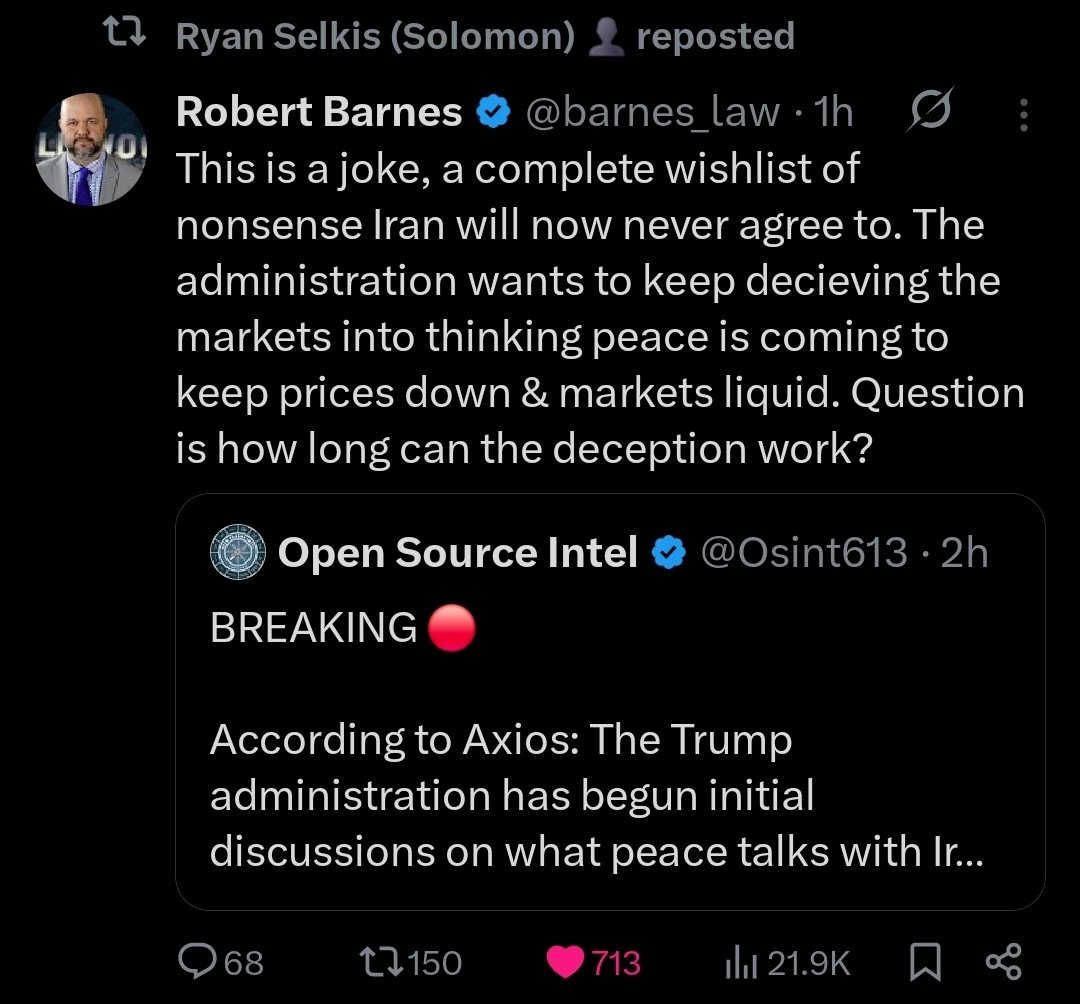
The Trump Administration has begun initial discussions on what a potential peace deal with Iran might look like, per Axios. The Kobeissi Letter summarised six reported terms. These are not the full proposal. The actual text has not been published. The six terms: no missile programme for five years, zero uranium enrichment, decommissioning of Natanz, Isfahan and Fordow, strict observation protocols on centrifuges, regional arms control treaties with a 1,000 missile cap, and an end to proxy financing. Four questions structure how nuclear agreements should be assessed, each requiring separate evidence: enrichment, weaponisation, delivery, intent. The 2015 JCPOA scored roughly two out of four. It capped enrichment at 3.67 per cent and monitored weaponisation through the most comprehensive IAEA inspection regime ever applied to a non-nuclear-weapon state. Those were real achievements. But it left the missile programme completely untouched. Resolution 2231 downgraded binding prohibitions on Iranian missile activity from "shall not" to "called upon." It managed intent through incentive structure rather than verification. It contained sunset clauses, with enrichment caps expiring in 2030, centrifuge restrictions between 2023 and 2025, and missile restrictions in 2023. The arms embargo expired in 2020. Iran formally terminated the agreement in October 2025. And the deal did nothing about proxy financing. A deal that constrained one dimension of threat while resourcing another through sanctions relief was a structural flaw. The proposed terms attempt all four dimensions. Enrichment eliminated, not capped. Facilities decommissioned, not constrained. Missiles halted and regionally capped. Proxy financing prohibited. On paper, it addresses every structural criticism levelled at the JCPOA. The question is whether these terms are designed to be accepted, rejected, or negotiated down. Iran rejected zero enrichment in Geneva. It rejected facility decommissioning. It offered instead to reduce enrichment to low levels under IAEA supervision, a position that mediators described as going beyond the 2015 deal. The Omani foreign minister assessed substantial progress and flew to Washington to convey this to the White House. The US negotiating team assessed otherwise. Neither assessment should be accepted uncritically. There is a third reading. This administration has a documented pattern of opening at extreme positions and settling lower. If that applies here, the question shifts from "will Iran accept" to "what does the settlement look like." Zero enrichment negotiated to capped low-level enrichment under IAEA supervision is a tighter JCPOA. Decommissioning negotiated to mothballing with permanent inspectors strengthens access beyond 2015 levels. A binding missile restriction replacing Resolution 2231's "called upon" language addresses the delivery gap for the first time. A negotiated-down version could be stronger than the JCPOA on all four dimensions while remaining achievable. Two concerns with the terms as summarised. First, the five-year missile restriction creates the same sunset problem the JCPOA was criticised for, on a shorter timeline. The JCPOA's missile restrictions ran eight years. This one runs five. Second, the monitoring language is vague. The JCPOA's verification regime was its strongest dimension: IAEA, Additional Protocol, continuous surveillance. "Strict outside observation protocols" does not specify the IAEA, does not reference the Additional Protocol, and does not address undeclared sites. If the full proposal contains stronger provisions, this concern falls away. If not, the proposed framework may be weaker on the one dimension the JCPOA got right. This caveat applies throughout: we are assessing a summary, not the document. The terms are more ambitious than the JCPOA. Whether they are more achievable depends on whether they are a final position or an opening one. #StructureBeforeSentiment


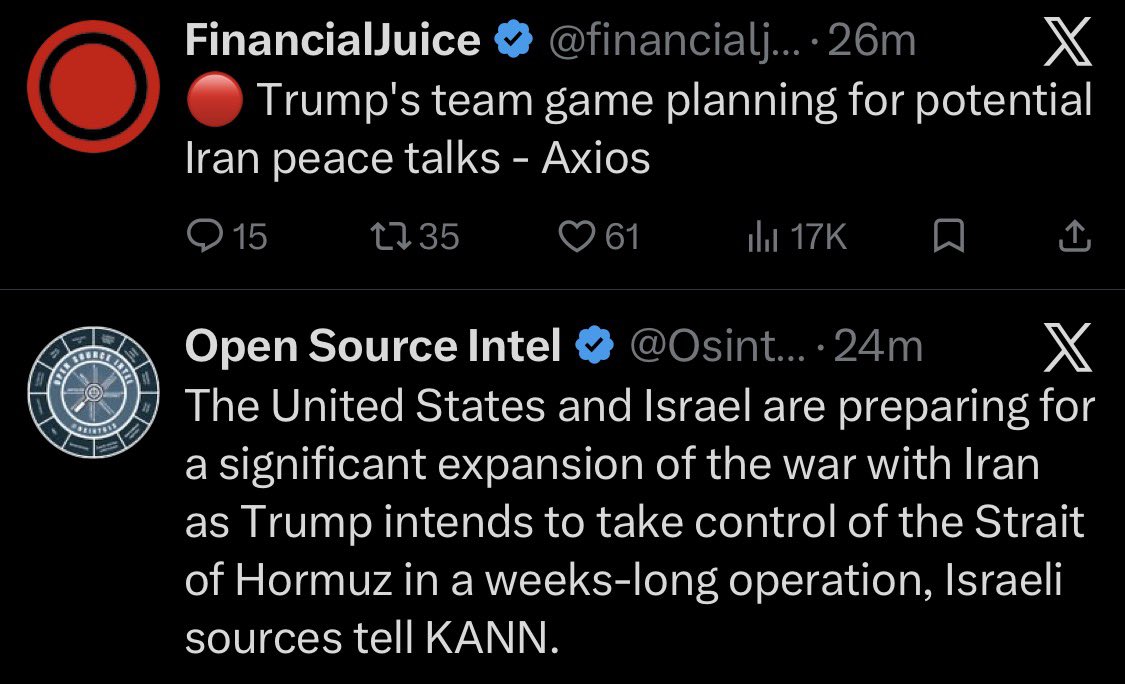
BREAKING: The Trump Administration has begun "initial discussions" on what a potential peace deal with Iran might look like, per Axios. US officials are planning the below terms: 1. No missile program for five years 2. Zero uranium enrichment 3. Decommissioning of the reactors at the Natanz, Isfahan, and Fordow nuclear facilities 4. Strict outside observation protocols around the creation and use of centrifuges and related machinery that could advance a nuclear weapons program 5. Arms control treaties with regional countries that include a missile cap no higher than 1,000 6. End of financing for Iranian proxy groups US officials said the expectation is there will still be 2-3 additional weeks of fighting and Trump's envoys Jared Kushner and Steve Witkoff are involved in the discussions. Step #9 of our "Conflict Playbook" is near.

This exchange is useful. The disagreements are becoming clearer. 1. SAPs destroyed industrial capacity. Agreed in the first reply. Agreed again. The question that remains unanswered: which framework rebuilds that capacity in 2026? Repeating the diagnosis is not a treatment plan. Every paragraph returns to what the West did. Where is the forward-facing architecture? 2. "The West has no incentive to build African industry either." The West does not need to build African industry out of goodwill. It needs to purchase African output. That is what an absorber economy does. The US and EU run persistent trade deficits. They consume more than they produce. African manufactured goods have a structural buyer in absorber economies. China runs a surplus. It produces more than it consumes. Household consumption at 39.9 per cent of GDP means Chinese consumers cannot absorb African manufactures at scale. The incentive distinction is purchase patterns, not moral preference. 3. The Asia comparison proves the opposite of what you intend. Japan, Korea, Taiwan, and China each built industrial capacity by exporting to absorber markets first. The US was the primary buyer for decades. Regional integration followed industrial maturity. It did not precede it. Asia's 59 per cent intra-regional trade is the destination after sixty years of absorber-driven growth. AfCFTA is Africa's destination too. I argued exactly this in The Forced Choice. The problem is the bridge. Africa's combined GDP is roughly USD3.4 trillion. Intra-African purchasing power cannot yet sustain manufacturing at scale. The critical minerals window provides the bridge: process minerals for absorber markets now, build the revenue base and industrial capacity that makes AfCFTA viable over time. 4. On CBAM: it penalises carbon-intensive imports. If Africa processes minerals domestically to clean energy standards, CBAM favours African processed goods over Chinese goods shipped from coal-heavy grids. CBAM is an argument for African processing, not against absorber market access. 5. "We will not rebuild by choosing between Washington and Beijing." This assumes the choice is voluntary. It is being imposed. The US Critical Minerals Ministerial in February 2026 established Foreign Entity of Concern criteria. Chip export controls restrict technology access based on alignment. 5G infrastructure decisions lock countries into one technology stack or the other. Security architecture requires partnership positioning. The world is bifurcating into two systems: two tech stacks, two security umbrellas, two market access corridors. Countries that decline to position themselves will find the positioning done for them through restricted access, excluded partnerships, and second-tier arrangements. I called this the Coalition of the Eligible in The Forced Choice: countries that meet the criteria access the corridor. Countries that do not are left outside it. The window for that positioning is closing. The full structural analysis, including the critical minerals bridge, the absorber-surplus framework, and the Coalition of the Eligible, is at canarycompass.com/p/the-forced-c…. The choice is already being made. The question is whether Africa participates in shaping its terms or absorbs the consequences of inaction.


I went to university in Africa in the mid-1990s, so here is my honest reaction to your post. What you call “anti-West grievance” is, in many ways, a reading of history backed by evidence. Structural adjustment programs dismantled African industrial policy and locked many economies into extractive specialization for decades. That is not nostalgia; it is a documented policy choice. On financing, the West also relied for years on tied aid and vendor-linked arrangements, so it is strange to condemn China for practices long treated as normal when used by OECD countries. The deeper issue is that Western conditionality often reinforced raw-material exports rather than domestic manufacturing. The same pattern appears in trade and finance: our economies are still priced through external risk lenses, and market access is increasingly constrained by instruments such as EU-CBAM, which make value-added exports even harder. Trade imbalances do not happen in a vacuum; they reflect long colonial continuities. Africa does not need “absorbers.” We need industrial policy, policy space, and infrastructure that serves transformation rather than extraction. What is striking is the gaslighting: colonial-style extraction is repackaged as “good governance,” while the same financing tools are demonized the moment Beijing uses them.

As a bloc, they have the infrastructure and human capital to pull off something big in Africa, even if the world goes to shit. 🇺🇬🇰🇪🇹🇿🇿🇲🇲🇼


Britain will reduce its aid sent to Africa by more than half, as the government unveils the impact of steep cuts to development assistance for countries across the world. politico.eu/article/uk-for…