Dean N Onyambu

5.9K posts

Dean N Onyambu

Dean N Onyambu

@InfinitelyDean

Fund Leadership & Multi-Asset Trading | Global Macro & Capital Strategy | Canary Compass | Structure Before Sentiment | Not Investment Advice

Katılım Temmuz 2010
4.5K Takip Edilen3.2K Takipçiler
Sabitlenmiş Tweet
Dean N Onyambu
Dean N Onyambu@InfinitelyDean·
Anyone who knows me knows this is my favourite photo. President Frederick Titus Jacob Chiluba leaned in, I stood tall, and my mother watched as power shook hands. It was one of those fully parent driven events. I just knew my mum was excited that the Zambian president was coming to Kenya. This was in the early 1990s, not long after Chiluba had succeeded Kenneth Kaunda. At that time he represented hope, a fresh chapter for Zambia after nearly three decades of one party rule. For Zambians living in Nairobi it was a moment of pride, a chance to meet the new leader who carried so much promise. My mum, working at the British Council, insisted I be there. She had come to Kenya for further studies, met my dad, and built a life here, but her roots and her pride in Zambia’s future carried her to the airport that day with me in tow. I did not grasp the gravity. I was just a child being taken to meet a visiting head of state. Yet today, when I look back, I see more. I see posture, symbolism, and history in a single frame. Chiluba leans forward, extending authority. I stand upright, unintimidated, hand outstretched. My mum looks on, smiling, the bridge between heritage, identity, and a moment of recognition. This photo reminds me that we rarely understand the weight of moments while we are in them. Their meaning unfolds years later when life teaches us how to see. For my mother, this was pride. For me, it became perspective. Power bends, youth rises, and the witness in the background holds both stories together. Sometimes leadership is exactly that: recognising when to lean in, when to stand tall, and when to simply bear witness so that others can remember.
Dean N Onyambu tweet media
English
25
42
429
24.1K
Dean N Onyambu retweetledi
Sentimental Foodie
Sentimental Foodie@SentimentalCook·
@InfinitelyDean's analysis is always on point. Zambia winning back the DRC maize meal market is a good news story, but Dean asks some important questions. Dean's post is well worth a read..
Dean N Onyambu@InfinitelyDean

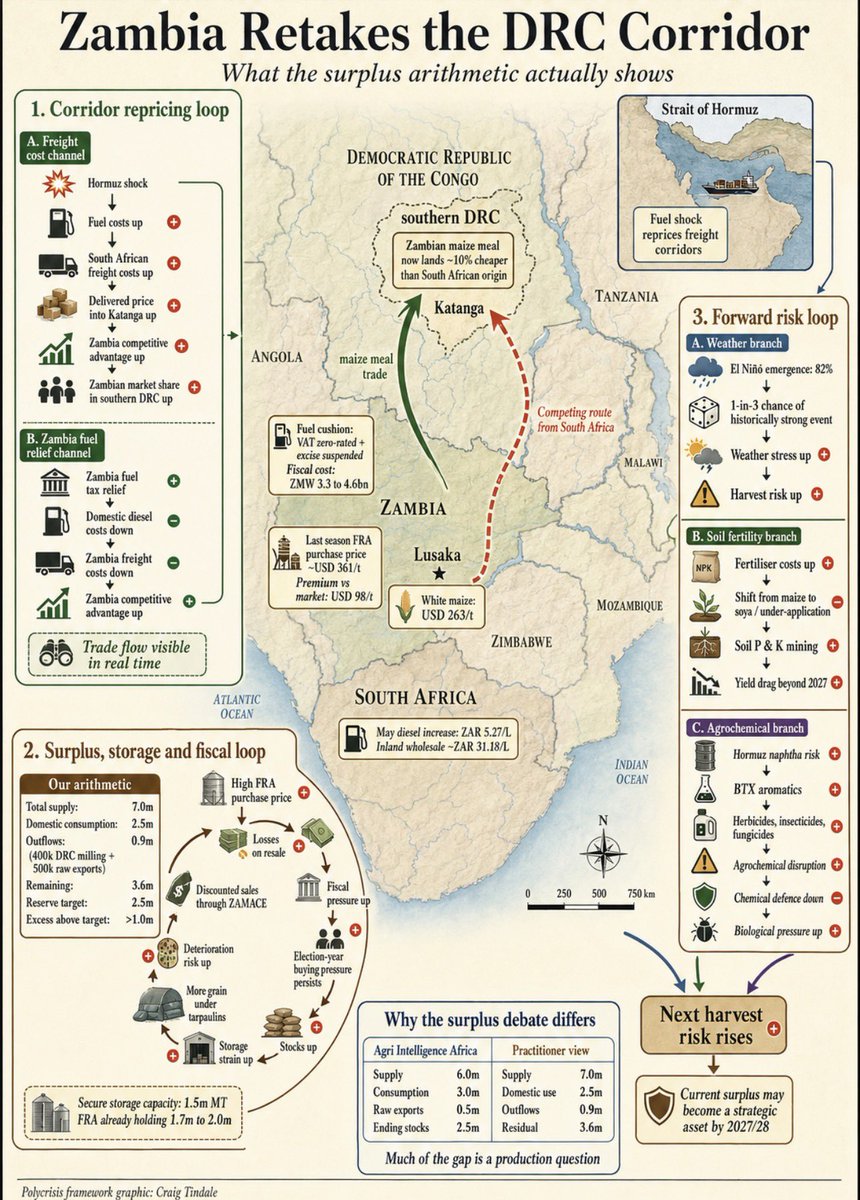
Zambia Retakes the DRC Corridor. What the Surplus Arithmetic Actually Shows. Agri Intelligence Africa reports Zambian maize meal now landing into southern DRC at roughly a 10 per cent discount to South African origin, with Zambia regaining market share lost in 2024. Two fuel policy responses explain the shift. South Africa's May diesel increase was ZAR5.27/litre after DMPR's correction, taking inland wholesale to approximately ZAR31.18. Zambia cushioned: VAT zero-rated, excise suspended at a three-month fiscal cost of ZMW3.3 to 4.6 billion. The differential repriced the freight corridor to Katanga in Zambia's favour. The Acid Test on Canary Compass traced this transmission in April: Hormuz reprices fuel, fuel reprices freight, freight shifts competitive advantage. It is now visible in a live trade flow. Lusaka white maize at USD263/t. FRA's last season gazetted purchase price converts to approximately USD361/t at the ZMW18.86 rate used in our May macro note. The 2026/27 price has not been gazetted. That is a USD98/t purchase price premium against current market, up from USD81 two weeks ago. The loss crystallises when FRA sells into next season below purchase price, as it is already doing with old stock through ZAMACE. In an election year, the pressure to buy more is unchanged. Agri Intelligence Africa and our supply chain estimates diverge on the exportable surplus, but the consumption gap is smaller than it appears. Their 3.0m consumption figure includes approximately 400,000 tonnes of maize milled in Zambia for the southern DRC meal trade. Strip that out and domestic consumption sits at roughly 2.6m, close to our 2.5m practitioner estimate. The divergence is overwhelmingly a production question: their 4.3m (which they note is conservative) against our supply chain projection of approximately 5.0m from practitioners with direct ground-level visibility. Our beginning stocks estimate was approximately 2.0m against their 1.7m. In their model, the balance sheet resolves: 6.0m total supply, 3.0m consumption, 500k raw exports, 2.5m ending stocks matching the strategic reserve target. In ours, it does not. Total supply at 7.0m, domestic consumption at 2.5m, even with 900k in outflows (400k DRC milling plus 500k raw exports), leaves 3.6m remaining. The 2.5m strategic reserve still leaves over a million tonnes above target with limited absorption channels. That excess compounds the storage and fiscal pressure. Secure national storage capacity is 1.5m MT. FRA is already holding 1.7m to 2.0m, with hundreds of thousands of tonnes under tarpaulins. Reaching the 2.5m strategic reserve target itself means holding 1.0m above secure capacity. Building and leasing additional storage from the private sector carries cost. Stock under tarpaulins carries risk of deterioration, particularly with NOAA now placing El Nino emergence at 82 per cent and CNN reporting a one-in-three chance of a historically strong event. FRA is already selling old stock through ZAMACE below purchase price, crystallising losses. In an election year, the pressure to buy into a system already beyond capacity compounds the fiscal drag on the primary balance we documented in Seven Stars. Three forward risks underneath the surplus. First, those carryout stocks may prove strategic by 2027/28 if El Nino materialises at the upper end. The conditional escape we identified in Seven Stars still holds: if climate and fertiliser shocks hit the 2026/27 planting season, FRA's stock shifts from liability to strategic asset. Second, the fertiliser-to-planting transmission is already live. The Acid Test documented Zambian farmers weighing a shift from maize to soya because soya's fertiliser requirement is a fraction of maize. As Craig Tindale (@ctindale) has mapped, when farmers under-apply fertiliser due to cost, crops mine residual phosphorus and potassium from the soil. That may buffer yields near term but risks depleting the soil bank, with potential yield drag extending beyond 2027 even if input prices normalise. Third, the dimension almost nobody in Africa is discussing. Hormuz carries 1.2m bpd of naphtha, the feedstock for the BTX aromatics from which herbicides, insecticides, and fungicides are synthesised. If that agrochemical supply chain is disrupted, crops face the risk of losing chemical defence at exactly the moment El Nino amplifies biological pressure. A surplus today does not fully protect the next harvest if fertiliser, agrochemical, and weather risks converge. Agri Intelligence Africa link and Craig Tindale (@ctindale) sources will be available in the comments. Polycrisis framework graphic: Craig Tindale.

English
0
1
4
242
🇦🇺Craig Tindale
@InfinitelyDean Dean Super interesting post .Keep them coming i’m always really interested in how one of my theories plays out in the ground as a confirmation of the system impact
🇦🇺Craig Tindale tweet media
English
2
3
8
586
Dean N Onyambu
Dean N Onyambu@InfinitelyDean·
Zambia Retakes the DRC Corridor. What the Surplus Arithmetic Actually Shows. Agri Intelligence Africa reports Zambian maize meal now landing into southern DRC at roughly a 10 per cent discount to South African origin, with Zambia regaining market share lost in 2024. Two fuel policy responses explain the shift. South Africa's May diesel increase was ZAR5.27/litre after DMPR's correction, taking inland wholesale to approximately ZAR31.18. Zambia cushioned: VAT zero-rated, excise suspended at a three-month fiscal cost of ZMW3.3 to 4.6 billion. The differential repriced the freight corridor to Katanga in Zambia's favour. The Acid Test on Canary Compass traced this transmission in April: Hormuz reprices fuel, fuel reprices freight, freight shifts competitive advantage. It is now visible in a live trade flow. Lusaka white maize at USD263/t. FRA's last season gazetted purchase price converts to approximately USD361/t at the ZMW18.86 rate used in our May macro note. The 2026/27 price has not been gazetted. That is a USD98/t purchase price premium against current market, up from USD81 two weeks ago. The loss crystallises when FRA sells into next season below purchase price, as it is already doing with old stock through ZAMACE. In an election year, the pressure to buy more is unchanged. Agri Intelligence Africa and our supply chain estimates diverge on the exportable surplus, but the consumption gap is smaller than it appears. Their 3.0m consumption figure includes approximately 400,000 tonnes of maize milled in Zambia for the southern DRC meal trade. Strip that out and domestic consumption sits at roughly 2.6m, close to our 2.5m practitioner estimate. The divergence is overwhelmingly a production question: their 4.3m (which they note is conservative) against our supply chain projection of approximately 5.0m from practitioners with direct ground-level visibility. Our beginning stocks estimate was approximately 2.0m against their 1.7m. In their model, the balance sheet resolves: 6.0m total supply, 3.0m consumption, 500k raw exports, 2.5m ending stocks matching the strategic reserve target. In ours, it does not. Total supply at 7.0m, domestic consumption at 2.5m, even with 900k in outflows (400k DRC milling plus 500k raw exports), leaves 3.6m remaining. The 2.5m strategic reserve still leaves over a million tonnes above target with limited absorption channels. That excess compounds the storage and fiscal pressure. Secure national storage capacity is 1.5m MT. FRA is already holding 1.7m to 2.0m, with hundreds of thousands of tonnes under tarpaulins. Reaching the 2.5m strategic reserve target itself means holding 1.0m above secure capacity. Building and leasing additional storage from the private sector carries cost. Stock under tarpaulins carries risk of deterioration, particularly with NOAA now placing El Nino emergence at 82 per cent and CNN reporting a one-in-three chance of a historically strong event. FRA is already selling old stock through ZAMACE below purchase price, crystallising losses. In an election year, the pressure to buy into a system already beyond capacity compounds the fiscal drag on the primary balance we documented in Seven Stars. Three forward risks underneath the surplus. First, those carryout stocks may prove strategic by 2027/28 if El Nino materialises at the upper end. The conditional escape we identified in Seven Stars still holds: if climate and fertiliser shocks hit the 2026/27 planting season, FRA's stock shifts from liability to strategic asset. Second, the fertiliser-to-planting transmission is already live. The Acid Test documented Zambian farmers weighing a shift from maize to soya because soya's fertiliser requirement is a fraction of maize. As Craig Tindale (@ctindale) has mapped, when farmers under-apply fertiliser due to cost, crops mine residual phosphorus and potassium from the soil. That may buffer yields near term but risks depleting the soil bank, with potential yield drag extending beyond 2027 even if input prices normalise. Third, the dimension almost nobody in Africa is discussing. Hormuz carries 1.2m bpd of naphtha, the feedstock for the BTX aromatics from which herbicides, insecticides, and fungicides are synthesised. If that agrochemical supply chain is disrupted, crops face the risk of losing chemical defence at exactly the moment El Nino amplifies biological pressure. A surplus today does not fully protect the next harvest if fertiliser, agrochemical, and weather risks converge. Agri Intelligence Africa link and Craig Tindale (@ctindale) sources will be available in the comments. Polycrisis framework graphic: Craig Tindale.

Dean N Onyambu tweet media
English
6
13
41
3.1K
Dean N Onyambu
Dean N Onyambu@InfinitelyDean·
Still, too few people talking about this convergence (fertiliser and El Nino).
Aakash Gupta@aakashgupta

The last time an El Niño this strong hit, it killed 50 million people. That was 3 to 4% of the entire world population. Scale that to today and you're looking at 250 million equivalent. The 1877 Super El Niño triggered simultaneous droughts across India, China, Brazil, and East Africa. Crops failed on four continents at the same time. The famine lasted three years. Researchers have called it "arguably the worst environmental disaster to ever befall humanity." NOAA's latest update gives a two-in-three chance this one reaches strong or very strong by fall. European models are even more aggressive. Sea surface temperatures need to exceed 2°C above normal to qualify as "super." The trajectory is pointing directly at that threshold. Here's what makes 2026 structurally different from every previous Super El Niño: there are two independent supply shocks converging on the same crop cycle. The Iran war has shut down roughly a third of the world's seaborne fertilizer trade through the Strait of Hormuz. US fertilizer supply was at 75% of normal in mid-March, right when the Corn Belt needed it most. Fertilizer prices hit their highest level since 2022. That input shortage is already baked into the 2026 growing season. The El Niño yield shock operates on a 6 to 12 month lag. India is forecasting below-normal monsoons for the first time in three years. Indonesia and Malaysia carry 90% of global palm oil, and El Niño production declines in those countries take 6 to 24 months to peak. Every strong El Niño in the past 55 years has reduced global cocoa production. So the fertilizer shortage weakens the crops El Niño is about to stress, and the El Niño yield collapse hits in 2027 on fields that were already under-fertilized in 2026. Two shocks with nearly identical lag structures, converging on the same harvest window. The difference between 1877 and 2026: we can see this one coming six months out. The commodity futures curve is barely pricing either shock. Whether that's rational discounting or willful denial depends entirely on what the Pacific Ocean does between now and October.

English
1
0
5
564
Dean N Onyambu retweetledi
Steve Hou
Steve Hou@stevehou·
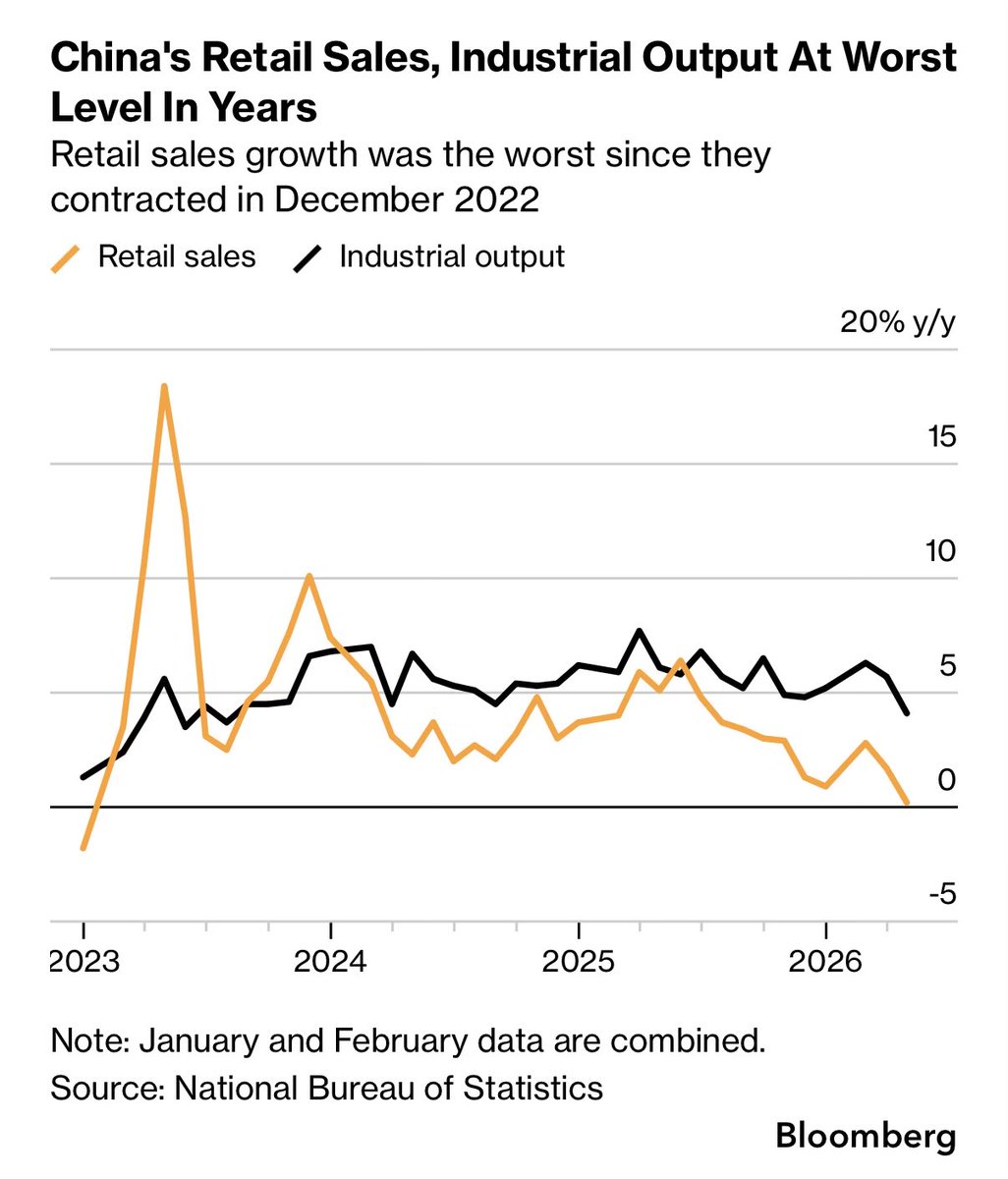
Apparently many are shocked by the latest set of official economic readings from China. No economists polled by BBG saw it coming. But see my post back in Jan and all the angry replies it received. I don’t think Iran is the main cause: its structural. But it clearly doesn’t help and so I think it explains China’s eagerness to nudge Iran towards a rapid resolution.
Steve Hou tweet media
Steve Hou@stevehou

China’s macro data is famously opaque and subject to doubts. But some things are harder to fake. China’s consumers and businesses are deleveraging and its households are having fewer children according to China’s own official data. These are what economists call revealed preferences. Either Chinese economy and consumers are weak or they operate under different economic laws of gravity. I don’t think China operates under different economic laws than the rest of the world. There are signs the economy may be bottoming but by all signs it seems bad.

English
18
54
229
48.9K
Football on TNT Sports
Football on TNT Sports@footballontnt·
This Bruno Fernandes stat will blow your mind 🤯
Football on TNT Sports tweet media
English
214
2.3K
14.6K
474.9K
Joe Kafuba🍎
Joe Kafuba🍎@Joe_Kafuba_MD·
Why would someone with an MBA be afraid of opening a business
English
149
160
1.3K
421.2K
Dingindaba Jonah Buyoya
Dingindaba Jonah Buyoya@BuyoyaJonah·
It is so infuriating that in today’s writing, you have to actively avoid certain punctuation to evade your content wasting away as AI. So, an em dash must disappear; but now I’m also not so sure about the semicolon.😞
English
10
18
167
6.4K
Dean N Onyambu retweetledi
Kelvin Phiri
Kelvin Phiri@phiri_family·
@InfinitelyDean The taxonomy is spot on. When Kariba dropped, solar couldn't anchor industrial demand. Variable energy lowers costs but FIRM power industrialises. Different capital structures for different functions - not complicated, just honest.
English
0
1
3
66
Dean N Onyambu
Dean N Onyambu@InfinitelyDean·
@Joe_Kafuba_MD Oh my friend, it absolutely matters. You might want to do a bit more research here, then ask the question again.
English
1
0
11
1.1K
Dean N Onyambu
Dean N Onyambu@InfinitelyDean·
@JitoKayumba And they also need access to credit. Movable collateral should load post-elections.
English
0
0
0
50
Jito Kayumba
Jito Kayumba@JitoKayumba·
The women operating their businesses in the bustling markets of our country are the true definition of resilience. Up before the sun, working tirelessly, yet always greeting you with the warmest smiles and an unbreakable spirit. ​They inspire me daily with their unmatched joy and work ethic. Every moment spent with them is not only heart-warming, but a masterclass in business and the warmth of the African spirit.
Jito Kayumba tweet media
English
4
3
46
1.1K
🅱️rian🇿🇲🇦🇷🏆⚽️📈
High profile UPND figures are suddenly vulnerable. This looks ruthless, coz it appears no seat is being treated as automatically “safe,” not even for Cabinet-level names. Whatever game they are playing, I’m so bought already 👌🏽💯
English
10
5
55
3K
Dean N Onyambu retweetledi
Tinashe
Tinashe@baba_nyenyedzi·
Nairobi, final reflections. Despite Nairobi being a haven of NGO work, impact funds, climate workshops and every species of grant funded virtue, one hears far less of the heavy socialist sermonising that so often drifts through Southern Africa. Why is that? I didn’t find a Karl Marx road as we did in Maputo…. Perhaps Kenya’s commercial bloodstream is simply too strong. Nairobi may host the NGO cathedral, but outside its stained glass windows the city is hustling: traders, founders, developers, agents, boda boda, financiers, exporters, coders and small businessmen all trying to make a shilling before the next traffic jam. The traffic jams here in the middle of high traffic and rain are extortion writ large. But the uber driver earning thrice the fee wasn’t complaining. Nor should we, but the wait time at a restaurant can stretch up to two hours, with the usual retort of “I’m almost there” serving as a signal to order the next dawa. The intellectual mood in Nairobi is softened by enterprise. Even the social impact crowd seems more likely to speak the language of scale, platforms, mobile money and market access than nationalisation, redistribution and state led salvation. Southern Africa, by contrast, still carries a heavier liberation era grammar. Politics there often begins with the state, the party, the struggle and the promise that history owes someone something. Nairobi feels more impatient with that theatre. It has its own dysfunctions, certainly, but its instinct is more transactional, more entrepreneurial, more “where is the opportunity?” than “where is the manifesto?” That may be why, even in a city full of NGOs, capitalism still manages to keep the microphone. I like it here….
Tinashe tweet media
English
67
216
834
88.2K
Dean N Onyambu
Dean N Onyambu@InfinitelyDean·
Misaligned Transition, Part 1: The Taxonomy Problem Capital labelled climate finance is arriving in Africa at growing scale. The outcomes are not following. The diagnosis is capital function mismatch. Climate finance does four distinct jobs that current architecture treats as one. This essay builds the taxonomy that separates them. Firm Power With Speed. Firm Power With Time. Pick a Lane. The Growth Lane delivers gas, geothermal, medium hydro, and pumped hydro within the industrialisation decade. The Resilience Lane delivers nuclear and large hydro over the decades beyond. Variable energy sits outside both: additive access and lower costs, not a system anchor. Kenya pitched a USD1bn geothermal data centre to Microsoft on the strength of 10,000 MW expansion potential. The project stalled. Existing capacity: 950 MW. The facility wanted 1 GW. The capital to expand has not followed. South Africa's C&I solar boom was not a planned transition. Eskom's coal fleet collapsed. Stage 6 load shedding became routine. The government introduced a two-year emergency tax incentive covering a third of capital costs. Solar scaled as a crisis response. Variable energy surged because firm power failed. The corrective taxonomy names four categories: Energy Volume Finance, Firm Power Finance, Grid Finance, Access Finance. Each requires different capital structures, risk profiles, and time horizons. Conflating them under one green label channels investment away from the firm power Africa requires to industrialise. Part 1 of 5. canarycompass.com/p/africa-energ…
Dean N Onyambu tweet media
English
1
1
7
540