James Baxter retweeté

As New Zealand turns its mind to energy, and offshore petroleum prospecting permits are being considered, it’s worth noting that Southland and Otago sit on millions of years of solar investment, with more than 9 billion tonnes of lignite in 10 major deposits - containing more than 20 times the energy content of the Maui gas field.
This is a very large, nationally significant resource which has the potential to be used as a feedstock for a petrochemical industry, using gasification technology to convert lignite to fertiliser, transport fuels or other high value energy products.
If extracted at a rate of 20 million tonnes per year, the lignite resource could provide energy and feedstock for most of New Zealand’s transport fuel and petrochemical requirements for over 300 years.
It largely sits close to the surface and is easy to access with opencast mining. It accounts for about 80% of New Zealand’s total coal resource and means New Zealand has one of the biggest coal reserves on earth, sitting around 14th in the world with more coal deposits than countries like Canada and Brazil.
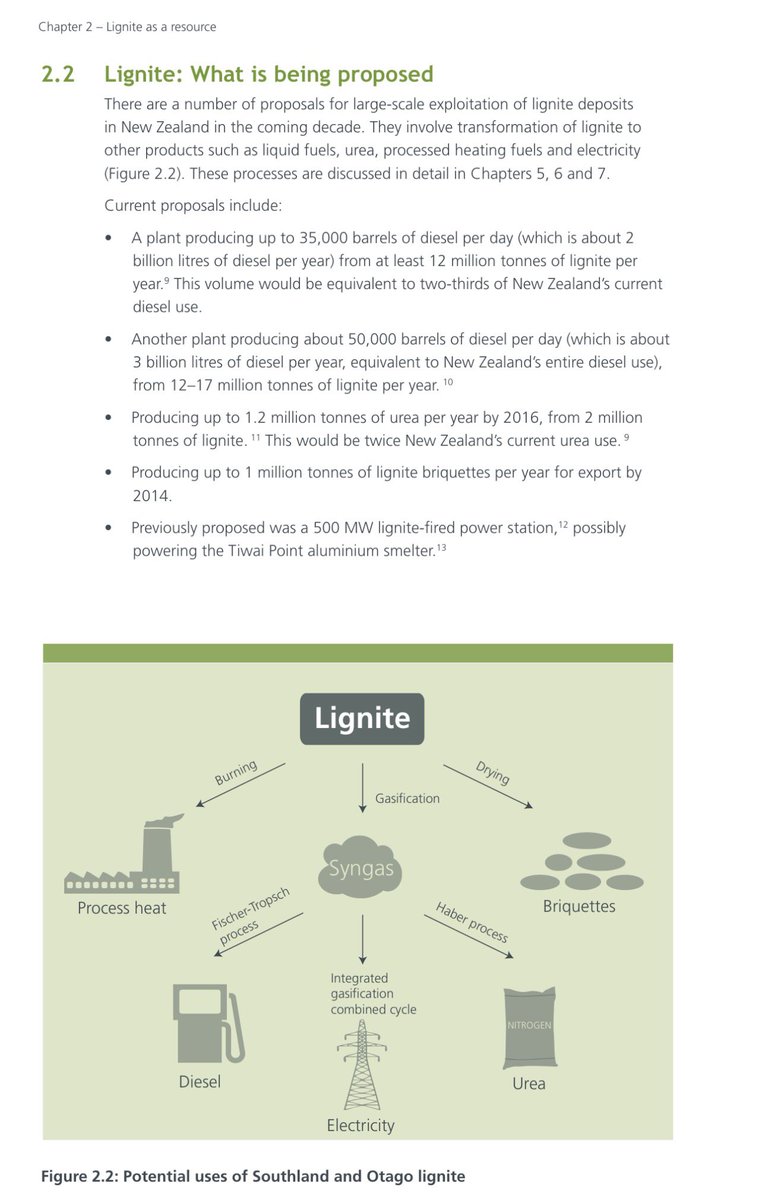
There were plans in the past to build plants using the Fischer-Tropsch process to turn some of the lignite into low-sulphur diesel and naphtha (used in the production of plastics, solvents and as a component of fuels like petrol and jet fuels).
In South Africa, Sasol has been producing diesel, petrol and jet fuel from coal since the 1950s, supplying approximately 28% of South Africa’s fuel needs, saving that country more than US$5 billion a year in foreign exchange.
There have also previously been plans to make up to 1.2 million tonnes of urea from 2 million tonnes of Southland lignite, which would be twice New Zealand’s current urea use. Most of our urea currently comes from Saudi Arabia, but this could make us a urea exporter.
Southland’s lignite is low sulphur, low ash, and 1.5 to 2 times as reactive as Australian or German brown coals. This makes it one of the best lignites globally for making syngas.
Syngas is an important universal industrial feedstock. It can be used to produce diesel and petrol via the Fischer-Tropsch process (which can run in existing engines and pipelines without modification), urea fertiliser via the Haber-Bosch process, methanol, hydrogen, or electricity via a combined cycle gas turbine.
There would be carbon and environmental trade offs to utilise this resource which would not be easy, but it’s hard to overstate just how significant the potential energy resource is.

English