

Rob Schweitzer
38 posts

Rob Schweitzer
@LessIsMoreLLC
Serial Entrepreneur - Inventor - Founder - Vibe Coder
Florida Inscrit le Eylül 2025
13 Abonnements13 Abonnés
@davidasinclair Especially if this becomes mainstream:
indiegogo.com/en/projects/vi…
English

Just launched on Indiegogo:
indiegogo.com/en/projects/vi…
Measured Isometric Strength Training Home Gym
The 5-Minute Strength Secret Used by Elite Performers
What if getting stronger only took 5 minutes…once a week?
• No gym memberships.
• No exhausting routines.
• No hours of workouts.
Just pure muscle activation through one of the most powerful training methods ever developed.

English
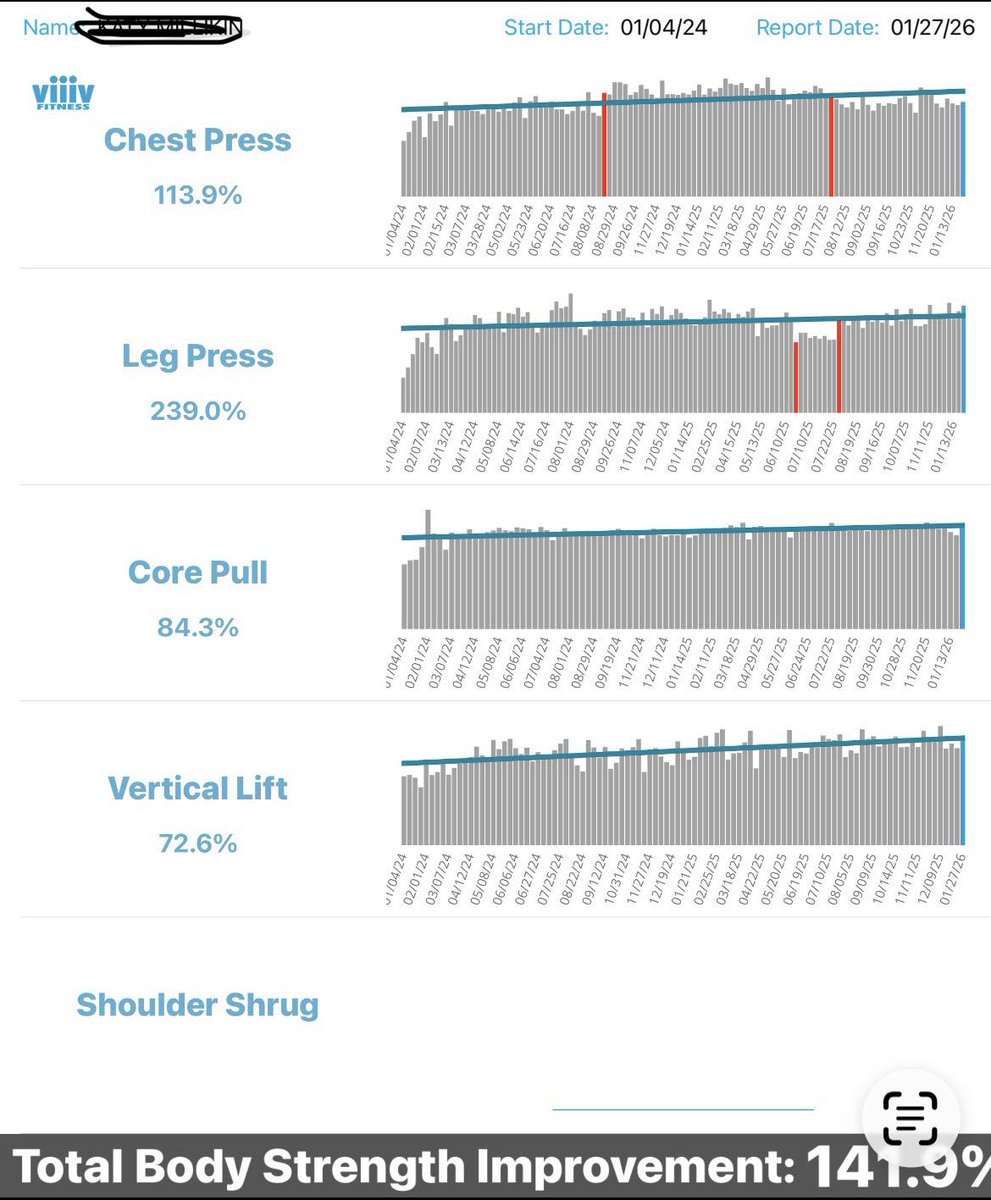
It’s not just about one workout. It’s how you trend over time.
Two years later, a 141.9% increase, and strength still trending up?
Traditional exercise programs age your body faster. viiiv Fitness changes the trajectory of the normal aging curve and makes you younger next year.
English
THE ATHLETES GAMBLE: WEIGHTLIFTING
There is no question the greatest athlete to ever walk the planet is fellow Auburn University alum Vincent "Bo" Jackson.
At 6'1" and 230 LBS of chiseled granite, he was dominant in not one, but two professional sports.
He did things you had to see to believe; he is a living legend.
But there was one thing he never did.
Lift weights.
He went to practice. He played the game. His natural physical talent was good enough.
Now, to be clear, this isn't going to be a rant against weight lifting.
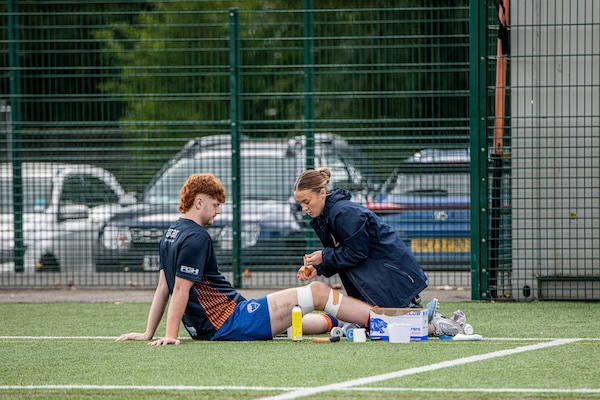
I do believe athletes can benefit from it. However, at best it comes up short on maximizing neuromuscular benefit. At worst it comes with a high orthopedic price to pay that doesn't optimize readiness on game day, or necessarily benefit the longevity of athletic performance.
Seventy years ago coaches were adamantly opposed to their athletes weight lifting. Now it's a requirement. Yet the debate has continued all these years: do athletes need to lift weights?
Hmmm. Need to? Probably more like have to. Everyone else is. It's not only part of the game. It's part of the business side of the game.
But with the rise in injury rates at all levels of play in the past 20 years, another question to ask is: are they lifting too much?
Who knows what too much is? But there is no shortage of evidence that weight lifting can do harm to athletes.
Long time highly respected NFL Strength Coach Mark Asanovich evolved his position over the years. "When i was a traditionally-based practitioner," Coach said, "I had injuries in the weight room as a result of the training I was prescribing. I was hurting kids."
He recognized the fact that weight lifting creates internal shearing forces that create minor accumulating injuries over time.
And even though those minor insults may not be obvious immediately, eventually it's going to show up on the field of play.
"The coaches will say the injury happened on the field”, Asanovich said, "but it didn't, it started in the weight room. They're still not making the connection."
But hey, athletes gotta lift to get bigger and stronger, right?
And they will get bigger and stronger. Yet, after almost 90 years, there is no scientific evidence that the getting bigger part contributes to the stronger part.
But it's easy to see why we would think this is true.
Athletes are typically young, and many of them are still going through the maturation process which is going to increase their size and strength at the same time anyway.
So do athletes even need to get bigger?
Not really. They already have physical gifts -- strength, power, coordination, quickness -- that make them good at whatever they want to do.
As Bo Jackson showed us, some of the best to ever lace 'em up never lifted any weights and were flat out better than all the others who were lifting weights.
I'm more interested in answering the question: "Is there a better way to get performance-enhancing benefits without compromising performance?"
In the 2021 INVERSE article titled Can Athletes Weight Lift Too Much? Tom Brady's Workouts Trigger a Debate, a review of the historic concern in sports history about the potential adverse side effects of weight lifting for athletes yielded this conclusion:
"...the key, then, feels like minimizing injury while maximizing performance: programming an in-the-gym workout that is not felt on the field. But those programs are hard to program, and don't come off the rack, and chafe with some sports organizations rigid philosophies."
Well, there's an alternative approach that solves these goals: it's as simple as just a few seconds of isometric effort.
Here's why:
Eliminating injury in the gym is easy. On a viiivPRO, you lock into a strong joint angle then give your best effort for a few seconds with very little joint movement. No micro trauma or inflammation to recover from.
Practice and games create enough of that already.
Performance enhancing workouts should not add to the recovery process. The athlete who masters this aspect of preparation will automatically have an advantage from week to week and deep into the season.
Difficult to program such a workout? Hardly. A caveman could do it.
It could also be mass replicated to service dozens of athletes with assembly line efficiency.
Now, would it clash with rigid coaching philosophies? Probably. Change is difficult but positive results grab attention.
Regarding performance, athletes basically need two things: movement skill and power.
Game-skills-at-game-speed is what practice is for. Improving power is where viiiv can offer more help than weight lifting.
Here's why:
I know the videos of players squatting 600 LBS are impressive, but that load isn't close to their true force producing capability. You've got to choose a weight that can be moved through a weaker part of the range of motion.
Will they benefit from moving that load? Absolutely. But there's a cost.
With 600 LBS on his back, the total vertical force into the floor of a 220 LB lifter is 750 LBS. Internal compressive force acting on the knee joints at the thighs-parallel position can be 7.5 times the load lifted, or 4,500 LBS with significant shearing forces.
When exerting 600 LBS of horizontal force on the viiivPRO with knees starting at about 60 degrees flexion, internal knee joint compression force can be around 750 LBS.
However, as the knees slightly extend as force production increases, that number declines. In addition, lower shearing forces at the start continue dropping to minimal.
Big difference in knee joint stress.
Now, anyone capable of squatting 600 LBS is probably capable of a 3,000 LB leg press on the viiivPRO. This of course will drive up knee compression force but it will still come with far less risk than squatting a barbell through a full range of motion. And it creates far more neurological impact in just a few seconds.
Remember, it's not about the load you can move, it's about the load you can create against something that doesn't move.
Exposure to the highest loads possible leads to far greater neurological adaptations.
Compared to concentric (lifting) and eccentric (lowering) contractions, it has been scientifically demonstrated that isometric contractions yield far greater changes in voluntary muscle activation.
Think of this as raising your ceiling, or getting a new "gear" to shift into.
Not only is creating a high load important, getting to that load quickly -- rate of force production -- is what athletics is all about.
The rate of force production is a huge determinant of motor unit recruitment and firing rates. In fact, a 3-4 times larger fraction of the motor unit pool is engaged, and maximum firing rates are highest in producing a fast contraction.
The cool thing is, movement isn't necessary to achieve a high rate of force production.
On a viiivPRO, you can create tremendous force quickly without any movement and get all the performance enhancing benefit with incredibly low risk.
You can also see your rate of force production in the software.
Now, quickly back to increased voluntary activation (VA): Not only do high loads lead to the greatest increases in VA, at sub-maximum efforts your VA actually decreases. This means you don't need to expend as much effort to do the same given workload; your "fuel efficiency" improves.
Essentially, you get a larger gap between your floor and ceiling. This raises the fatigue threshold and increases capacity; the ability to do a skill over and over again.
If an athlete can save energy and delay fatigue as competition duration increases, this becomes a huge competitive advantage.
And once again, athletes can get this with very little risk to joints and soft tissue.
The point here is not to pick on weight lifting. It's to point out that there is an option that can still get athletes performance-enhancing results without the inherent downside of lifting weights that can negatively affect performance.
Athletes can continue to go with what they know, or they can try something different.
Either way is a gamble, but a new approach just may be worth it.
English
For nearly 90 years, there has never been one shred of proof that getting bigger through exercise makes you stronger.
Isn't it interesting that the words bigger and stronger are always used together?
Recently Scott, a viiivPRO owner, reached out with kind feedback about an article I wrote and asked me a question that opened the door to revisit this topic.
Scott told me he had a discussion with Dr. Jeremy Loenneke.
If you didn't know, he is the co-author of the 2016 review THE PROBLEM OF MUSCLE HYPERTROPHY: REVISITED, and lead author of the 2019 review EXERCISE-INDUCED CHANGES IN MUSCLE SIZE DO NOT CONTRIBUTE TO EXERCISE-INDUCED CHANGES IN MUSCLE STRENGTH.
Obviously, Dr. Loenneke is an authority on the subject of hypertrophy and strength, and as he told Scott, his research shows no correlation between changing muscle size through exercise and increased strength.
But this isn't anything new.
In 1939, Schneider was skeptical of the role exercise-induced changes in muscle size played with changes in muscle strength.
He wrote in PHYSIOLOGY OF MUSCULAR ACTIVITY, "casual observation is sufficient to prove that muscles do not make a similar gain in size."
This skepticism was highlighted and built on in 1952 when THE PROBLEM OF MUSCLE HYPERTROPHY: A REVIEW by PJ Rasch was published in The Journal of American Osteopathic Association.
But here we are, nearly 90 years later, and there has never been one shred of proof that getting bigger through exercise makes you stronger?
But that's what we believe.
So Scott asked him a simple question:
"What is the point of muscle hypertrophy if not to provide for increased force potential?"
Dr. Loenneke replied that he didn't know what the purpose is and perhaps it serves no purpose at all.
Scott then asked me if I had any thoughts on this.
So glad you asked.
READ FULL ARTICLE:
viiivfitness.com/blog/?id=bigge…

English
This is what happens when you stimulate new bone growth on the viiivPRO:
English
I gave Claude Opus 4.5 the URL of one of my sites and told it to redesign it.
The video below shows what it did in a few minutes.
You can see the before/after as I scroll both home pages side-by-side. The After version is what Claude Opus 4.5 came up with.
The Before version is the site as it's been since last updated in 2021 - I was not looking forward to redoing it. Now I don't have to.
I used this prompt:
"Take this static website URL trimyouspray.com, and rebuild the entire website so it can be hosted on Railway. This would include the ECWID order page widget that allows my shopping cart to display on that page and redesigning the site for speed, SEO, and aesthitics."
It asked some clarifying questions (design preferences, change any content?) and in a few short minutes had the website shown on the right. Almost perfect.
I had to do some tweaks, but otherwise I'm very impressed. I didn't use Figma or anything.
If I did this again, I'd be sure to provide a list of all the page URLs to redesign because it missed some pages.
I use Emergent (@emergentlabs) with Claude Opus 4.5 and Railway for deployment.
English
Twenty years of experience with clients using just seconds of isometric effort once a week has shown me why this approach is the simplest, most desirable, and most sustainable option for improving quality of life for every person, especially our older population.
So when I saw a recent 60 Minutes (@60Minutes) segment where Dr. Peter Attia (@PeterAttiaMD) outlined his proposal for how to train for your last decade of life, it was perfectly clear his recommendations are everything but simple, desirable, or sustainable.
"At age 75 men and women fall off a cliff," says Dr. Attia. "If you don't do something about it, in your last 10-15 years you will fall to a level of about 50% of your total capacity physically and cognitively."
He wants to create a framework for how to train for this "marginal decade" with the goal of getting you another 15 enjoyable years.
Love it. I share the same goal.
The difference is, his framework is an old rickety cabin you're not crazy about visiting, but will tolerate for a weekend.
My structure is so inviting and comfortable that you can't wait to get there and you want to stay for weeks.
My framework feels nice and is built to last.
Let's dive into this interview.
Dr. Attia says the key indicator of overall health and longevity is your VO2max.
First, everywhere you look, someone is telling you about the most important indicator.
This person says its grip strength, that person says its leg strength. And Dr, Attia says it's VO2max.
There is never just ONE key indicator.
There are too many other metrics and lifestyle factors that need to be considered.
Second, VO2max testing has numerous problems and validity issues, such as:
• inconsistent and inaccurate results
• unnatural and stressful testing environment
• fatigue causes people to stop (not a lack of oxygen)
...and it takes a lot of time and expense.
Third, how many people could, or would be willing to run at a maximum speed for several minutes?
Not many.
Besides, the number you get is meaningless.
The juice just isn't worth the squeeze.
"So you think anyone, whether they are 45 or 65, should be training like athletes for advanced age?" asks 60 Minutes contributing correspondent Norah O'Donnell (@NorahODonnell).
"Absolutely, life is a sport" replies Dr. Attia.
Well, with the rise in severe and overuse-related athlete injuries every year at all levels of play, this recommendation doesn't sound aligned with a goal of more enjoyable years later in life.
Sounds like arthritis to me.
Ms. O'Donnell continues, "Dr. Attia says the best drug to delay physical and cognitive decline is exercise, and he takes it in large doses. He aims for about 10 hours a week: cardio to burn fat; intense intervals for VO2max; and weightlifting to maintain strength and muscle mass."
This is yet another example of how intelligent people with huge platforms can lead you in the wrong direction, or at least a direction that costs you valuable time, energy, and joint health while you continue searching for a better fit.
Because let's be honest: What he's doing ain't it.
As with most Doctors, Dr. Attia is largely data driven.
The problem with this is that it can reduce listening, learning, and creativity.
There's nothing wrong with using data to make informed decisions, but it has to be balanced with space for human insight, experimentation, and reflection, which is necessary for true innovation.
I don't see anything innovative in Dr. Attia's proposal. It's the same old stuff we've been fed for decades, and we know how that's been working out.
Honestly, there is nothing innovative about what I propose.
For decades, however, I have listened to what people like/don't like, learned from them, and observed an undeniably strong alignment of their values, far better results, and enthusiastic satisfaction from doing something that simply gets us back to what is natural.
How things impact real people in real life is the only data that drives me.
My goal all along has been to answer the question:
"What is the simplest, most results/time-efficient, most desirable, and most sustainable gateway into a better quality of life for the largest percentage of people?"
The answer?
Just a few seconds of isometric effort once a week.
Here's why it makes the most sense:
Let's start with Roland Prinzinger's research on life energy theory.
This shows that each of us begins life with a calorie and energy account. We draw on this account throughout life and depending on our life style choices this life energy is depleted sooner or later.
(Want data? Read: The Joy of Laziness by Axt and Gadermann)
Lets get one thing straight: "exercise" is a man-made concept; it is an energy robber; it is a psy-op.
You know why only 20% of adults meet the physical activity guidelines for both aerobic and muscle-strengthening activities, and that ratio never really changes?
Because man-made exercise is unnatural.
The 80% are the smart ones, but even they wouldn't mind adding something that makes them feel and perform better, as long as it harmonizes with their true nature.
Speaking of nature:
Dr. Sean O'Mara has studied the difference between animals and humans. Humans have chronic disease. Wild animals don't.
Humans exercise. Wild animals exercise too - but it's called natural living.
Animals don't burn through their life energy to rationalize eating a piece of cake, feed an addiction, combat boredom, or socialize.
They save it for those times when they need to eat or fight or flee or get a little action, if you know what I mean.
Just a few seconds of isometric effort once in a while mimics the episodic fight/flight occurrences in living naturally.
It nicely fills the absence of fight/flight events in modern day living.
And with those events springs results that you cannot get from conventional exercise.
What Dr. Attia proposes is the antithesis of natural living.
If you follow his program you will spend 6% of the total hours in one year on exercise that will burn up your life energy, wear out your joints, and age you faster.
I'm still trying to figure out how that will extend my life and make it more enjoyable.
With an occasional 20 second viiiv session once a week, you will spend 0.2% (yes, that's ZERO POINT TWO PERCENT) of your yearly hours doing something that feels much more natural, is far less stressful, offers far more benefits, conserves your life energy, and allows you to age more slowly (and that's on the high end. I'm lucky if I choose to do 20 seconds in a year).
And with it also comes a huge array of benefits that you can't get from man-made exercise.
(I've written so much about these benefits so please get over to our blog and read!)
Suffice it to say, just seconds of an isometric effort provides all upside without any of the downside associated with conventional exercise.
So contrary to what Dr. Attia encourages, I don't want you to "train" for your later years of life.
I want you to save your life energy and simply live confidently that you have the capacity to do whatever you want/need to do, whenever you have to or want to.
As we begin a new year, all the gyms and home exercise equipment will see a surge in usage...until mid February.
Then the quit happens.
Because it sucks.
Because we continue to tell ourselves to do something that viscerally we can't stand.
It's important to remember:
The statistics show compliance with physical activity guidelines actually goes down with increasing age.
So how does Dr. Attia's approach help the "marginal decade?"
I work with a lot of 80 year olds. They consistently and happily show up each week and give a maximum effort for 20 seconds in January, February, March, and every other month until we come back around to the start of the next year.
Then they do it all over again.
Because it fits like a tailor made suit.
Because they feel good.
Which choice is more likely to attract, retain, and benefit the most people, especially those in the marginal decade, Dr. Attia's way, or my way?
As "Digger" would always say with that thick southern drawl on the show Moonshiners, "That's a no-damn-brainer."
Remember: Only birds in a cage think the one that flies is crazy.
You can keep suppressing your natural instinct to stay with the pack, or you can do what comes natural and be free.
At viiiv Fitness, we provide a product you can use to spread the benefits of better quality of life and freedom from a destructive exercise narrative to millions and millions more people than you can ever reach with the same old exercise BS.
No matter what Dr. Attia says, you can't exercise your way to a longer and more enjoyable quality of life.
You can, however, control how quickly you age yourself.
Make a lot of bad choices, and not only will you leave more years on the table on your way out, but the shorter time you do get will be filled with the consequences of those choices and certainly much less enjoyable.
- By Brian Murray, M.Ed
Director of The Way it Should Be, viiivfitness

English
Just published my 5th Chrome extension - FreeHelpDesk.me. No more paying for Zendesk!
I just cancelled my Zendesk subscription and now I'm using Free Help Desk instead:
• Knowledge Base you can embed on your website and customize with your colors
• Forward support emails to Free Help Desk to create support tickets
• Add a Widget to your website so customers can get support by searching your Knowledge Base articles or submitting a support ticket
• Brand it with your logo/colors
• Import all of your existing Zendesk knowledge base articles with 1 click
• Create Macros for canned responses
• Respond to support tickets - Customers are notified with branded email notifications
• Customer portal for your customers to view/reply to support tickets
• Reports to see how well you're managing your support tickets
Completely FREE. If you're paying for Zendesk, now you don't need to.
English
Just approved and can be found here: chrome.google.com/webstore/detai…
English
When I was 10 years old, my family vacationed in Orlando and the hotel we stayed at had the classic Atari video game 'Food Fight', which I loved, but I never saw it again anywhere.
So I vibe-coded 'Fruit Fight', a loving tribute to the legendary 1983 Atari classic Food Fight, as a Chrome Extension.
It's been submitted to the Chrome Store and is awaiting approval, which usually takes just a couple days.
If anyone wants to play it, I'll post the link to the Chrome Store where you can install it and play for free as soon as it's published and 'live'.
English
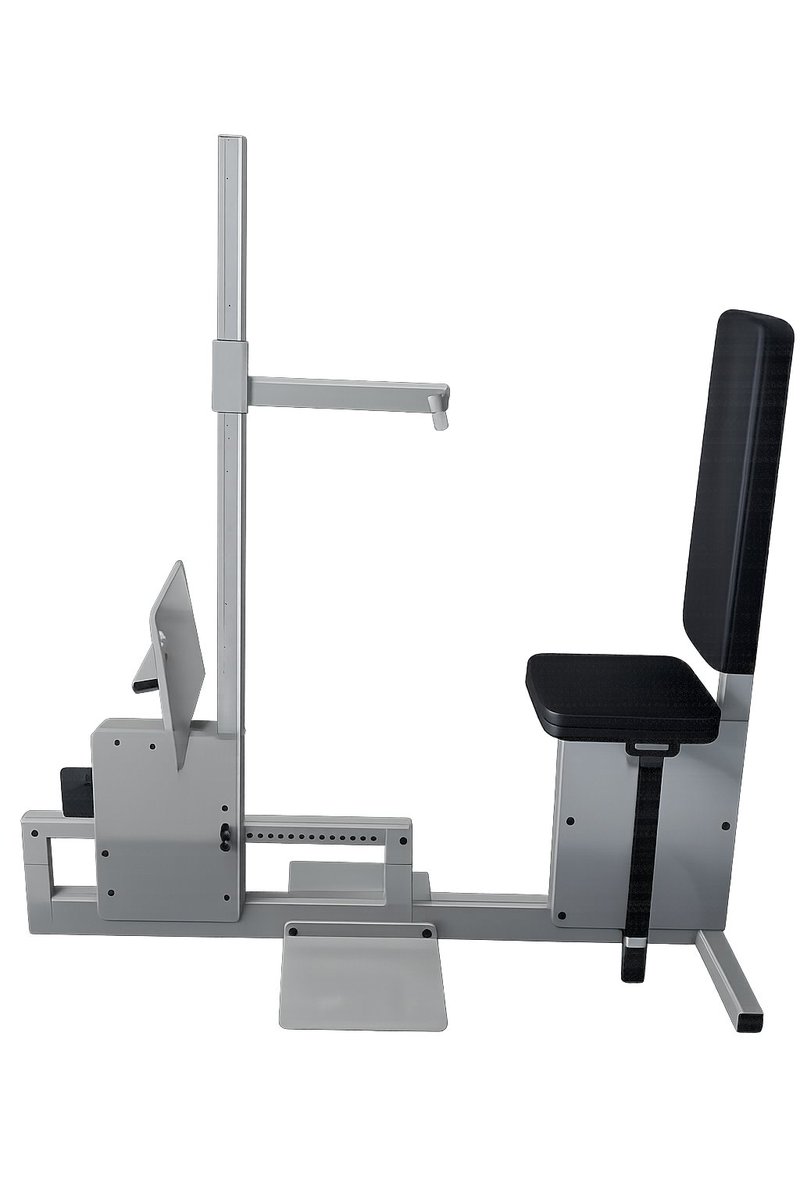
Re-designed bottom rail/vertical lift platform for the viiiv-C - almost ready!
English


I have vibe coded multiple webapps and chrome extensions using Emergent over the past several months. Some have been very complex, others more simple.
Here are the steps I use (not a developer or coder, but used to code decades ago):
1. Validate my idea using lowfruit.me
2. Use the output from that and ask Grok to create a development guide for developing a webapp ( or chrome extension) to give the Coding Agent (in Emergent). Go through this and edit as needed so everything is covered you can think of (all the features, requirements)
3. Add custom instructions (i.e. where it will be deployed, what kind of security is needed, what API will be used and the API Keys for them, etc). If it's a Chrome Extension, I add instructions applicable to Chrome extensions (i.e. can't connect to a backend through localhost, etc). Most Important is to add: "Do not use any fallback data - be sure all errors are explicitly shown and provide robust logging so bugs can be troubleshooted"
4. Set the Agent loose to see how far it gets. I use Opus 4.5 in Emergent. It does a very good job on the first pass. Then start testing and fixing until ready to deploy.
5. When everything functions, update the UI with better colors/layout/images, etc. (i.e. don't worry about the UI design initially)
6. Choose your deployment platform (I use Railway or Render). You many also need a MongoDB or other for the backend. If you need a backend, be sure you consider how many concurrent users, etc. because if your DB chokes the app will crash.
7. Find people that may be interested using it with AILeadGen.me
English

You don't need original ideas.
You need validated problems.
I just mined Reddit, G2, and Indie Hackers for 2 minutes and found 12 opportunities with real demand.
Here's exactly how I found 12 validated SaaS ideas in 2 minutes:
Step 1: site:reddit.com "I wish there was a tool"
Step 2: site:g2.com [tool] cons "small business"
Step 3: site:indiehackers.com "$5K MRR"
Step 4: Claude Code analyzes patterns
The results? 🤯
3 examples of what it found:
1️⃣ Newsletter Email Tools
Problem: Mailchimp is $300/mo for features nobody uses
Gap: Simple $20/mo tool for writers
Market: 50M newsletter creators
2️⃣ Micro-Influencer CRM
Problem: Tools built for mega-influencers
Gap: Sponsor tracking for 10K-100K accounts
Market: 200M micro-influencers
3️⃣ No-Code Automation (Actually Simple)
Problem: Zapier overwhelms non-technical users
Gap: Pre-built workflows, visual UI
Market: 500M small business owners
I found 9 more like these.
Plus the exact framework to find your own.
Want the complete prompt?
👇 Comment "VALIDATED"
👆 Follow me (so I can DM you)
Sending everything in the next 2 hours.
No catch. Just want to see what you build with it 🚀

English
