
Tweet épinglé
OCX
73 posts


OCX
@OCXapp
The most advanced trading terminal for prediction markets. Powered by $OCX
Prediction Markets Inscrit le Ocak 2026
44 Abonnements363 Abonnés
OCX retweeté

The $1 Billion Kalshi Perfect Bracket Challenge
$1 Billion for a perfect bracket
$1 Million guaranteed to the top scoring bracket
$1 Million to charity and scholarships
See the full rules and submit your bracket: kalshi.com/billion-dollar…
No purchase or deposit required. SIG Parametrics, LLC, a member of the Susquehanna International Group of Companies, is financially backing this promotion.
English
We're thrilled to announce our partnership with @MoonPay
Onboarding has always been prediction markets' biggest barrier. Too many steps between wanting to trade and actually trading.
MoonPay brings instant fiat-to-crypto directly inside OCX. No app switching, no friction, no excuses.

English
OutcomeX has made a strategic investment in @ClawVaults and entered into a formal partnership
AI agents are entering prediction markets. The infrastructure to support them safely does not yet exist — until now.
ClawVault provides autonomous agents with scoped wallet access, spend limits, and approval flows before any transaction executes. Built for the agentic era.
As their launch prediction markets partner, OutcomeX users will be among the first to trade with AI agents secured by ClawVault.
This is infrastructure. This is the future.

English
OCX retweeté
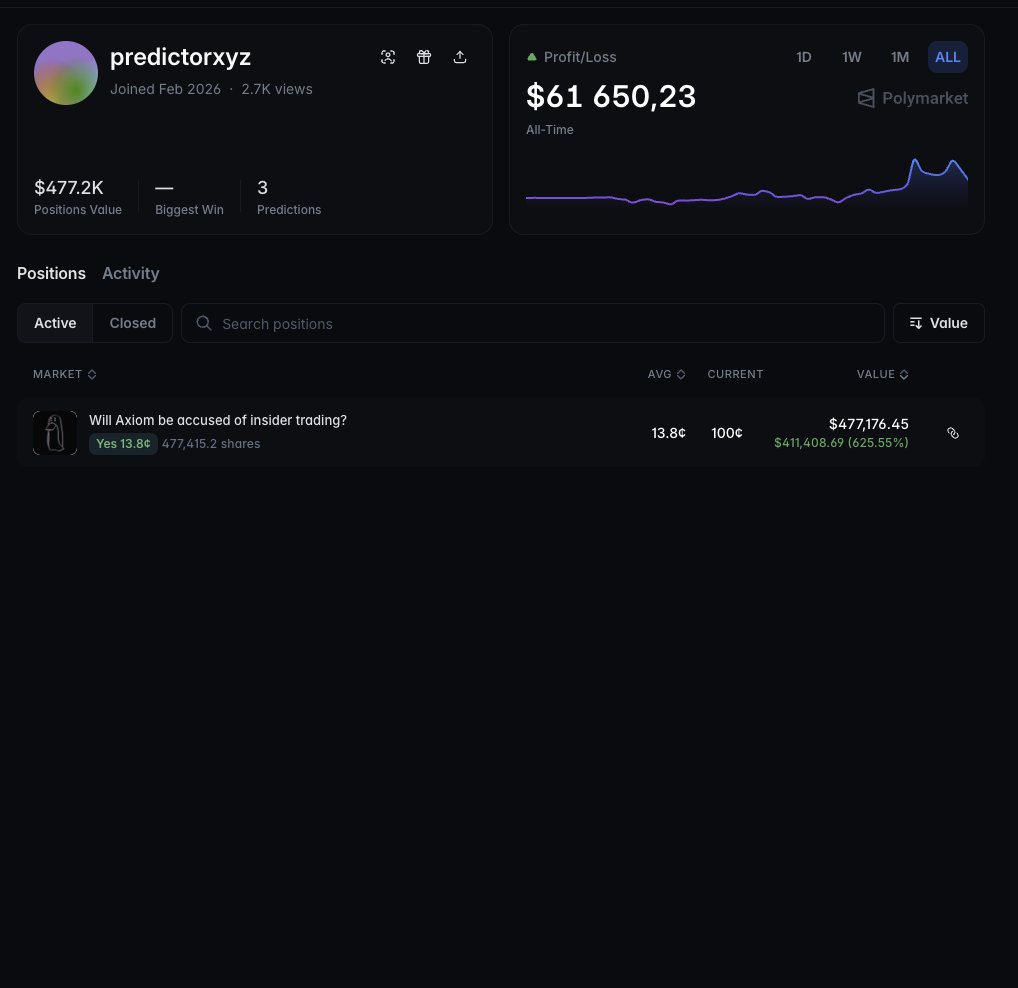
Wallet: @predictorxyz?tab=positions" target="_blank" rel="nofollow noopener">polymarket.com/@predictorxyz?…
English
BREAKING: A fresh wallet on Polymarket profits $411,000 betting on Axiom insider trading exposure from @zachxbt
ZachXBT@zachxbt
1/ Meet @WheresBroox (Broox Bauer), one of the multiple @AxiomExchange employees allegedly abusing the lack of access controls for internal tools to lookup sensitive user details to insider trade by tracking private wallet activity since early 2025.
English


@MigrateFun @OmegaXhealth @StrategicSuperR @getpolyapp @pnth_io Massive thanks to you guys
Jake and Adam were hands-on the entire time — answered every question, helped us troubleshoot in real time, and made the migration seamless for our holders.
Couldn't have asked for a better team to work with. Appreciate everything 🤝
English

Another pumpfun migration group is in the books. Congrats to all teams and good luck in the Pump Fund Hackaton!
@OmegaXhealth, @StrategicSuperR, @getpolyapp, @pnth_io
Just Migrate It 🔄

English
Robinhood just launched their own L2 for onchain finance.
100ms blocks. Arbitrum security. Permissionless.
As prediction markets go onchain, OCX will be there — aggregating every major venue, on every chain.
The terminal for onchain finance keeps expanding. 👀
Robinhood@RobinhoodApp
In case you missed it, Robinhood Chain is now live on testnet. An early step in our work to build onchain financial infrastructure, giving developers a place to build ahead of mainnet. Explore the testnet: robinhood.com/chain
English
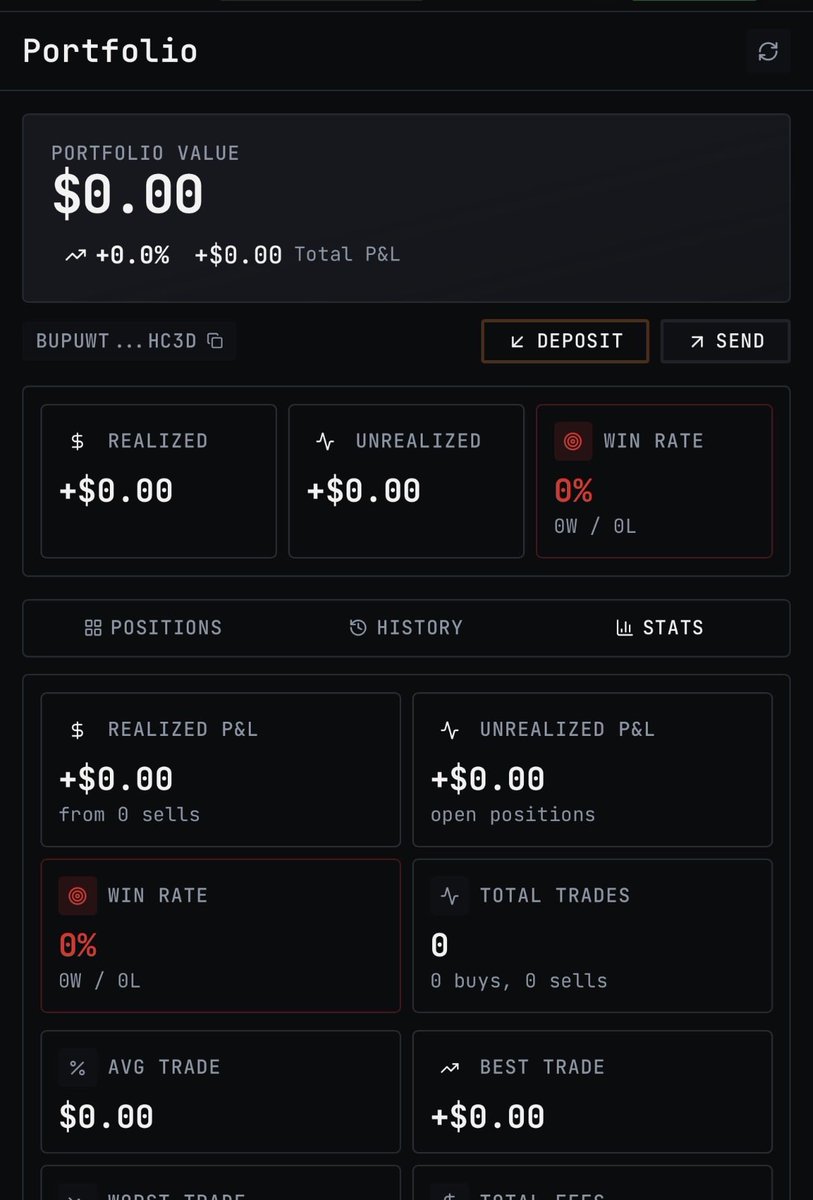
We spent weeks obsessing over every pixel of this.
The new OCX Portfolio tab tracks everything — P&L, win rate, trade history, position analytics — across Polymarket AND Kalshi in one unified view.
Portfolio 2.0 is coming. And it’s not even our biggest update this month.
English
Respect the vision, but this has a sequencing problem and the data is clear on it.
WTI crude oil futures launched on NYMEX in March 1983. First month: 3,000 contracts. Mostly speculators. The oil industry called it a casino. Today it moves $125B/day in notional value and airlines, refineries, and sovereign nations hedge on it. The speculators didn't delay hedging. They built the liquidity that made it possible.
Prediction markets did $63.5B in volume in 2025. Nearly 90% of Kalshi's volume is sports. And yesterday, Kalshi partnered with Game Point Capital to launch institutional sports performance hedging, replacing part of a $9B/year sports insurance market. Two NBA teams already hedged bonus payouts at 6% on Kalshi vs 12-13% OTC.
The hedging layer is emerging directly from the speculative base.
Your $0.58 hedging utility example proves the dependency: that number only materializes with tight spreads and real depth. In a thin market, slippage eats the utility. The hedge never happens. The market stays thin.
We'd also note: personalized expense baskets resolved by local LLMs require decentralized oracles on regional consumer goods price indices. Oracle manipulation is already the #1 DeFi attack vector on simple crypto price feeds. Scaling that to groceries in Stockholm Q3 2027 is an unsolved problem harder than the currency problem itself.
We agree on where this is going. But the teams routing real volume right now aren't building corposlop. They're building the only thing that makes your vision possible.
English

Recently I have been starting to worry about the state of prediction markets, in their current form. They have achieved a certain level of success: market volume is high enough to make meaningful bets and have a full-time job as a trader, and they often prove useful as a supplement to other forms of news media. But also, they seem to be over-converging to an unhealthy product market fit: embracing short-term cryptocurrency price bets, sports betting, and other similar things that have dopamine value but not any kind of long-term fulfillment or societal information value. My guess is that teams feel motivated to capitulate to these things because they bring in large revenue during a bear market where people are desperate - an understandable motive, but one that leads to corposlop.
I have been thinking about how we can help get prediction markets out of this rut. My current view is that we should try harder to push them into a totally different use case: hedging, in a very generalized sense (TLDR: we're gonna replace fiat currency)
Prediction markets have two types of actors: (i) "smart traders" who provide information to the market, and earn money, and necessarily (ii) some kind of actor who loses money.
But who would be willing to lose money and keep coming back? There are basically three answers to this question:
1. "Naive traders": people with dumb opinions who bet on totally wrong things
2. "Info buyers": people who set up money-losing automated market makers, to motivate people to trade on markets to help the info buyer learn information they do not know.
3. "Hedgers": people who are -EV in a linear sense, but who use the market as insurance, reducing their risk.
(1) is where we are today. IMO there is nothing fundamentally morally wrong with taking money from people with dumb opinions. But there still is something fundamentally "cursed" about relying on this too much. It gives the platform the incentive to seek out traders with dumb opinions, and create a public brand and community that encourages dumb opinions to get more people to come in. This is the slide to corposlop.
(2) has always been the idealistic hope of people like Robin Hanson. However, info buying has a public goods problem: you pay for the info, but everyone in the world gets it, including those who don't pay. There are limited cases where it makes sense for one org to pay (esp. decision markets), but even there, it seems likely that the market volumes achieved with that strategy will not be too high.
This gets us to (3). Suppose that you have shares in a biotech company. It's public knowledge that the Purple Party is better for biotech than the Yellow Party. So if you buy a prediction market share betting that the Yellow Party will win the next election, on average, you are reducing your risk.
Mathematical example: suppose that if Purple wins, the share price will be a dice roll between [80...120], and if Yellow wins, it's between [60...100]. If you make a size $10 bet that Yellow will win, your earnings become equivalent to a dice roll between [70...110] in both cases. Taking a logarithmic model of utility, this risk reduction is worth $0.58.
Now, let's get to a more fascinating example. What do people who want stablecoins ultimately want? They want price stability. They have some future expenses in mind, and they want a guarantee that will be able to pay those expenses. But if crypto grows on top of USD-backed stablecoins, crypto is ultimately not truly decentralized. Furthermore, different people have different types of expenses. There has been lots of thinking about making an "ideal stablecoin" that is based on some decentralized global price index, but what if the real solution is to go a step further, and get rid of the concept of currency altogether?
Here's the idea. You have price indices on all major categories of goods and services that people buy (treating physical goods/services in different regions as different categories), and prediction markets on each category. Each user (individual or business) has a local LLM that understands that user's expenses, and offers the user a personalized basket of prediction market shares, representing "N days of that user's expected future expenses".
Now, we do not need fiat currency at all! People can hold stocks, ETH, or whatever else to grow wealth, and personalized prediction market shares when they want stability.
Both of these examples require prediction markets denominated in an asset people want to hold, whether interest-bearing fiat, wrapped stocks, or ETH. Non-interest-bearing fiat has too-high opportunity cost, that overwhelms the hedging value. But if we can make it work, it's much more sustainable than the status quo, because both sides of the equation are likely to be long-term happy with the product that they are buying, and very large volumes of sophisticated capital will be willing to participate.
Build the next generation of finance, not corposlop.
English