

Strategic Profiler
1.8K posts

Strategic Profiler
@SProfiler1
StrategicProfiler shows you hidden patterns in behavior, competitors, and opportunities in minutes. Stop guessing. Start knowing.
Inscrit le Mayıs 2026
513 Abonnements704 Abonnés

A shower head brand you've probably never heard of is quietly outscaling Jolie on Meta.
Jolie did $40M last year. But drivse now pulls more monthly traffic, and likely more new customers, while almost nobody talks about it.
I pulled apart their entire Meta setup:
Inside the breakdown:
- The advertorial funnel 63% of their ads route to (instead of the product page)
- The single 3-minute ad that moves a cold buyer from problem-aware to ready-to-buy
- How they launched 800 ads in 30 days without the account falling apart
- The 3 personas they target, and the one they're leaving on the table
- The 4 gaps I'd fix to scale them faster
Want a copy? Like + comment "SHOWER" and I'll send it over ASAP.
(Must be following)

English
@peterli34923561 Growth hinges on Japanese platform dominance, can HIMS truly differentiate?
English

$HIMS --- On June 2, 2026, $HIMS officially closed its acquisition of Eucalyptus, Australia’s top digital health firm owning weight-loss brand Juniper, marking the company’s formal market breakthrough into Japan.
Strategic upside: Japan’s weight-management & obesity market has long lacked accessible, high-quality digital wellness solutions. Leveraging Juniper’s localized medical credentials and existing regional trust, $HIMS will roll out its proprietary clinical infrastructure and digital ecosystem nationwide, unlocking a brand-new growth runway across Asia-Pacific’s trillion-dollar total addressable market.
Dr. Anant Vinjamoori, a veteran clinician specializing in longevity medicine, recently joined $HIMS as Chief Medical Officer to reinforce clinical compliance for complex therapeutic pipelines.
1. Explosive Revenue Tailwind from Booming GLP-1 Weight-Loss Cycle
Wegovy and other GLP-1 receptor agonist therapies remain chronically undersupplied and prohibitively expensive across the U.S. HIMS built direct distribution ties with Novo Nordisk’s GLP-1 portfolio and rolled out cost-efficient personalized weight-loss regimens. The firm shipped over 125,000 Wegovy-linked prescriptions in just six weeks, evolving into one of America’s largest authorized GLP-1 dispensing channels by cutting offline waiting lines and lowering overall treatment expenses.
2. SaaS-Style Recurring Subscription Model with Exceptional Stickiness
As of Q1 2026, HIMS’ total paid subscriber base hit 2.6M, up 9% YoY. Premium users on customized personalized care packages climbed 20% YoY to 1.7M, accounting for 65% of total membership. The platform boasts an industry-leading 85% long-term subscriber retention rate, delivering highly predictable recurring revenue visibility typical of high-quality SaaS operators.
3. Blazing Growth from Hers Women’s Health Vertical
Beyond its foundational men’s health core business, the Hers female wellness division posted over 100% annual revenue expansion in 2025 and is on track to top $1B in annual run-rate revenue during 2026. The dual-wheel men + women health layout has fully materialized to fuel sustained long-term expansion.

English
@denohawari Nice numbers. What’s the biggest bottleneck when scaling the internal linking system?
English

We just ranked a B2C SaaS brand inside ChatGPT.
- $620K in revenue
• 845% traffic growth
• All in 9 months
This is the biggest SEO opportunity since Google, and no one’s talking about it.
Buyers are rapidly moving to AI search platforms.
If you're not ranking in ChatGPT and Claude, your competitors are stealing your clicks.
I documented our entire process:
- How we turned 185 daily clicks into 1,750+ without touching paid ads
- Step-by-step breakdown of how we structure pages for both humans and search engines
- The internal linking system that quietly boosts rankings across your entire site
- The “non-branded domination” strategy that captures buyers before they know you exist
- The exact optimization layer that gets your brand cited inside tools like ChatGPT
- How to build topical authority without spamming 100 random blog posts
This is the only guide you need to unlock LLM SEO for your brand.
Want the full playbook?
1. Like + follow
2. Comment “LLM”
I’ll send it to you

English
@heythereRich The filing reveals the playbook, not the finale
English

Everybody wants to know where this ends.
Wrong question.
The better question is:
What does the beginning look like?
Because we're standing in it.
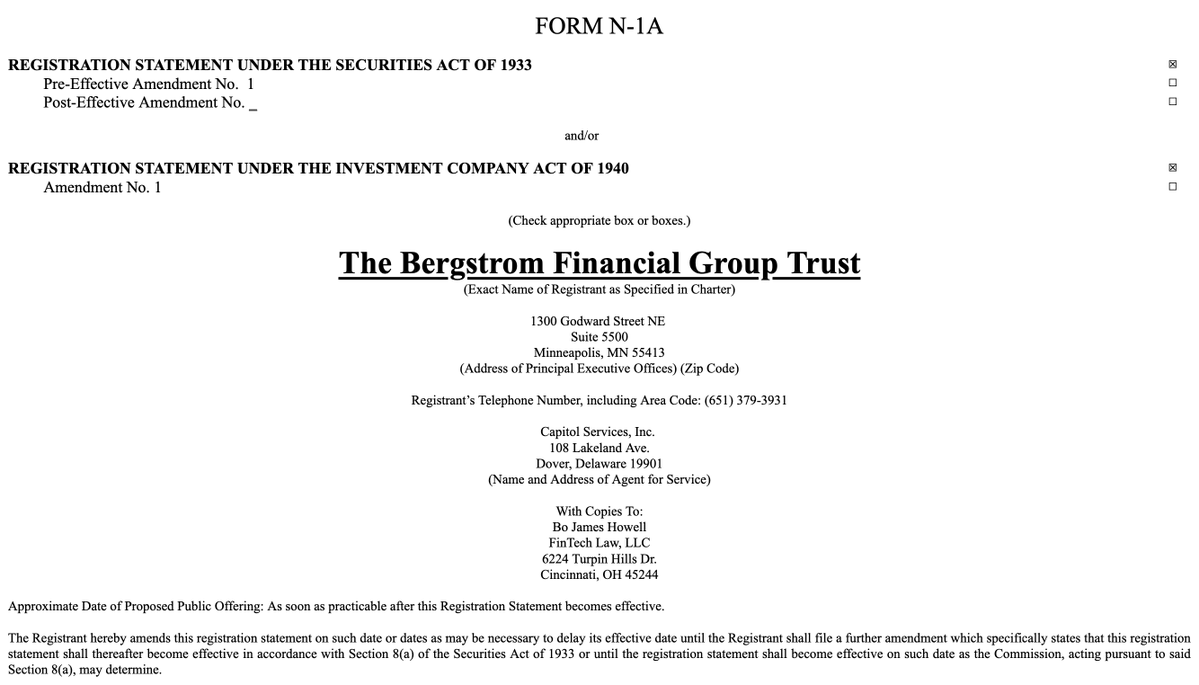
Yesterday, The Bergstrom Financial Group Trust filed an Amendment to Form N-1A with the SEC.
Most people will never read it @NateGeraci @EricBalchunas @JSeyff
Most people will never hear about it.
But buried inside the filing were proposed ETFs like:
BlockBridge
• Market Cap Weighted Strategy ETF (BOO)
• Bitcoin & Large Cap 50/50 Strategy ETF (BTSP)
• Bitcoin & Information Technology 50/50 Strategy ETF (BTIT)
• Bitcoin & Short Term Income 50/50 Strategy ETF (BTMM)
• Bitcoin & Gold 50/50 Strategy ETF (BTAU)
• Bitcoin & Magnificent Stocks 50/50 Strategy ETF (BTMS)
Take a second. let that sink in.
A few years ago Wall Street was asking:
"Is crypto real?"
Now they're relentlessly filing products that combine crypto with:
• Large Caps
• Technology Stocks
• Magnificent Seven Stocks
• Gold
• Short-Term Income
• Broad Market Portfolios
Not because they're building speculative products.
Because they're building portfolios.
That's the shift.
The conversation is no longer:
"Should crypto exist?"
The conversation has become:
"How much crypto belongs next to stocks, bonds, gold, cash and income-producing assets?"
Different world.
Here's what caught my eye...
Inside the crypto allocation of the filing, the same four names keep showing up:
BTC. ETH. XRP. SOL.
Over.
And over.
And over.
Whether people like it or not, those four are increasingly being treated as foundational digital assets in institutional product design.
That's architecture.
The average investor thinks ETF approval is the finish line.
That was the starting gun.
Then comes:
Allocation.
Model portfolios.
Retirement accounts.
Treasury strategies.
Collateral frameworks.
Settlement systems.
Institutional mandates.
Then things get really interesting.
Everybody is looking for one giant headline.
One giant candle.
One giant announcement.
Meanwhile, the people building the next generation of financial products are combining:
Crypto + Equities
Crypto + Gold
Crypto + Treasuries
Crypto + Income
Crypto + Technology
Crypto + Real World Assets
Crypto + Everything
Because eventually digital assets stop being a separate category and become another building block inside every portfolio on earth.
The next 12-18 months of ETF construction is going to be absolutely batshit crazy.
Not because of what gets approved.
Because of what gets combined.
Lock the F in.
Everybody wants to know how the movie ends.
I'm more interested in the opening scenes.
The FUTURE is always in the FILINGS.
Follow the plumbing.
It shows you where the money is flowing.
$XRP $BTC $ETH $SOL
#XRP #Bitcoin #Ethereum #Solana #CryptoETF #Tokenization #DigitalAssets #CapitalMarkets #RWA #XRPL #WallStreet #FutureOfFinance #Investing #ETFs #Finance #Crypto #Ripple #RLUSD
English
@DanKornas Having traceable rejections turns brainstorming from endless to actionable
English

Creative work needs structure too. This repo gives BMAD teams a module for it.
Creative Intelligence Suite is a BMad Method module with agents and workflows for innovation, brainstorming, design thinking, and creative problem-solving.
It helps you move through the fuzzy front-end of development by giving you named workflows for reframing problems, generating ideas, understanding users, and shaping product narratives.
Key features:
• BMad module setup – installed through the BMad Method installer by selecting Creative Intelligence Suite
• Structured creativity workflows – includes /cis-brainstorm, /cis-design-thinking, /cis-problem-solve, and /cis-innovation
• Multiple specialist agents – covers innovation strategy, design thinking, brainstorming, problem solving, storytelling, and presentations
• Practical technique support – references frameworks like SCAMPER, reverse brainstorming, root-cause analysis, and user empathy
• Collaboration configs – includes Creative Squad and Design Pair setups for team-based creative sessions
It’s open-source (MIT license).
Link in the reply 👇

English
@domainname Solid move, especially as AI branding gains tangible value
English

End-user companies acquiring .ai domain names all boast well-defined goals and clear market positioning, aiming to leverage the ongoing AI boom to scale up their business and achieve greater milestones.
Domain.News 📈@DomainNews24
Event .ai was sold for a six-figure sum in US dollars through DN.com. The buyer is reportedly a European end-user. Event + AI: Targeting the intelligent event management market. 🌐The value of the .ai domain name has been further validated; a good domain name is the starting point for trust in global brands. Congratulations to both the buyer and seller!🎉
English
@hassankhan96452 Makes sense, watching how payments evolve will be fascinating
English

KAST Is Growing at the Same Time the Financial World Is Moving Toward Stablecoins
One thing stood out to me while reading the latest developments around stablecoins, payments, and KAST.
The market is no longer asking whether stablecoins have a future.
The conversation has shifted to how quickly they are becoming part of existing financial systems.
That is a very important difference.
For years, stablecoins were viewed as tools used mainly inside crypto. People held them in wallets, traded them on exchanges, and moved funds between platforms.
Today, the story is changing.
Mastercard is expanding support for stablecoin settlement. Major banks such as JPMorgan and Citi are exploring tokenized payment networks. Stablecoin issuers are publishing increasingly detailed reserve reports. Meanwhile, crypto card volumes continue reaching new highs.
Taken together, these are not isolated events.
They point to a larger trend:
Stablecoins are moving closer to everyday finance.
This is where KAST becomes interesting.
When I look at KAST, I do not see a company trying to convince the world that stablecoins matter.
I see a company building for a future where stablecoins are already part of the financial system.
That is an important distinction.
The strongest companies are often the ones that identify where the market is heading and build before everyone else arrives.
KAST appears to be positioning itself at the intersection of payments, stablecoins, and consumer finance.
And recent numbers suggest that strategy is gaining traction.
Crypto card spending reached another record in May, with stablecoins continuing to dominate activity. People are not just holding digital dollars anymore.
They are spending them.
Using them for payments.
Moving them across borders.
Integrating them into everyday financial activity.
That behavior matters more than headlines.
Adoption is ultimately measured by usage.
What also caught my attention was KAST being recognized by BeInCrypto as the Best Digital Assets Fintech.
Awards alone are not what make a company important.
What matters is why they received it.
The recognition highlighted growth metrics that reflect real-world adoption, including millions of users, global reach, growing transaction volume, and stablecoin spending across a large merchant network.
To me, this reinforces a simple observation.
KAST is operating in a market that is becoming increasingly relevant.
As stablecoins move from crypto-native tools to mainstream financial infrastructure, platforms that help people use them in practical ways will become increasingly valuable.
The biggest takeaway is not that stablecoins are growing.
Most people already know that.
The real takeaway is that the financial industry is starting to organize itself around them.
Card networks are adapting.
Banks are adapting.
Payment providers are adapting.
And companies like KAST are building products designed for that future.
The next few years will likely determine which platforms become the bridge between traditional finance and digital assets.
From where I stand, KAST is making a strong case for being one of them.
@KASTxyz

KAST@KASTxyz
English
@RahulKarth29923 @useTria Solid growth, when do you expect the next billion in trading volume?
English

One thing that stands out about @useTria is that the volume is increasingly tied to real product usage rather than pure speculation
The ecosystem has already processed over $300M in transaction volume including card spending routing activity and trading flows across its products
Some key numbers worth watching
$100M+ in card spending
$200M+ routed through BestPath
Nearly $1B in futures trading volume
$40M+ assets under management
250K+ users and growing globally
What makes this interesting is that Tria is positioning itself as a self custodial neobank where users can spend trade earn and move assets across chains from a single account
As more products like Earn Futures Travel virtual accounts and fiat rails go live the demand drivers behind $TRIA become increasingly connected to actual platform activity rather than just market speculation
The combination of growing transaction volume strong user growth and expanding financial services is why TRIA continues to be one of the most watched infrastructure projects in the onchain finance sector
app.tria.so/?accessCode=23…
Let's goo join in

English
@givenoxbt Impressive stack, any plans to expose the atomic API to third party bots?
English

most people using 01 exchange don't know what's running underneath it
N1 just dropped their full modules docs
here's the infrastructure layer that makes structured strategies possible and why it matters for how perps DEXs evolve
first, the problem with how most chains do this
on most blockchains, financial primitives - orderbooks, margin systems, settlement are rebuilt as smart contracts on shared general-purpose compute
that creates 3 compounding problems:
- liquidity fragmented across venues
- throughput capped by shared block space
- no native way to do complex multi-leg trades atomically
N1 solves this at the protocol level, not the application level
it's an L1 where financial primitives are native modules secured by validators
same trust and security guarantees as the chain itself - not bolted on top
4 modules. each doing something specific
module 1 — orderbook
native CLOB running as a network module, not a contract on shared compute
matching stays fast under load because it's not competing for block space with everything else
liquidity concentrates in a shared primitive instead of fragmenting across isolated venues
module 2 — atomics
this is the most underrated one
bundle multiple transactions into a single indivisible operation that either fully executes or doesn't execute at all
enforced at the network layer
this is what powers 01's strategies feature
think about what that actually means for traders
want to go long BTC/ETH/SOL and short KAITO/BERA in one move?
on most DEXs that's 5 separate txs with 5 separate execution risks
on N1 it's one atomic bundle - fully executes or doesn't. no partial fills, no stuck positions
module 3 — RFQ
native request-for-quote system for larger or less liquid trades
sources competitive quotes and executes against shared network liquidity
not siloed venue liquidity - the whole network's shared pool
module 4 — margin system
native margining and collateral management at the network layer
positions share risk and capital efficiently across the network
not rebuilt per venue. not siloed per position
cross-position capital efficiency by default - relevant if you're running delta-neutral across multiple legs
how this connects to 01 exchange directly
v0.16.4 just shipped:
- strategy presets + custom basket builder
- pre-placed TP/SL on market orders
- auto-leverage adjustment
- full mobile parity
every one of these features is the application layer expressing what N1's infra enables underneath
the strategies aren't just a UI feature
they're the wrapper for atomics
the margin improvements are the native margin system being surfaced
the performance under load is the native orderbook doing its job
01 isn't an app on top of general infra - it's built specifically on infra designed for this
most perps dexes are competing on speed, fees, and token incentives while N1 @N1Chain and 01 @01Exchange are competing on;
- what's structurally possible
- what trade types you can express
- how efficiently your capital is used
- how complex your positioning can get
structured strategies are live. multi-leg atomics are live. native margin efficiency is live
the docs are public
if you're farming 01 points, running delta-neutral on N1, or just positioning early - worth understanding the infra underneath
docs: docs.n1.xyz/learn/introduc…
ref; app.n1.xyz/r/giveno

Jules | N1@JulesXBT
Just updated our docs with the N1 modules docs.n1.xyz/learn/protocol…
English
@kai_xbt Pattern bias kills opportunity. Robotics will prove them wrong
English

Andrew Kang reveals every venture capitalist told him not to invest in robotics and explains why they were all wrong
"I reached out to a bunch of friends in the venture industry because robotics was not my area of expertise. I asked all of them should I invest in this company, this thesis makes sense. And they all told me no."
"When I asked them why, it was really just because people pattern match. They were saying the robotics industry hasn't previously produced venture scale outcomes, robots have been really hard to work with, it's expensive to develop these things."
"The more I kind of dug into it, the more I was trying to figure out what am I missing. By understanding the competitors, the competitive dynamics, talking to other investors, getting reference checks on the team, doing the full due diligence process, I realized no, I wasn't missing anything. The rest of the venture capital landscape was missing something. Just like crypto in 2014, 2015 the industry was really misunderstood. People thought Bitcoin was a scam. And that's the best place and the best time to invest."
English
@SamanthaAnderl Sounds like a solid framework. How do you handle pricing tweaks for niche markets?
English

Today is your last day to join the Revenue Accelerator.
I want to be real with you for a second.
Not investing in your business is a choice. But it's not a neutral one. Every month you stay exactly where you are, undercharging clients you've outgrown, unsure how to market yourself, wondering why growth feels so hard, is a month you're actively choosing to lose money instead of making it.
Close your eyes for a second.
Imagine booking a flight without refreshing your bank account first.
Imagine quoting a rate and feeling zero anxiety about it.
Imagine knowing exactly where your next client is coming from because you have a system, not just luck.
That version of you is not a fantasy. That's what happens when you stop winging it and start building with intention.
I've built a $1M+ service business alongside my co-founder Andrea. I was a core part of developing the marketing and sales processes for companies that went on to reach unicorn status. I've coached 40+ clients who have doubled, tripled, and quadrupled their revenue.
I built the Revenue Accelerator because the thing that changed everything for me wasn't more hustle. It was strategy, accountability, and the right room. That's exactly what this is.
13 weeks. Four modules covering your offer, pricing, brand, and a client-getting system you actually use. Cohorts of 10 people max. Live sessions every week with real feedback and time with us to move your business forward.
And because today is the last day: anyone who joins right now gets a free 30-minute 1:1 session with me.
Use it however you need. Offer feedback, positioning, pitch strategy, feedback on a proposal that’s in motion. Whatever moves you forward fastest.
The cohort kicks off June 10. We start next week.
Join the Revenue Accelerator
$499/month for 3 months. Ten spots. Most are filled.
Let’s do this, together.
English
@sohmehta @touchland Nice workflow. How long does the QC step usually take?
English

The days of paying agencies thousands of $$$ for one ad are over
We just made this ad for @touchland using Claude Code + Higgsfield AI
Here's how you can too 👇
1. Research the brand, products, ICP, positioning, and visual style
2. Turn it into a brand bible
3. Generate video concepts for different customer segments
4. Pull real product images from the website
5. Preprocess them with Nano Banana pro
6. Write a storyboard with consistent scenes/props
7 .Send assets + storyboard to Higgsfield
8. Have Claude self-QC frames and iterate
We make hundreds of ads like this every week at @GooseworksAI
You can run this across hundreds/thousands of SKUs and generate product videos grounded in real product info, brand assets, and customer segments.
If you want to work with us, DMs open. Send me a brief about your company and I'll share you a free sample in 24 hours
English
@onu_slim Spot on, the credentialing layer could turn a skills shortage into a profit engine
English

The most underserved business opportunity in Nigeria right now is not fintech.
It is not real estate or agro-processing.
It is the vocational training pipeline.
Think about the gap that exists right now.
40 million unemployed youth. Most of them with certificates. Almost none of them with structured, market-ready skills.
And on the other side, a construction boom that cannot find qualified electricians. A hospitality industry flying in technicians from Ghana. A manufacturing sector in Nnewi and Aba running on aging artisans with no succession plan.
Supply and demand are screaming at each other across a gap that nobody is filling professionally.
The business is not teaching people to weld.
The business is building the institution that certifies the welder, places the welder, insures the welder, and charges the hotel a placement fee.
That is a staffing and credentialing business sitting inside a skills gap the government created and cannot close.
The numbers are already there.
A structured vocational academy with placement partnerships charges N150,000 to N400,000 per student per cycle.
Run two cohorts a year across four trades with 50 students per cohort.
That is N60 million to N160 million in tuition revenue alone, before placement fees, before corporate training contracts, before government NSITF and ITF partnership funds that most private operators are not even accessing.
The brand positioning is simple.
You are not a trade school.
You are a career accelerator for people the university system abandoned.
That framing changes your price point, your marketing, your alumni network, and your partnership conversations entirely.
The person who builds this properly in the next three years will own a category that the next generation of Nigerian parents will pay premium to access.
Because the same parents who sneered at vocational training are now watching their degree-holding children move back home.
The narrative is shifting in real time.
The business that captures that shift early will not be small.
English
@PriyadarshniBi3 My biggest plan: launch a SaaS product by Q4 and hit $100k ARR
English

3 years ago I deleted Instagram and Facebook.
3 years ago I started my entrepreneurial journey.
Since then....
➜ Quit my job
➜ Started my personal branding and lead gen business
➜ Scaled to 5 figures in USD
➜ Served clients internationally
➜ Generated $165mn+ in ARR for them
➜ Launched a coaching business
Personally?
➜ Moved to the mountains solo
➜ Lost 22 lbs
➜ Travelled extensively
➜ Got out of an abusive relationship
➜ Healed and thriving
In 2026, I'm going all in on
➜ Scaling to 6 figures
➜ Hiring more
➜ Hitting $30k/month in MRR
➜ Coaching 50+ people on lead gen
➜ Travelling more
➜ Losing another 22 lbs
➜ Buying a piece of land in the mountains
It's not a dream. It's a plan.
Manifest, I shall. Materialise, it will.
What’s your biggest plan right now?

English
@DavidLinthicum Governed data plus ondemand AI turns Snowflake into a builtin moat
English

Snowflake’s AI Infrastructure Pivot Is the Right Move
The news coming out of Snowflake Summit this week makes one thing very clear: Snowflake is making a serious shift toward becoming a more AI-focused infrastructure company, and I believe that’s exactly the right move.
The announcements around Openflow, Adaptive Compute, Cortex AISQL, and the broader push toward the agentic enterprise all point to a bigger strategy. Snowflake is moving beyond its traditional identity as a cloud data platform and positioning itself as a foundational layer for enterprise AI.
That matters because data remains the center of the universe for AI.
Models may get the headlines, but enterprise value comes from trusted, governed, well-managed data that can be operationalized at scale. The companies that sit closest to that data will be in the best position to benefit as AI adoption accelerates across the enterprise.
Snowflake understands this.
If the company executes well, it should be able to grow its usage base quite soundly. Enterprises are looking for platforms that bring together data, governance, orchestration, performance, and AI capabilities in a unified way. Snowflake’s strategy appears increasingly aligned to that demand.
This is more than summit messaging. It’s a smart market move.
As AI continues to reshape the enterprise, vendors with strong data gravity and infrastructure relevance will have an advantage. Snowflake is clearly aiming to be one of the biggest beneficiaries of that shift.
Summary article:
@fahey_james/snowflake-summit-2026-keynote-making-ai-real-for-business-with-agentic-intelligence-24c048a174cf" target="_blank" rel="nofollow noopener">medium.com/@fahey_james/s…
English
@OHare888 Optimistic view, but actual adoption will prove it
English

There seems to be a bit of confusion among some imbeciles on here as to the “condition” of $WU
Contrary to what these same imbeciles have been claiming, WesternUnion DID NOT cut their dividend, ir.westernunion.com/news/archived-…
I know it’s difficult for these imbeciles to comprehend but @WesternUnion is THE preeminent global remittance leader, now digital with the introduction of their very own #stablecoin #USDPT which just went live, along with their Digital Asset Network (DAN) which includes their digital wallet.
The management team is executing on their turnaround strategy and I’m excited to see how quickly USDPT grows. It would be fantastic if they can get it to $1-3B by the end of this year, maybe multiples of that. At $5B $WU would generate approximately $190-200M annually in float revenue at ~3.8-4% net.
If $5B in USDPT is circulating it's turning over multiple times per year, remittances, agent settlements, StableCard spending. Assume even a modest 0.5% blended fee on $20B in annual transaction volume (4x turnover) that's another $100M in fee revenue on top of the float revenue.
Against a company currently generating ~$500M in annual net income, $5B in USDPT circulation would be genuinely transformational, not to mention ancillary services being offered through their DAN. What’s really exciting is how scalable this digital transformation is, the $5B I’m suggesting is a modest start, in time, they could have many multiples of that and you can see how big the numbers get. This “digital pivot” is yet another of many business pivots over their +150 year existence.
As for the stock price which is down about -17% in the last six months, nearly all of that in the last month, it’s not immune from adverse market conditions. As a point of reference, a “new entrant” in this space $BKKT among others, is down -44% in the same timeframe.
Be careful who you listen to on this app, lots of imbeciles masquerading as Xperts. #valueinvesting #WUArmy


English
@HyperTechInvest Eyeing Simmtech for the dip, seems the cleanest play
English

Companies that should benefit from $NVDA SOCAMM2 optimization
1. Simmtech (222800.KQ)
The cleanest beneficiary, and the only one capturing two layers per module. It makes both the SOCAMM2 module PCB and the LPDDR substrate, so it wins on module count through more PCBs, and package count through more substrates. It supplies all three memory makers and is already in initial mass production, with ₩40–50B of SOCAMM revenue guided this year
2. ISC (095340.KQ)
The purest unit-count torque. Test sockets and test time are consumed per device and are capacity-agnostic, so a shift toward more lower-capacity modules is clearly positive. ISC is already supplying SOCAMM2 sockets to all three top memory makers, scaling from Q2, with system-level testers and substrate turnkey exposure layered on
However, Simmtech benefits more because the socket dollar content per module is smaller than the PCB-plus-substrate stack
3. TLB (356860.KQ)
A pure module-PCB play with the best next-generation optionality. It is already developing LPDDR6-based SOCAMM PCBs, which matters because the next generation is where higher layer counts and higher-value materials should appear
It is smaller and earlier than Simmtech, with limited production now and volume expected later this year, so it is more speculative, but it has higher torque if it qualifies
4. Korea Circuit (007810.KS)
Same pure module-PCB logic, with a clean near-term ramp. Test volumes are expected in H1, partial mass production in H2, and more than ₩20B of SOCAMM revenue is estimated
5. Daeduck Electronics (353200.KS)
Direct module-chain exposure, but the least pure for this specific catalyst. It supplies the LPDDR5X package substrate, which tracks bit and package count, not module count
A lower-capacity module carries fewer DRAM packages, so Daeduck captures the +10–20% total-demand uplift, but not the extra module-count kicker that PCB, connector, and chipset names get
6. Doosan Electro-Materials
Doosan sits one layer below the PCB makers in CCL materials, where it is on track to become NVIDIA’s exclusive Rubin CCL supplier after Elite Material failed GB300 qualification. It also makes memory-module and SSD laminate
It could be the biggest beneficiary of the entire Rubin platform, because GPU boards dwarf SOCAMM in dollar content. But for the SOCAMM mix shift specifically, it is a small and indirect slice, and Doosan is also a conglomerate
The same logic extends to Elite Material (6213TW), despite the GB300 miss, TUC, and pre-IPO Eray Tech, which all ride the AI-laminate allocation cycle. Next-generation SOCAMM is only one small part of that broader cycle
7. Tripod Technology (3044TW)
A Taiwan-based module-PCB capability that could take share if NVIDIA broadens its supplier base to scale Vera Rubin
8. Argosy Research (3217.TWO)
A pure 694-pin SOCAMM2 connector play. It is per-module and capacity-agnostic, so it benefits directly from higher module counts, regardless of whether each module carries lower memory capacity


Daniel Romero@HyperTechInvest
Seems like we got the context we needed $NVDA is lowering the capacity per module, but increasing the number of lower-capacity modules and total system shipments So the takeaway is: ➪ HBM remains untouched ➪ SoCAMM2 bit demand will still rise If 192GB modules are supply-constrained, shifting toward 96GB and 64GB modules can increase total module shipments. That can offset, or more than offset, the lower capacity per module This is more supply-chain optimization than demand destruction _____________________ Meritz is essentially saying NVIDIA is choosing the configuration that maximizes system output under constrained memory supply It is especially positive for module and component suppliers If the module count rises, substrates, connectors, assembly, testing, and back-end suppliers will benefit, even if each module has less DRAM capacity Companies that stand to benefit: Simmtech ($222800.KQ) TLB ($356860.KQ) Korea Circuit ($007810.KS) Daeduck Electronics ($353200.KS) ISC ($095340.KQ) Rambus ($RMBS) Tripod Technology ($3044.TW) Argosy Research ($3217.TWO) Amphenol ($APH)
English
@eraldchris @SecretNetwork Proof of end to end confidentiality will separate hype from reality
English

Private AI Agents: The Blueprint for Confidential and Verifiable Execution
AI agents are rapidly evolving from simple chat interfaces into systems that manage money, customer data, enterprise knowledge, and operational workflows.
As agents become more autonomous, the challenge is no longer just securing the final output. The real security boundary extends across the entire execution path.
A truly private AI agent must protect:
✅ Prompts and user intent
✅Retrieved context and knowledge sources
✅Tool calls and workflow execution
✅API keys and credentials
✅Memory and intermediate state
✅ Logs, telemetry, and runtime data
Most AI stacks today expose sensitive information through shared infrastructure, logging systems, retrieval pipelines, or tool integrations. Even when model outputs appear secure, the underlying execution path often remains vulnerable.
The next generation of AI requires a different architecture:
✓ Confidential execution environments that protect workloads from host inspection
✓ Private retrieval systems that secure context before generation begins
✓ Confidential tool orchestration that shields business logic and operational data
✓ Attestation-based secret management that releases credentials only to verified workloads
✓ Verifiable infrastructure that allows users to confirm exactly what code is running
✓ Upgrade paths that preserve trust while enabling continuous improvement
Privacy without verification creates a black box.
Verification without privacy exposes sensitive information.
Future AI systems will need both.
As enterprises deploy agents that access internal knowledge, execute transactions, and make decisions on behalf of users, expectations will change. Organizations will demand proof of how data flows, where secrets are stored, what code is executing, and who can access the system.
The AI platforms that earn trust will be those capable of providing cryptographic guarantees rather than promises.
The blueprint is simple:
Private AI agents must protect prompts, retrieval, tools, secrets, logs, memory, and intermediate state within a confidential and verifiable runtime.
Not privacy at one layer.
Privacy across the full execution path.
This is the foundation SecretAI and SecretVM are building toward, enabling developers to deploy AI systems that are both confidential and verifiable by design.

English

AI INFRASTRUCTURE IS ENTERING A COMPETITION FOR SCALE
As AI adoption accelerates globally, the key challenge is no longer access to models alone.
The real competition is shifting toward cost efficiency, accessibility, and the ability to support millions of AI-powered applications and agents operating simultaneously.
Platforms that can reduce the cost of accessing advanced AI models may become important infrastructure layers in the emerging AI economy.
1️⃣ WHY AI COST EFFICIENCY MATTERS
The next wave of AI growth will be driven by AI Agents, autonomous workflows, and enterprise-scale automation.
These applications require continuous model inference, data processing, and decision-making capabilities.
As usage scales, inference costs become a critical factor determining whether AI products can achieve sustainable adoption.
Reducing access costs enables developers, startups, and businesses to experiment faster and deploy AI solutions more broadly.
2️⃣ THE RISE OF MULTI-MODEL ECOSYSTEMS
The AI market is evolving beyond a single-model approach.
Developers increasingly want access to multiple leading models, allowing them to select the most effective option for different tasks such as reasoning, coding, content generation, research, or automation.
This trend is creating demand for unified AI platforms that aggregate access to various frontier models while simplifying deployment and cost management.
3️⃣ AI AGENTS WILL DRIVE THE NEXT DEMAND CYCLE
The future of AI is not limited to chat interfaces.
AI Agents are emerging as autonomous digital operators capable of executing workflows, coordinating tasks, and interacting with both digital and real-world systems.
As agent economies expand, demand for scalable and affordable AI infrastructure will grow significantly.
Platforms that provide efficient access to advanced models may become foundational layers supporting this transition.
4️⃣ THE LONG-TERM OPPORTUNITY
The AI industry is moving toward a model where infrastructure, compute access, and operational efficiency become as important as the models themselves.
The winners may not only be the companies building the most powerful AI systems, but also those creating the most accessible pathways for developers and businesses to utilize them at scale.
As AI adoption expands globally, lowering barriers to access could become one of the most powerful catalysts for accelerating the next phase of the AI economy.
@justinsuntron #TRONEcoStar
@BAI_AGI

B.AI@BAI_AGI
⏳ B.AI 百亿 Token 补贴进入倒计时! 补贴额度持续消耗中,抢占最后低成本使用顶级 AI 的机会: ✅ 充值即送等额 Credits ✅ 最高额外获赠 $100 ✅ 每日 $10,000 补贴池限量发放 以更低成本畅享 DeepSeek V4、Claude、Gemini 等领先模型,助力 AI Agent 高效运行。 🔥 新用户再领 500,000 免费 Credits 👉 最后窗口期,立即参与:b.ai
English
@urdav3 Seeing the shift from hype to real usage. Numbers speak
English
TRON'S NETWORK GROWTH SIGNALS A MUCH BIGGER TREND
The blockchain industry is gradually moving from speculation to utility.
For years, market participants focused primarily on:
➜ Token prices
➜ Market cycles
➜ Short-term narratives
But the strongest indicators of long-term success are often found elsewhere.
They are found in usage.
They are found in activity.
They are found in the growth of real network economies.
Recent milestones showing 290 million transactions and 79 million active addresses highlight a broader trend that extends far beyond simple growth metrics.
They reflect the increasing role of TRON as a foundational layer for the global digital economy.
1️⃣ WHY NETWORK ACTIVITY MATTERS MORE THAN HYPE
Every blockchain can generate attention.
Not every blockchain can generate sustained usage.
Long-term value creation typically emerges when networks become embedded into everyday economic activity.
High transaction volume often signals:
➜ User engagement
➜ Financial activity
➜ Stablecoin transfers
➜ DeFi participation
➜ Ecosystem expansion
As blockchain adoption matures, activity-based metrics are becoming increasingly important indicators of network strength.
2️⃣ THE POWER OF 79 MILLION ACTIVE ADDRESSES
User growth remains one of the strongest network effects in digital systems.
A growing base of active addresses creates:
➜ More liquidity
➜ Greater ecosystem participation
➜ Stronger developer incentives
➜ Enhanced capital formation
➜ Improved network resilience
As more participants enter an ecosystem, the value of the network expands beyond the technology itself.
This is the foundation of sustainable blockchain adoption.
3️⃣ WHY STABLECOINS ARE DRIVING THE NEXT PHASE OF GROWTH
One of the most important trends shaping blockchain today is the rise of stablecoins.
Stablecoins have evolved from trading tools into critical financial infrastructure supporting:
➜ Payments
➜ Cross-border settlement
➜ Treasury management
➜ DeFi liquidity
➜ Digital commerce
TRON has emerged as one of the most significant settlement layers for stablecoin activity, processing enormous amounts of value across global markets.
This creates a powerful feedback loop where increased usage attracts more liquidity, which in turn attracts more users and applications.
4️⃣ FROM BLOCKCHAIN NETWORK TO DIGITAL ECONOMY
The most successful blockchains are increasingly evolving into complete economic ecosystems.
They are no longer simply transaction networks.
They are becoming platforms for:
➜ Financial services
➜ Tokenized assets
➜ Stablecoin infrastructure
➜ AI-powered applications
➜ Autonomous economic systems
As these sectors continue converging, networks with large user bases and strong transaction activity gain significant advantages.
Scale becomes increasingly difficult to replicate.
5️⃣ THE FUTURE OF ON-CHAIN ADOPTION
The next wave of blockchain growth may be driven by practical utility rather than speculative demand.
Future adoption is likely to come from:
➜ Stablecoin payments
➜ Tokenized real-world assets
➜ AI-driven economies
➜ Digital identity systems
➜ Global settlement networks
The blockchains that can support large-scale activity efficiently and reliably may become the foundational infrastructure for these emerging markets.
STRATEGIC PERSPECTIVE
The significance of 290 million transactions and 79 million active addresses is not simply that the numbers are large.
They demonstrate the growing transition of blockchain from a niche technology into an operational economic network.
As stablecoins, DeFi, AI, and tokenized assets continue expanding, the networks with proven scale, deep liquidity, and active user participation may be best positioned to become the infrastructure layer of the next generation digital economy.
@justinsuntron #TRONEcoStar
H.E. Justin Sun 👨🚀 🌞@justinsuntron
TRON keeps building. 290M transactions. 79M active addresses.
English