The Scaffidi Lab
117 posts

The Scaffidi Lab
@ScaffidiLab
Led by Paola Scaffidi, we're a group at at IEO (Milan) and the Francis Crick Institute (London) and interested in epigenetics and cancer. 🧬🧪👩🔬👨🔬
Milan, Italy Inscrit le Aralık 2018
110 Abonnements635 Abonnés
Tweet épinglé

We are on Bluesky at @scaffidilab.bsky.social - follow us there
English

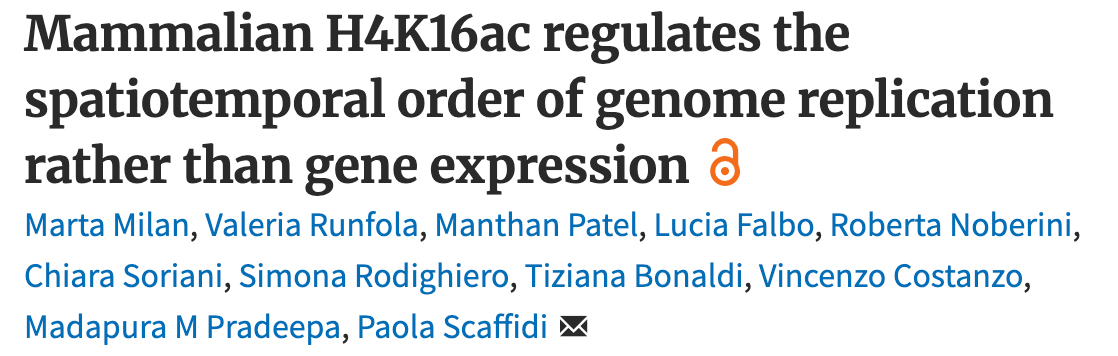
Histone acetylation - not always about transcriptional activation: H4K16ac safeguards the genome replication program by repressing premature replication of heterochromatin. Well done Marta Milan! tinyurl.com/yuy9m8t3

English


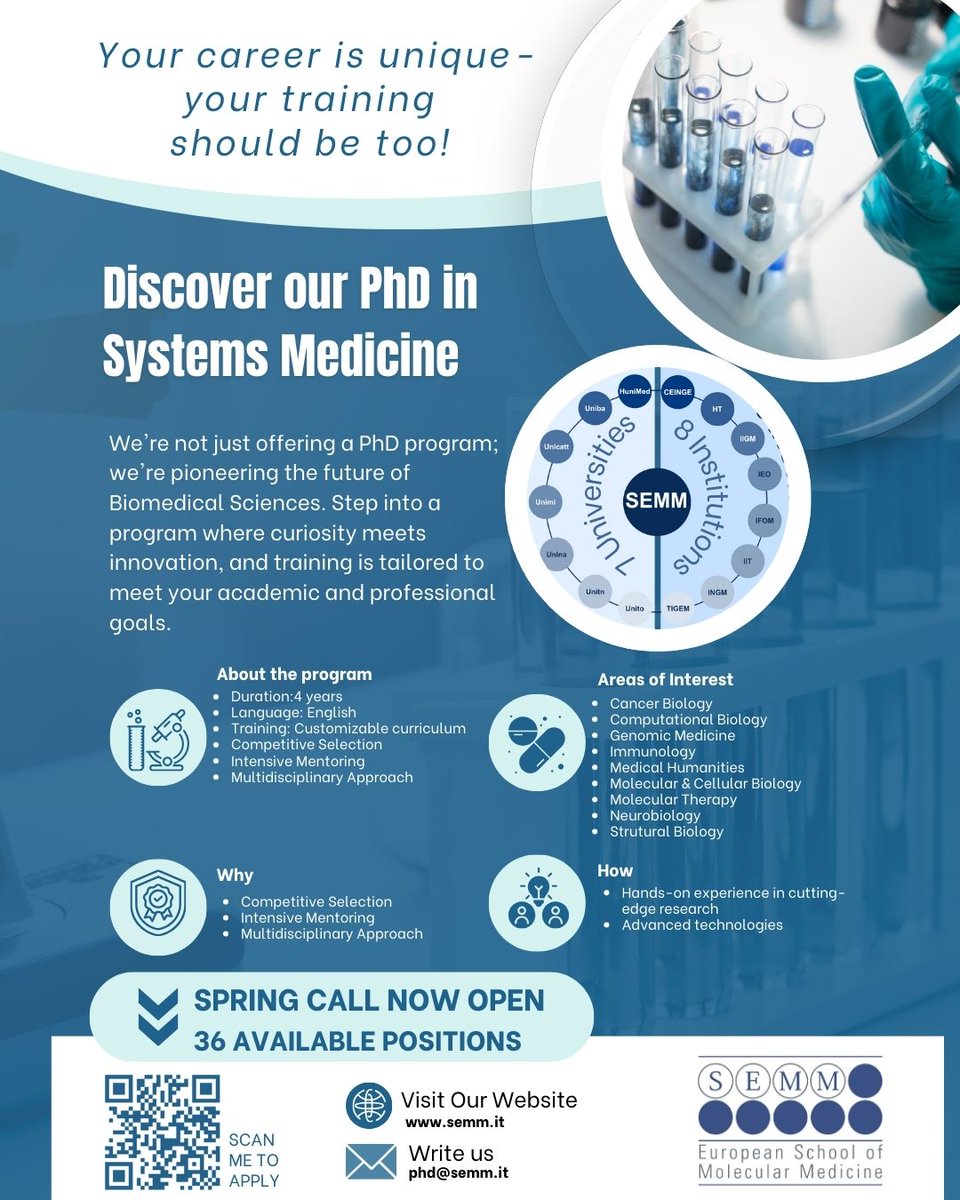
Position available in our lab research.ieo.it/careers-and-jo…
Français

Many passionate and motivated young scientists IEO research dropbox.com/scl/fi/qgcp2nh…
English

Thank you EMBO & members. Delighted to join!
embo.org/press-releases…
English
The Scaffidi Lab retweeté

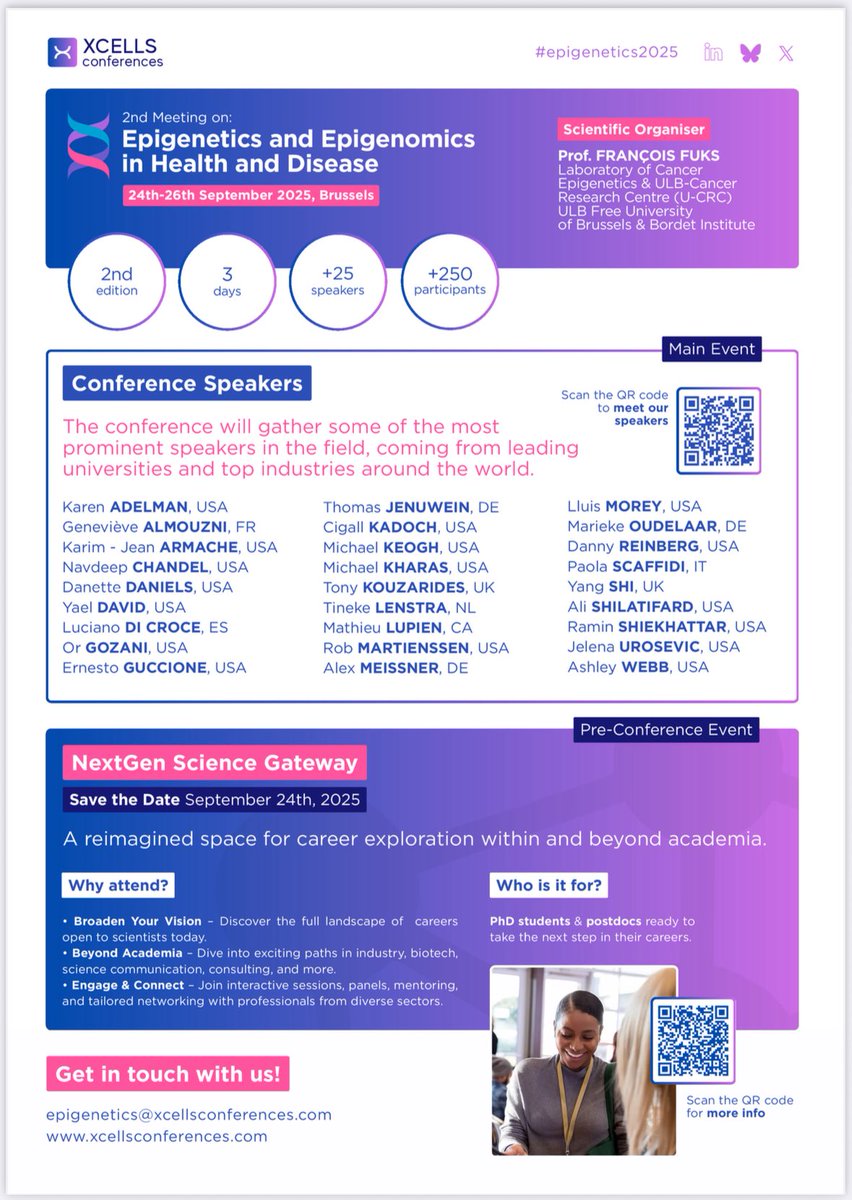
🚨 New meeting this fall in Brussels! 🚨
Cutting-edge science, amazing colleagues, & a RARE career development workshop for trainees-covering pharma, consulting, writing, start-ups & more 🤩
#epigenetics2025
Registration is open!!
@epicypher @FuksLab
xcellsconferences.com/epigenetics2025

English

We are very grateful to @fondaz_veronesi for awarding our Ruba Al Khalaf a research fellowship to pursue her work on epigenetic dysregulation in cancer. Many thanks to Fondazione Veronesi and all those who support scientific research! #UnNuovoAnnovoDiRicerca
#Fondazioneveronesi

English

Many #epigenetic regulators of diverse function in human cells - how do they cooperate to robustly control cell behaviour? we have addressed this experimentally doi.org/10.1093/nar/gk… and discussed implications for cancer doi.org/10.1016/j.trec… @IEOufficiale @TheCrick
English

@SGRodriques Most early-career GLs @TheCrick have done amazingly well, w huge impact in many fields. I wonder how they managed - maybe good ideas and solid science rather than bla bla bla? @SantosLaB8, @pontus_skoglund,@DinisCalado,@jonnykohl,@LiGroup_Crick,@AnastasiouLab,@TurajlicLab, etc
English

Monday was my last day as a group leader at the Francis Crick Institute.
I got my job at the Crick in 2020, almost exactly 5 years ago, right as COVID was beginning. I had finished my PhD in 2019, and had always told myself that I would only ever be an academic if I could find a place where I didn’t have to write grants, didn’t have to teach, and wasn’t on a tenure clock. The Crick is one of a very small number of research institutes that affords its academics such privileges, and the Crick is also endowed with extraordinary facilities, right in the heart of London. The offer for early-career researchers is almost too good to be true: almost $1M/yr in core support in personnel, reagents, and core facility usage, plus a generous startup equipment budget.
The Crick delivered on its promises, but European science faces some extraordinary headwinds, which are hard to overcome. The general lack of funding has been well-documented, and the red tape is indeed far beyond anything that American academics have to deal with. But the primary challenge is cultural, and is both far less visible and far more pernicious. About 6 months in, I was sitting in a meeting with some other faculty and core facility leaders, arguing that we needed to build out an ambitious screening platform similar to those at the Broad. Heads bobbed up and down. And then, as people were filing out, one of the group leaders hung around behind and said, “Sam, you really have a lot of that American energy.” I chuckled. “Don’t worry,” she said, “Stay here for three years, and we’ll beat it out of you.”
The list of such events goes on and on. Showing up at the sequencing core facility on Friday at 3pm with a library ready to load, and being told that I could submit a request form that would be processed the week after next (not next week, of course, because the person responsible was on annual leave), and then they would reach out to schedule a time to discuss my requirements in more detail. I asked if I could simply load the library on a Miseq that was sitting, idle, in plain view, and was met with bewilderment. Having health and safety called to inspect my lab because I had stacked two stackable hybridization ovens without a proper risk assessment on file. And, worst of all, having one student or postdoc after another decline positions to go to San Francisco or Boston because, as excited as they were about the work we were doing, they wanted to be where the action was.
This is only part of the story, though. The UK abounds in excellent researchers, and the Crick in particular is indeed a truly remarkable institution. Paul Nurse, the Crick’s visionary leader, has attracted some of the most talented early-career group leaders in the world, like Pontus Skoglund, David Bauer, and many others. Paul has also cultivated a “can-do” attitude among his executive team: whenever I needed something, I knew that Paul or Richard Treisman or Sam Barrell or Steve Gamblin or one of the other executives would back me up. If the UK wants to maximize its scientific output, it needs to double down on funding for the Crick and its other top-performing institutions, and that funding will certainly pay off. And the UK has also been at the forefront of new experiments in ways to do science. ARIA has done a spectacular job in moving fast and supporting contrarian research through its programs and through new structures like FROs, and Pillar VC's new Encode fellowship (also ARIA-supported) is one of the best ideas I have seen for how to bring AI talent to hard science problems. But at the same time, there is only so much you can do against a cultural background that penalizes ambition: the further you got at the Crick away from the top executives, the more you would encounter the traditional European “second place is okay as long as you gave it a good shot” kind of attitude.
Needless to say, the group leader was right: I did not last for three years. It took me about a year to recognize that the UK would not be a long-term home, and another year and a half to found FutureHouse, in the second half of 2023. I have lived in San Francisco since then. At the elite levels, Europe has an extreme brain drain problem. The most ambitious people are mostly in the US, and so the most ambitious people continue to come here. The US’s position as a talent magnet is not something we can take for granted; I am sure that with the correct combination of policies, we could eventually drive people elsewhere. But it is also not a position that will be easily lost, simply because there is nowhere else in the world that is anywhere near as attractive for talent. As long as the most ambitious and determined people can still find ways to get here, they will.

English

@RoukosVassilis @MundlosLab @StefanMundlos @AkisPapantonis @MolecularCell @imbmainz @sfb1361 @upatras 👏👏 congratulations Vassilis and all!!
English

Happy to share our new work in collaboration with the @MundlosLab @StefanMundlos & @AkisPapantonis labs, published today in @MolecularCell Many congratulations to all co-authors and many thanks to the funding agencies for the important support @imbmainz @sfb1361 @upatras
Molecular Cell@MolecularCell
Online Now: Type II topoisomerases shape multi-scale 3D chromatin folding in regions of positive supercoils dlvr.it/TFwXmD
English


Exciting postdoctoral opportunity to work on a EU-funded collaborative study aimed at identifying epigenetic determinants of drug tolerance in cancer. Stellar collaborators @VallotCeline @ShemaEfrat @BonaldiTiziana Plass/Gerhäuser @DKFZ & Balazs Gyorffy

English
The Scaffidi Lab retweeté

Thank you @EMBO - delighted to join this fantastic network! Thanks to everyone who has accompanied me in my scientific journey - mentors and mentees, colleagues, friends and family who share the ups and downs of research @IEOufficiale @Crick
EMBO@EMBO
Outstanding scientists elected to EMBO Membership: in EMBO’s 60th anniversary year, 100 new members and 20 associate members join the community embo.org/press-releases…
English

I am delighted to see @ScaffidiLab on this list. Congratulations!
embo.org/press-releases…
English