SpaceComputer - 天机

843 posts

SpaceComputer - 天机 banner
SpaceComputer - 天机

SpaceComputer - 天机

@SpaceComputerIO

The distributed compute network for security services in low earth orbit https://t.co/OuYPKv4dik

https in orbit Inscrit le Mayıs 2024
88 Abonnements4.6K Abonnés
SpaceComputer - 天机
SpaceComputer - 天机@SpaceComputerIO·
51,600 + 88,000 + 1,000,000 = 1,139,600 Satellites Kessler's syndrome looking good here.
SpaceComputer - 天机 tweet media
Sawyer Merritt@SawyerMerritt

NEWS: Jeff Bezos' rocket company Blue Origin has filed an official request with the FCC to launch and operate a constellation of 51,600 AI satellites (orbital datacenters), just two weeks after Amazon filed a formal petition calling on the FCC to deny @SpaceX’s 1 million-satellite proposal for orbiting datacenters, going as far to claim the project would take “centuries” to deploy. Blue Origin's project, called “Project Sunrise,” would include up to 51,600 satellites in low Earth orbit, designed to run AI and cloud computing workloads using constant solar power. The system would primarily use laser (optical) links between satellites. Blue Origin says "space-based data centers could relieve pressure on Earth’s power grids and water usage."

English
2
1
8
243
B=MananzeZA
B=MananzeZA@Thormichaey·
Here’s why extremely bullish on public pseudo-randomness beacons 👀 Because randomness is one of the most underestimated primitives in all of crypto and AI infrastructure. Most systems today still rely on: •Local entropy •Validator-controlled randomness •Opaque generation methods Which creates a hidden problem: if randomness can be influenced, everything built on top of it can be gamed. Why public randomness beacons matter A public pseudo-randomness beacon gives you: Unbiasable outputs no single party can manipulate outcomes Verifiability anyone can independently check the randomness Liveness guarantees continuous, predictable generation Global availability same source of truth for everyone This turns randomness into shared infrastructure, not a hidden assumption. What this unlocks 1. Fairness in onchain systems •Gaming, lotteries, NFT mints, leader elections •No more validator advantage or timing exploits 2. Secure cryptographic coordination •Key generation •MPC / threshold systems •Distributed consensus 3. Trustworthy AI workflows •Sampling •Model randomness •Agent coordination If randomness is compromised, AI outputs can be subtly steered. That’s a massive attack surface most people ignore. Why now We’re moving into a world of: •Autonomous agents •High-value onchain systems •Cross-chain coordination All of these depend on unpredictability + verifiability at scale. Public randomness beacons become the clock + entropy layer for this new internet. Only made possible by @SpaceComputerIO
English
1
0
3
37
alin.apt
alin.apt@alinush·
Actually, I do enjoy talking about this: “Real randomness” is a sham… there’s no way to really (cryptographically) prove it’s “real.” You may say “signature from my space computer is enough” but it’s not easy to bootstrap meaningful trust in such systems (TEEs, etc.)
SpaceComputer - 天机@SpaceComputerIO

The entire crypto industry decided that algorithmic randomness with a proof attached was good enough and just stopped asking questions. Nobody wanted to have the conversation about whether the randomness itself is actually real. So let's have it now 👇
English
5
1
11
589
SpaceComputer - 天机
SpaceComputer - 天机@SpaceComputerIO·
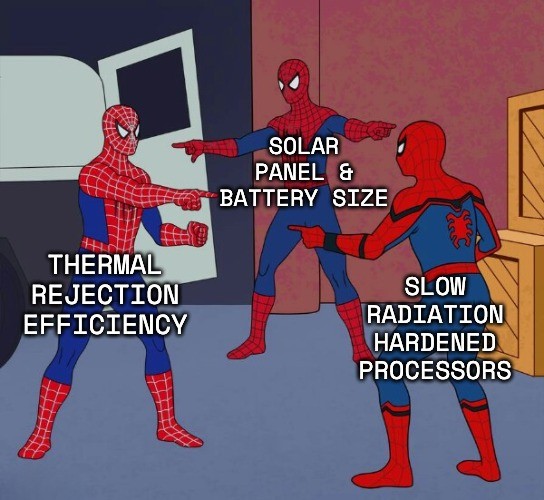
These constraints form a closed loop. More compute = more power = produces more heat = more mass ∴ higher launch costs Conversely: improve one link, improve the whole system. We can't change the laws of physics, but we can improve the technology. That's the biggest opportunity for space computing.
SpaceComputer - 天机 tweet media
English
0
0
2
84
SpaceComputer - 天机
SpaceComputer - 天机@SpaceComputerIO·
3. Radiation-hardened processors survive space but perform 1,000 to 10,000x slower than commercial hardware. That inefficiency means more waste heat per computation, which loops right back into the thermal and power constraints.
English
1
0
3
86
SpaceComputer - 天机
SpaceComputer - 天机@SpaceComputerIO·
Space is -270°C and cooling is still the hardest engineering problem in orbital computing. Everyone's bullish computing in orbit. But they don't say what makes it so hard. What nobody tells you is orbital computing constraints are a chain reaction problem 🧵
SpaceComputer - 天机 tweet media
English
4
4
16
390
SpaceComputer - 天机 retweeté
frezabek
frezabek@rezabfil·
Prague is calling and this time, we're bringing space with us 🛰️ What if your next secure data center wasn't on Earth? At ETHPrague, I'll dive into Confidential Computing in Space, leveraging satellite-level isolation + SW/HW co-design to rethink TEEs. Talk: Space Fabric: Reinventing Hardware Architecture for Orbital Infrastructure If you're there, let's connect 👇
ETHPrague@EthPrague

Our local tech brewer @rezabfil is the newest addition to our speaker lineup! Co-founder with a great experience working with our friends at @SpaceComputerIO and many others, this is a talk you definitely shouldn’t miss! This May at ETHPrague ☀️ 🎟️ Get tickets in bio


English
1
5
15
544
SpaceComputer - 天机
SpaceComputer - 天机@SpaceComputerIO·
@0xMaskedMiner It is cold in orbit! But because space is a vacuum, the classic cooling of releasing the heat into orbit doesn't work. That's why radiative cooling and other mechanisms are super important. Otherwise the satellite overheats with nowhere for the heat to go, and stops functioning
English
1
0
1
5
SpaceComputer - 天机
SpaceComputer - 天机@SpaceComputerIO·
Other than energy, cooling is the biggest constraint for orbital computing and orbital data centers. Biggest constraints for cooling in orbit: 🛰️ cooling unit size 🛰️ rate of heat transfer 🛰️ cooling mechanism position on the satellite We analyzed the landscape for cooling orbital compute. Learn about the different cooling mechanisms of orbital compute companies👇
SpaceComputer - 天机@SpaceComputerIO

x.com/i/article/2021…

English
5
2
13
525
SpaceComputer - 天机
SpaceComputer - 天机@SpaceComputerIO·
@tranaiht so true! luckily if you position the radiator away and keep the solar panels facing the sun (in sync with the sun in orbit)! Though for ultraviolet radiation, hardware has to withstand radiation for many years, so the hardware remains functional and intact! 🫡
English
0
0
1
9
Avin
Avin@tranaiht·
@SpaceComputerIO That's the real challenge for satellites enduring constant ultraviolet radiation.
English
1
0
1
16
B=MananzeZA
B=MananzeZA@Thormichaey·
Every cryptographic key begins with a random number Better randomness stronger security @SpaceComputerIO
English
1
0
2
45
SpaceComputer - 天机
SpaceComputer - 天机@SpaceComputerIO·
@libapi_ sorry we are just responding now, it's so cool that you got cTRNG running! Let us know what you're curious to build with cosmic randomness 😎👽
English
0
0
0
10
libapi
libapi@libapi_·
发现了一个比较有噱头的项目 @SpaceComputerIO 非常朋克 ,好有意思的项目 ,如果地球上的随机数可以被人为物理修改 ,那就上到近地轨道卫星。 这不是普通的伪随机数,也不是软件算法生成的,而是物理世界产生的 真随机数 文档说的。 保证公平性,不会被人类/项目方或用户操控修改随机数, 保证任何需要随机性的场景都能可信、安全、透明地执行。 什么是Orbitport ? Orbitport是通往轨道服务的门户,例如cTRNG(宇宙真随机数生成器)等spaceTEE,由多个提供商和卫星提供服务,以确保高可用性和可靠性 Orbitport 提供统一的 API,用于访问来自多个来源的服务,并可在服务发生故障时进行切换。它还提供本地回退方案(针对受支持的服务),以简化请求流程并应对底层服务的高负载或宕机情况。 什么是 cTRNG ? 宇宙真随机数生成器 (cTRNG) 是一项轨道服务,它提供从卫星硬件采集的真随机数,目前由 [此处应填写卫星名称] 提供cEDGE支持。卫星还会对生成的数据进行签名,以确保数据是由卫星生成的,并且未被篡改。Crypto2Aptos Orbital 以下是我在 ,电脑上运行的宇宙真随机数 来自低轨道卫星🛰️ TRNG = True Random Number Generator(真随机数生成器) aptosorbital = 随机数来自 Aptos Orbital 的轨道设备(卫星端点) data = 太空随机数的十六进制数据 成为早期用户 zama 也跟 @SpaceComputerIO 合作了吗 @semicondurian @zama @randhindi @rezabfil @SpaceComputerIO @analog_kyle
libapi tweet media
中文
24
4
23
3.5K