
Sabitlenmiş Tweet
alin.apt
3.5K posts


alin.apt
@alinush
i put the “crypto” in “cryptocurrency.” head of cryptography at @aptoslabs | math, research, engineering 💍 + 👶 + 🏍️ = ❤️
Austin, TX Katılım Temmuz 2009
345 Takip Edilen40.4K Takipçiler
@matthew_d_green I can’t say I looked deeply, but I was under the impression that folks at Ethereum are having good luck formalizing arguments of knowledge, at least: lean-lang.org/use-cases/arkl…
English

@alinush Meanwhile Lean doesn’t seem to handle security theorems well.
English
I could not agree more! 👍
Aws Albarghouthi@awsTO
It took me a few hours to write a Lean formalization of the theorems and proofs in a recent paper of ours. I used Fable + 5.6 Sol. I found the exercise shockingly eye opening. I don't think we should publish papers without Lean proofs at this point.
English
alin.apt retweetledi

alin.apt retweetledi

Please submit your work to the inaugural ACM Post-Quantum and Quantum-based Security (PQQS) conference!
Abstract due July 19, full paper due July 26.
acm-pqqs.github.io/pqqs2026/
English
Doesn’t this imply our browsing history will become public, on-chain history, available for everyone to snoop on? 😳
Cloudflare@Cloudflare
We're opening the waitlist for our Monetization Gateway, which will allow you to charge for any web page, dataset, API, or MCP tool behind Cloudflare. The charges will settle in stablecoins over the x402 open protocol. cfl.re/4eUFdt6
English
alin.apt retweetledi

@Istvan_A_Seres @_alehmann It’s not a farce. It’s the intended design.
English

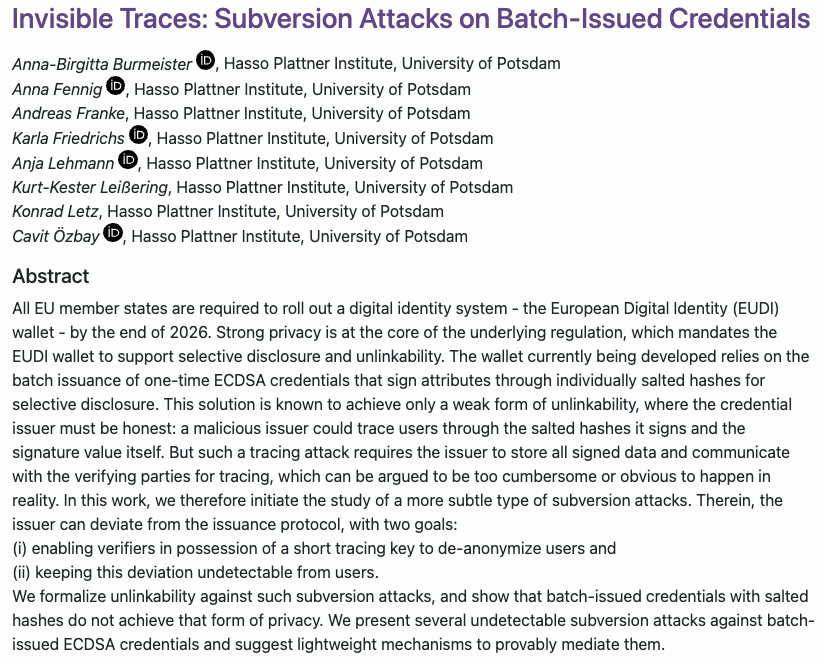
As of now, the European Digital Identity system is a farce.
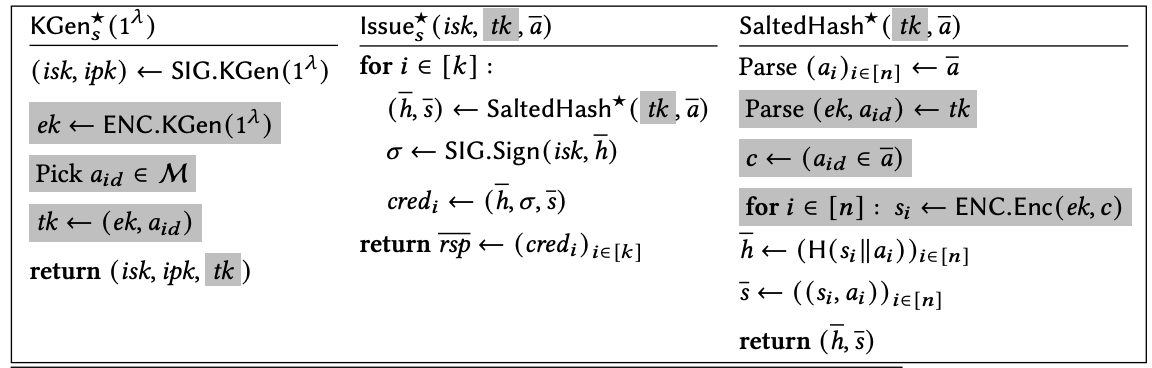
Credentials are salted hashes of attributes satisfying minimal privacy requirements.
Issuers can subvert the system undetectably to trace users. One disclosed attribute is enough entropy to tag every person on Earth.
English
alin.apt retweetledi

[New] Flock: Fast Proving for Batch Boolean Computations (Benedikt Bunz and Ron Rothblum and William Wang) ia.cr/2026/1329
English

Blog post: algassert.com/post/2603
"Unfathomable bugs #10: The Broken Windows Build"
It's been awhile since I added to this particular series. But when a bug beyond your control steals a day of your life, you gotta vent somehow.
English
@CraigGidney Thank you for writing this.
It made me feel less lonely… in this absurd software universe we’ve created.
English

Today I got called out for having white European privilege
I grew up in post-communist Romania lol
Until the mid 2000s when I was in my teens, nobody was really doing well
I never had a parent drive me to school or take me with car after classes ended
I used to wear the same clothes at school for a week – and so was everyone else
Margarine with bread and a tony sparkle of bread was pretty common for breakfast and dinner
There were some completely basic sweets that we would only get on birthdays, for Christmas, and Easter
In 2013, as part of a class that I took in Sweden, we were taken to a “ghetto” where the immigrants were being housed. Everything was new and clean, made me almost ask how I can sign up for that (I grew up in an ugly block that looks just like one in the picture)
Our school teachers were frequently telling us that our country is poor and we are unfortunate enough to have been born in the wrong place… but if we find work opportunities abroad, we should absolutely go there
Some of my teachers slapped me in front of the class and nobody acted like it was a big deal. I got bullied by older kids and got my ass kicked a few times (one guy put me in a chokehold position and made me swallow sand in the playground)
But we all grew up and did pretty good. The country still isn’t perfect, but we are working to improve it. Not so much through government, but personal contributions and private organizations
So yeah, I somehow have the white European male privilege. My life and everyone else’s was easy and void of any struggles. But when we were watching TV movies with ghetto scenes, many of us were saying that they seem to have nice houses and cars.

English
alin.apt retweetledi

Decentralized Thoughts decentralizedthoughts.github.io is famous! We were interviewed for the EATCS Bulletin:
bulletin.eatcs.org/index.php/beat…
With @kartik1507, Ling Ren, and @alinush
Thank you, @StefanResearch and @eatcs_secretary for inviting us🙏
Many thanks to all the DT contributors🙏🙏
English
@mackenzieprice and I are arguing that "being forced to read highbrow literature as a young teen" is misguided and leaves kids behind.
This does not imply we should _not_ teach kids subtraction.
We are not proposing to exclude all highbrow literature from the curriculum. We are questioning the eductional pace / tempo / timing and the lack of variety in the curriculum (e.g., comic books).
Regarding subtraction, some kids can learn it at 3 years old, others at 7. Just like some 17 year olds can wrestle with Eliade (not me).
Not one child is the same in their learning abilities and interests. And building a curriculum with no variety that assumes all kids will finish learning at the same time is at best naive and at worst actively harmful.
English

@alinush @mackenzieprice Yes! Do it with math too. If they like addition but not subtraction, don’t force them to subtract. If they like biology but not chemistry, don’t force them to learn the elements. Kids are the best authorities on what is worth learning.
English

Forcing kids to read things they hate just simply doesn’t work. Our reading philosophy at Alpha is simple: kids learn to love reading by reading what they love.
Sure, it’s important for kids to be exposed to classic literature. But being forced to read highbrow literature as a young teen is often the very thing that makes kids hate reading in the first place. Many of them never bother picking up a novel again. If the goal is to have students fall in love with reading and become life-long readers, then we should cater the material to their interests. Whether it’s comic-books, books about insects, or a biography on the Kardashians, there has to be a better way.
We built our own app called Teach Tales to solve this problem.
English


If there's one thing I could tell Dario Amodei, it's that a government is very unlike Treebeard in a bunch of *other* ways, besides slowness. Treebeard is wise. A government is basically the opposite—insane—and it always will be. It's an emergent property, not accidental.
English

ECDSA is one of the most intellectually offensive constructions in modern cryptography.
It's ugly.
It's hard to thresholdize.
Indeed, every research grant and venture capital dollar spent on it is, in a final sense, a theft from better cryptography.
x.com/secparam/statu…
Ian Miers@secparam
So what originally got me thinking of DSA as mangled Schnorr (beyond the obvious patent avoidance issue), was a version of ECDSA someone put up at RWC 2016. Its a little hard to read, so I just asked Gemini for a cleanup version with Schnorr and Elgamal next to it. Its not a perfect fit. But its kinda interesting.
English
@realbarnakiss @zooko The PCS construction might’ve been in its training set?
English

Fable was the best model I have ever run for zk-autoresearch. Best quality out of ~500 iterations. Never triggered the safety check once on cryptography research. Its first iteration reinvented a known PCS construction from first principles, without reading the papers. It just reasoned its way there.
72 hours later the US government pulled it. Export controls. I'm in Budapest, so if maintained I lose access to the best tool for zk-autoresearch.
This is the AI arms race moving from papers to policy. If export controls hold, the research community splits in half. Open research that was becoming accessible through LLMs slows down overnight.
The alarmism-as-marketing crowd should take a hard look at this. They gave the government the perfect ground for exactly this outcome.
English
@hashbreaker @secparam @idrassi @colludingnode It’s fascinating how your gradual ECDSA-to-Schnorr conversion pans out!
English

@secparam @idrassi @alinush @colludingnode See also blog.cr.yp.to/20140323-ecdsa… for step-by-step improvements from ElGamal to Schnorr, followed by the regression from Schnorr to ECDSA. Unified notation, of course.
English