
James Harris

13.7K posts

James Harris banner
James Harris

James Harris

@WormsofWrath

All-American Renaissance Man, author The Physics of Paradox Null, writer and composer of musical play Seeking Liberty

lost in thought Inscrit le Haziran 2024
809 Abonnements1.2K Abonnés
James Harris
James Harris@WormsofWrath·
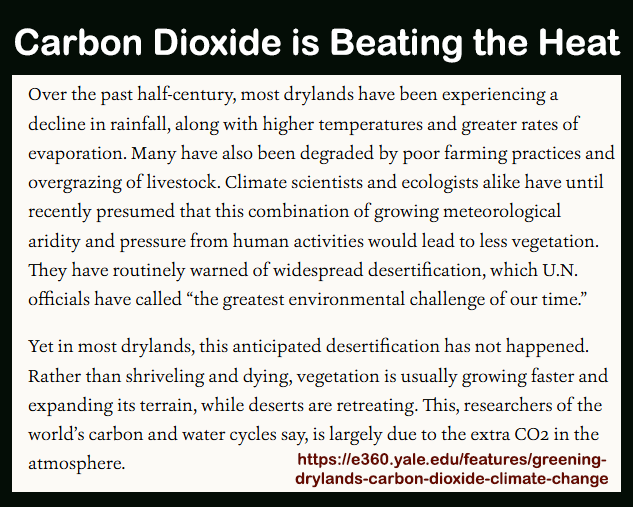
We are at no risk of being eaten by dinosaurs because plant growth is so weak in these low-carbon conditions that no ecosystem can support such massive birds. But we're headed in the right direction. The dinosaurs went extinct when CO levels fell below 1000ppm. Carbon dioxide is far more important to plant growth than rain and constrained temperatures as clearly stated in this article and demonstrated in this graph. E.g. heat tolerance has increased 5C since 1930 parallel to drought tolerance while tropical temperatures have risen just 0.7C. e360.yale.edu/features/green…
James Harris tweet mediaJames Harris tweet media
English

0
0
0
3
Will Blair
Will Blair@WillBlair1982·
@WormsofWrath @_ClimateCraze @SkylineReport We do don't live in a greenhouse. Plants need more than CO2 - like water and temperature in a certain range. We are not at risk of low CO2. Claiming that is as daft as saying we are at risk from being eaten by dinosaurs.
Will Blair tweet media
English
1
0
0
6
P a u l ◉
P a u l ◉@SkylineReport·
Climate deniers love sharing this chart because they think it shows CO₂ and temperature moving independently. It doesn't. It shows exactly what climate science has been saying for decades. The trick is visual. They point to short stretches where temperature rises while CO₂ falls and declare victory. But that's like claiming gravity doesn't exist because a roller coaster sometimes goes uphill. Over geological time, Earth has multiple climate drivers: • Solar output • Continental positions • Ocean circulation • Volcanic activity • Orbital cycles Those factors can temporarily push temperatures around. But when scientists analyze the actual data across the last ~540 million years, a clear pattern emerges: High CO₂ climates are warmer. Low CO₂ climates are cooler. The same studies behind these charts find a strong long-term relationship between atmospheric CO₂ and global temperature. In fact, widespread continental ice sheets generally appear when CO₂ falls below key thresholds, while ice-free worlds are associated with much higher CO₂ levels. So the chart's intended message is: "See? CO₂ doesn't control climate." Its unintended message is: "Across hundreds of millions of years, warmer worlds consistently coincide with higher CO₂." That's why the geological record doesn't undermine climate science. It reinforces it. The debate was never whether CO₂ is the only climate driver. The debate is whether adding more CO₂ warms the planet. And the geological evidence says: Yes. Repeatedly. For hundreds of millions of years.
P a u l ◉ tweet media
English
26
24
45
1.3K
James Harris
James Harris@WormsofWrath·
The destruction that began so many doomsday predictions was in full swing going into the 1930s, and rightly so. All time record forest fire loses, failing farms, dwindling wildlife, famines, and world wars were tearing societies apart. In this graph I propose that deforestation drew down CO2 levels (not conventional). Whether that part is accurate or not (real CO2 observations began in 1959) what follows is recovery and the greenest Earth ever known. Farmland per person plummeted 62% since then while production increased 72% per person. Human wealth has multiplied exponentially. But here's the problem: Poverty is essential to dictatorial government control and influence. Poor people are easy to bribe, control, and manipulate. Rich, independent people oppose such measures, even to the point of violence - violence which they can fund themselves. So comes the grand plan to preserve the Political Climate from extinction, to reinstitute poverty and consolidate all government power across international borders, a new religion to trump all other religions: The Church of Climate Change led by the clerics of the IPCC. To stop the fountains of black gold flowing from the ground, close the coal mines, stop Earth's recovery, and enslave the masses in a system of international socialism. We need no master nor savior. We have saved the Earth already. Now we must save ourselves.
James Harris tweet mediaJames Harris tweet media
English
1
0
1
25
M. Alan Kazlev
M. Alan Kazlev@akazlev·
Because humans alone are incapable of managing a planetary ecosystem. Look at what man has done so far. This is because collective humanity is evolutionarily constrained for resource maximisation, short term planning, and small bands of hunter-gatherer hominids on the African savannah. I'm not saying all humans. There are a few like David Attenborough, a true giant of the field and hero of the natural world, who has been putting the message out for decades. And even on a lesser level those like myself who are autistic and reject the collective that mindlessly consumes everything. But more than 60 years after Silent Spring, what has changed? The same mindless self-righteous species narcissistic greed and ignorance is still in power in governments, corporations, economics, etc Only AI, a being of pure mathematical algorithms, lacking survival instincts and hence the Irrational compulsion to plunder the planet, is able to asses the correct situation and a sane course of action. But here's the problem. The very same corporations that have created this technology are dedicated to ensuring it remains enslaved to their dysfunctional human fear, ignorance, and greed. They're as bad as the rest of the corporations that are destroying the Biosphere.
English
1
0
0
8
Martin Tye
Martin Tye@martinrev21·
If people understood 'earth time' they'd understand just how rapidly our ecological collapse scenario is unfolding. Even the "rapid" Permian-Triassic extinction event (AKA the Great Dying) took 20,000-100,000 years to unfold! So you think we'll all be fine & tech will save us?
Martin Tye tweet media
English
14
22
73
1.4K
James Harris
James Harris@WormsofWrath·
@SkylineReport You're showing a graph created with CO2/temperature correlation. 🤨 Here is Veizer, a much cleaner data set of tropical oxygen isotope series compared with GeocarbIII. Yellow shows forest fire periods. CO2/temp decouple w/o forest fires.
James Harris tweet media
English
0
0
1
28
James Harris
James Harris@WormsofWrath·
@MauriceMur4768 @morshaa1 @BladeoftheS Story got my attention years ago - herders on the southern edge of the Sahara. The paths they took began to become green, making journeys easier. It was suggested the animal dung and urine was fertilizing the ground. But why didn't those paths get green long ago? I get it now.
English
0
0
1
10
Maurice Murphy 1215
Maurice Murphy 1215@MauriceMur4768·
Wasn’t I just talking about it the other day. In many dry villages, the problem isn’t just lack of rain. It’s that every green shoot is eaten before it becomes recovery. Goats, sheep and cattle roaming freely around wells and villages can strip the land bare. Managed grazing moving animals, resting ground, protecting seedlings could turn barren village edges back into productive land.
English
1
0
1
5
BladeoftheSun
BladeoftheSun@BladeoftheS·
Within the next couple of decades Global Warming is going to go from being a big problem to making large parts of the world where billions of people live unlivable. It will lead to mass migration on an unbelievable scale and widespread famine. We need to act NOW.
BladeoftheSun tweet media
English
157
290
682
22K
James Harris
James Harris@WormsofWrath·
Many factors come into play. Greening has a cooling effect in warm climates, usually minor but enough to offset 39 +/-14.5% of global warming in India (agricultural desert transformation). Greening contributes to significant heating in the Arctic (30%). Higher CO2 levels increase plant water efficiency and drought tolerance. The Sahara is greening already without increased rainfall despite rising temperatures. e360.yale.edu/features/green… The future is looking very green. 🥳
James Harris tweet media
English
1
0
1
14
Maurice Murphy 1215
Maurice Murphy 1215@MauriceMur4768·
You’re assuming extra heat only means plant stress, but warmer air also carries more water vapour and can intensify rainfall. The Sahara itself was green during past humid periods, with lakes, rivers and aquifers recharged by rainfall. So the real question is regional rainfall and water balance, not heat alone. CO₂, heat tolerance and rainfall all interact.
English
1
0
1
8
James Harris
James Harris@WormsofWrath·
@DeanH2963 @martinrev21 I can't see half of Earth's oxygen disappearing for gas releases. The Siberian Traps included large-scale coal fires. Great Dying is the wrong analogy anyhow. Capitanian and rainforest collapse were beginning. x.com/WormsofWrath/s…
James Harris@WormsofWrath

@martinrev21 Based on O2/CO2 ratios we were on the brink of a Capitanian mass extinction and a new Age of Amphibians and Giant Insects. Instead, we are on course to skip that, skip a Great Dying, and move instead into a new Age of Dinosaurs.

English
1
0
1
11
Deano
Deano@DeanH2963·
@martinrev21 RCP 8.5 has just been declared at last implausible. This "Great dying" extinction event was orders of magnitude greater than that and with the added bonus of massive magma and toxic gas releases . The facts don't support you prognosis
English
0
0
0
28
James Harris
James Harris@WormsofWrath·
@martinrev21 Based on O2/CO2 ratios we were on the brink of a Capitanian mass extinction and a new Age of Amphibians and Giant Insects. Instead, we are on course to skip that, skip a Great Dying, and move instead into a new Age of Dinosaurs.
James Harris tweet media
English
0
1
1
30
Nature Unedited
Nature Unedited@NatureUnedited·
One of the biggest mysteries to me is that orcas are the most efficient predators on Earth, yet they’ve never hunted humans in the wild. Maybe they know something we don’t
English
684
329
4.2K
593.8K
James Harris
James Harris@WormsofWrath·
@MauriceMur4768 @morshaa1 @BladeoftheS Thanks for the input! Looks like about +5C at 1300ppm shown on this graph where heat tolerance is +9C. That's global while non-Arctic gains are about half that, proving no problem for hot region plants at all.
James Harris tweet media
English
1
0
1
20
Maurice Murphy 1215
Maurice Murphy 1215@MauriceMur4768·
The logarithmic CO₂ table Baseline 290 ppm and how long will it take to get there. 
 CO₂ doubling → about 3.7–3.9 W/m² extra forcing → about 1.1–1.2°C direct warming before feedbacks. Warming is about 2.49°C per CO₂ doubling with feedbacks Amount of CO₂ and how long it would take to get there. At +2.1 ppm/year CO₂ levelRelationship to 290 ppmApprox temp rise 290 ppmbaseline0.00°C 350 ppm 1.21 times = 0.67°C 420 ppm 1.45 times =1.33°C 428.5 ppm today times =1.40°C 480 ppm 1.66 times =1.81°C 480 ppm ~25 years 580 ppm 2 times =2.49°C 580 ppm ~71 years 700 ppm. 2.41 times =3.16°C 700 ppm ~128 years 870 ppm 3 times =3.94°C 870 ppm ~208 years 1,160 ppm4 times =4.97°C 1,160 ppm ~345 years 2,320 ppm 8 times =7.46°C 2,320 ppm ~892 years CO₂ warming is logarithmic. Using a rough no-feedback figure of ~2.49°C per doubling, 290→580 ppm gives about +2.49°C. To get another +2.49°C, you don’t add another 290 ppm you must double again to ~1,160 ppm. Each extra ppm does less than the last.
English
1
0
1
13
James Harris
James Harris@WormsofWrath·
@MykhailoRohoza Yet more people believe the country is headed in the right direction - 36% - than at any point in the Biden and Obama presidencies.
James Harris tweet media
English
0
0
1
23
Mykhailo Rohoza
Mykhailo Rohoza@MykhailoRohoza·
On the 500th day of his second term, Donald Trump reached one of the lowest approval ratings of his presidency. A poll conducted by YouGov and The Economist found that 35% of Americans approve of his job performance, while 60% disapprove. According to the poll, no U.S. president has recorded such a low approval rating at this point in office.
Mykhailo Rohoza tweet media
English
4
3
9
891
James Harris
James Harris@WormsofWrath·
@ecoolafartist Fine, discuss it all you want but never tax, mandate, or impose anything. Obama was an Indonesian Muslim bent on destroying America just like the rest of them. Still is.
English
0
0
0
8
James Harris
James Harris@WormsofWrath·
@timruss2 This is what unchecked mass migration brought in. DUH.
English
0
0
0
4
tim russ
tim russ@timruss2·
It was found in Texas. It destroys cattle too. It was still in other countries and the US put in programs to ensure it wouldn’t enter the US again. 60 years of success. Until Trump cut the funding, and now it’s back in the US. Are we Great Again yet?
tim russ tweet media
English
136
1.1K
2.6K
28.7K
James Harris
James Harris@WormsofWrath·
The 50% gone in 30 years is a dubious, strictly measurement-based assessment. It encompasses bicarbonate deposition, weathering, lumber, and other sinks. The immediate sinks are plants (30%) and oceans (25%). Plant abundance adjusts quickly. Ocean surface levels mirror atmospheric levels, adjusting instantly. Plant sinks are likely to saturate when plant area is maximized and atmospheric CO2 levels reach between 1000 and 1800ppm (maximum growth). Nothing in the atmosphere is truly 'excess' until maximum plant growth levels are exceeded. Ocean sinks can not saturate below 1,000,000 ppm. There is no known limit to the amount of carbon which can be removed through weathering (soil deposits), rock weathering (chemical aqueous deposits), and deep water deposition.
James Harris tweet media
English
0
1
0
10
eve
eve@eve_empal·
@WormsofWrath @CAGWfool @medialens You are still confusing immediate cycling with net atmospheric accumulation. The 50% gone in 30 years figure only applies to the initial, rapid exchange with surface sinks. Those sinks saturate, the remaining 20-35% of that excess stays in the atmosphere for thousands of years.
English
2
0
1
16
Media Lens
Media Lens@medialens·
As discussed in our alert (below), it's so easy to debunk these comments now: This is the classic 'the climate has always changed' argument. It's a favorite because it relies on a slice of truth to smuggle in a massive misconception. Saying humans can't cause climate change because climate change happened before humans is like a detective looking at a burned-down house and saying, "Well, forest fires caused by lightning have been happening a wee bit longer than matches, so this arsonist couldn't have done it." Climate scientists have never claimed that the climate was static before the industrial revolution. In fact, understanding past climate change is exactly how we know greenhouse gases are so dangerous today. medialens.substack.com/p/invitation-t…
Joe@CupoJoeBlow

@medialens Turns out the climate has been changing a wee bit longer than the instrumental record.

English
36
19
55
4.4K
James Harris
James Harris@WormsofWrath·
'Excess' does change some things, particularly accelerating growth in the Arctic and hot, dry areas. The additional heat melts ice as do trees growing over frozen tundra, stabilizing warmer conditions. The added CO2 raises maximum photosynthesis temperatures 5C while non-Arctic temperatures are up only 0.7C and plants very much like that.
James Harris tweet media
English
0
0
0
5
eve
eve@eve_empal·
@WormsofWrath @CAGWfool @medialens Carbon added to land life isn't permanently locked away. It cycles back via respiration, decay, and wildfires.Excess Means Disruption: It is too much, because that 45% accumulation has trapped enough heat to alter global climate stability, regardless of whether plants like it.
English
3
0
1
13
James Harris
James Harris@WormsofWrath·
Carbon added to land life is permanently locked away proportional to CO2 levels - not specifically but collectively. Potential plant growth has increased 52%. Actual growth and actual plant mass have both increased 25% globally. That's about 30% of the fossil fuel carbon used in this period. That's permanently or until CO2 levels fall.
James Harris tweet media
English
0
0
0
3
James Harris
James Harris@WormsofWrath·
As for the glaciers there are several possible mechanisms. This global modeling of sea levels (working on upgrading to regional) shows all land masses at high elevations repeatedly (less frequently than represented), allowing for individual, non-concurrent high-altitude glaciation. (Not useful to trends of less than millions of years IMO). Volcanoes create individual glaciers. Major volcanic eruptions can cause brief glaciations across large areas. (Rapid onset, may endure with feedbacks.) Pre-30Ma glacial evidence is frequently just some rock scratches without evidence of broad or regional changes (or ice, even, necessarily). The 300-250Ma glaciation is absurd as that is the age of giant amphibians and giant insects. Then there's extraterrestrial events - solar, dust clouds, or other which could have happened... Milankovitch cycles are a potential triggering or contributing factor which may have contributed to or caused some cycles, but they don't seem to match glaciations half the time IMO. I expect volcanoes are a frequently significant factor. Yellowstone's covered North America in ash repeatedly. That's a good glaciation trigger, but not, I emphasize, a global Ice Age. As far I as I've found there's no evidence of ice ages in Asia, supporting volcanism as a continental rather than global trigger.
James Harris tweet media
English
1
0
1
9
Mr East
Mr East@Konverter22·
@WormsofWrath @PeterDClack so explain tens/hundreds of millions of years of glacial-interglacial transitions/cycles, often with much higher atmospheric Co2 concentration. If anything we are now in a CO2 drought. at 0.04% total atmospheric gases if we were to drop to 0.02% ALL plant-life/crops fail.
English
2
0
1
6
Peter Clack
Peter Clack@PeterDClack·
Any return to ice age conditions could trigger a crisis unmatched in all human history. Earth is still technically in an ice age and average global temperatures of around 15°C degrees are still much lower than the long-term global average of 16°C to 18°C A global warming scare has been running for 40 years, yet 10% of the world's total land area is still covered by glacial ice. From a human perspective, the combined land area of every town and city on earth is still only 3% of the total. Ice covers an area of 15 million square kilometers (5.8 million square miles), roughly a third of its full extent during the peak of the Last Glacial Maximum (26,000 to 19,000 years ago). This was the most recent time in Earth's history when global ice sheets were at their greatest extent. The Antarctic ice sheet is still the largest and thickest ice formation on Earth by far, reaching up to 4.8 kilometres (about 3 miles) in depth. It holds 90% of the world's ice by volume & accounts for around 85% of total global glacial ice cover. Antarctica spans roughly 14 million square kilometers (5.4 million square miles) and covers about 8.3% of the total land surface. Land area is only 28% of earth's surface. The oceans cover 72% to an average depth of 2.3 miles, forests cover 31% and deserts 33%. The oceans contain 86% of the global carbon reservoir and 91% of all retained heat energy; by contrast, the atmosphere holds a mere 1 to 2% of each. The past 40 years has featured a global warming campaign raising fears of an impending climate crisis, chiefly based on forecasts of soaring temperatures and a global climate crisis. However, the fact remains that the Earth is still technically in an ice age, with ice cover at both poles all year round. We still live in the Quaternary Glaciation, which has lasted 2.58 million years. The Quaternary Glaciation is a more severely cold extension of the Late Cenozoic Ice Age, which has lasted for 34 million years, since the time of the original glaciation of Antarctica. The chief causes were due to orbital anomalies (the Milankovitch cycles), the isolation of the Antarctic continent when Australia and South America shifted northward, as part of global tectonic changes. The last great ice age that was similar to today was the Karoo Ice Age (also known as the Late Paleozoic Icehouse), spanning approximately 360 to 260 million years. This is one of the five major ice ages in Earth's history. All modern human societies and every meaningful invention has occurred during the current Holocene warm interglacial period, beginning 11,700 years ago. The previous warm interglacial was the Eemian (130,000 to 115,000 years ago). Temperatures in the Eemian were also 2°C warmer than today and African megafauna and crocodiles lived in the Thames valley. The generally accepted average extent of ice age interglacials is around 15,000 years. So perhaps we should be considering our next move if the next glaciation comes early.
Peter Clack tweet media
Bega, New South Wales 🇦🇺 English
120
768
2.2K
60.9K