
Codependent

979 posts

Codependent banner
Codependent

Codependent

@code_pendent

Cofounder @SentrioVSM | CTO @esprofile | Photography buff | Sport addict | Dive-Rest-Repeat

Inscrit le Ocak 2012
531 Abonnements92 Abonnés
Codependent retweeté

Aran Komatsuzaki
Aran Komatsuzaki@arankomatsuzaki·
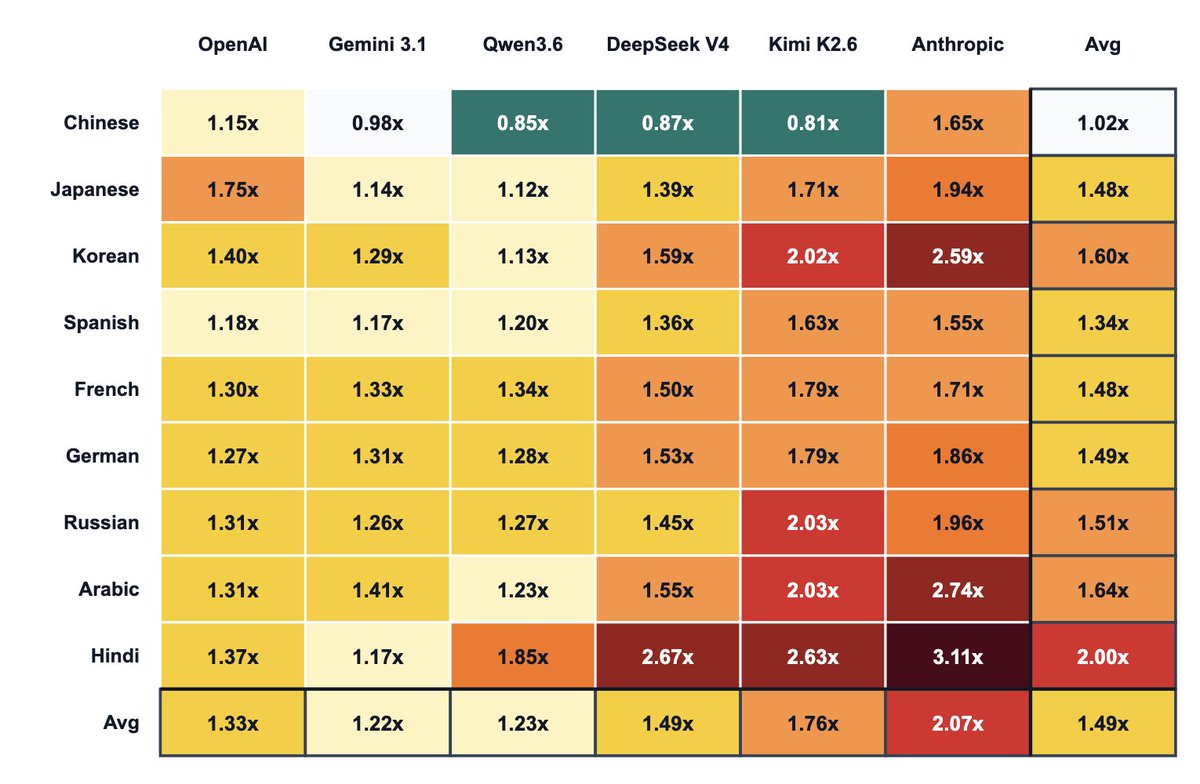
Follow-up on non-English token-inefficiency with more model-language pairs: - Chinese is cheaper than English on major Chinese models - Gemini and Qwen provide least non-English tax - Anthropic has the highest tax by far; Kimi is next - Hindi is the worst-covered language here, despite its massive speaker base
Aran Komatsuzaki tweet media
Aran Komatsuzaki@arankomatsuzaki

The non-English tax is real. Sutton's Bitter Lesson, translated across languages and normalized to OpenAI English token count: Hindi: OpenAI 1.37×, Anthropic 3.24× Arabic: OpenAI 1.31×, Anthropic 2.86× Chinese: OpenAI 1.15×, Anthropic 1.71× Claude’s tokenizer charges a much higher linguistic tax.

English
61
253
1.3K
496.4K
Codependent retweeté
BURKOV
BURKOV@burkov·
If you don't understand this, you will not understand why LLM-based agents are irreparably failing for a general-purpose problem solving. An agent (by the way it was the topic of my PhD 20 years ago) to be useful, must be rational. Being rational means to always prefer an outcome that results in the maximal expected utility to its master/user. Let’s say an agent has two actions they can execute in an environment: a_1 and a_2. If the agent can predict that a_1 gives its user an expected utility of 10, and a_2 gives an expected utility of -100, then a rational agent must choose a_1 even if choosing a_2 seems like a better option when explained in words. The numbers 10 and -100 can be obtained by summing the products of all possible outcomes for each action and their likelihoods. Now here is the problem with LLM-based agents. The LLM is not optimizing expected utility in the environment. It is optimizing the next token, conditioned on a prompt, a context window, and a training distribution full of examples of what helpful answers are supposed to look like. Those are not the same objective. So when we wrap an LLM in a loop and call it an “agent,” we have not created a rational decision-maker. We have created a text generator that can imitate the surface form of deliberation. It may say things like: “I should compare the expected outcomes.” “The best action is probably a_1.” “I will now execute the optimal plan.” But the internal mechanism is not selecting actions by maximizing the user’s expected utility. It is generating a continuation that is statistically appropriate given the prompt and prior context. This distinction matters enormously. For narrow tasks, the imitation can be good enough. If the environment is constrained, the actions are simple, and the success criteria are close to patterns seen in training, the system can appear agentic. But for general-purpose problem solving, the gap becomes fatal. A rational agent needs stable preferences, calibrated beliefs, causal models of the world, the ability to evaluate consequences, and the discipline to choose the action with maximal expected utility even when that action is boring, non-linguistic, or unlike the examples in its training data. An LLM-based agent has none of that by default. It has fluency. It has pattern completion. It has a remarkable ability to compress and recombine human text. But fluency is not rationality, and a plausible plan is not an expected-utility calculation. This is why these systems so often fail in strange, brittle, and irreparable ways when given open-ended responsibility. They are not failing because the prompts are insufficiently clever. They are failing because we are asking a simulator of rational agency to be a rational agent.
English
171
271
1.6K
200.9K
Codependent retweeté
Cinefilia Cult
Cinefilia Cult@cinefiliacult·
Casi 86 años tiene esto👇🏼. Quizás, el discurso más emblemático e importante de la Historia del Cine👌 No conviene olvidarlo… “El gran dictador (1940)” es magistral❤️
Español
55
2.1K
4.3K
96.7K
Codependent retweeté
Alejandro Serrano
Alejandro Serrano@trupill·
The new version of my book "Functional Programming Ideas for Curious Kotliners" has been released! The final version has been updated to use context parameters, and contains updated sections on persistent collections and composables. leanpub.com/fp-ideas-kotlin
English
1
12
42
2K
Codependent
Codependent@code_pendent·
@trupill So… when will we get context parameter? 😬
English
0
0
1
34
Codependent retweeté
NEGA 🔻 🇵🇸
NEGA 🔻 🇵🇸@Nega_Maiz·
Absolutamente épico e histórico: miembros de The Offspring, Rancid, Bad Religion y Pennywise mientras todos cantan “Bro hymn” en el concierto de despedida de NOFX en San Pedro, California. Decenas de miles de personas. Se cierra una etapa. Hubiera dado un riñón por estar.
Español
64
697
3.5K
306.6K
Codependent
Codependent@code_pendent·
@Naturgy @NaturgyClientEs Por qué tengo un call center vuestro (numeración 621) llamándome todos los días para colarme un supuesto descuento cuando no he dado consentimiento a las comunicaciones comerciales? Es necesario que os denuncie a la @AEPD_es ?
Codependent tweet media
Español
0
0
0
32
Codependent retweeté
Interesting STEM
Interesting STEM@InterestingSTEM·
Algebra and Calculus cheat sheets
Interesting STEM tweet mediaInteresting STEM tweet media
English
2
188
1.2K
203.3K