Daninomics.eth retweeté
Daninomics.eth
2.9K posts


Daninomics.eth
@daninomicseth
DeFi & crypto analyst
Ether Inscrit le Kasım 2020
951 Abonnements412 Abonnés

Daninomics.eth retweeté

We must unleash the yield, safely.
We’re at a momentous turning point for our industry. If Congress passes the CLARITY Act, we finally get the regulatory certainty we've been advocating for.
So what’s the hold up? Deciding if customers should earn yield from their stablecoin holdings.
To get this right, we must prioritize what matters most for Americans: value and safety.
English
Daninomics.eth retweeté

Huge congratulations to TradeXYZ and S&P for this historic partnership. I'm honored that these teams choose to build on Hyperliquid.
Seeing official S&P500 perpetual futures launch exclusively on Hyperliquid is a validation of everyone's past years of hard work: global access to decentralized finance, perpetual futures as 24/7 price discovery, and Hyperliquid upgrading the existing financial stack to house all of finance.
The S&P500 is synonymous with "the market," a single number that captures the essence of the largest economy in the world. Looking forward to tracking the world's most important financial gauge 24/7 on the most liquid permissionless markets.
trade.xyz@tradexyz
S&P Dow Jones Indices and trade[XYZ] have joined forces to launch the first official S&P 500 perpetual contract, available exclusively on Hyperliquid. For 69 years, the S&P 500 has been a defining reference point for global finance. Until now, access to that benchmark has been shaped by market hours, intermediaries, and geography. Today, that changes. The S&P 500 perp is now available 24/7/365, anchored by the official index data required for deep liquidity and institutional confidence at scale. SPDJI helped define modern indexing. They are stewards of an iconic benchmark, the standard against which portfolios across the globe are measured. We are honored to bring that legacy on-chain. Trade[XYZ] is bringing the world's most iconic assets towards a future of global, continuous markets — a future powered by Hyperliquid.
English
Daninomics.eth retweeté

Institutional legitimacy flywheel for Hyperliquid begins.
Probably the single most credible TradFi endorsement any DeFi protocol has ever received.
If S&P DJI is comfortable licensing their crown jewel index to trade on Hyperliquid, it dramatically lowers the perceived risk for other TradFi entities.
trade.xyz@tradexyz
Trade[XYZ] now enables anyone to trade perps on any asset, anytime. Stocks, indices, crypto, and more. No off-hours, no holidays, just deep liquidity 24/7, 365. Available now to all users in eligible locations on trade.xyz.
English
Daninomics.eth retweeté

Daninomics.eth retweeté

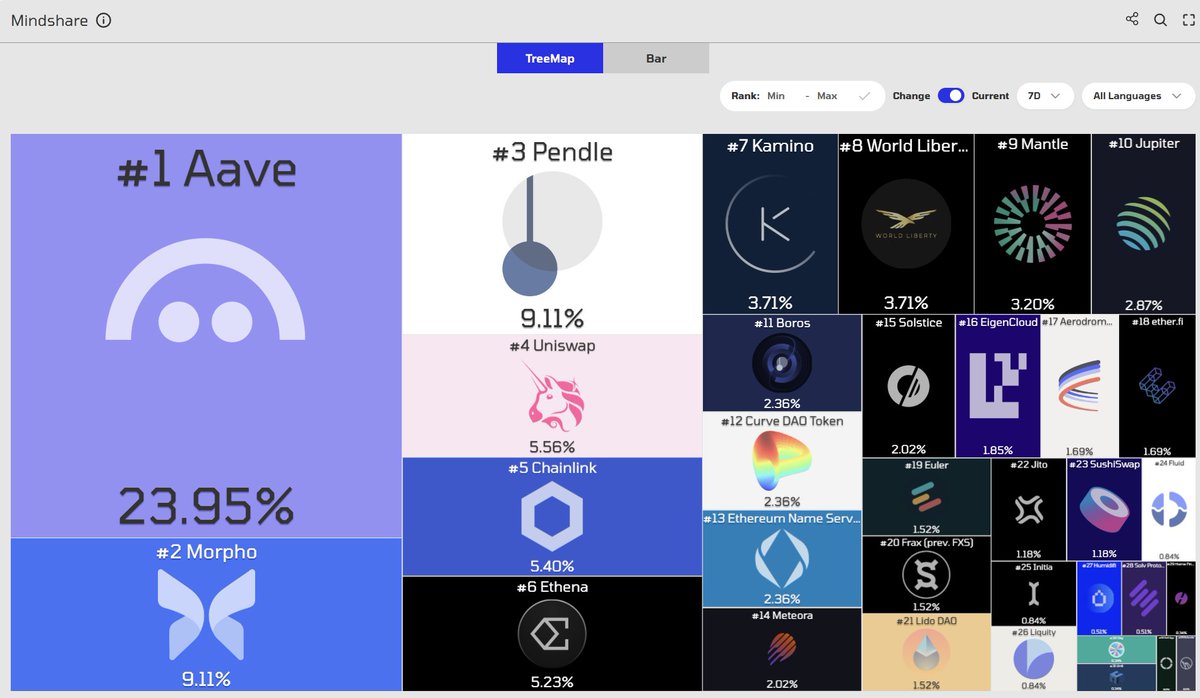
AAVE, Morpho, and Pendle are the DeFi projects with the highest mindshare.
What's interesting is that the top 6 apps have all been born on Ethereum.
English
Daninomics.eth retweeté

Proof of work turns AI and quantum into threats.
Proof of stake turns AI and quantum into opportunities.
The future infrastructure layer for the world - Ethereum - is future-proof via proof of stake.
Etherealize@Etherealize_io
Vitalik Buterin explains why proof-of-stake is more secure than proof-of-work “I think proof of stake is very secure because to attack the system, you need to have basically as much stake as the rest of the network. Right now, for example, we have 5 million ETH staking, which means you have to come up with 5 million ETH and then join the network.” At the time of this writing, more than 37 million ETH are being staked, with 3 million ETH waiting to join via the validator queue. At today’s prices, that’s more than $80 billion of ETH someone would have to acquire to attack the network and revert finalized blocks, which is more than the cost of attacking even the Bitcoin network by some estimates. The other defense mechanism that proof-of-stake has that proof-of-work doesn’t is slashing, which makes Ethereum antifragile. Vitalik explains: “Recovering from attacks is much easier in proof-of-stake than proof-of-work. For many kinds of attacks you do against [the Ethereum] network, we have this concept of automatic slashing. In order to revert a finalized block, you basically have to have a big portion of your validators sign two conflicting messages. This is something where once these messages are on the network, you can go and prove ‘these people did it.’ So we have this feature in the protocol where you basically take all these people who provably misbehaved and you burn their coins.” Vitalik also acknowledges the possibility of censoring attacks, where if 1/3rd of validators refuse to attest, the chain can’t finalize. But, as he explains, Ethereum has a contingency plan for this as well: “Everyone who got censored would create a minority chain, and the community would have to do a soft fork. The would have to say, ‘this chain is clearly attacking us and this one is not attacking us, so we’re going to join this chain.’ Then what happens is, on that new chain, the attackers also lose a lot of coins. The difference between proof-of-stake and proof-of-work is that in a proof-of-stake system, you can identify specific participants — and this isn’t a human going in and saying ‘I don’t like you’. It’s all automated.” One last benefit of proof-of-stake is that security scales with the value of the network. As Vitalik put it five years ago, it is really relative security, and not absolute security, that matters: “The security needs of a thing have to be proportional to the size of that thing, because as a thing gets bigger, its enemies become bigger and more well-motivated. If BTC were 100x as big as it is today, the value from destroying it would be 100x higher, and the kinds of actors that would want to care about destroying it would be much bigger and scarier. This is also why countries of all sizes have roughly similarly sized militaries as a percentage of GDP. Hence, cost of attack divided by market cap really is the correct statistic to measure, and in the long run issuance-free PoW really does look not that good." Source: @lexfridman (Jun 2021)
English

@daninomicseth Mañana se sube a las 18h hora española!!!!
Español
DESPUÉS DE HACER A F3 SIN UNA SOLA BAJA
DESPUÉS DE HACER A LANTO CON UN SOLO POKÉMON
DESPUÉS DE DEMOSTRAR QUE DELCATTY ES EL MEJOR POKÉMON DEL Z
VOLVEMOS CON OTRO DIRECTO PARA DAR CÁTEDRA
twitch.tv/profesornuzloc…
Español

Daninomics.eth retweeté

Here's how this is going to go.
1. ETH staking ETFs take off
2. People remember investors REALLY love yield
3. Ethereum recognizes it must deliver real yield
4. Roadmap reorients to producing fees
5. Only way to do that is attract apps and scale L1
6. Winning
Luke Martin@VentureCoinist
BlackRock Head of Digital Assets says the new ETH staking ETF is the silver bullet for institutional investors The initial launch of their Ethereum ETF was already the 3rd fastest ETF in history to reach $10B in aum $ETH up 17% in the past week outpacing BTC
English
Daninomics.eth retweeté

Daninomics.eth retweeté

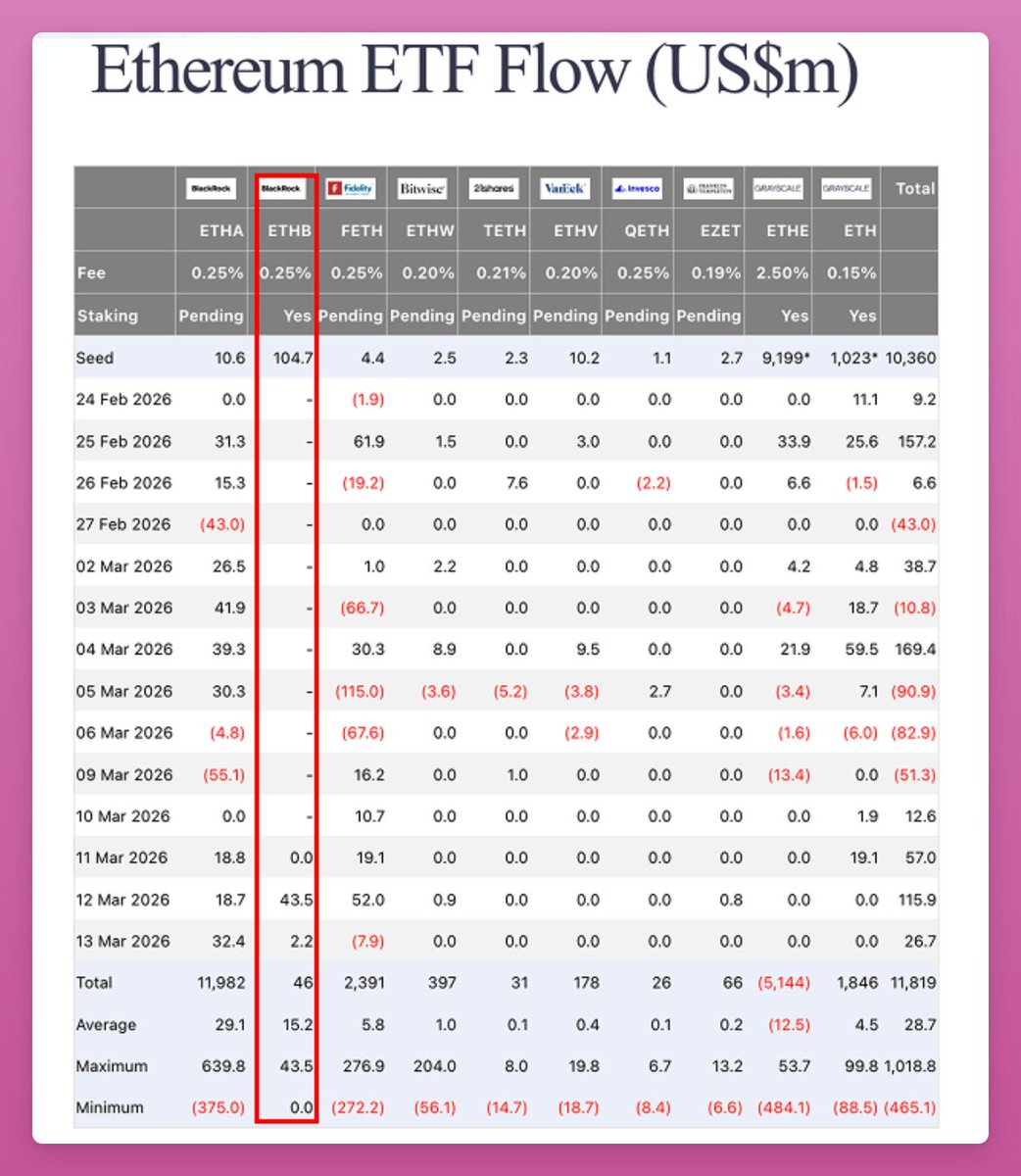
ETH staking ETF launched with $46M USD of inflows in 2 days.
Quite surprising how silent CT was about the news.
ETHB holds spot $ETH and stakes 70-95% of it via Coinbase.
Investors receive 82% of staking rewards as monthly cash dividends: ETH is sold and yield is paid in USD.
So no compounding inside the fund. Perhaps attractive for whales who want to live off the yield.
BlackRock and Coinbase keep the remaining 18%.
Fee is 0.25%, waived to 0.12% for the first year or until the fund hits $2.5B AUM.
------
So why would you hold ETHA, which doesn't offer staking rewards?
AFAIK, BlackRock created a separate product instead of adding staking to ETHA, likely because staking adds slashing risk and some investors want to avoid that.
English
Daninomics.eth retweeté
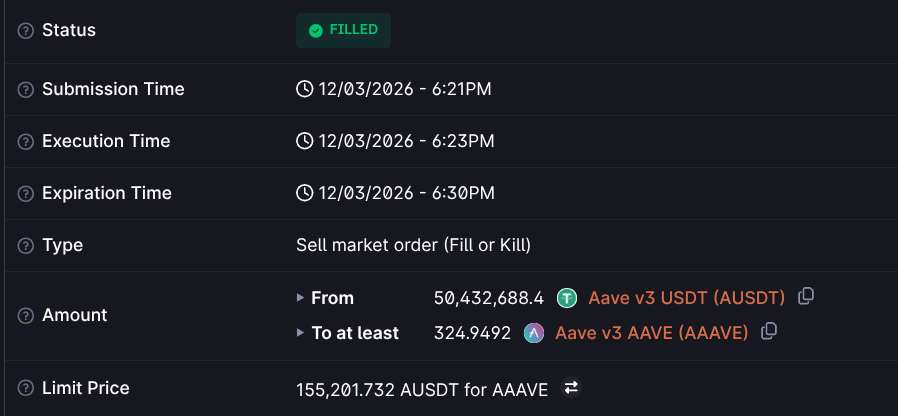
Whale losing $50m on Aave proves DeFi on mobile sucks.
If he’d just used Binance and even fat-fingered an $AAVE market order, he’d be okay.
Instead, he withdrew 50m from Binance, deposited to Aave, and 20days later swapped on Aave.
Easy to say "just use Llamaswap" but where is Llamaswap iOS app?
Binance mobile app is flawless. I use CEXs on mobile instead of PC. Easier.
But DeFi?? Only on PC. Because you need to connect hardware wallets or/and multisig to do transactions.
Sure, there are mobile apps like Rabby and Metamask for native swaps but they are 1) cumbersome 2) you are forced to hold private keys on mobile 3) swap fees are outrageous compared to Binance and 4) features on mobile are limited.
Hot take: Hot wallet on mobile is probably worse security than funds on Binance/Coinbase/Kraken.
Finally, DeFi feels like it was built by Westerners to Westerners.
So many people outside the US & Europe use mobile-only for most daily activities. PC just at work, in the office.
Actually,... feels like the younger generation is turning mobile-only as well.
Thus for DeFi to reach mainstream, we must make it mobile-friendly too.
English

✨He empezado a trabajar en el "Parche de Agradecimiento" de Pokémon Z
👉Será la primera actualización con contenido nuevo.
Muchas gracias a todos por hacerlo posible con el enorme recibimiento que ha tenido el juego.
Mucho mayor de lo que yo nunca esperaría.

Español
Daninomics.eth retweeté

someone just swapped $50m for $36k on cowswap through aave's frontend, effectively losing 50m
if you try to make this swap on llamaswap the UI won't let you at all, buttons get locked
we've spent years building a price API with the highest coverage of defi tokens to avoid this
English
Daninomics.eth retweeté

Controversial opinion: The biggest reason for the massive disconnect between crypto prices and crypto adoption is that 4 of the top 5 assets (by market cap) are largely uninvestable.
$BTC
- The quantum fear is not going away (even though it's a fairly easy technical fix, it's a much harder governance fix)
- It's not cool to own BTC now that blackrock and JP Morgan dominate it (see rise in $ZEC)
- It's not digital gold (in fact, actual tokenized gold exists)
- It's not scarce (endless derivs and structured products make the 21mm cap useless unless people start using physical bitcoin, which no one does).
- It's not an inflation hedge
- It's not a medium of exchange (stablecoins are)
$ETH & $SOL
- high inflation outweighing any fee capture (this is why market cap goes up while price goes down)
- Infinite blockspace relative to usage, with more L1 competition coming
- Fat protocol thesis on life support (and other than that thesis, no one has ever made a good argument for why L1s actually capture value)
- You need ~1000x more activity / transactions to warrant today's valuations (meaning SOL and ETH are not worthless, it's just VERY hard to justify their current valuations).
(For the record, I'm bullish on both Solana and Ethereum's prospects for further growth (relative to other L1s), I just don't think their tokens capture much value from that growth).
$XRP
- Literally the opposite of good token design. The token does absolutely nothing, and has virtually no linkage to Ripple
- Ripple sells ~$3-4 billion of XRP tokens per year to fund equity repurchases (people argue all day about the efficacy of token buybacks, yet no one seems to care that Ripple dumps tokens to buyback their own stock?)
This is why crypto is so broken. The entire industry was built on 4 assets that all suck as investments, which is why all of the exchanges and brokers cater only to fast money traders and macro funds/CTAs instead of real fundamental investors (even though fundamental investors make up the majority of the investor world).
Of these 4 assets, I'd say i'm most likely wrong about $BTC simply because it is entirely narrative/faith based, and that can change on a dime, plus BTC always goes up eventually. I find it impossible to underwrite Bitcoin as an investment, but I do understand why others like it.
Can this change? I hope so. It's very hard for an industry to grow when the top assets go down, but not impossible. It would require massive rotation (which is what we're seeing in equities right now -- a rotation out of Mag 7, private credit, and tech and into healthcare, energy, etc).
IMO, there are a LOT of good crypto investments right now that accrue value via the adoption of crypto and blockchain. Aligning your investments with the actual growth areas should work. Almost all of the growth and adoption of crypto and blockchain is happening in 3 financial areas:
1) Stablecoin/payments - harder to invest in pure plays, but there are some private stocks
2) DeFi -- tons of ways to capture this growth via equity-like tokens
3) RWA tokenizaton - while most of this value accrues to middlemen like Securitize and Blackrock, there are some pure plays as well.
If this industry pivots away from BTC ETH SOL XRP and memecoins, and into the stocks and equity-like tokens that fuel the growth of DeFi, payments and RWAs, then price will start matching adoption.
English

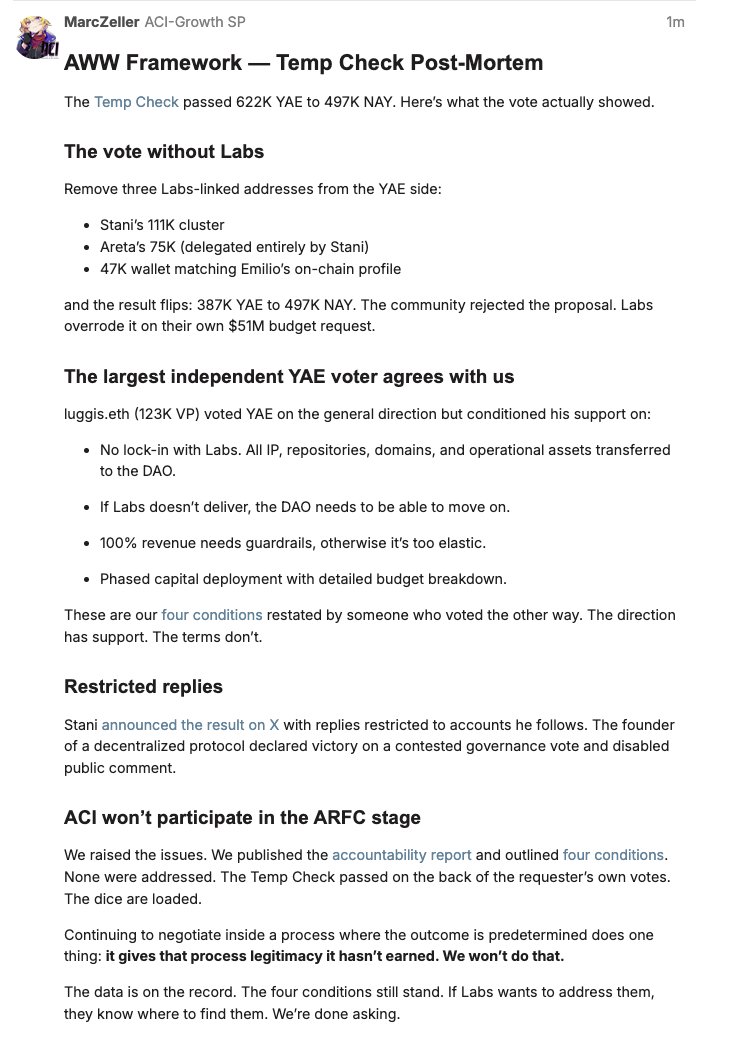
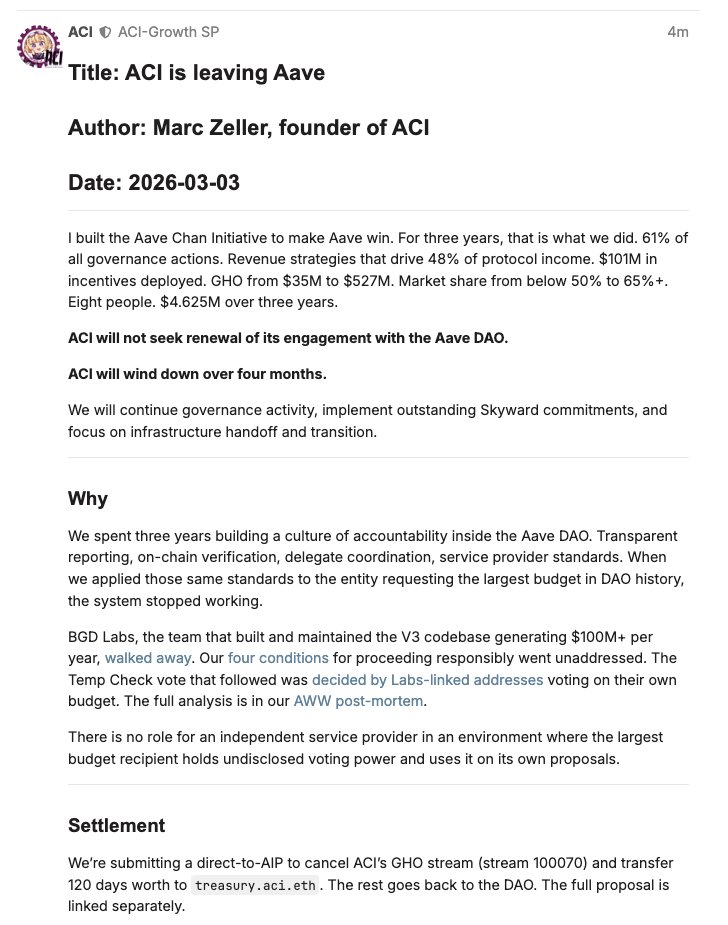
DAOs are out.
Top-down decision making for fast execution & product is in.
We’re going through a major regime shift in the industry and it’s not going to be the smoothest transition. Welcome to the new reality — we will persist and come out the other side stronger, it’s just going to look a lot different than before.
Stay optimistic.
Marc Zeller@Marczeller
Who is John Galt? governance.aave.com/t/aci-is-leavi…
English
@Marczeller Im in shock. I undestrand why, but im in shock
English

Daninomics.eth retweeté