Base@0xBaseee
Why @variational_io points will be worth $100 — full thesis.
Before we start, bookmark this so you don't lose it later.
Let's do the math first:
Points distribution runs until end of Q3, per the docs.
That means ~9M points at TGE.
I expect a 25-30% genesis drop. Why?
The team has repeatedly praised how well Hyperliquid rewarded its community, and with 50% of total $VAR supply reserved for community rewards, dropping less than Lighter (25%) wouldn't make sense if Variational wants to be the first real Hyperliquid competitor long-term.
So, to hit $100 per point at launch, $VAR needs a $900M market cap — or $3-3.5B FDV.
Why do I think that's achievable?
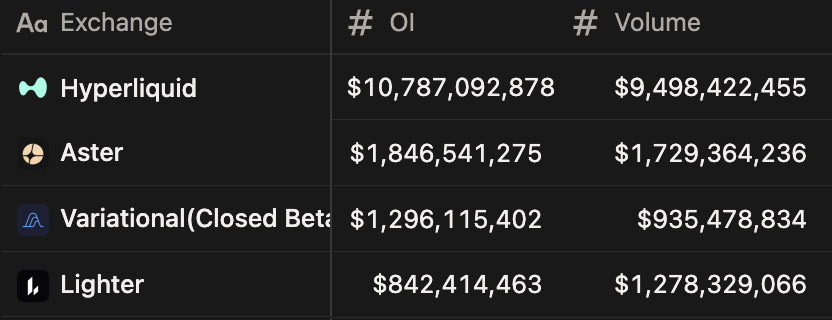
Let's compare it to a direct competitor: $LIT, trading at $2.5B FDV.
Variational already beats it on both core metrics:
→ Open interest: $1.26B vs. $880M
→ Net revenue: $1.27M vs. $860K (bi-weekly)
That's 40%+ better than Lighter — on both fronts.
And here's the thing: APIs aren't even live yet.
No bots, no market makers, no quants.
Just manual traders.
Variational is still in private beta (invite-only) and months away from TGE.
Phase 2 & 3 of RWAs haven't even launched — thousands of new RWAs and drastically reduced slippage are still ahead.
So there are still countless catalysts left that could significantly grow current metrics before TGE even happens.
But let's stay conservative.
Even if $VAR launched today, its metrics alone justify a $3.5B FDV — 40% higher than $LIT's $2.5B valuation, matching how much Variational outperforms Lighter in open interest and net revenue.
That would value $VAR at ~5% of $HYPE.
For perspective: when $LIT launched last year, it was worth 10% of $HYPE.
That means:
→ The whole perp dex sector is growing fast.
→ $VAR wouldn't be overvalued at $3.5B.
$100 per point doesn't sound so crazy anymore, right?
And I don't think it stops there.
Sure, it could dip or consolidate post-TGE like most airdrops do.
But that doesn't change the long-term picture.
Variational is taking on-chain RWAs to a new level.
Instead of building a new orderbook and bootstrapping liquidity per RWA market (like CLOB DEXs such as Hyperliquid), Variational plugs directly into existing TradFi liquidity.
TradFi has spent decades building deep orderbooks.
Why compete with that when you can tap into it instead?
This lets Variational skip the costly market-maker incentive game — and scale to list far more RWA markets, way faster.
TradFi liquidity isn't even live yet (coming soon in Phase 2). And already, 25% of current open interest comes from RWAs alone.
That ratio only grows once TradFi liquidity gets injected and thousands of new RWA markets go live — positioning Variational as the venue for price discovery on weekends, off-hours, holidays, and beyond.
Variational was never a cheap Hyperliquid clone.
It's actually the first real competitor to Hyperliquid for RWA market share — with a model that scales better.
And the team is more than stacked to execute on this vision.
@variational_lvs, CEO of Variational, studied mathematics at a top US university — at age 12.
He moved to Columbia at 18, worked at Google and Goldman Sachs, then co-founded quant trading firm Qu Capital in 2017 with @edward_yu_var (co-founder of Variational).
Beyond the founders, the team brings experience from Google, Meta, Virtu, IMC, and Jane Street.
A product is only as good as its team — and Variational is stacked on both ends.
If this doesn't have you FOMOing into points, you must hate money.
~10 weeks left until points distribution ends.
APIs aren't live yet. Use this opportunity to stack as many points as you can.
You'll regret not acting on this in a few months.
An invite code is required to access the private beta — so you might as well use the one with the best perks.
Code OMNIBASESOL gives you the highest available points boost (15% instead of the usual 12%): omni.variational.io/?ref=OMNIBASES…