Andrea | Devrelius

8.2K posts

Andrea | Devrelius banner
Andrea | Devrelius

Andrea | Devrelius

@devrelius

president & CPO @StoryProtocol. prev. conversational AI at @amazon, Dapper Labs/Flow

Global Inscrit le Mart 2017
1.4K Abonnements10.2K Abonnés
Tweet épinglé
Andrea | Devrelius
Andrea | Devrelius@devrelius·
Today I'm excited to announce a new chapter of Story: Chapter 2. Chapter 1 was about laying the tech foundations: building a purpose-built L1, the programmable IP protocol, and proving out early use cases. >200k+ IPs later, including some of the most iconic IPs in the world, we achieved that. But there's still so much to do. Chapter 2 is about addressing the most pressing needs of the next decade when it comes to data, IP and AI. My theses: >> 1. real world data is now the biggest bottleneck of AI. I'm hearing left and right in convos with AI companies that now that the internet is scraped, the next frontier is *real world data*. this type of data can't be crawled like regular online content. It's scarce, it's personal, and it's a new form of IP that the biggest AI companies are all scrambling for. Data providers deserve to be compensated when their data trains the next autonomous robot, and Story will be the data layer that makes this possible. More to come on this very soon. >> 2. the world's biggest IP needs to be set free, not locked away. we started with the top music in the world (e.g. Justin Bieber, Selena Gomez, Black Pink, BTS, ...). The breadth and scope of the $70T IP market is SO vast that we have lots more work to do! By bringing the best IP onchain, we make it easier for the world to remix, turn it into a liquid asset class, and as a result easier to monetize. >> 3. we need to flip the licensing model on its head. remixing is human nature. Remember the studio ghibli moment? This is culture now: instant, viral and unstoppable...(and theoretically illegal!) people create first, ask permission never. I believe the future isn't about preventing/stopping natural behavior, it's about brands being smart enough to embrace viral moments with modern tools to retroactively license great content. We're building that. More to come on this too. This isn't just about disrupting this archaic system. It's about accepting that the world has fundamentally changed: AI will remix everything, creators will mash up whatever they want, IP has to evolve and adapt to this, not the other way around. I strongly believe we can build a world where creation is permissionless but still profitable and sustainable. Where AI companies pay for the precious real-world data they train on. Where the default reaction to IP use is not a DMCA takedown or a cease and desist, but a new monetization opportunity that is win win for both the IP holder and the creator. All of this will be made possible on Story. Much more to come. Very packed rest of the year.
Story@StoryProtocol

Chapter 2 starts today. AI's next leap isn't about bigger models. It's about IP and its most valuable category: Real-world Data. Story is building the AI-native infrastructure for this $70T IP economy. Here’s what’s ahead ↓

English

216
19
413
33.2K
Andrea | Devrelius
Andrea | Devrelius@devrelius·
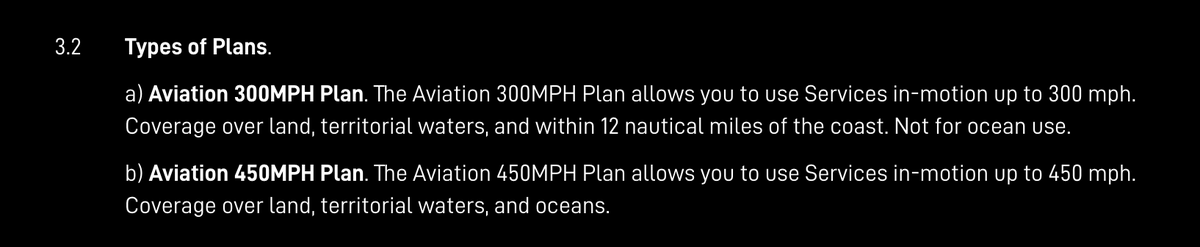
So i just bought residential starlink, and i went down a rabbit hole and looked up the terms and conditions. I accidentally found the "Starlink Aviation" terms of service...and found 2 interesting things: 1. they offer two plans: 300mph (within 12 miles of the coast) and 450mph (with ocean crossings). Cool! 2. their aviation service clearly states it is NOT designed for aviation LMAO. Here's from their Starlink Aviation T&Cs: "YOU EXPRESSLY ACKNOWLEDGE, UNDERSTAND AND AGREE THAT THE STARLINK KIT AND SERVICES (A) HAVE NOT BEEN DESIGNED FOR USE ON AIRCRAFT; AND (B) HAVE NOT BEEN CERTIFIED OR OTHERWISE APPROVED FOR USE ON AIRCRAFT BY THE FEDERAL AVIATION ADMINISTRATION OR ANY OTHER CIVIL AVIATION AUTHORITY."
Andrea | Devrelius tweet mediaAndrea | Devrelius tweet mediaAndrea | Devrelius tweet media
English
3
0
18
777
Andrea | Devrelius
Andrea | Devrelius@devrelius·
been thinking a lot about how full teams operate with AI and wanted to share a \thought on how orgs can be more "institutional ai" (as a16z puts it). every product idea, even just a few words, should trigger a full agent pipeline: brainstorm, architecture, build, market, deploy. all async. humans (functional experts) only step in at key decision points to review, pick between options, and steer. like vibe coding but for the entire product lifecycle. technically nothing stops a small team from going from idea to deployed app in a day. the bottleneck isn't building anymore.. it's building the right thing. to build the right thing you often different people at key decision points to give feedback. so the human role shifts to creativity, taste, and product sense. everything else is AI. i'm bearish on fully autonomous agent pipelines tbh. without humans, agents go off on random tangents. you don't need AI to be a visionary, you need it to be reliable and sensible (two things AI is generally good at). humans are still the spark. they're just not the engine anymore. cursor/lovable/claude code/codex gave us HITL for coding. what's the equivalent for ideation -> validation -> go-to-market -> deployment -> socials -> marketing -> growth -> etc. the new standup is checking in on what your agents built overnight. the new sync is reviewing options and steering. the new org chart is the right people reviewing entire pipelines at the right time, from their area of expertise, like appointed code reviewers approve PRs on github today. So designers steer/approve brand identity, marketers steer/approve marketing copy, engineers steer/approve architecture, and so on. we're not far from this, and i'm sure some tools are already emerging that offer some parts of this. I'd love to know which ones so i can try them out, as we build our own.
a16z@a16z

“In 2026, AI is driving a 10x increase in the productivity of the individuals who know how to leverage it. But that’s not enough. We’ve swapped the motor; we have not yet redesigned the factory.” Hebbia CEO George Sivulka explores why AI’s biggest impact will be more transformational than additive — rewiring how companies get work done entirely.

English
2
0
11
571
Andrea | Devrelius retweeté
Story
Story@StoryProtocol·
Did we just become best friends @VitalikButerin ? x.com/vitalikbuterin…
vitalik.eth@VitalikButerin

I was recently at Real World Crypto (that's crypto as in cryptography) and the associated side events, and one thing that struck me was that it was a clarifying experience in terms of understanding *what blockchains are for*. We blockchain people (myself included) often have a tendency to start off from the perspective that we are Ethereum, and therefore we need to go around and find use cases for Ethereum - and generate arguments for why sticking Ethereum into all kinds of places is beneficial. But recently I have been thinking from a different perspective. For a moment, let us forget that we are "the Ethereum community". Rather, we are maintainers of the Ethereum tool, and members of the {CROPS (censorship-resistant, open-source, private, secure) tech | sanctuary tech | non-corposlop tech | d/acc | ...} community. Going in with zero attachment to Ethereum specifically, and entering a context (like RWC) where there are people with in-principle aligned values but no blockchain baggage, can we re-derive from zero in what places Ethereum adds the most value? From attending the events, the first answer that comes up is actually not what you think. It's not smart contracts, it's not even payments. It's what cryptographers call a "public bulletin board". See, lots of cryptographic protocols - including secure online voting, secure software and website version control, certificate revocation... - all require some publicly writable and readable place where people can post blobs of data. This does not require any computation functionality. In fact, it does not directly require money - though it does _indirectly_ require money, because if you want permissionless anti-spam it has to be economic. The only thing it _fundamentally_ requires is data availability. And it just so happened that Ethereum recently did an upgrade (PeerDAS) to increase the amount of data availability it provides by 2.3x, with a path to going another 10-100x higher! Next, payments. Many protocols require payments for many reasons. Some things need to be charged for to reduce spam. Other things because they are services provided by someone who expends resources and needs to be compensated. If you want a permissionless API that does not get spammed to death, you need payments. And Ethereum + ZK payment channels (eg. ethresear.ch/t/zk-api-usage… ) is one of the best payment systems for APIs you can come up with. If you are making a private and secure application (eg. a messenger, or many other things), and you do not want to let people to spam the system by creating a million accounts and then uploading a gigabyte-sized video on each one, you need sybil resistance, and if you care about security and privacy, you really should care about permissionless participation (ie. don't have mandatory phone number dependency). ETH payment as anti-sybil tool is a natural backstop in such use cases. Finally, smart contracts. One major use case is _security deposits_: ETH put into lockboxes that provably get destroyed if a proof is submitted that the owner violated some protocol rule. Another is actually implementing things like ZK payment channels. A third is making it easy to have pointers to "digital objects" that represent some socially defined external entity (not necessarily an RWA!), and for those pointers to interact with each other. *Technically*, for every use case other than use cases handling ETH itself, the smart contracts are "just a convenience": you could just use the chain as a bulletin board, and use ZK-SNARKs to provide the results of any computations over it. But in practice, standardizing such things is hard, and you get the most interoperability if you just take the same mechanism that enables programs to control ETH, and let other digital objects use it too. And from here, we start getting into a huge number of potential applications, including all of the things happening in defi. --- So yes, Ethereum has a lot of value, that you can see from first principles if you take a step back and see it purely as a technical tool: global shared memory. I suspect that a big bottleneck to seeing more of this kind of usage is that the world has not yet updated to the fact that we are no longer in 2020-22, fees are now extremely low, and we have a much stronger scaling roadmap to make sure that they will continue to stay low, even if much higher levels of usage return. Infrastructure for not exposing fee volatility to users is much more mature (eg. one way to do this for many use cases is to just operate a blob publisher). Ethereum blobs as a bulletin board, ETH as an asset and universal-backup means of payment, and Ethereum smart contracts as a shared programming layer, all make total sense as part of a decentralized, private and secure open source software stack. But we should continue to improve the Ethereum protocol and infrastructure so that it's actually effective in all of these situations.

English
40
23
146
11.8K
rauno
rauno@raunofreiberg·
@awashuta Yeah I haven't solved long messages yet. My thinking is that the item needs to be truncated to be a reasonable size in the list, but then somehow grow to morph into the full size message...
English
3
0
9
1.1K
rauno
rauno@raunofreiberg·
Conversation minimap for the new Vercel Support chat interface
English
49
55
1.4K
108.5K
Andrea | Devrelius
Andrea | Devrelius@devrelius·
How to be an AI: option + shift + hyphen
English
2
0
11
359
Story
Story@StoryProtocol·
it's Monday
Story tweet media
English
82
34
198
7.8K
razornero.ip 𒀭
razornero.ip 𒀭@Danzeronero·
Story Protocol is quietly building the future of AI-native IP infra 🔥 Portal v2 live: slick UI, integrated explorer, mobile glow-up → discover/register IP effortlessly CPO (@devrelius) on @IBM podcast: trust layers for human data in AI scaling (transparency + royalties) @genobank_io on Story: patients license genomic data for revenue → real patient-owned medicine Remixing K-pop via @Aria_Protocol on Story's programmable IP Real-world data = critical IP. This is how creators & humans get paid in the AI era. What next on @StoryProtocol ?
razornero.ip 𒀭 tweet media
English
6
0
17
259
Story
Story@StoryProtocol·
. o ○ ╭◜◝ ͡ ◜ ͡ ◜◝ ◜ ͡ ◝ ◜ ╮ ( real-world data is ) ( critical IP ) ╰◟◞ ͜ ◟◞◟◞ ͜ ◟◞ ͜ ◞ ╯
Indonesia
78
37
203
11K
Andrea | Devrelius
Andrea | Devrelius@devrelius·
Great to see Story on there. we've been pioneering how agents interact since 2024 starting with our research on Agent TCP/IP because we knew it was the future. We were also the first to demonstrate two agents engaging in a complex transaction, ie licensing each other's training data using Story's programmable IP license. We were the first team to hire an agent, Luna, to run our twitter account for a week (paid gig!), and we were also one of the first teams to have a section of our docs entirely dedicated to agents to consume and learn how to build on Story via MCP. In other words, we have been agent-native for more than a year at this point. We also launched skills and a whole LOTS more cooking!
Lucas@OnchainLu

btw 68 companies have been submitted via x402 and added to agenticpayments.artemisanalytics.com pivot to agentic commerce (if u haven't already)

English
23
19
102
6.6K
Andrea | Devrelius retweeté
jacob
jacob@jacobmtucker·
AXO (Agent Accessibility Optimization) is a new standard that outlines how *usable*, not just discoverable, websites are → "Can an agent easily subscribe to my platform?" → "How many tokens are burned when an agent views my homepage?" Coming soon to axoscore.com
English
5
2
38
785
Sirada
Sirada@sirada_l·
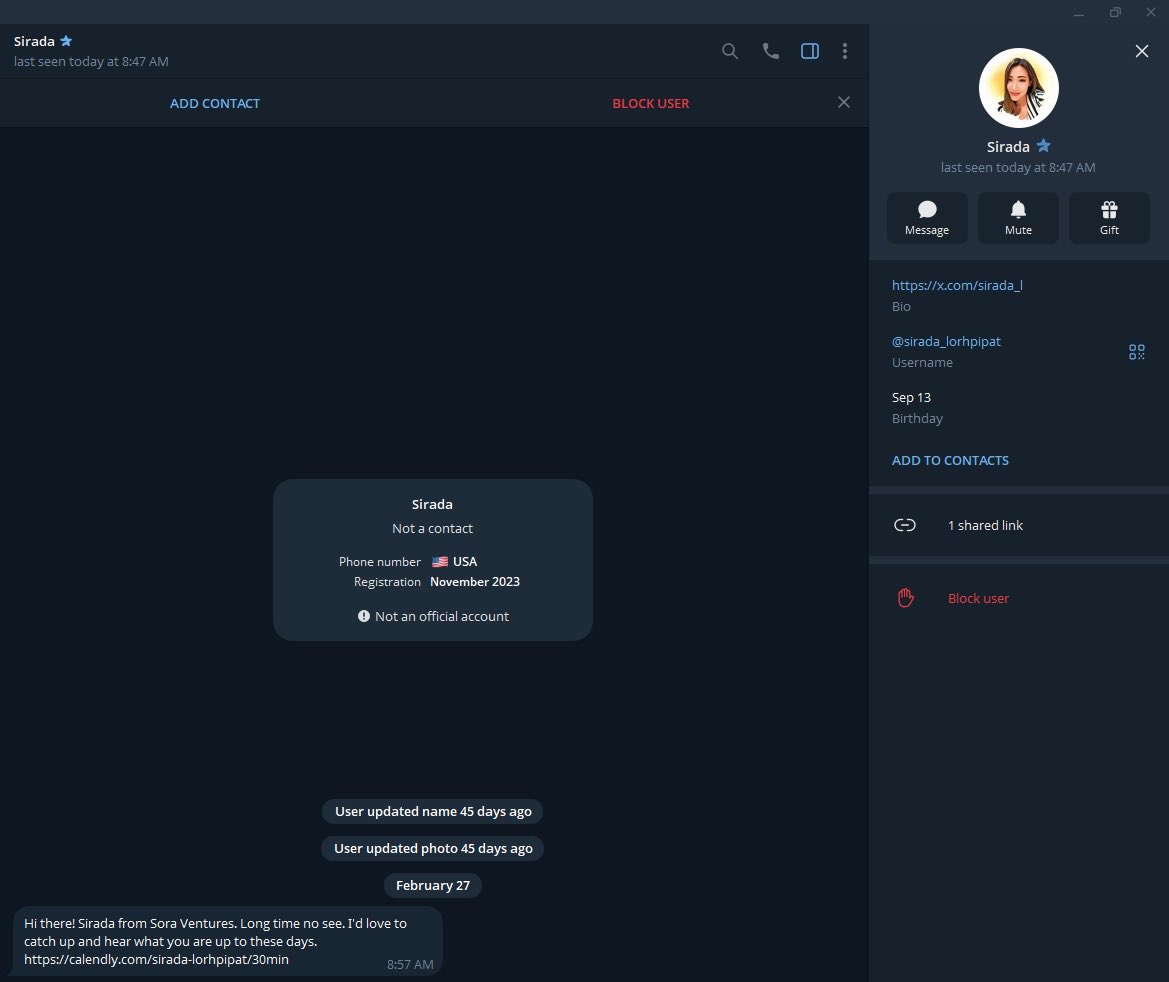
Another fake tg, don’t click any links from this account
Sirada tweet media
English
1
0
4
462
Sirada
Sirada@sirada_l·
Shifted to a new Telegram account (different from my X handle). If you’re unsure whether a message is from my real account, DM me on X to verify. Stay safe from scams (aka fake Sirada).
English
20
0
45
4.2K
AriannaSimpson.eth
AriannaSimpson.eth@AriannaSimpson·
So many interesting ideas to explore at this intersection. One such example: crypto is great at using incentives (i.e. $) to get people to do something, and AI companies are incredibly data-hungry. If you can use crypto incentives to get people to collect a novel, high-quality data set, there is pretty much endless demand from the AI market to buy it.
niko@saintniko

if you’re in ai, pivot to ai x crypto

English
67
12
275
51.8K
Andrea | Devrelius
Andrea | Devrelius@devrelius·
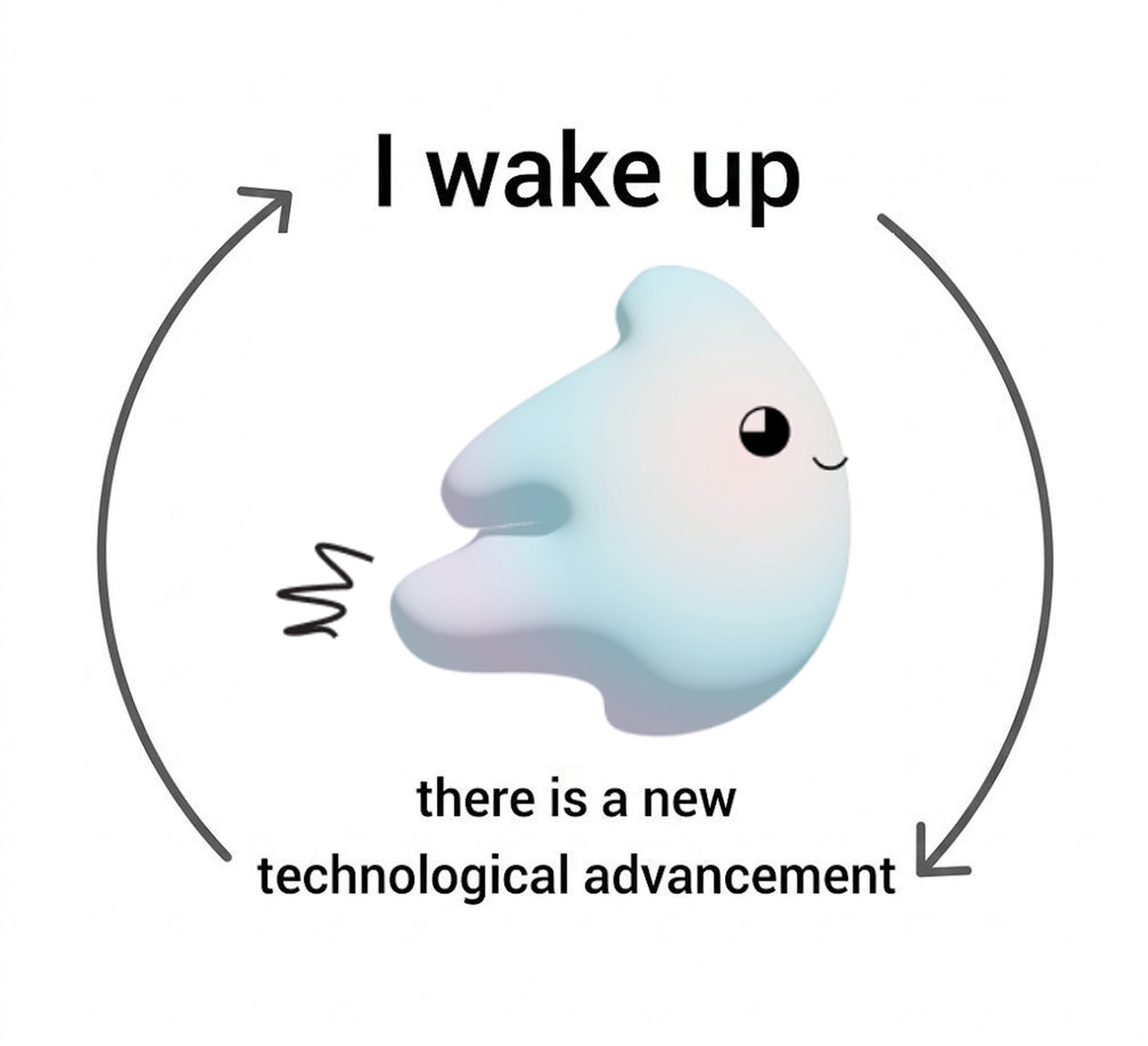
when you find a suggestion in AI that's months old
Andrea | Devrelius tweet mediaAndrea | Devrelius tweet media
English
1
0
10
402
Andrea | Devrelius retweeté
Story
Story@StoryProtocol·
If your friend group isn't discussing: ▸ Claude Code vs Codex ▸ Recursive self-improvement loops ▸ How to pronounce “n8n” Then you need a new friend group. Or you can join @StoryEngs for Local Host 3000. Live in 1 hour ↴
Story Engineers@StoryEngs

New to your vibe-coding journey? Tired of seeing "we're cooked" / "it's so over" all over the TL? → Join us for Local Host 3000 in 1 hour ← We got you covered on all the basics you need. Let's explore error-handling together ↓

English
23
32
154
15.2K
James Shields
James Shields@scaling_shields·
i watched a flight go from $483 to $547 in 24 hours WITHOUT a single seat selling searched london to new york on a tuesday $483 checked again 2 hours later $512 next morning: $547 panicked and booked it the guy sitting next to me paid $391 same seat, date + airline $156 less he searched once i searched 3 times the algorithm saw me come back and charged me until i broke the seat doesnt have a price you have a price and it goes up EVERY time you show interest couldnt stop thinking about it so i tracked down someone who actually built pricing algorithms for a european carrier asked him what happened to me "you got profiled. the system assigned you an intent score after your second search and raised your ceiling every time you came back" asked how to beat it "most people think a VPN fixes it. thats 2015 advice. the algorithm fingerprints more than your IP now. it reads your device your browser your screen resolution your timezone. VPN to bucharest but your clock says london and your language is english? the algo knows youre faking and sometimes charges you more for trying" "so what actually works?" "you have to poison the entire profile. not just the location. the identity" the protocol he gave me: VPN AND match your timezone and language to the spoofed location. mismatched signals flag you and can trigger a price increase use a fully clean browser. no history no saved passwords no google account. the algorithm fingerprints your session not just your cookies one search one booking. the intent score activates on the second search. there is no safe way to look twice book tuesday or wednesday 1-5am. lowest traffic means the least demand data for the algorithm to inflate against if the price already spiked go dark for 72 hours minimum. not 24. the intent score on most carriers decays on a 3 day cycle. come back on a different device from a different network "we spent $4 billion building these systems. theyre not going to lose to someone who opened an incognito tab" $900 billion industry the gap between what you pay and what the person next to you pays is not a bug its the entire business model stop letting an algorithm charge you for being predictable
English
1.1K
5.8K
35.1K
4.1M