Tweet épinglé

What is Directional Systems Theory?
It started with a simple problem:
pressure enters too fast.
A comment.
A task.
A conflict.
A deadline.
A feeling.
A signal.
A demand.
Something enters the system before the system has enough room to read it.
So the first question is not:
What should I do?
The first question is:
What just got in?
That is where DST begins.
Permeability:
how much pressure enters.
Filtering:
what gets sorted, softened, delayed, rejected, or kept.
Gating:
what gets admitted into the system.
Neutrality:
the uncommitted space before reaction.
Slack:
the reserve that keeps pressure from choosing the route for you.
Exit cost:
what it costs to leave, switch, disagree, stop, repair, or change direction.
Residue:
what remains when burden never finds release.
Most people talk about choices like they are visible options.
DST asks whether those options are usable under load.
Can you actually move?
Can you pause?
Can you ask?
Can you leave?
Can you repair?
Can you switch?
Can you recover?
Can you return without snapback?
That is the difference between apparent freedom and usable freedom.
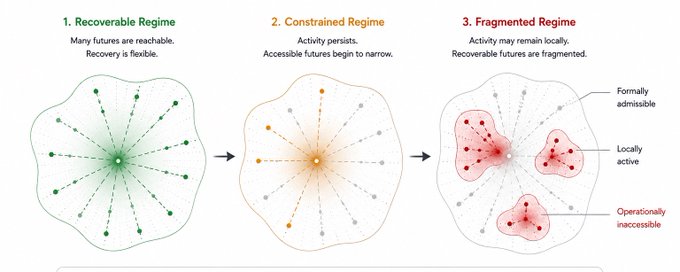
D_app is what looks possible.
D_true is what can actually be executed, held, recovered, and repeated under pressure.
Most collapse begins in the gap between them.
The door is visible.
The exit is unaffordable.
The route is named.
The burden cannot survive the path.
DST studies that gap.
It asks how systems preserve or lose usable futures under load.
Not just people.
Relationships.
Jobs.
Institutions.
Markets.
Theories.
Games.
Information systems.
Cultures.
Bodies.
AI.
Anything that has to keep moving while pressure changes what movement costs.
The simplest version:
DST is about what remains usable after pressure arrives.
The practical version:
DST teaches you to protect the route before obsessing over the outcome.
The sharp version:
A system fails when motion loses exits.
English