George Anadiotis

5.3K posts

George Anadiotis banner
George Anadiotis

George Anadiotis

@linked_do

Analyst, Consultant, Engineer, Founder, Researcher, Writer. Got Tech, Data, AI and Media, and not afraid to use them.

Athens, Greece Inscrit le Ocak 2014
1.3K Abonnements2.3K Abonnés
Tweet épinglé
George Anadiotis
George Anadiotis@linked_do·
Pragmatic AI Training: A Progressive Framework for AI Mastery The journey from AI Literacy to AI Proficiency starts before taking the first step. It starts by meeting people where they are, and finding the right map and companions. Pragmatic AI has been developed and honed over the course of years, built on a set of guiding principles, and validated by organizations such as the German Agency for International Cooperation (GIZ), the International Organization for Migration (IOM), and GC Europe, a leading oral health company. Its pillars: 🧠 You don’t have to be a data scientist to benefit from AI. People who understand AI broadly and can apply it flexibly thrive. This is Pragmatic AI 📚 Start with AI Literacy, and move towards AI Proficiency 👥 Learn the first principles of data and AI, build on a coherent progression and stay up to date applying transferable skills and tools 🙌 Adapt to individual needs and organizational settings, and leverage opportunities for feedback, networking, and follow-up ⚖️ Develop systems that are trustworthy, ethical, and beneficial to society 🎯 The Seven Principles of Pragmatic AI: Foundational. Evolutionary. Practical. Sustainable. Contextual. Interactive. Responsible. This is not a "learn how to prompt", a "buy subscriptions, burn tokens, run agents", or a "build neural networks with Python" course. Pragmatic AI is for Consultants | Creatives | Entrepreneurs | Executives | Managers | Solopreneurs who want to use AI and lead AI initiatives without becoming data scientists or writing code. What it covers: * Data Science and Machine Learning Fundamentals * Advanced Machine Learning, Natural Language Processing and GenAI * Data Modeling, AI Governance, Regulation, Ethics, and Deployment * Managing AI and Organizational Change There is a bundle of free resources you can peruse: * AI Literacy Assessment -> 2026.pragmaticai.training/ai-literacy-as… * Six Pillars of AI Literacy -> linkeddataorchestration.com/2025/02/26/the… * Seven Principles of Pragmatic AI -> linkeddataorchestration.com/2025/11/03/the… * AI Strategy Session -> 2026.pragmaticai.training/ai-strategy-se… And if you are ready to take the next step, join Pragmatic AI Training 2026 👇 2026.pragmaticai.training An immersive retreat where data science meets strategic leadership in one of the world's most inspiring locations. ✨ A unique course teaching the first principles of data science and AI, how to apply them using free and open source AI tools, and how to drive and manage organizational transformation with AI. The Experience: 📍 Lake Kaiafas, near Ancient Olympia, Greece 🗓️ May 24-30, 2026 🏛️ All-inclusive retreat combining learning with cultural immersion 🎯 Interactive lectures + hands-on practice #AITraining #DataScience #ExecutiveEducation #AIStrategy #DigitalTransformation #LeadershipDevelopment #MachineLearning #AIForBusiness #DataLiteracy #ProfessionalDevelopment #AIGovernance #ResponsibleAI #BusinessIntelligence #TechLeadership #AIRetreat #AILiteracy
George Anadiotis tweet media
English
2
2
5
684
George Anadiotis
George Anadiotis@linked_do·
Connected Thinking Monday: Biology, Culture, and Cosmic Evolution - Rethinking the Foundations of Human Futures "The failure to understand culture, and in particular the relationship between biology and culture as part of cosmic evolution, may be one of the primary failings of science in the modern world. This is a factor in holding back progress in our understanding of both the nature of humanity and the future of humanity. Therefore, in my approach to the deep future I focus on the emergence of the big historical cultural era." - Cadell Last, Big Historical Foundations for Deep Future Speculations: Cosmic Evolution, Atechnogenesis, and Technocultural Civilization, 2015 Modern science has been extraordinarily powerful at breaking things apart - isolating variables, specialising disciplines, optimising subsystems. What it has been far less capable of is synthesis: understanding how biology becomes culture, how culture becomes civilisation, how civilisation becomes a force in cosmic evolution. This fragmentation is not merely an academic problem. It produces leaders, institutions, and policies that optimise for the measurable and the immediate, while remaining blind to the deep patterns that actually determine where humanity is heading. Cadell Last's intervention points to what macro-history and big history offer that conventional analysis cannot: a frame wide enough to hold biology, culture, and deep time together in a single coherent view. Only from that altitude can we begin to ask - and answer - meaningful questions about the next system. Not as a policy adjustment, but as a phase transition in the long arc of human becoming. This is the intellectual foundation on which Connected Thinking is built. 👉 We explore how to bring this synthesis to life: → Civilizational Patterns: An Introduction to Macro-History 2026.connected-thinking.space/talks/civiliza… → The Pulsation of the Commons Hypothesis 2026.connected-thinking.space/talks/the-puls… → P2P and the Commons 2026.connected-thinking.space/talks/p2p-and-… → The Next System: What Can We Know? 2026.connected-thinking.space/talks/the-next… Ancient wisdom. Contemporary synthesis. Future vision. Lived experience. Learn more and register here 👇🏻 2026.connected-thinking.space 🌿 Seminars on foot reviving the peripatetic tradition of ancient philosophers, where walking, thinking, and dialogue converge to explore civilizational patterns and future systems. 📍 Lake Kaiafas, Greece | 🗓️ May 17–23, 2026 In this series of short posts we introduce concepts and quotes from the @mbauwens P2P Foundation's Civilizational Analysis, on which Connected Thinking is based. #ConnectedThinking #MondayQuotes #MacroHistory #PeerToPeer #TheCommons #PeripateticLearning #SystemsThinking #CivilizationalPatterns #TransformativeLearning #FutureOfWork #ConsciousLeadership #RegenerativeFuture #Sensemaking #MetaCrisis #Sustainability
George Anadiotis tweet media
English
1
4
4
181
George Anadiotis
George Anadiotis@linked_do·
🎯 Principles and Applications of Pragmatic AI: Contextual Have you ever sat through a training that felt like it was designed for someone else entirely? The wrong level. The wrong examples. The wrong pace. Useful, perhaps, in the abstract, but not for you, not for your work, not for your organization. Most AI training programs are built with a one-size-fits-all mindset. They meet no one quite where they are. There is a better way — and it starts before the first session even begins. That's the Contextual Principle of Pragmatic AI: Adapt to individual needs and organizational settings. A clear philosophy and solid core material are what make meaningful fine-tuning possible. Being Contextual is the Fifth Principle of Pragmatic AI. 🔢 What does it look like in practice? It begins with an honest assessment. Not a gatekeeping exercise, but a diagnostic. 🔍 🔹 Before the course begins, every participant completes the Pragmatic AI Literacy Assessment. This is a research-backed framework covering six critical competencies: Recognition, Understanding, Application, Evaluation, Ethical Navigation, and Creation. Accurate, actionable, and done in under 10 minutes. 🔹 The assessment doesn't generate abstract scores. It delivers recommendations that directly inform training priorities, so the course meets each cohort where it actually is, not where it's assumed to be. 🔹 Built on a clear philosophy and a robust core curriculum, the course adapts without losing coherence. The foundation is fixed. The fine-tuning is deliberate. 🔹 Participants join via a complimentary AI Strategy onboarding session. In this one-on-one conversation we go over background, goals, and how to get the most out of the experience. The result is a course that feels remarkably personal, while benefitting from group dynamics. Because the best learning doesn't happen when you're trying to keep up or waiting for others to catch up. It happens when everything is calibrated just right. ⚖️ Pragmatic AI is built on experience and research, designed for busy professionals, validated by leading global organizations, and delivered in person at an all-inclusive resort, where the environment itself is part of the calibration. Check the full agenda and reserve your seat here 👇🏻 2026.pragmaticai.training 🌿 A course for people who want to understand the first principles of AI, and learn how to use it to get results. 📍 Lake Kaiafas, Greece | 🗓️ May 24–30, 2026
George Anadiotis tweet media
English
0
1
2
88
George Anadiotis
George Anadiotis@linked_do·
Connected Thinking Monday: The Loss of Applicability - Why Our Civilizational Operating System Is Failing "What we are witnessing is not a civilizational crisis but the loss of applicability of hierarchical coordination. The dominant challenges of our time are planetary. Climate destabilization, existential technological risk, systemic fragility, and global interdependence cannot be addressed within fragmented, competing units. Yet the prevailing form of social coordination divides humanity into self-referential structures — states, blocs, corporations — each pursuing local optimization. This form may have operated on a smaller scale. At a global scale, it becomes internally contradictory. It produces fragmentation where coherence is required. Competition where coordination is essential. Short-term advantage where long-term survival is at stake. What collapses is not stability within the system, but the system's applicability itself. Not a crisis, but a loss of applicability! A crisis can be resolved from within the logic that produced it. What we are facing cannot. This is not a failure of leadership. Not a deficit of technology or intelligence. Not a moral collapse of humanity. It is the exhaustion of a form that is no longer capable of operating under contemporary conditions. In this sense, what we are witnessing is not a civilizational crisis but the loss of applicability of hierarchical coordination." - Andrei Lubalin If hierarchical coordination is losing its applicability, the question becomes: what comes next, and can we even know? At Connected Thinking we explore precisely this. We trace the deep civilizational patterns that brought us here, examine how peer-to-peer relationships and the commons have historically offered alternative logics of coordination, and ask what a next system might actually look like. Our core sessions speak directly to the territory Lubalin maps: 🔹 Civilizational Patterns: An Introduction to Macrohistory. Understanding the long arc that produced the current impasse 🔹 The Pulsation of the Commons Hypothesis. How commons-based coordination has pulsed through history as an alternative 🔹 P2P and the Commons. The emerging logic of peer-to-peer as a post-hierarchical coordination model 🔹 The Next System: What Can We Know? Mapping the contours of what replaces the exhausted form Ancient wisdom. Contemporary synthesis. Future vision. Lived experience. Learn more and register here 👇🏻 2026.connected-thinking.space 🌿 Seminars on foot reviving the peripatetic tradition of ancient philosophers, where walking, thinking, and dialogue converge to explore civilizational patterns and future systems. 📍 Lake Kaiafas, Greece | 🗓️ May 17-23, 2026 In this series of short posts we introduce concepts and quotes from Michel Bauwens and the P2P Foundation's Civilizational Analysis, on which Connected Thinking is based. #ConnectedThinking #MondayQuotes #MacroHistory #PeerToPeer #TheCommons #PeripateticLearning #SystemsThinking #CivilizationalPatterns #TransformativeLearning #FutureOfWork #ConsciousLeadership #RegenerativeFuture #Sensemaking #MetaCrisis #Sustainability
George Anadiotis tweet media
English
0
2
3
209
George Anadiotis
George Anadiotis@linked_do·
♻️ Principles and Applications of Pragmatic AI: Sustainable Not maxing out on your ChatGPT tokens? Then you're not really using AI to its full potential - and you're falling behind. Of all the myths circulating about AI, this one might be the most disingenuous. Textbook FOMO, dressed up as advice. The truth is there is far more to AI than GenAI. And far more to GenAI than ChatGPT. Access should never be a barrier. And with the richness of free and open source resources available today, it doesn't have to be. This is the Sustainable principle of Pragmatic AI: A course designed for busy professionals and validated by leading global organizations. Build on transferable skills, work with tools anyone can use, and keep what you learn yours permanently. 🔢 Being Sustainable is the Fourth Principle of Pragmatic AI. Sustainable here doesn't mean just environmentally responsible - though that matters too. It means building a practice that doesn't depend on expensive subscriptions, proprietary platforms, or access that can be taken away. What does it look like in practice? 🔹 We work with vetted free and open source tools. Tools you can pick up and use the moment you leave the room, at zero cost. 🔹 We don't just demonstrate. We walk through the functionality together, learning and applying first principles as we go, so the understanding sticks. 🔹 Everything we build during the course is 100% reproducible. No paywalls. No dependencies. No expiry date. 🔹 The skills are transferable. The tools are accessible. The knowledge is yours to keep, adapt, and build on, whatever direction AI moves next. What you learn doesn't become obsolete the moment a subscription lapses or a platform pivots. It compounds. Pragmatic AI is built on experience and research, designed for busy professionals, validated by leading global organizations, and delivered in person at an all-inclusive resort, which adds a whole other dimension to learning and doing. Check the full agenda and reserve your seat here 👇🏻 2026.pragmaticai.training 🌿 A course for people who want to understand the first principles of AI, and learn how to use it to get results. 📍 Lake Kaiafas, Greece | 🗓️ May 24-30, 2026 #PragmaticAI #AITraining #DataScience #ExecutiveEducation #AIStrategy #DigitalTransformation #LeadershipDevelopment #MachineLearning #AIForBusiness #DataLiteracy #ProfessionalDevelopment #BusinessIntelligence #TechLeadership #AIRetreat #AILiteracy #Solopreneur #FutureOfWork
George Anadiotis tweet media
English
0
1
2
96
George Anadiotis
George Anadiotis@linked_do·
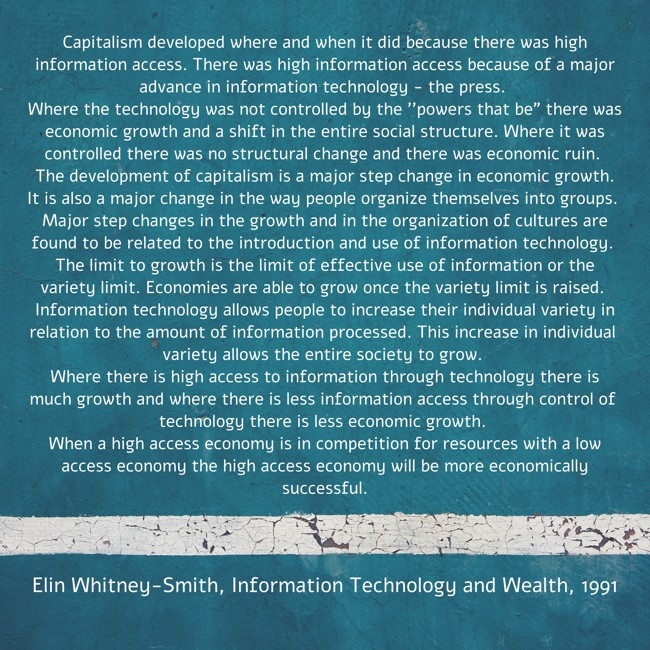
Connected Thinking Monday: Information as the Engine of Civilizational Change "Capitalism developed where and when it did because there was high information access. There was high information access because of a major advance in information technology - the press. Where the technology was not controlled by the 'powers that be' there was economic growth and a shift in the entire social structure. Where it was controlled there was no structural change and there was economic ruin. The development of capitalism is a major step change in economic growth. It is also a major change in the way people organize themselves into groups. Major step changes in the growth and in the organization of cultures are found to be related to the introduction and use of information technology. The limit to growth is the limit of effective use of information or the variety limit. Economies are able to grow once the variety limit is raised. Information technology allows people to increase their individual variety in relation to the amount of information processed. This increase in individual variety allows the entire society to grow. Where there is high access to information through technology there is much growth and where there is less information access through control of technology there is less economic growth. When a high access economy is in competition for resources with a low access economy the high access economy will be more economically successful." - Elin Whitney-Smith. Information Technology and Wealth: Cybernetics, History and Economics. 1991 Whitney-Smith wrote this in 1991, yet her insight cuts straight to the heart of our civilizational moment. If every great systemic transformation is ignited by a new information order, what does the rise of peer-to-peer networks, open knowledge, and the digital commons mean for the system that comes next? This is precisely what Connected Thinking explores: From the macrohistorical patterns that shaped past civilizations → to the P2P and Commons dynamics emerging today → to the question we can no longer avoid: What does the next system look like, and how do we get there? Ancient wisdom. Contemporary synthesis. Future vision. Lived experience. Learn more and register here 👇🏻 2026.connected-thinking.space 🌿 Seminars on foot reviving the peripatetic tradition of ancient philosophers, where walking, thinking, and dialogue converge to explore civilizational patterns and future systems. 📍 Lake Kaiafas, Greece | 🗓️ May 17–23, 2026 In this series of short posts we introduce concepts and quotes from Michel Bauwens and the P2P Foundation's Civilizational Analysis, on which Connected Thinking is based. #ConnectedThinking #MondayQuotes #MacroHistory #PeerToPeer #TheCommons #PeripateticLearning #SystemsThinking #CivilizationalPatterns #TransformativeLearning #FutureOfWork #ConsciousLeadership #RegenerativeFuture #Sensemaking #MetaCrisis #Sustainability
George Anadiotis tweet media
English
0
2
3
315
George Anadiotis
George Anadiotis@linked_do·
🛠️ Principles and Applications of Pragmatic AI: Practical Are you interested in learning how to fine-tune self-attention for transformers? If you know what that even means, congratulations. You're among the relatively few people familiar with the inner workings of the models powering much of modern AI. 🎓 But here's the truth: you don't need that level of detail to understand the fundamentals of AI or to use it productively. Theory matters. But real mastery and real utility come from learning by doing. That's the Practical Principle of Pragmatic AI: be results-oriented, hands-on, and always connected to the real world. 🔢 Being Practical is the Third Principle of Pragmatic AI. The Pragmatic AI Training is a course designed for busy professionals and validated by leading global organizations. What does it look like in practice? The course is deliberately designed as a 50/50 experience: half theory, half labs. Not theory-heavy with a token exercise at the end. A genuine balance, by design. ⚖️ 🔹 We learn enough theory to understand how things work. We go deep enough to be useful, without disappearing down rabbit holes. 🔹 We build things. We use tools that don't require a PhD and are available to everyone in the room. 🔹 We work as a cohort. We learn from each other as much as from the curriculum, with tailored guidance throughout. 🔹 We step back regularly to reflect, connect the dots, and use what we've learned to see the bigger picture. By the end, you don't leave with a certificate you'll forget. You leave with a working understanding you can apply on Monday morning. 📅 Pragmatic AI is built on experience and research, designed for busy professionals, validated by leading global organizations, and delivered in person at an all-inclusive resort, which adds a whole other dimension to learning and doing. Check the full agenda and reserve your seat here 👇🏻 2026.pragmaticai.training 🌿 A course for people who want to understand the first principles of AI, and learn how to use it to get results. 📍 Lake Kaiafas, Greece | 🗓️ May 24-30, 2026 #PragmaticAI #AITraining #DataScience #ExecutiveEducation #AIStrategy #DigitalTransformation #LeadershipDevelopment #MachineLearning #AIForBusiness #DataLiteracy #ProfessionalDevelopment #BusinessIntelligence #TechLeadership #AIRetreat #AILiteracy #Solopreneur #FutureOfWork
George Anadiotis tweet media
English
0
1
1
106
George Anadiotis
George Anadiotis@linked_do·
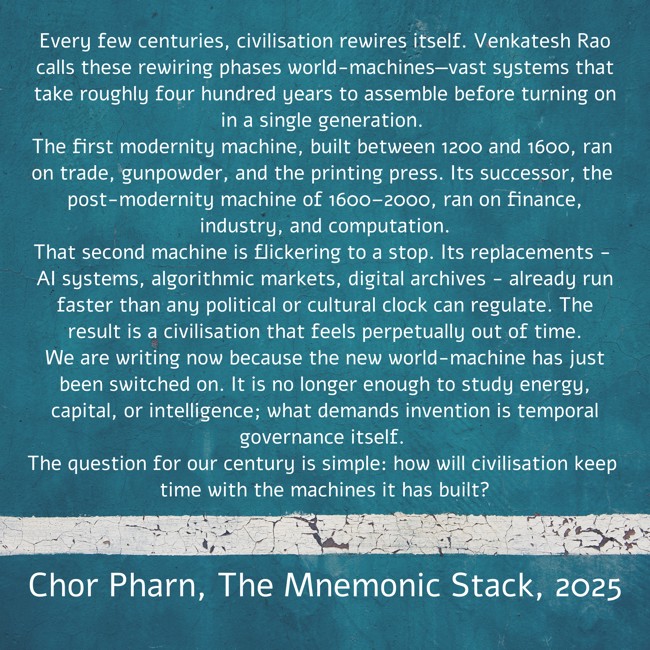
Connected Thinking Monday Quotes: How will civilisation keep time with the machines it has built? "Every few centuries, civilisation rewires itself. Venkatesh Rao calls these rewiring phases world-machines—vast systems that take roughly four hundred years to assemble before turning on in a single generation. The first modernity machine, built between 1200 and 1600, ran on trade, gunpowder, and the printing press. Its successor, the post-modernity machine of 1600–2000, ran on finance, industry, and computation. That second machine is flickering to a stop. Its replacements—AI systems, algorithmic markets, digital archives—already run faster than any political or cultural clock can regulate. The result is a civilisation that feels perpetually out of time. We are writing now because the new world-machine has just been switched on. It is no longer enough to study energy, capital, or intelligence; what demands invention is temporal governance itself. The question for our century is simple: how will civilisation keep time with the machines it has built?" @ChorPharn, The Mnemonic Stack, 2025 Rao's world-machines are the entry point. Connected Thinking goes deeper: into the macrohistorical patterns beneath each rewiring, the commons that pulse through civilizational transitions, the peer-to-peer logic now emerging as the new machine switches on, and the question of what the next system can actually look like. Ancient wisdom. Contemporary synthesis. Future vision. Lived experience. Learn more and register here 👇🏻 2026.connected-thinking.space 🌿 Seminars on foot reviving the peripatetic tradition of ancient philosophers, where walking, thinking, and dialogue converge to explore civilizational patterns and future systems. 📍 Lake Kaiafas, Greece | 🗓️ May 17-23, 2026 In this series of short posts we introduce concepts and quotes from Michel Bauwens and the P2P Foundation's Civilizational Analysis, on which Connected Thinking is based. #ConnectedThinking #MondayQuotes #MacroHistory #PeerToPeer #TheCommons #PeripateticLearning #SystemsThinking #CivilizationalPatterns #TransformativeLearning #FutureOfWork #ConsciousLeadership #RegenerativeFuture #Sensemaking #MetaCrisis #Sustainability
George Anadiotis tweet media
English
0
2
5
231
George Anadiotis retweeté
Michel Bauwens
Michel Bauwens@mbauwens·
* The Noosphere a different realm, it's not just planetary, it's another plane: linkeddataorchestration.substack.com/p/connected-th… @linked_do explains the p2p approach: "Medieval guilds were trans-local in their own fashion: craftsmen traveled between regions, carried knowledge across borders, and maintained standards across cities. But guilds were always collocated. Physical proximity was essential to the work. Today’s peer-to-peer communities are scattered across continents yet deeply coordinated. The shift is not merely one of geographic scale. “It’s not just a bigger geography,” Bauwens says. “It’s actually another plane.” He borrows the concept of the noosphere – the sphere of shared human knowledge – to describe it. The digital commons has its own geography, its own territories, its own dynamics. It is not an extension of physical space; it is a new kind of space altogether. Looking further back, Bauwens finds a more surprising historical parallel: religious communities. The Pope was never the head of a physical nation-state in the modern sense. He led all Catholic believers, wherever they lived. These were communities of affinity, not kinship or geography, organized around shared belief and common purpose. Today’s digital communities organize around shared projects and joint aims. Bauwens calls it “object-oriented sociality”: what unites people is a common goal, not a common location."
English
0
1
8
234
George Anadiotis
George Anadiotis@linked_do·
➡️ Principles and Applications of Pragmatic AI: Evolutionary Are you looking for online AI courses you can finish in a day? If yes, there are plenty that promise exactly that. Best of luck. If you've realized that's a mirage, but you are serious about understanding the first principles of AI and learning how to use it to get real results, then you already sense something important: The techniques and tools you learn should connect. Each new one should find its natural place in a living, growing ecosystem. That's the Evolutionary Principle of Pragmatic AI: build a coherent progression, and stay ready for what comes next. Being Evolutionary is the Second Principle of Pragmatic AI. The Pragmatic AI Training is a course designed for busy professionals and validated by leading global organizations. What does it look like in practice? The course is designed as a deliberate journey, with each stage deepening and expanding the last. 🔹 It begins with the essentials: Data and AI Fundamentals, Data Science and Statistical Analysis: the bedrock everything else rests on. 🔹 From there, the lens widens: Exploratory Data Analysis and Visualization, Machine Learning Algorithms and Evaluation: where patterns start speaking and models start making sense. 🔹 Then comes the frontier: Natural Language Processing, Generative AI, Data Modeling and Ontology Design, Knowledge Graphs and RAG - where the most widespread adoption of AI is happening. 🔹 Finally, we zoom out to the landscape: Data Governance, AI Frameworks, Cloud Services, No-Code and Low-Code options, and pathways for AI application development, so you leave knowing not just what exists, but what to do with it. Nothing is taught in isolation. Everything connects. 🔗 Pragmatic AI is built on experience and research, designed for busy professionals, validated by leading global organizations, and delivered in person at an all-inclusive resort, so the learning has room to breathe. Check the full agenda and reserve your seat here 👇🏻 2026.pragmaticai.training 🌿 A course for people who want to understand the first principles of AI, and learn how to use it to get results. 📍 Lake Kaiafas, Greece | 🗓️ May 24-30, 2026 #PragmaticAI #AITraining #DataScience #ExecutiveEducation #AIStrategy #DigitalTransformation #LeadershipDevelopment #MachineLearning #AIForBusiness #DataLiteracy #ProfessionalDevelopment #BusinessIntelligence #TechLeadership #AIRetreat #AILiteracy #Solopreneur #FutureOfWork
George Anadiotis tweet media
English
1
1
2
107
George Anadiotis
George Anadiotis@linked_do·
Connected Thinking: On History, Technology, and the Art of Seeing What's Coming What if the chaos around us isn't collapse, but transformation? 🌀 @mbauwens has spent decades mapping the edges of change. From peer-to-peer networks to the commons, from medieval guilds to distributed autonomous organizations, he's been tracking something most people miss: 🌱 The seeds of a new civilization, already growing underneath the noise. In this conversation, we explore how the internet didn't just connect computers - it created an entirely new plane of human organization. One where people coordinate across the planet without hierarchies, intermediaries, or anyone giving orders. 🏡 ↔ 🌐 They call it cosmolocalism. What is heavy stays local. What can be shared, travels everywhere. But this isn't just theory. It's a lens. A way of reading history that tells you exactly where you are, and what's worth building right now. Are you post-seasonal, clinging to a logic whose time has passed? Seasonal, playing the current moment well? Or pre-seasonal, working on the seeds that will matter when the time is ripe? 🦋 The caterpillar, Michel reminds us, already carries the DNA of the butterfly. This is Connected Thinking. Join us: linkeddataorchestration.com/2026/02/25/con… #ConnectedThinking #MacroHistory #PeerToPeer #TheCommons #PeripateticLearning #SystemsThinking #CivilizationalPatterns #TransformativeLearning #FutureOfWork #ConsciousLeadership #RegenerativeFuture #Sensemaking #MetaCrisis #Sustainability
English
0
2
3
177
George Anadiotis
George Anadiotis@linked_do·
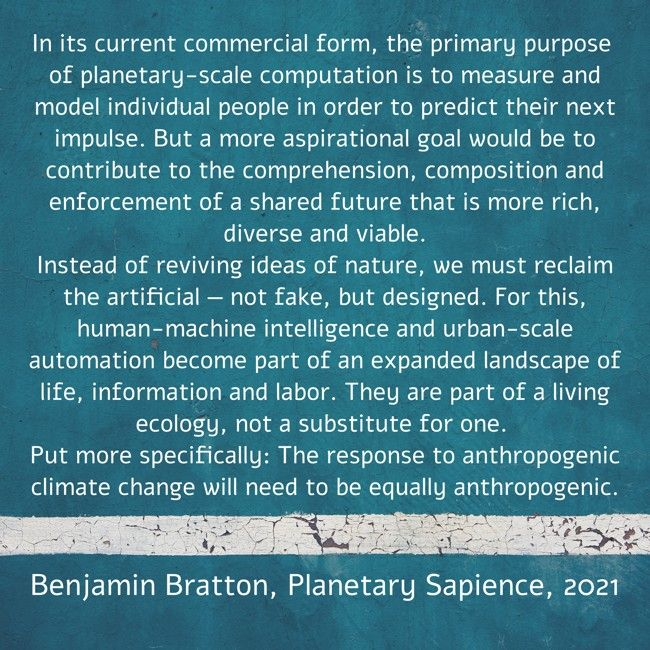
Connected Thinking Monday Quotes: Designing a Shared Future "In its current commercial form, the primary purpose of planetary-scale computation is to measure and model individual people in order to predict their next impulse. But a more aspirational goal would be to contribute to the comprehension, composition and enforcement of a shared future that is more rich, diverse and viable. Instead of reviving ideas of nature, we must reclaim the artificial — not fake, but designed. For this, human-machine intelligence and urban-scale automation become part of an expanded landscape of life, information and labor. They are part of a living ecology, not a substitute for one. Put more specifically: The response to anthropogenic climate change will need to be equally anthropogenic." — Benjamin Bratton. Planetary Sapience. 2021 This vision sits at the heart of Connected Thinking: understanding how civilizations consciously design their systems. From macrohistorical patterns that shape collective futures, to the evolution of the commons, peer-to-peer coordination, and emerging post-capitalist models. The journey explores how societies can intentionally create viable, regenerative futures. Ancient wisdom. Contemporary synthesis. Future vision. Lived experience. Learn more and register here 👇🏻 2026.connected-thinking.space 🌿 Seminars on foot reviving the peripatetic tradition of ancient philosophers, where walking, thinking, and dialogue converge to explore civilizational patterns and future systems. 📍 Lake Kaiafas, Greece | 🗓️ May 17–23, 2026 In this series of short posts we introduce concepts and quotes from Michel Bauwens and the P2P Foundation Civilizational Analysis, on which Connected Thinking is based. #ConnectedThinking #MondayQuotes #MacroHistory #PeerToPeer #TheCommons #PeripateticLearning #SystemsThinking #CivilizationalPatterns #TransformativeLearning #FutureOfWork #ConsciousLeadership #RegenerativeFuture #Sensemaking #MetaCrisis #Sustainability
George Anadiotis tweet media
English
0
1
2
424
George Anadiotis retweeté
Michel Bauwens
Michel Bauwens@mbauwens·
My priority this year is to finish my book proposing a civilizational history of human coordination capacity. Four chapters are in draft form, in 2 different versions. But I am a little bit stuck. First of all, I have written all my books with co-authors. It's a kind of stimulation I may need, because being eternally curious, I'm continuously exploring new material, rather than writing it down. So, I need a intellectually sophisticated person who would be interested in co-authoring, while allowing me to take the overall lead. Second, I am very precarious in income, and going from material crisis to material crisis. Right now, my family's stuff in Bangkok is in boxes, due to an inability to come up with rent money. So I am in one right now, and this is why I launched the fundraising yesterday, to specifically guarantee the work on the wiki. If you think my work is important, please consider responding to the fundraising. Beyond the 'emergency' request, how do I even solve the structural issue, given my political positioning makes me fall between the two chairs. Neither Soros nor the Koch brothers (as a type of NGO funder) would be interested in funding the kind of integrative work I am attempting. Who would ? In this pragmatic age of KPI's, who funds deeper civilizational research ? The following is a copy of a dialogue with chatGPT. While the AI only knows a small part of my work due to my recent questions, as I am moving from the cultural historians to the cultural-spiritual historians, it nevertheless has an impressive grasp of the logic of my research and inquiry. Anyways, I am not giving up and never will, just sharing the circumstances in which I am working My difficulties are largely due to my own personality traits no doubt. Nevertheless, I have been able to send my four kids, all healthy and motivated youngsters, to the uni, despite being underfunded from 2005 to 2013, and from 2018 onwards. One more year to go and the two last ones will be done. Web3 sources of funding seem to be drying up due to crashing treasuries. chatgpt.com/s/t_699bded275…
English
7
8
37
3.9K
George Anadiotis
George Anadiotis@linked_do·
🧱 Principles and Applications of Pragmatic AI: Foundational AI is moving at breakneck speed. Keeping up doesn't mean chasing every trend. It means understanding the fundamentals well enough to adapt to anything. That's the First Principle of Pragmatic AI: Be Foundational. The Pragmatic AI Training is a course for people who want to understand the first principles of AI, and learn how to use AI to get results. What does Being Foundational look like in practice? Here's how we spend the first four hours of the Pragmatic AI agenda. We begin by building a shared language — tracing AI's history and evolution, establishing key concepts and terminology, and grounding every participant in the same frame of reference. From there, we turn to data itself: its many forms, how it's characterized, managed, processed, and put to work. We then uncover how raw data transforms into business intelligence through the essential principles of data science and statistical analysis. And because understanding only becomes mastery through practice, we bring everything together with a hands-on lab where participants get acquainted with the course environment, the datasets, and the organizational context in which we'll be working throughout the week. Four hours in, AI starts feeling less like a black box and real-world data more like a language you're already beginning to speak. Pragmatic AI is built on experience and research, designed for busy professionals, validated by leading global organizations, and delivered in person at an all-inclusive resort. What you need to join? A laptop and your attention. Seats are limited. Check the full agenda and reserve yours here 👇🏻 2026.pragmaticai.training The Experience: 📍 Lake Kaiafas, Greece 🗓️ May 24-30, 2026 🏛️ All-inclusive retreat combining learning with cultural immersion 🎯 Interactive lectures + group activities + hands-on practice #PragmaticAI #AITraining #DataScience #ExecutiveEducation #AIStrategy #DigitalTransformation #LeadershipDevelopment #MachineLearning #AIForBusiness #DataLiteracy #ProfessionalDevelopment #BusinessIntelligence #TechLeadership #AIRetreat #AILiteracy #Solopreneur #FutureOfWork
George Anadiotis tweet media
English
0
1
3
170
George Anadiotis
George Anadiotis@linked_do·
🗺️ The Graph Analytics market is heading toward $9.5B by 2032 - but can you navigate it? Graph technology has evolved from a niche curiosity to a multi-billion dollar market, and it's accelerating fast with AI. But for engineers, data scientists, architects, and technology leaders, the tooling landscape can feel overwhelming and fragmented. That's exactly why we built The State of Graph: a comprehensive, structured repository, visualization, and analysis of the entire graph technology space. Today, we're sharing the first of 7 categories: 🔍 Graph Analytics Graph analytics uncovers patterns in connected data powering use cases like: → Fraud detection & network security → Risk propagation & anomaly detection → Community analysis & influence mapping → BI, retail, and social networks 📊 The numbers speak for themselves: $2.41B in 2025 → $9.49B by 2032 (21.61% CAGR) This catalog is built for those who are choosing, building, or evaluating graph analytics tools. Not just listing everything, but mapping how frameworks, libraries, and platforms align with real-world constraints. We limit inclusion to tools where graph algorithms are core functionality, not afterthoughts. This project started as a hallway conversation at Connected Data London 2024, and has been a labor of love throughout 2025 with Maya Natarajan and Anisha Mane. We debuted it live at @Connected_Data London 2025, and now it's yours to explore. 👉 Check out the Graph Analytics Catalog v.1: stateofthegraph.com/2026/02/10/the… Do you have questions, feedback, or want help navigating it? Reach out - we'd love to hear from you. #GraphAnalytics #GraphTechnology #DataScience #ConnectedData #NetworkAnalysis #FraudDetection #AIInfrastructure #DataEngineering #TechTrends #EmergingTech #Analytics #Algorithms
George Anadiotis tweet media
English
0
0
2
95
Michel Bauwens
Michel Bauwens@mbauwens·
At Connected Thinking we explore what's being born: peer-to-peer networks, commons-based governance, and the next coherent system. We'll examine: → Macrohistory's repeating patterns → The pulsation of commons through time → P2P as civilizational infrastructure → What we can know about the next system Ancient wisdom. Contemporary synthesis. Future vision. Lived experience. Learn more and register here 👇🏻 2026.connected-thinking… 🌿 Seminars on foot reviving the peripatetic tradition of ancient philosophers, where walking, thinking, and dialogue converge to explore civilizational patterns and future systems. 📍 Lake Kaiafas, Greece | 🗓️ May 17-23, 2026 In this series of short posts we introduce concepts and quotes from Michel Bauwens and the P2P Foundation's Civilizational Analysis, on which Connected Thinking is based. For more info connect with @linked_do !
Michel Bauwens tweet media
English
1
1
8
168
George Anadiotis
George Anadiotis@linked_do·
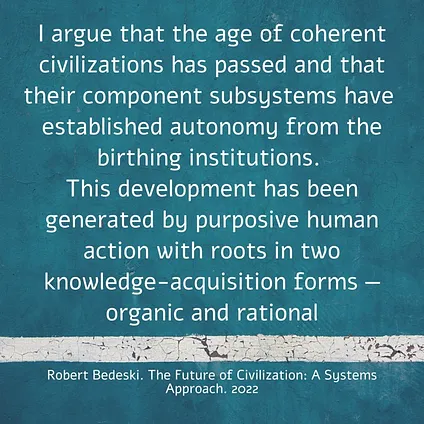
Connected Thinking Monday: On civilizational coherence "I argue that the age of coherent civilizations has passed and that their component subsystems have established autonomy from the birthing institutions. This development has been generated by purposive human action with roots in two knowledge-acquisition forms - organic and rational" -Robert Bedeski. The Future of Civilization: A Systems Approach. 2022 So what emerges after fragmentation? Robert Bedeski captures the breakdown we're witnessing. At Connected Thinking we explore what's being born: peer-to-peer networks, commons-based governance, and the next coherent system. We'll examine: → Macrohistory's repeating patterns → The pulsation of commons through time → P2P as civilizational infrastructure → What we can know about the next system Ancient wisdom. Contemporary synthesis. Future vision. Lived experience. Learn more and register here 👇🏻 2026.connected-thinking.space 🌿 Seminars on foot reviving the peripatetic tradition of ancient philosophers, where walking, thinking, and dialogue converge to explore civilizational patterns and future systems. 📍 Lake Kaiafas, Greece | 🗓️ May 17-23, 2026 In this series of short posts we introduce concepts and quotes from @mbauwens and the P2P Foundation's Civilizational Analysis, on which Connected Thinking is based. #ConnectedThinking #MondayQuotes #MacroHistory #PeerToPeer #TheCommons #PeripateticLearning #SystemsThinking #CivilizationalPatterns #TransformativeLearning #FutureOfWork #ConsciousLeadership #RegenerativeFuture #Sensemaking #MetaCrisis #Sustainability
George Anadiotis tweet media
English
0
3
5
245
George Anadiotis
George Anadiotis@linked_do·
@MarceloReFi Thank you! Feel free to book a strategy session if you want to explore further
English
0
0
1
16
Mar.celo.eth
Mar.celo.eth@MarceloReFi·
Interesting, saving for later
George Anadiotis@linked_do

Pragmatic AI Training: A Progressive Framework for AI Mastery The journey from AI Literacy to AI Proficiency starts before taking the first step. It starts by meeting people where they are, and finding the right map and companions. Pragmatic AI has been developed and honed over the course of years, built on a set of guiding principles, and validated by organizations such as the German Agency for International Cooperation (GIZ), the International Organization for Migration (IOM), and GC Europe, a leading oral health company. Its pillars: 🧠 You don’t have to be a data scientist to benefit from AI. People who understand AI broadly and can apply it flexibly thrive. This is Pragmatic AI 📚 Start with AI Literacy, and move towards AI Proficiency 👥 Learn the first principles of data and AI, build on a coherent progression and stay up to date applying transferable skills and tools 🙌 Adapt to individual needs and organizational settings, and leverage opportunities for feedback, networking, and follow-up ⚖️ Develop systems that are trustworthy, ethical, and beneficial to society 🎯 The Seven Principles of Pragmatic AI: Foundational. Evolutionary. Practical. Sustainable. Contextual. Interactive. Responsible. This is not a "learn how to prompt", a "buy subscriptions, burn tokens, run agents", or a "build neural networks with Python" course. Pragmatic AI is for Consultants | Creatives | Entrepreneurs | Executives | Managers | Solopreneurs who want to use AI and lead AI initiatives without becoming data scientists or writing code. What it covers: * Data Science and Machine Learning Fundamentals * Advanced Machine Learning, Natural Language Processing and GenAI * Data Modeling, AI Governance, Regulation, Ethics, and Deployment * Managing AI and Organizational Change There is a bundle of free resources you can peruse: * AI Literacy Assessment -> 2026.pragmaticai.training/ai-literacy-as… * Six Pillars of AI Literacy -> linkeddataorchestration.com/2025/02/26/the… * Seven Principles of Pragmatic AI -> linkeddataorchestration.com/2025/11/03/the… * AI Strategy Session -> 2026.pragmaticai.training/ai-strategy-se… And if you are ready to take the next step, join Pragmatic AI Training 2026 👇 2026.pragmaticai.training An immersive retreat where data science meets strategic leadership in one of the world's most inspiring locations. ✨ A unique course teaching the first principles of data science and AI, how to apply them using free and open source AI tools, and how to drive and manage organizational transformation with AI. The Experience: 📍 Lake Kaiafas, near Ancient Olympia, Greece 🗓️ May 24-30, 2026 🏛️ All-inclusive retreat combining learning with cultural immersion 🎯 Interactive lectures + hands-on practice #AITraining #DataScience #ExecutiveEducation #AIStrategy #DigitalTransformation #LeadershipDevelopment #MachineLearning #AIForBusiness #DataLiteracy #ProfessionalDevelopment #AIGovernance #ResponsibleAI #BusinessIntelligence #TechLeadership #AIRetreat #AILiteracy

English
1
1
3
161