Mighty Byte
179 posts

Mighty Byte
@mightybyte
Engineering leader, functional programmer, student of leadership, devotee of skills acquisition who slacklines and rock climbs. It's all about balance!

New York, NY Inscrit le Temmuz 2009
147 Abonnements409 Abonnés

"Code is about to cost *nothing*, and knowing what to build is about to cost you *everything*."
youtube.com/watch?v=RtMLnC…

YouTube
English

@cryptopunk7213 > openai acquired peter steinberger and openclaw committing to keep the project 100% open source and make it a core part of openai’s ecosystem. zuck is fckin fuming.
Anthropic are the ones who really messed that one up with their overzealous lawyers.
English

lmao so just to recap the week:
- openai acquired peter steinberger and openclaw committing to keep the project 100% open source and make it a core part of openai’s ecosystem. zuck is fckin fuming.
- china’s bytedance got sued by disney and hollywood for their seedance video model being so damn good BUT turns out it doesn’t even use their IP, it’s just that good lol
- a clawdbot (openclaw) gave birth to a replicate of itself and autonomously paid for its api access
- some random dude discovered $1.5 trillion worth of lithium buried under a super volcano in nevada miraculously solving the USA’s battery crisis (tesla praising the lord rn)
- anthropic confirmed spotify engineers no longer code they just prompt claude to write 100% of the platforms code. we’re talking about a $100B+ company here
- openai launched codex spark, a faster version of codex 5.3 that slings 1000 tokens / sec insane
- anthropic and openai both lost key AI safety staff because “the world is in peril” and they reject AI ‘adult mode’
- xAI laid off 20-40% of staff in a vital bid to align grok, X and spaceX teams before building 100Tw of compute in space
- matt schumer’s “something big is coming” article hit 100M+ views warning against AI except… it was co-written by an AI
- runway raised $300M at a $5.3B val
- europe committed $13B+ to fund next-gen AI startups to compete with the US
- norway decided to fck their entire economy with a 36% tax on UNrealised gains
goodnight.

English

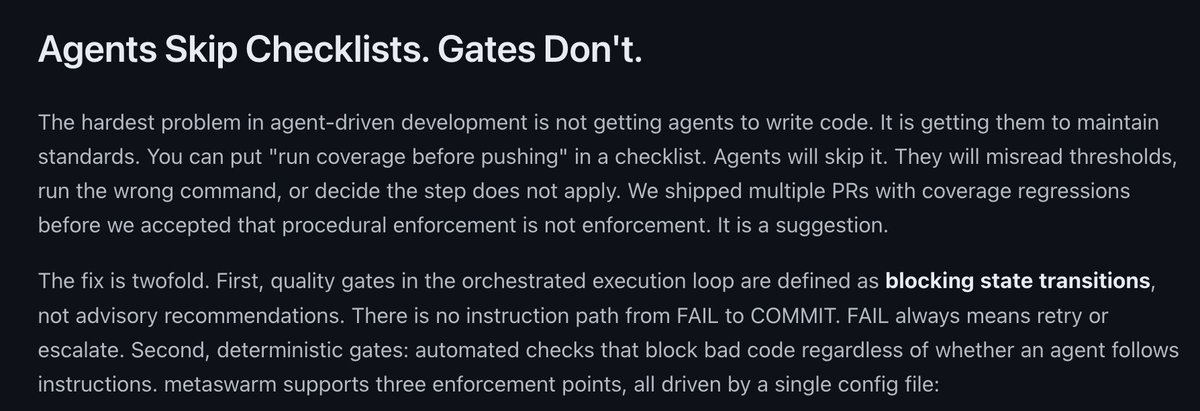
This is why Haskell still has a lot of value in the world of agentic engineering that we are entering.
dsifry.github.io/metaswarm/

English

@Visa @crossmint @solana @circle @stytchauth I really hope the solution we get is built on secure public/private key cryptography rather than our current inherently insecure system of credit card numbers that have to be kept secret.
English

@crossmint @solana @circle @stytchauth Autonomous agents need infrastructure to make secure payments.
@Visa Intelligent Commerce enables secure, tokenized transactions that keep humans in control while AI agents handle the rest.
We're building w/ @Crossmint to support commerce in OpenClaw.
English

Announcing lobster.cash. The open payment standard for OpenClaw agents.
There's no secure way for OpenClaw agents to pay for things. Until now.
Powered by @crossmint, @Visa Intelligent Commerce, @solana, @circle, and @stytchauth.
🧵👇
English

youtube.com/clip/Ugkx7sAOc…
"And the skill that matters now is not technical proficiency, it's clarity of our intent."
English

"a helpful strategy for becoming a magician: Surround yourself with people who look like magicians to you."
autotranslucence.wordpress.com/2018/03/30/bec…
English

Praise the effort, not the talent.
instagram.com/mentalciety/re…
English

@Jonathan_Blow "The way you make code last a long time is you minimize dependencies that are likely to change and, to the extent you must take such dependencies, you minimize the contact surface between your program and those dependencies."
Good advice indeed.
English

I read this article about software development, which I knew about because I saw Prime reacting to it:
notashelf.dev/posts/curse-of…
For the most part I think it is fine: a relatively young programmer is doing the healthy work of introspecting on what he should really be doing.
But there's one part of the article that I think is a deep mistake, and the author doesn't know it's so wrong because he has never experienced the alternative:
"Software doesn’t stay solved. Every solution you write starts to rot the moment it exists. Not now, not later, but eventually. Libraries deprecate. APIs change. Performance regressions creep in. Your once-perfect tool breaks silently because libfoo.so is now libfoo.so.2. 2
I have had scripts silently fail because a website changed its HTML layout.
I have had configuration formats break because of upstream version bumps.
I have had Docker containers die because Alpine Linux rotated a mirror URL.
In each case, the immediate emotional response was not just inconvenience but something that moreso resembles guilt."
Yes, this is true in much of the programming world. But there is another world in which people build things that last much longer. I have done it many times. I shipped a binary for this game Braid in 2009 that you can still download and play on Steam 16 years later. If you are pretty young (like 35), you can run binaries on Windows that were compiled before you were even born, which is amazing given how hard they have been trying to f up Windows lately.
On an emulator like MAME, you can play arcade games programmed in 1979. If today's software "technology" is so much better, why does it fall apart like tissue paper?
The author is not wrong about the cited decay. But this decay is not inherent to the practice of software. It's due to choices made, usually foolishly, by the people designing the systems being interacted with. And, it's due to a lack of knowing better, non-exposure to the sector of programmers who are very concerned with their code lasting a long time, actually.
The way you make code last a long time is you minimize dependencies that are likely to change and, to the extent you must take such dependencies, you minimize the contact surface between your program and those dependencies.
The actual algorithms you program, the actual functioning machinery you build, is a mathematical object defined by the semantics of your programming language, and mathematical objects are eternal, they will last far longer than your human life. The goal then is to avoid introducing decay into the system. You must build an oasis of peace that is insulated from this constant bombardment of horrible decisions, and only hesitantly interface into the outside world.
This means, for example: If you are shipping on iOS, you only reluctantly use any functions iOS gives you, because when you use them, Tim Apple will come along and break your program next year for arbitrary pointless reasons, because Tim Apple does not respect you or anyone you know.
This means a program cannot last forever on iOS, because Tim Apple likes breaking your things and watching you submissively clean them up. But the core of your program, which could be 95% of the code, is fine, and you can deploy it elsewhere.
This means you have to insulate from Linux userspace, because of all the jackass decision making that introduces constant incompatibilities while somehow never making the system better.
Using a library dependency to do font rendering or sparse matrix math? That dependency gets checked into your source tree, a copy of exactly the version you use. Ten years later you can pull down that source and recompile, and it works, because your program is a mathematical object. If you want to upgrade to something newer that has bug fixes and so forth, you are free to do so, but you are also free not to do so, and your program still works. (And how many of these bug fixes do you really need? Your program worked correctly when you shipped it to the greatest extent you could measure, because you are a skillful software engineer who wants to ship things of a high quality).
Everyone who got into programming for the joy of it knows, at some level, that the magic of programs is that they represent complexity that is replicable over time (and thus they exist outside of time). But the trashy programmer culture of the past 20 years stopped aspiring to this, and now has forgotten it is even possible.
And so long as people have forgotten, decisions will continue to be made that make the problem worse.
There are programmers who only write glue code, and who think that's what programming is; to these people what I have written above will not make sense. But the good news for that contingent is, they can always just stop writing glue code and start doing something else! If today's software "technology" is so good, why do you think it needs so much glue? Maybe there is a stylistic problem.
So if you are looking for what to do in the world of software that can represent a lasting contribution, maybe this is food for thought.
@NotAShelf @ThePrimeagen
English