
Fabien Candau

3.2K posts

Fabien Candau banner
Fabien Candau

Fabien Candau

@Blogageco

Econ Pr. I work on international and urban economics issues, frequently (but not always) with environmental implications. Also at @[email protected].

शामिल हुए Ağustos 2010
553 फ़ॉलोइंग950 फ़ॉलोवर्स
पिन किया गया ट्वीट
Fabien Candau
Fabien Candau@Blogageco·
So happy to share our paper @WorldDevJournal We show that: 🚢International trade of agricultural goods partly mitigates climate change 🚰But water scarcity in 2050 will have a strong impact on comparative advantages HOWEVER not everywhere...check out! doi.org/10.1016/j.worl…
English

2
1
9
0
Fabien Candau रीट्वीट किया
fipaddict
fipaddict@fipaddict·
Mais dans l’attente, son décrochage pose une vraie question - en particulier pour les entreprises et administrations qui souhaiteraient déployer un modèle français pour des raisons de souveraineté et risquent d'avoir des résultats décevants à l'arrivée.
Français
2
1
12
2.3K
Fabien Candau रीट्वीट किया
Jesús Fernández-Villaverde
Jesús Fernández-Villaverde@JesusFerna7026·
Let me explain why I believe modern economics is such a powerful tool for understanding the world. I’ll do this by discussing a great paper by Simone Cerreia-Vioglio, @UncertainLars, Fabio Maccheroni, and Massimo Marinacci, “Making Decisions Under Model Misspecification,” published in the Review of Economic Studies a few months ago. Imagine I want to drive from UC San Diego to UCLA, but I’ve never driven that route before. I need to build a “model of the world” to guide me, which we usually call a map. Maps are simplified representations of reality. They can’t include every detail if they’re to be useful. Borges, in his short story On Exactitude in Science, makes this point beautifully. (In practice, I don’t draw the map myself—I use an app—but someone still had to make it.) Because maps simplify, I can’t fully rely on them. Maybe last night’s storm knocked down a tree and closed a street, or there’s construction and the ramp off the highway in LA is shut down. This uncertainty matters. Suppose I’m driving to UCLA for an important talk at 11 a.m. If the ramp is closed, I might need 15 extra minutes. When should I set my alarm to arrive on time, while still getting enough sleep to give a good talk? The problem is that I can’t assign precise probabilities to all these contingencies. How likely is the fallen tree? Or new roadwork? Even the best traffic apps can’t capture every disruption, and some might happen after I’ve already left. In economic terms, my “model of the world” (the map) is misspecified—and no matter how hard I try, I can’t fully fix that. But sitting down and crying about misspecification doesn’t answer my basic question: when do I set the alarm? Too early, and I’m exhausted. Too late, and I’m late. Simone and his co-authors offer a way to think about this. They start from the idea that we often hold several structured models of an economic phenomenon, grounded in theory. For example, a central bank might use a standard New Keynesian model and a search-and-matching model of money. Yet, aware that each model is misspecified by design, the bank adds a protective belt of unstructured models—statistical constructs that help it gauge the consequences of misspecification. The beauty of the paper is that it provides an axiomatic foundation for this protective belt (and even generalizes it to include a Bayesian approach). It shows that if a decision-maker’s preferences meet certain conditions —reflecting both rational and behavioral features— then those preferences can be represented by an augmented utility function that formally accounts for misspecification. Crucially, we don’t assume that augmented utility function; we derive it. We start with general, plausible properties of preferences and prove that they imply such a representation. That’s real progress. Instead of writing endless critiques of expected utility or rational expectations (as many have done for decades, with little to show), we now have a formal way to reason about misspecification—precise definitions, clear boundaries of validity, and awareness of what we still don’t know. Take, for instance, a brilliant Penn graduate student on the market, Alfonso Maselli economics.sas.upenn.edu/people/alfonso… His job-market paper pushes this frontier further. He studies cases where a decision-maker not only faces model misspecification but is also unsure which model best fits the data and can’t assign probabilities to them—what we call model ambiguity. In my example, the central bank is unsure whether the New Keynesian or the search-and-matching model fits better, and it worries that both might be incorrect. If you read Simone et al. or Alfonso’s paper, you’ll see how misguided—and, frankly, cartoonish—many of the recent criticisms of economics on X have been. First: the idea that economists don’t understand math or have “physics envy.” The math in these papers is subtle and advanced—utterly different from what physicists do (neither better nor worse, just distinct). An engineer transitioning into economics would find these tools unfamiliar. Second: claims of ideological bias are unfounded. I have no idea about the political views of the authors, and I’d be surprised if anyone could infer them from the analysis—beyond vague guesses about typical academics. Third: This has almost nothing to do with what one learns as an undergraduate, or even in first-year graduate school. If your knowledge of economics stops at an intro textbook, it’s best not to pontificate on the field’s frontiers. Fourth: Is this science? Debating that word’s boundaries is pointless; every definition of “science” breaks down somewhere. The Germans solved this long ago with the idea of Wissenschaft—the systematic pursuit of knowledge, whether of nature, society, or the humanities. By that measure, modern mainstream economics is clearly a Wissenschaft: a disciplined, cumulative, and highly useful effort to understand how the world works. Simone and his co-authors have demonstrated that beyond any reasonable doubt.
Jesús Fernández-Villaverde tweet media
English
44
475
1.8K
347.1K
Fabien Candau रीट्वीट किया
Sid Gundapaneni
Sid Gundapaneni@MacroscopeEcon·
I cannot understate how much I enjoyed Chad Jones’ talk at Hoover’s past weekly seminar. He’s an absolutely phenomenal presenter. A must-watch for anyone interested in growth, labor, or AI. youtu.be/U-ziizXkuXg?si…
YouTube video
YouTube
English
5
26
136
64.7K
Fabien Candau रीट्वीट किया
Itai Sher
Itai Sher@itaisher·
For no particular reason, if people are interested in ordinal vs cardinal utility and interpersonal comparisons in social welfare evaluation, here are two papers, one with a classic treatment and another with a new approach that I really like.
Itai Sher tweet mediaItai Sher tweet media
English
4
17
179
11.2K
Fabien Candau रीट्वीट किया
Helmut🔅Reisen
Helmut🔅Reisen@HrReisen·
Chloé, Lagerfeld & Aghion: Qui est Philippe Aghion, le conseiller de Macron devenu prix Nobel d'économie 2025 qui a grandi dans les défilés de mode ? | Vanity Fair vanityfair.fr/article/rencon…
Français
0
2
1
976
Fabien Candau रीट्वीट किया
Nicolas Cadène 🌍
Nicolas Cadène 🌍@ncadene·
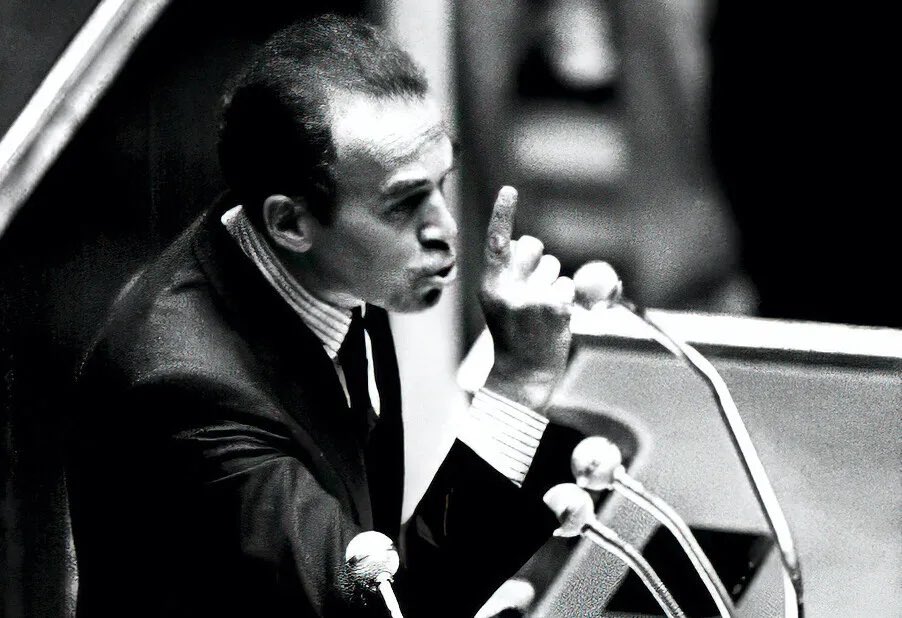
#Badinter #Panthéon «Le fascisme ne se lève pas comme la tempête en une nuit. D’abord rampant, dissimulé, ordinaire, il progresse par les voix de la haine, avivée par les difficultés économiques. Il s’empare des cœurs avant de pervertir les esprits puis de prendre le pouvoir»☝️
Nicolas Cadène 🌍 tweet media
Français
296
1.6K
3.7K
139.3K
Fabien Candau रीट्वीट किया
Maitre Eolas🇫🇷
Maitre Eolas🇫🇷@Maitre_Eolas·
Que ce soit très clair : tout ce que dit @HerveLehman ici est faux. Que ce soit un mensonge ou de l'inculture mêlée d'aveuglement idéologique, je l'ignore, et je m'en fiche un peu.
Le Figaro@Le_Figaro

«Quand Badinter est nommé garde des Sceaux, il libère 40% des détenus car il est contre la prison. Cela a entraîné une hausse très importante de la délinquance. Deux ans après, tous ceux qui ont été libérés sont revenus en prison», rappelle @HerveLehman dans «Points de Vue».

Français
73
436
1.3K
107.8K
Fabien Candau रीट्वीट किया
Lulu NYT
Lulu NYT@LuluGNavarro·
I am obsessed with the soybean saga which to my mind isn’t getting enough attention. ICYMI: Because Trump’s tariff war, China has stopped buying US soybeans. Very bad for our midwestern famers. Meanwhile, Trump decides to bailout pal Argentina which turns around and sells their soybeans at a discount to … China. Our farmers doubly hurt. More reporting here. fortune.com/2025/09/30/wha…
English
113
1.1K
3.7K
226.3K
Fabien Candau रीट्वीट किया
Aymeric Pontier
Aymeric Pontier@aympontier·
Visualisation des courants océaniques de la Terre par la Nasa
Català
15
64
226
8.5K
Insee
Insee@InseeFr·
@Blogageco Bonjour, Vous trouverez le déflateur du PIB ici : insee.fr/fr/statistique… Plus précisément dans le tableau 1.101-1.103 puis l'onglet 1.103 Évolution des indices de prix du produit intérieur brut et de ses composantes.
Français
1
0
1
165
Fabien Candau
Fabien Candau@Blogageco·
bonjour @InseeFr je cherche des données de déflateur du pib sur disons 2000-2023, pas trouvé sur votre site, vous pourriez m'envoyer un lien vers la page, merci!
Français
1
0
0
260
Fabien Candau रीट्वीट किया
La Grande Conversation
La Grande Conversation@_LaConversation·
👵👴 Passer d'un système par répartition à un système par capitalisation : quelles conséquences ? Cela implique de faire financer deux systèmes en parallèle pendant plusieurs décennies. Le coût est colossal. Retrouvez l'analyse d'@WeilEric ici : lagrandeconversation.com/economie/la-re…
La Grande Conversation tweet mediaLa Grande Conversation tweet media
Français
4
6
12
17.1K
Fabien Candau रीट्वीट किया
Oleg Itskhoki
Oleg Itskhoki@itskhoki·
Never have I felt so ashamed to be an American "US joins Russia to vote against UN resolution condemning Russia war against Ukraine" cnn.com/.../us-joins-r… 18 countries voted against including Russia, Belarus, North Korea, Hungary, Israel & the United States. China abstained.
English
6
14
217
16.8K
Fabien Candau रीट्वीट किया
Gabriel Zucman
Gabriel Zucman@gabriel_zucman·
Nulle mystère à cette démobilisation L’imposition des ultra-riches est plébiscitée par l’opinion publique: 70%-80% des Français y sont favorables Le vote d’hier (116 pour et 39 contre, soit 75% / 25%) est le reflet de cette volonté majoritaire en France (comme partout ailleurs)
Français
2
23
83
3.3K
Fabien Candau रीट्वीट किया
Ingrid H. Kvangraven
Ingrid H. Kvangraven@ingridharvold·
Just seeing the RCT 'scandal' brewing among econs again. This is not a question about some bad apples or some instances of malpractice. The RCT industry has been completely distorted from its inception in Econ and this is closely tied to the incentive structure of the discipline.
English
6
99
459
108.2K
Fabien Candau रीट्वीट किया
Víctor Sancibrián
Víctor Sancibrián@sancibrian_v·
📢 We just posted a MATLAB suite for panel local projections. It supports estimation and inference, including small-sample refinements, fixed-effects, controls, cumulative responses... Available at github.com/TinchoAlmuzara… together with replication files.
Víctor Sancibrián@sancibrian_v

💥On panel local projections with macro shocks💥 Our new WP w/ @martinalmuzara: ▫️ micro data and macro questions (e.g., firms and monetary policy) ▫️ heterogeneity and impulse responses ▪️ how to compute standard errors? ▪️ what is the role of cross-sectional variation? 🧵

English
2
42
208
29.5K
Fabien Candau रीट्वीट किया
François Geerolf
François Geerolf@FrancoisGeerolf·
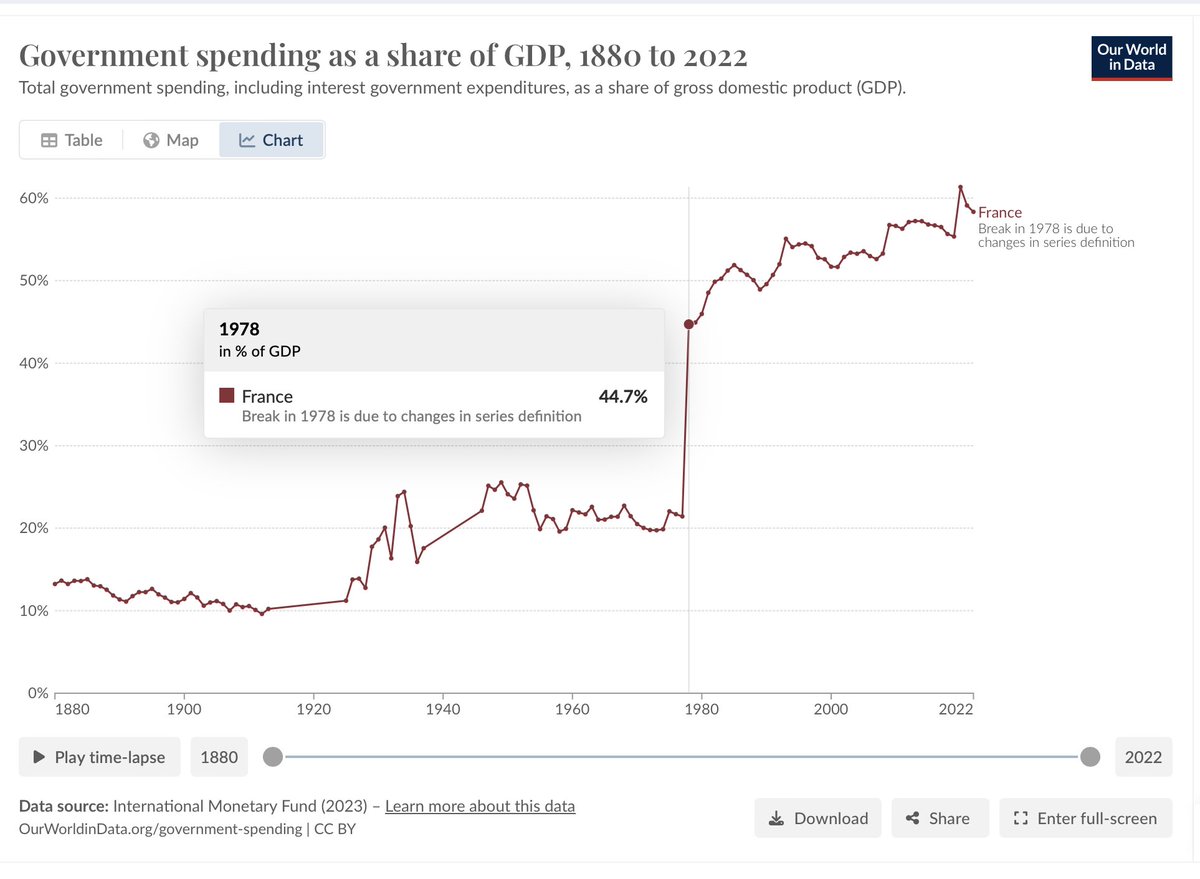
"Renseignez-vous".🤦‍♂️ Comment peut-on croire que les dépenses publiques aient doublé en 1981 ?😅 Le fait que les dépenses publiques 🇫🇷 fassent un saut de 21.4% à 44.7% du PIN (et c'est en 1978, pas en 1981 !!!) est évidemment du à un changement de méthodologie dans ces données...
François Geerolf tweet media
Français
5
13
46
2.7K