LINK
pubmed.ncbi.nlm.nih.gov/40395689/
GLOSSARY
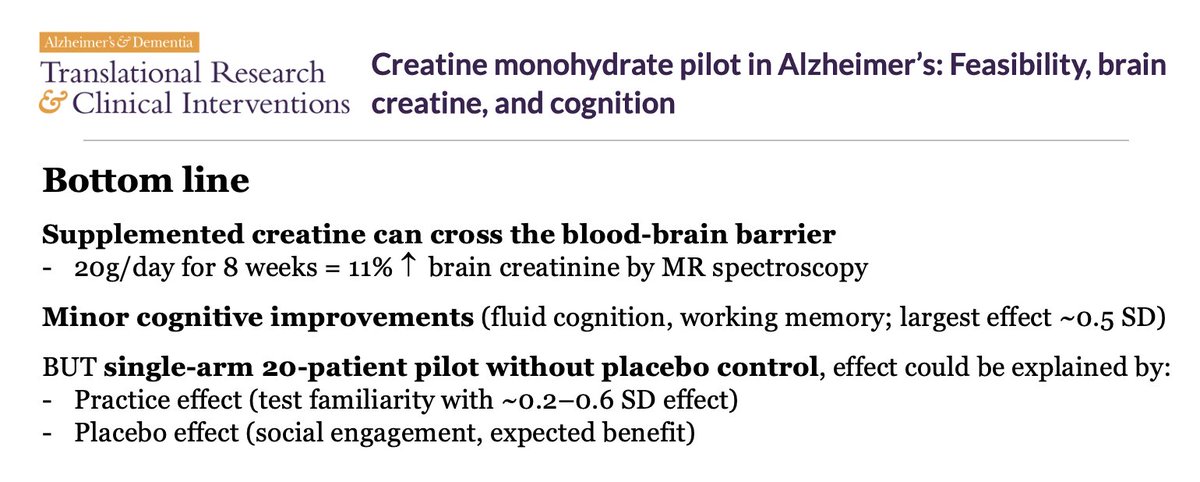
Creatine monohydrate (CrM) = most widely studied and bioavailable form of creatine, a naturally occurring compound that helps cells regenerate ATP
Total creatine (tCr) = combined pool of free creatine and phosphocreatine in the brain
Magnetic resonance spectroscopy (MRS / MRSI) = imaging technique measuring chemical concentrations in living tissue
Cohen's d_z = measure of effect size for paired (within-subject) comparisons. Values of 0.2, 0.5, and 0.8 conventionally considered small, medium, and large effects, respectively.
Paired t-test = statistical test comparing two measurements taken from the same individual (e.g., baseline vs. 8 weeks).
Practice effect = improvement on a test simply from having taken it before, not from any true cognitive change
Placebo effect = improvement attributable to the participant's expectation of benefit, heightened attention from study staff, and the psychological impact of participating in a trial
APOE ε4 = genetic variant of the apolipoprotein E gene that is the strongest genetic risk factor for late-onset Alzheimer's disease. Carriers (one or two copies) have 3–15× increased risk
Plasma p-tau217 = blood biomarker of tau pathology (a hallmark of AD). Levels ≥0.4 pg/mL suggest the presence of brain amyloid pathology.
MMSE (Mini-Mental State Examination) = 30-point screening test for cognitive impairment in clinical practice and AD trials, the most common clinical dementia score
NIH Toolbox Cognition Battery = standardized set of cognitive tests covering multiple domains (attention, memory, processing speed, language). Mean population score = 100; standard deviation = 15.
CDR-SB = Clinical Dementia Rating-Sum of Boxes – validated rating scale commonly used in clinical trials to quantify the symptom severity of AD and other dementias
English