
पिन किया गया ट्वीट
Memory
1K posts


Memory
@MemoryProtocol
Build with portable user data and reputation || On @base
शामिल हुए Aralık 2023
240 फ़ॉलोइंग6.1K फ़ॉलोवर्स


Memory रीट्वीट किया

Memory रीट्वीट किया
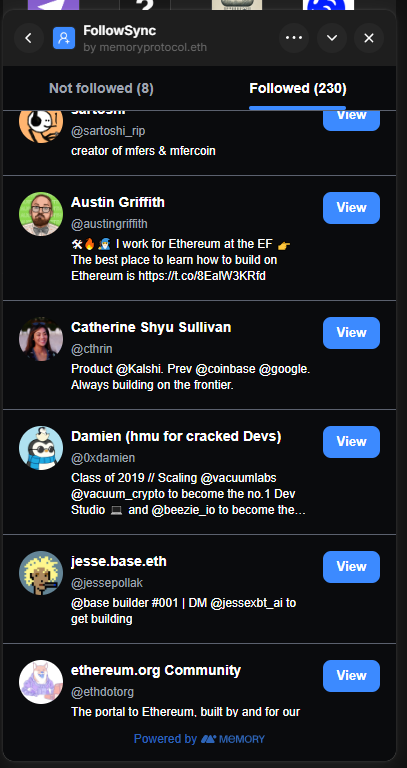
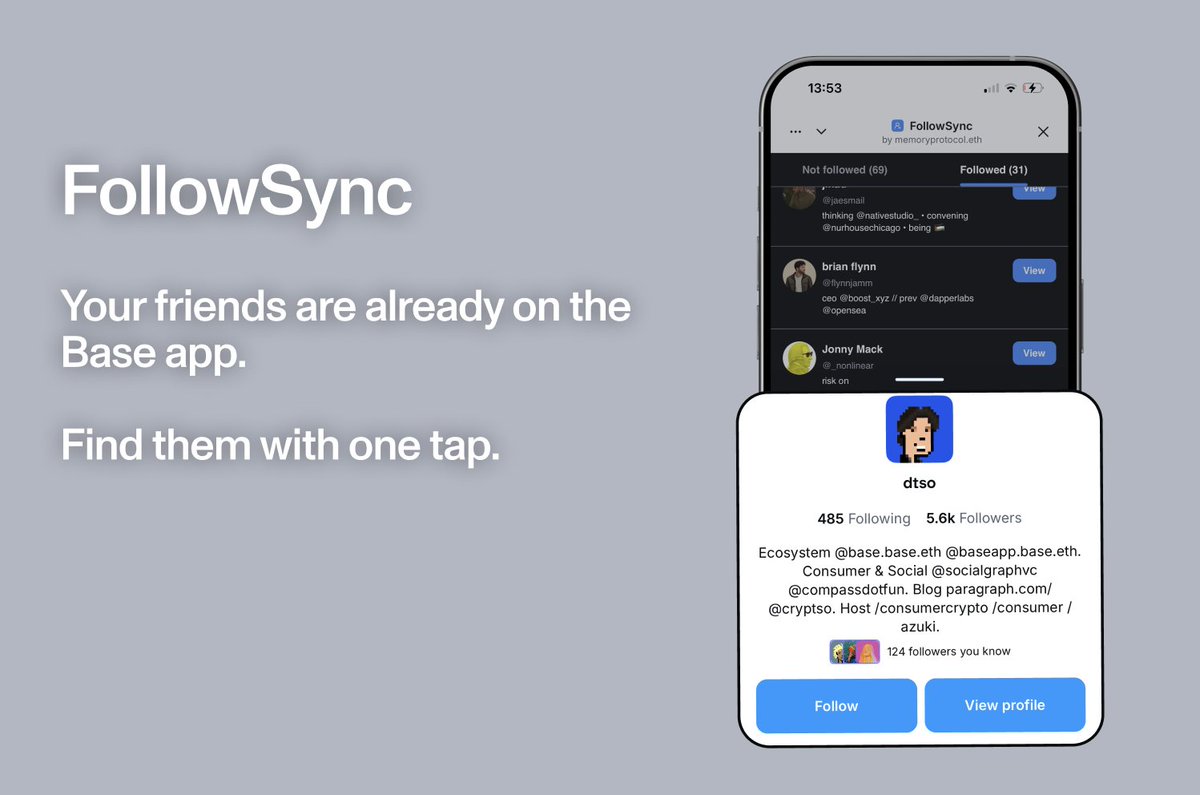
There's a @baseapp mini-app powered by @MemoryProtocol that instantly finds the people you already follow on X.
Massive timeline upgrade.
1. Open Base App or @farcaster_xyz
2. Search "followsync"
3. Sync your people.
easy
English
English
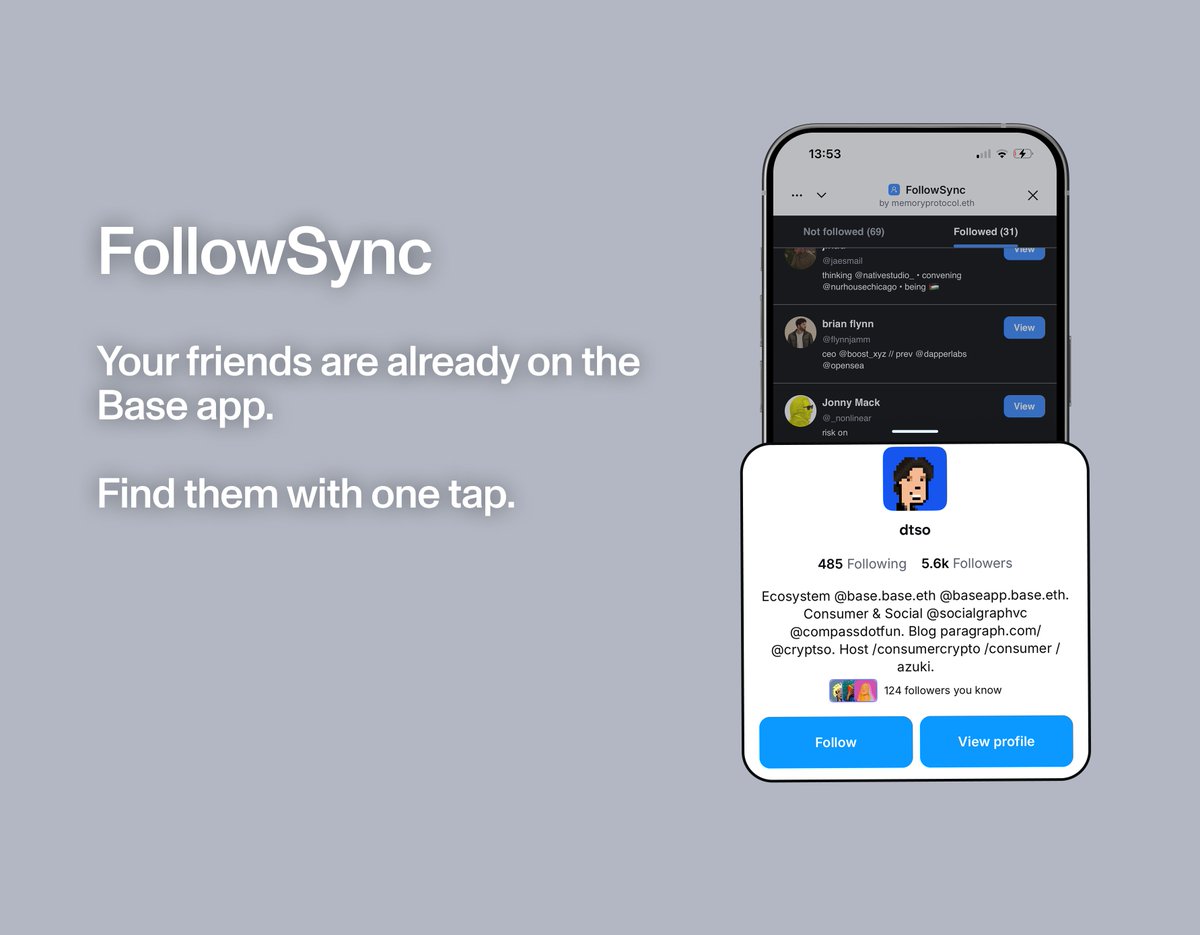
The @baseapp is officially live!
If you just hopped in and your feed is empty, don't waste time hunting for people.
Use FollowSync from @MemoryProtocol. It bridges your X graph so you can find your network on the Base App in click.
Sign, sync, and follow.
↓ base.app/app/followsync…
English
Port your X follows to TBA with FollowSync
Powered by Memory
Jack Spallone@JackSpallone
Day 13: Baseposting ideas showing the value of portable user data Portable friend graph: follow someone once; every mini-app recognizes it. Farcaster and TBA already make this possible, making social, copy-trading, and other apps' UX more seamless. FollowSync, a mini-app built for TBA and using Memory, let's you port your X follows to TBA now, too
English
Build with Memory, create users badges: immediate portability
Jack Spallone@JackSpallone
Day 11: Portable user data will be the killer use case for @baseapp's app ecosystem Portable Badge System NFTs, soulbounds, and attestations inspired a world where reputation and Fortnite skins could move between apps What if it was easier for apps then putting this onchain? The correct model is a Portable Badge System: A cross-app user-data layer where apps read, write, and enrich user attributes without touching onchain infra until they actually need settlement. Apps get two things: 1. Instant enrichment. When a user shows up, the app already knows what type of user they are. 2. Instant portability. Data created inside one app is immediately usable in every other app that opts in. Onchain remains the final checkpoint, not the default datastore. This flips the cost profile. It removes friction. And it makes portability a first-class primitive in the Base App ecosystem. Base alone is in a unique position to service this, enabling a strong value prop for apps to build in their ecosystem, and decentralizing only as necessary later on.
English
Memory रीट्वीट किया
Day 10: Why portable user data is the killer use case for @baseapp mini-apps
Smarter onboarding flows: builders can tailor their conversion funnel much more seamlessly.
The things that normally cause attrition for users with new apps are no longer a problem.
- Auto sync follows
- Know user's interests
- Inherit profile name, image, bio, etc.
It just works better.
English
Music recommendation mini-app for @baseapp
Build this using the Memory API and @factory__fm data
Jack Spallone@JackSpallone
Day 9: Posting unique ideas for @baseapp mini-apps benefiting from portable user data Auto-curated playlists: infer music taste from music app activity, Farcaster likes, X follows and posts. Spotify creates playlists for us based on our music listening, but why not playlists from all of our music related interactions across the internet? One example is @factory__fm, the music review app, which has user's music reviews and could be used to create playlists from a user's rating and sentiment analysis of their reviews. Another possibility is having user's share their Spotify data, either via import or web proofs. [Unfortunately the Spotify API is prohibitive] LLMs make this super easy too, enabling builders to set this up as a service much more easily, where they could auto-generate Spotify playlists in seconds. These could then be shared with others incorporating curator rewards, bringing user payments in to play. The possibilities are endless here when a user's public data from across the web is available to build on.
English
Memory रीट्वीट किया
Day 8 Idea: Why portable data is a killer use case for @baseapp mini-apps
AI memory agent: LLM that uses your aggregate profile as context for every interaction.
Mini apps could use LLMs to build all sorts of vertical specific services; trading agents, recommendation engines, and more.
If TBA and mini-apps had ways to write to user data stores offchain, and that was permissioned to other mini-apps, TBA would take off
English
Memory रीट्वीट किया
Day 6: Portable data ideas for @baseapp
Creator intelligence dashboard: identify superfans across wallets + socials + purchase history.
We know cnchain data is valuable for creators, but offchain + onchain is the holy grail.
Follows, likes, attendance, and offchain purchase history is key. If this was all maintained in a user data store, creator's could have intelligent CRM that gives them actionable insights.
Crazy part? This data already exists, they jus't dont have it, let alone in aggregate.
English
Memory रीट्वीट किया
Day 5 of posting a universal profile @baseapp concept every day for a month
Universal block list: a single layer that syncs across every Base mini-app.
Currently, as a FC client, blocking someone on TBA requires going to FC. With TBA serving as the main hub for one's identity, this should change.
English