Fable: "write me a rhyming poem with six four line stanzas, each stanza removes another vowel. the first has no u, the second no u or i, etc."
Timo Verbeek
135 posts

@TimoV765
Applied GenAI @Zonneplan | perfecting the art of context engineering | all about LLMOps & evals


Fable: "write me a rhyming poem with six four line stanzas, each stanza removes another vowel. the first has no u, the second no u or i, etc."

BREAKING: SpaceX has agreed to acquire Cursor, the world's fastest growing software startup, for $60 billion in an all stock deal. Cursor has over 1 million paying customers, more than $2 billion in annualized revenue, and is projected to hit $6 billion by end of 2026. At $60 billion, this is the largest software acquisition in history, paying 20 to 30 times Cursor's current revenue. The deal is subject to regulatory approval and expected to close in Q3 2026. SpaceX now owns the rockets, the satellites, the AI models, the chips, and is about to own the tool every developer on earth uses to write code.

Breaking: SpaceX said it would buy Cursor for $60 billion, striking a massive deal for an autonomous coding agent shortly after its blockbuster IPO on.wsj.com/4xDAULx


Fable 5 is dead. We just resurrected it — cheaper, open and you hold the keys. OpenRouter dropped Fusion 48h ago and broke the internet. We tested it hard. The synthesizer is insane for deep research… but absolute dogshit for coding. So we fixed it. Meet OrcaRouter.ai DSL — the version you actually own. One prompt → fans out to any panel you want → judge + synthesizer → one god-tier answer. But unlike black-box slugs, you control the entire graph in YAML. Fable 5 level intelligence… without waiting for Anthropic to turn it back on 🧵👇


Anthropic's Mythos has been accessed by a small group of unauthorized users, raising questions about control of the AI model bloomberg.com/news/articles/…


Introducing Project Glasswing: an urgent initiative to help secure the world’s most critical software. It’s powered by our newest frontier model, Claude Mythos Preview, which can find software vulnerabilities better than all but the most skilled humans. anthropic.com/glasswing

Really enjoyed chatting with @michael_nielsen about how we recognize scientific progress. It's especially relevant for closing the RL verification loop for scientific discovery. But it's also a surprisingly mysterious and elusive question when you look at the history of human science. We approach this question stories like Einstein (who claimed that he hadn't even heard of the famous Michelson-Morley experiment, which is supposed to have motivated special relativity, until after he had come up with the theory), Darwin (why did it take till 1859 to lay out an idea whose essence every farmer since antiquity must have observed?), Prout (how do you recognize that isotopes exist if you cannot chemically separate them?), and many others. The verification loop on scientific ideas is often extremely long and weirdly hostile. Ancient Athenians dismissed Aristarchus's heliocentrism in the 3rd century BC because it would imply that the stars should shift in the sky as the Earth orbits the sun. The first successful measurement of stellar parallax was in 1838. That's a 2,000-year verification loop. But clearly human science is able to make progress faster than raw experimental falsification/verification would imply, and in cases where experiments are very ambiguous. How? Michael has some very deep and provocative hypotheses about the nature of progress. One I found especially thought-provoking is that aliens will likely have a VERY different science + tech stack than us. Which contradicts the common sense picture of a linear tech tree that I was assuming. And has some interesting implications about how future civilizations might trade and cooperate with each other. So many other interesting ideas. Hope you enjoy this as much as I did. 0:00:00 – How scientific progress outpaces its verification loops 0:17:51 – Newton was the last of the magicians 0:23:26 – Why wasn’t natural selection obvious much earlier? 0:29:52 – Could gradient descent have discovered general relativity? 0:50:54 – Why aliens will have a different tech stack than us 1:15:26 – Are there infinitely many deep scientific principles left to discover? 1:26:25 – What drew Michael to quantum computing so early? 1:35:29 – Does science need a new way to assign credit? 1:43:57 – Prolificness versus depth 1:49:17 – What it takes to actually internalize what you learn Look up Dwarkesh Podcast on YouTube, Apple Podcasts, or Spotify.


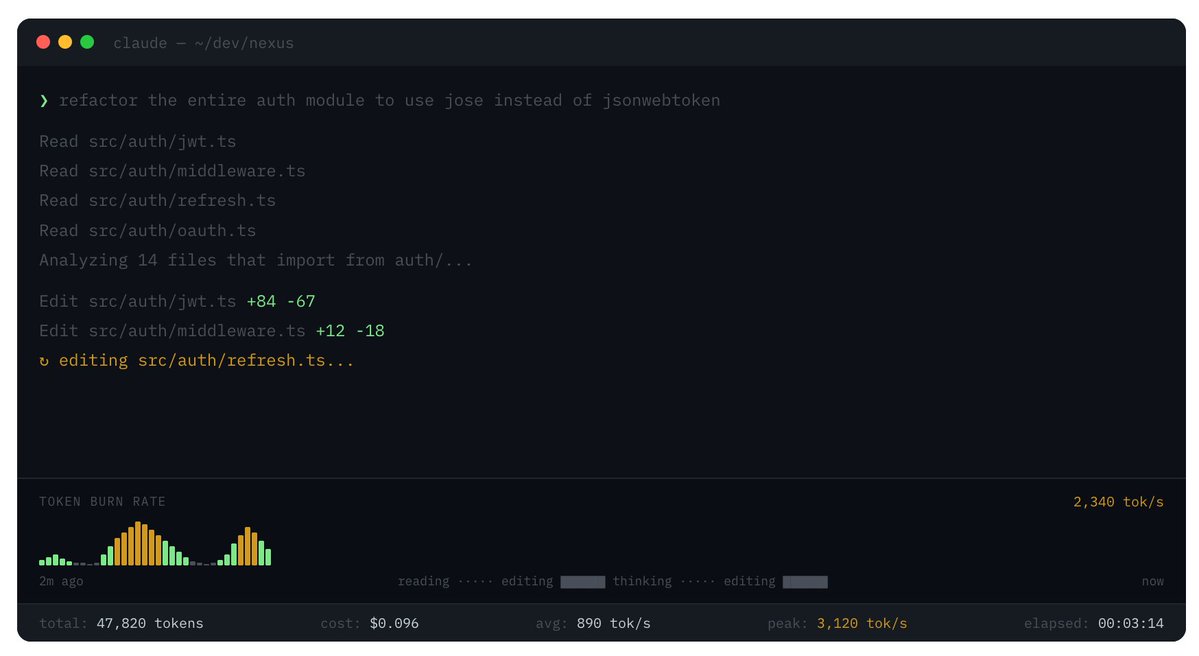
thread of more agent ui explorations: (warning long thread. would be helpful to know which are more interesting) 1) waveform showing your tok/s usage over time