Harry Tchilinguirian 🛢

1.9K posts

Harry Tchilinguirian 🛢 banner
Harry Tchilinguirian 🛢

Harry Tchilinguirian 🛢

@tchiling

#Oil never sleeps" Following / retweets are not endorsements. Tweets are my own. #OOTT

London, England शामिल हुए Şubat 2009
483 फ़ॉलोइंग3.2K फ़ॉलोवर्स
Harry Tchilinguirian 🛢
Harry Tchilinguirian 🛢@tchiling·
Through the oil looking glass pemedianetwork.com/petroleum-econ… Persian poet and mathematician Omar Khayyám wrote: “The Moving Finger writes and, having writ, moves on.” The initiation of military operations by the US and Israel against Iran on 3 March was a transformational moment not only for the Gulf region but also for global oil markets — one from which there is no return. No matter how this war ends, or what objectives are ultimately achieved, there will be no reverting to the previous status quo. At the invitation of @PetroleumEcon, I wrote an opinion piece on the current dynamics of the oil market. With new events unfolding by the hour, it was hard to come up with a thematic that would have a shelf life of more than a half a day. So I took on the idea of how the market achieves equilibrium in these trouble times. With little scope in volumetric adjustments in current state of supply and demand fundamentals, it is all down to price changes to bring about a equilibrium, albeit even fleetingly. For the lost volumes through Hormuz, quantity-wise, there is no immediate replacement solution to allow the oil price to deflate with speculators selling the fact, having bought the rumour. The price adjustment in the coming weeks will inevitably be messy as the market tries to separate signal from noise. Brent futures may well ultimately converge towards the physical Dubai benchmark, with a potential move towards $150/bbl. However, in the near term, it is more likely, if no de-escalation takes place, for Brent futures to converge first towards UAE’s Murban crude valuation, which recently crossed above $125/bbl, before it takes aim at catching up with Dubai. This, in my opinion is likely to come even as Treasury Secretary Scott Bessent dismisses rumours of intervention in financial oil markets and raises the possibility of easing sanctions on Iranian crude already on water and conducting unilateral US SPR releases. #OOTT #OIL #BRENT #US #IRAN
Harry Tchilinguirian 🛢 tweet media
English
2
2
9
4.4K
Harry Tchilinguirian 🛢
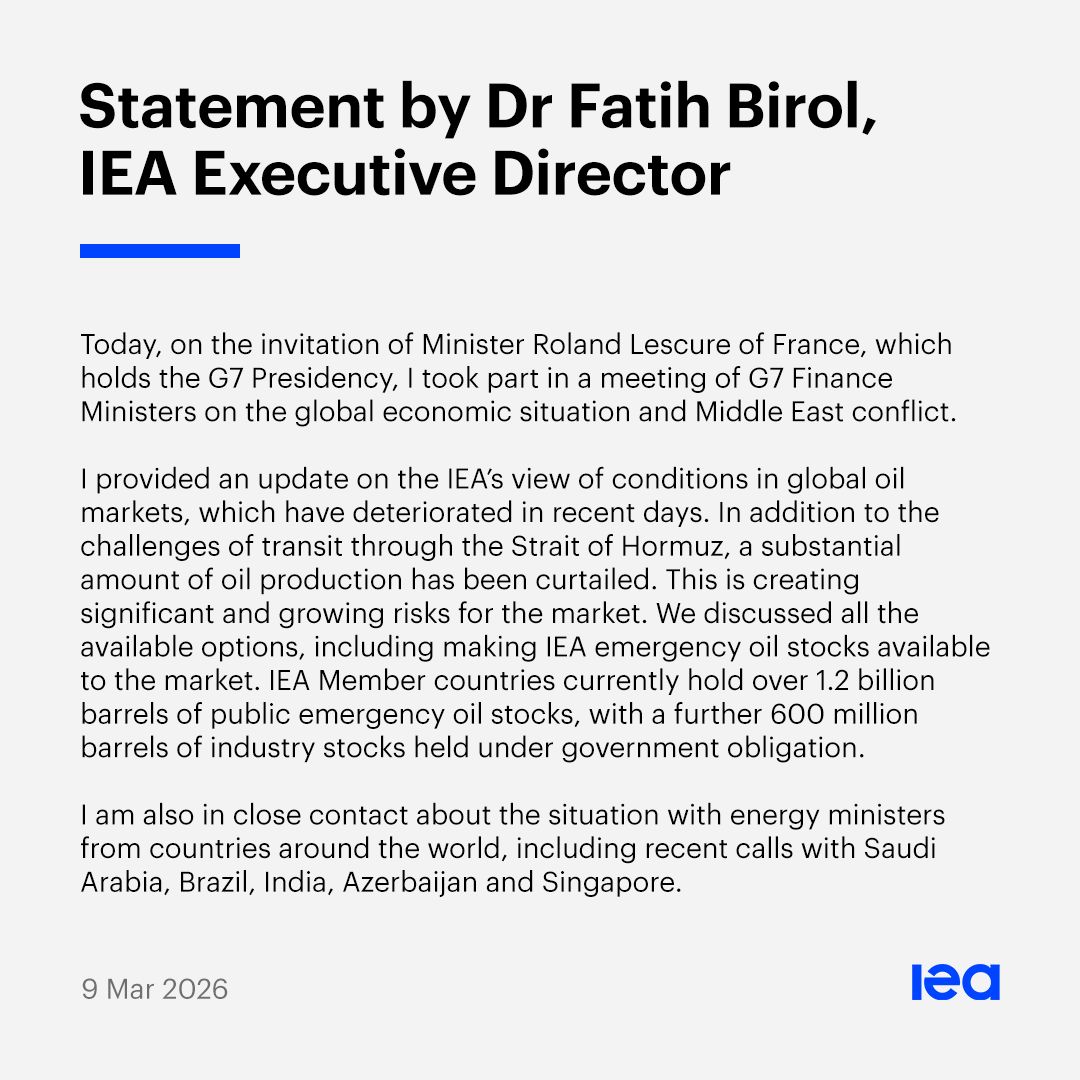
This statement does not feel like the @IEA is imminently ready to pull the trigger on a strategic stock release, or I am reading this wrong? Perhaps it is a slow burning fuse … from there is abundant supply but a logistical problem in the oil market last week to recognizing supply cut backs for key producers in the Gulf this week, maybe we may well slow walk into a coordinated release …
English
0
0
1
364
Fatih Birol
Fatih Birol@fbirol·
Today, on the invitation of Minister Roland Lescure of France, which holds the G7 Presidency, I took part in a meeting of G7 Finance Ministers on the global economic situation and Middle East conflict. My statement on the meeting: iea.li/4ugOD98
Fatih Birol tweet media
English
9
66
107
43.1K
Harry Tchilinguirian 🛢
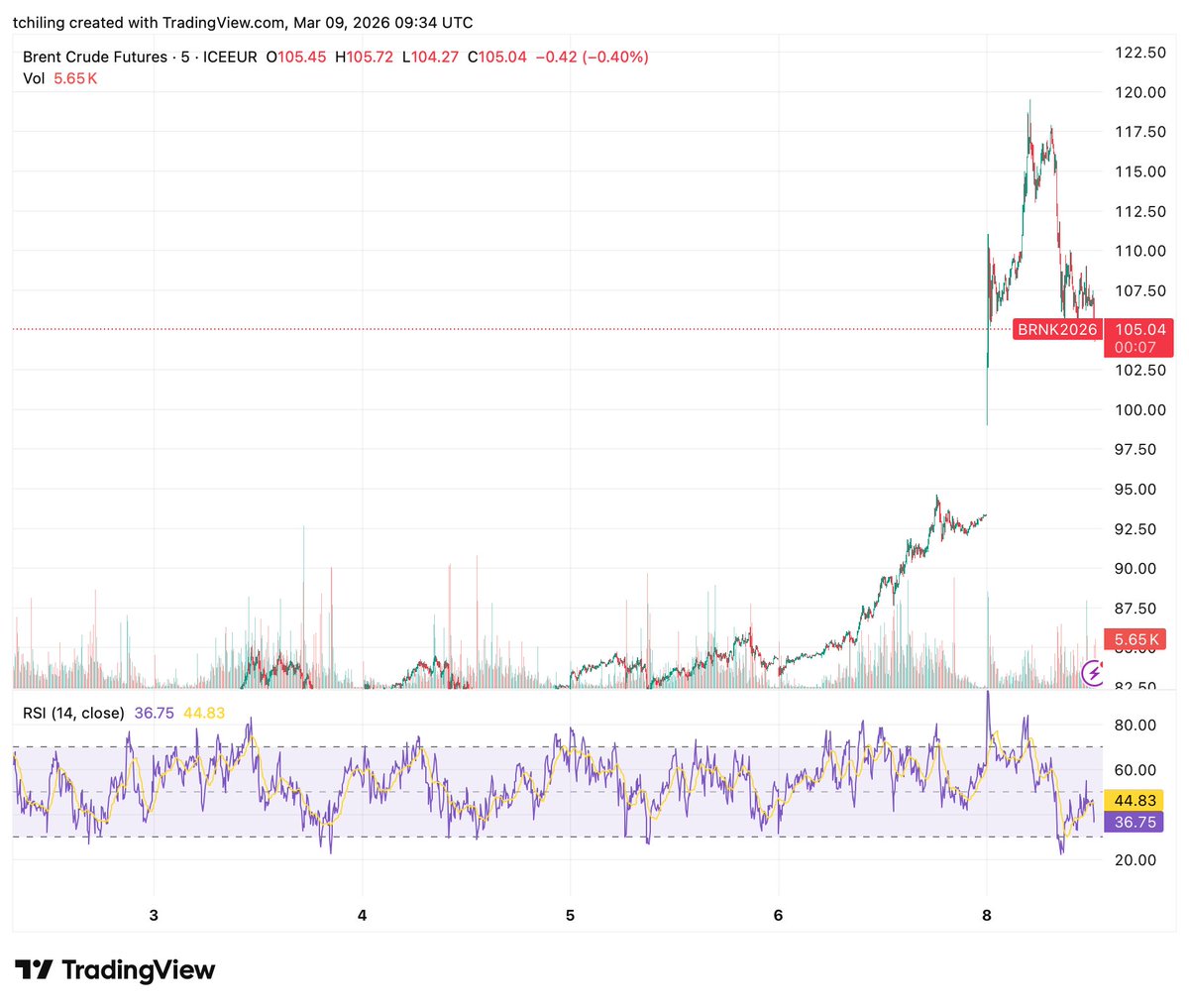
#OOTT #Oil #US #Iran — how markets rebalance Basic economics suggests that market equilibria are reached either through mostly volumetric adjustments — the Keynesian view, reflecting the assumption of sticky prices — or through price alone, if you adhere strictly to the neoclassical school of thought. In practice, the balancing mechanism is usually some combination of both, with the possibility that price can over- or undershoot its theoretical equilibrium level during periods of instability or stress. In the current oil market, a volumetric adjustment — what in trading analytics jargon is referred to as the “solver” — has yet to emerge. This adjustment volume can take the form of a short-term solution such as a release of strategic stocks or the resumption of safe transit for oil tankers through the Strait of Hormuz, understanding there is an the inevitable ramp-up period in normalising logistics and scheduling before flow is fully restored. Alternatively, we can have combination of both where a stock release is a bridge measure before Hormuz traffic returns to normal. #Brent futures surged to nearly $120/bbl at the Asian open this morning, before settling back down at the time of writting around $105/bbl. This is what a market attempting to rebalance looks like in the face of a potentially durable supply disruption. Price is doing the heavy lifting in achieving a new equilibrium. Later today, #G7 governments are expected to hold an emergency meeting to discuss conditions in the oil market and the potential need for a coordinated release of strategic reserves by the International Energy Agency (IEA). The Financial Times reported that energy ministers will hold a call with the IEA’s executive director, Fatih Birol, at 8.30 am New York time. In the interim, while waiting for that call and any decision it might bring, we cannot discount that the flat price of Brent can test higher again.
Harry Tchilinguirian 🛢 tweet media
English
0
1
6
585
Harry Tchilinguirian 🛢
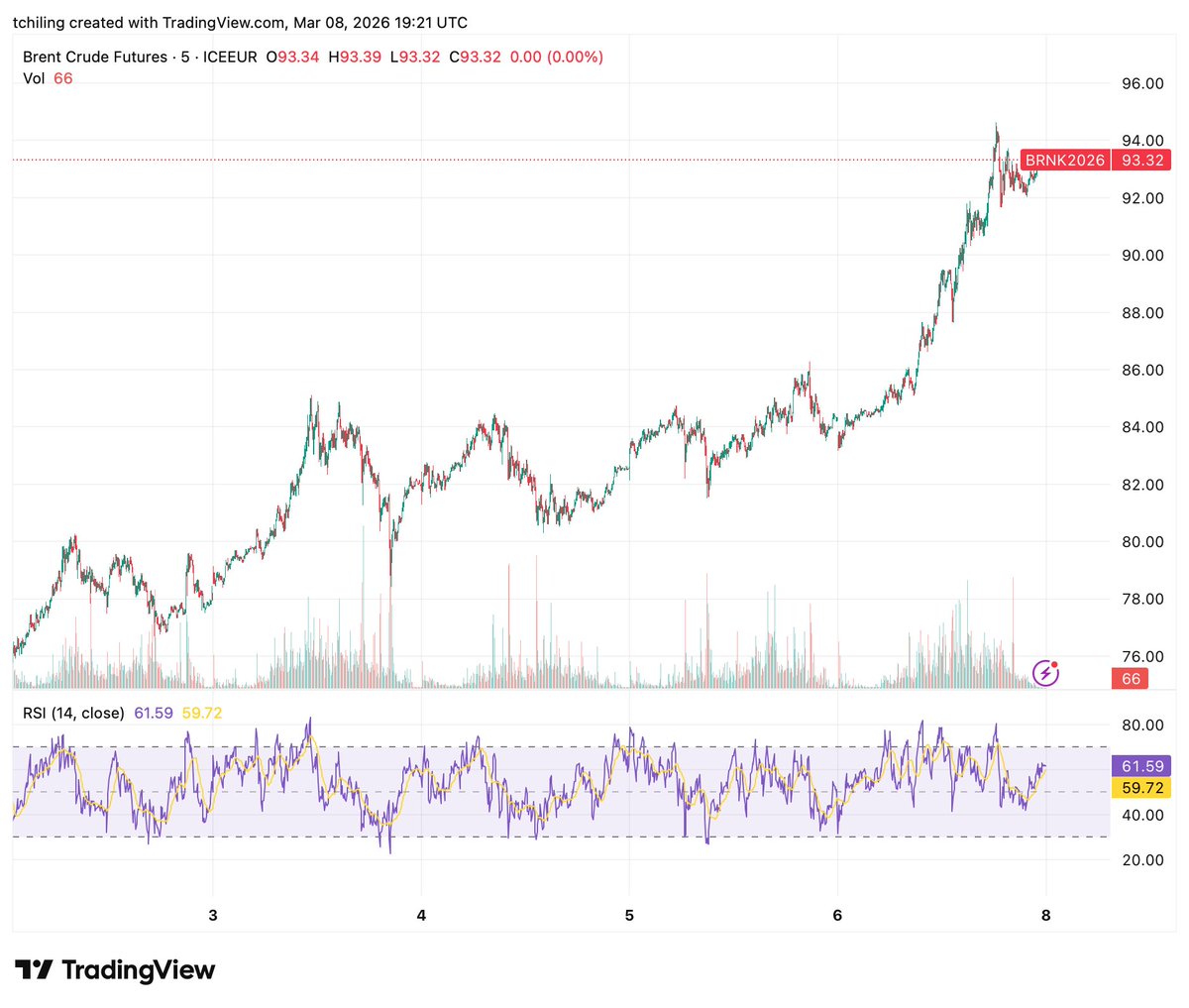
#OOTT What constitutes a supply disruption and the march higher in #oil prices The market’s initial response to the outbreak of conflict between the #US and #Iran was proportionate, with Brent futures climbing from the low $70s into the low $80s a barrel. Last week, Brent rose decisively above $90/bbl as traders began pricing in the supply shock associated with the potential for a prolonged disruption to flows through the Strait of #Hormuz. Physical prices for Middle Eastern crude grades have in turn moved above $100/bbl. Speculation has grown that Gulf producers may be forced to shut in production as limited storage capacity becomes saturated. Iraq has reportedly cut back output, with the UAE and Saudi Arabia thought likely to follow, even as they divert some supply respectively to the Red Sea at Yanbu and to Fujairah on the Gulf of Oman. The Executive Director of the International Energy Agency (IEA), Fatih Birol, indicated last week that global oil supply remained abundant for the time being and that the market faces a logistical, not a production, problem. A release of strategic stocks is not being contemplated at the time of writing. Since its creation, the #IEA has coordinated five emergency stock releases, including during the Gulf War in 1991, hurricanes in the Gulf of America in 2005, the Libyan civil war in 2011, and more recently the conflict in Ukraine. In the event of an actual or potentially severe supply disruption, the agency first assesses the market impact before determining the need for a coordinated response. In the current circumstances, the distinction between a disruption that removes sufficient production to trigger IEA action and the inability of oil to move in and out of the Strait of Hormuz is likely lost on the market. The global oil supply chain is under severe strain as crude cannot reach its end users, most notably in Asia. Barrels that have been unable to leave the Gulf since hostilities began are effectively lost, forcing refiners either to source supplies elsewhere or draw on inventories. For India and China, sanctioned oil held in floating storage offers one option, but only a short-term solution. From the market’s perspective — and arguably in reality — if oil cannot move through Hormuz, the outcome is effectively the same as halting production: a supply gap that pushes prices higher until flows are restored or demand destruction occurs. When producers eventually curtail output at the wellhead is, in my view, less pressing than the need for the market to balance. Whether that occurs through a volumetric solution — such as an IEA stock release or the safe passage of oil through Hormuz — or through a higher flat price, I lean towards the latter. As such, backwardation in the prompt spreads of the curve, already at stratospheric levels could widen further.
Harry Tchilinguirian 🛢 tweet media
English
0
0
3
569
Harry Tchilinguirian 🛢 रीट्वीट किया
JH
JH@CRUDEOIL231·
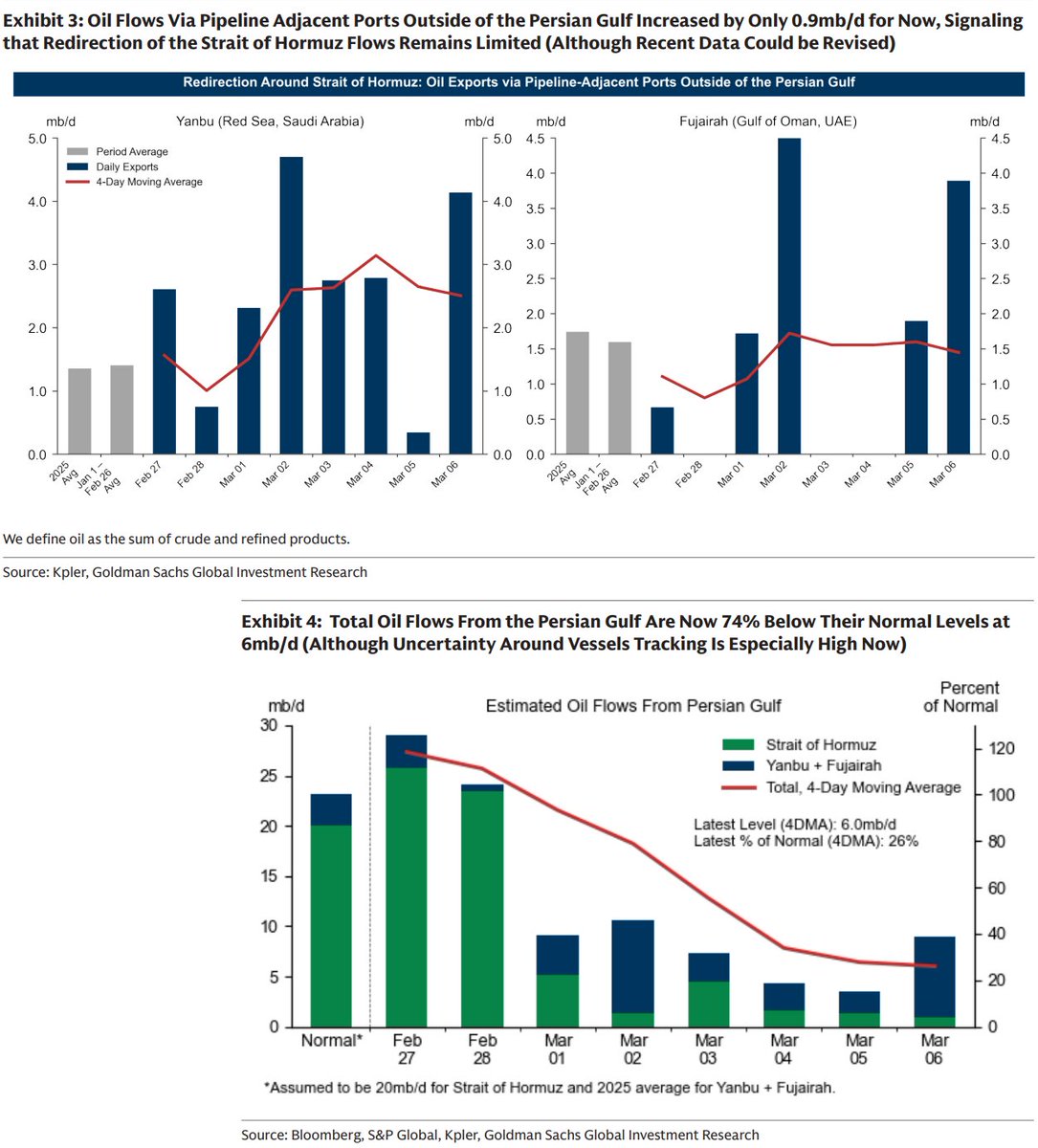
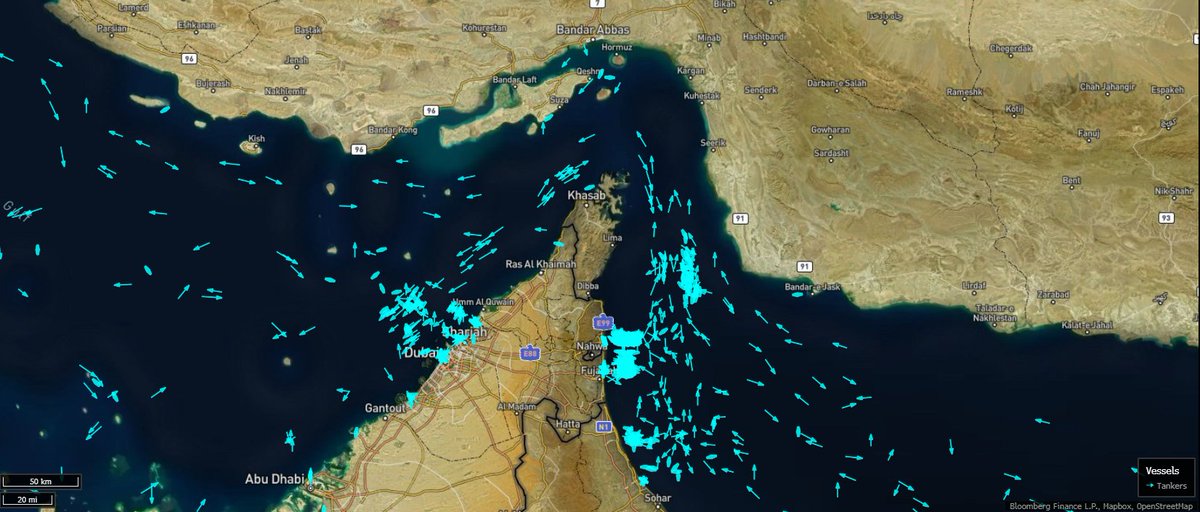
Saudi and the UAE are trying to reroute some of the flow through Yanbu and Fujairah, but it’s nowhere near enough to offset the massive liquid losses from the Hormuz shutdown. On top of that, physical diffs for crude loading outside the Persian Gulf and tanker rates are through the roof—some grades have already blown past $100/bbl. If traffic doesn't get moving again fast, even Saudi and the UAE are looking at production shut-ins. #oott #com
JH tweet media
English
6
37
222
21.3K
Harry Tchilinguirian 🛢 रीट्वीट किया
Javier Blas
Javier Blas@JavierBlas·
TRUMP ON IRAN AND OIL PRICES: "...People felt that something had to be done [on Iran]. So, if we have a little high oil prices for a little while, but as soon as this ends, those prices are going to drop, I believe lower than even before..."
English
28
40
331
110.2K
Harry Tchilinguirian 🛢
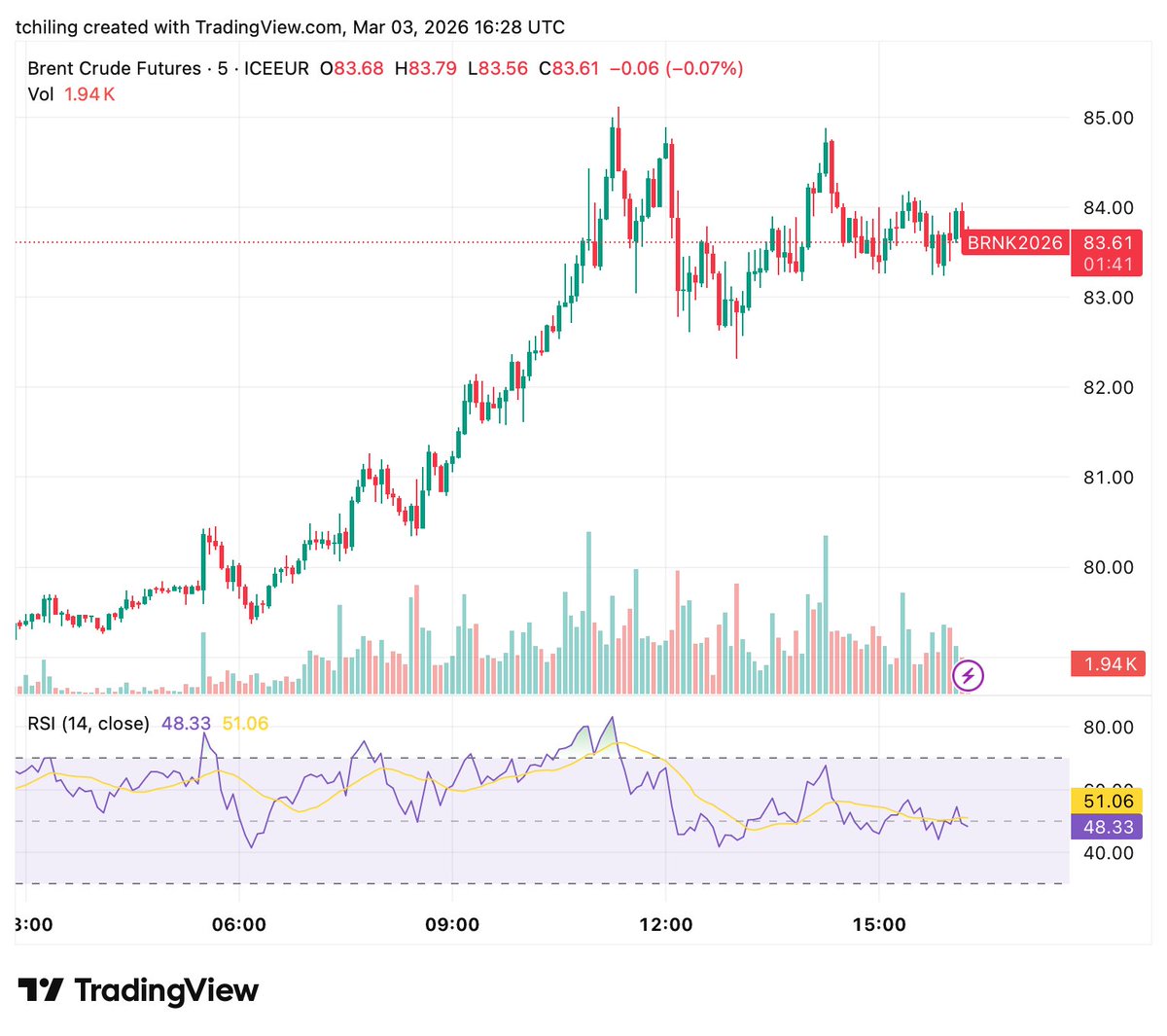
#OOTT #US #Iran - #Oil, why so glum, chum? The rise in oil prices has been relatively restrained given the volume of crude potentially at risk in the region, both in terms of production and flows through the Strait of Hormuz. At the time of writing, Brent futures is trading near $84/bbl — a non-negligible increase from the low $70s seen before the US-Israeli attack on Iran — but from a flat-price perspective, we have seen much higher levels historically. Several mitigating factors may explain why the international benchmark has not pushed decisively beyond $100/bbl, as some had anticipated. To begin with, the market was already heavily positioned on the long side as tensions between the US and Iran mounted. The scope to add further length possibly diminished once kinetic action began, notably given previous Gulf War episodes in 1990 and 2003, when price spikes were followed by swift sell-offs. Commodity trading advisers were holding net long Brent positions above those seen during last June’s 12-day war even before hostilities began. From a physical market perspective, Gulf producers including Saudi Arabia and the UAE had ramped up exports ahead of the confrontation, moving barrels closer to end consumers and reducing the immediate risk of interruption to supply obligations. Key importers of crude transiting the Strait of Hormuz also have substantial storage buffers. Much of the implied stock build in the global oil balance for 2025 and early 2026 came in China’s SPR, which Beijing could tap to keep refineries supplied. In addition, sizeable volumes of sanctioned Iranian crude remain in floating storage in the South China Sea. Indian refiners could step up purchases of sanctioned Russian oil held in floating storage too — something that may already be under way, as Urals’ discount to Brent narrows. Japan, another major buyer dependent on Hormuz flows, has said it holds ample reserves in the event of disruption. There is also the prospect of a co-ordinated OECD response. The International Energy Agency (@IEA) convened an emergency meeting today, raising the possibility of a strategic stock release. More broadly, some investors may be wagering that, given the waterway’s strategic importance, any attempt by Iran to impede durably transit would prompt a swift US response aimed at restoring flows and containing a price rise — particularly given President Trump’s preference for cheap oil. China and India may also become involved if a disruption were to persist. Crucially, there has so far been no significant damage to oil infrastructure (loading and production). While that risk cannot be discounted, Gulf states’ air defence systems appear, so far, to be containing drone and missile threats. Taken together, these factors help explain why, despite a pivotal Middle East episode, oil prices have reacted in a proportionate fashion rather than spiking as if we were hit by a sustained supply shock. What are your thoughts? Why isn’t oil rocketing? 🚀
Harry Tchilinguirian 🛢 tweet media
English
4
0
5
625
Harry Tchilinguirian 🛢 रीट्वीट किया
Bachar EL-Halabi | بشار الحلبي
🚨#Pakistan PM’s statement following his call with the Saudi Crown Prince makes no mention of Iran, which has attacked Saudi Arabia and other Gulf countries. Notably, Pakistan and Saudi Arabia signed a defense pact just weeks ago. While expressing “full solidarity” with #SaudiArabia and “the brotherly Gulf countries,” and condemning the Israeli attack on #Iran and the “subsequent attacks in the Gulf region,” the statement makes no explicit reference to Iran’s missile strikes on those same Gulf countries.
Shehbaz Sharif@CMShehbaz

I spoke with my dear brother HRH Crown Prince Mohammed bin Salman this evening to express Pakistan’s strong condemnation of the dangerous regional escalation following the Israeli attack on Iran and subsequent attacks in the Gulf region. Pakistan stands in full solidarity with Saudi Arabia and our brotherly Gulf countries in this perilous time. We remain ready to play a constructive role for peace and pray that the blessings of Ramadan bring calm and stability to our region.

English
1
4
4
5K
Harry Tchilinguirian 🛢 रीट्वीट किया
Javier Blas
Javier Blas@JavierBlas·
Very early hours. Lot may change. So far on oil: 1) Oil loading continues KSA, UAE, Kuwait, Qatar, Iraq 2) Tankers crossing Hormuz, but a few U-turning 3) A single report of explosions at Kharg Island (maybe the small Iranian navy base?) 4) OPEC+ meeting Sunday; KSA/UAE surge?
Javier Blas tweet media
English
20
337
1.2K
323.8K
Harry Tchilinguirian 🛢
Harry Tchilinguirian 🛢@tchiling·
#OOTT #US #IRAN: 48 hours is a long time The United States and Israel have initiated military operations against Iran, with reports of bombings across the country. Tehran has responded by targeting US air bases and other sites in the Middle East and Israel. The objective has been made clear by President Trump: beyond eliminating imminent threats to the American people and denying Iran any potential to acquire nuclear capability, the aim of this military operation is also regime change and to enable the Iranian people to overthrow their government and to take back their country. From an oil market perspective, it is unsurprising — as many have noted — to act while markets are closed. How the oil market will respond 48 hours later, at Monday’s Asian open, will depend on the outcomes of the military actions. This can include, but is not limited to, the neutralisation of Iran's navy to ensure the continued flow of oil through the Strait of Hormuz, the destruction of missile launch sites or the removal of key religious leaders, government and political officials, or senior members within Iran's Revolutionary Guard. Any announcements from OPEC+ in the interim, regarding a potential increase in production to offset the potential for a prolonged disruption to Iranian crude exports, will also shape market sentiment, as could a statement from the International Energy Agency on its readiness to release stocks. 48 hours can be viewed, in my view, as a long period of time under these circumstances. The key question is how much the US and Israel can achieve over the course of the weekend to prevent oil prices from overshooting on Monday. And the length of time between any price spike and a very long market subsequently selling into the price rise, will depend on the extent of success of this military operation.
English
0
1
3
813
Harry Tchilinguirian 🛢
Harry Tchilinguirian 🛢@tchiling·
People often forget that the observation made in terms of the number of assets is intended purely to provide historical context. The objective of the build-up in the Persian Gulf has yet to be made explicit: is it designed to bolster diplomatic leverage as talks with Iran continue in Geneva, or is it a prelude to future kinetic action? Time will tell. I am no military expert either, but I do not think that anyone is disputing for example that US Air Force capability today is not what it was back then. In previous Gulf military build ups, F-16s, F-18s and, mostly F-15s underpinned US air dominance. Today, the fifth generation aircraft like the F-22 Raptor and F-35 Lightning, alongside the extensively upgraded F-15E fourth generation fighter gives the US orders-of-magnitude greater air dominance and offensive capabilities.
English
1
0
1
170
Javier Blas
Javier Blas@JavierBlas·
@NomadSolv2024 I'm simply an observer. And I'm noting the firepower vs other periods. I have not make a comment on whether it is "doable" or "undoable." For starters, we don't know what the "do" is. And that's part of the problem.
English
4
1
51
4.4K
Harry Tchilinguirian 🛢 रीट्वीट किया
Javier Blas
Javier Blas@JavierBlas·
During the Gulf War in 1990-91, the US deployed six aircraft carriers to the region (and two additional French and UK carriers), including four US carriers inside the Persian Gulf. In 2003, it deployed five. So far, the US has one carrier in the area with another approaching.
English
34
58
371
122.5K
Harry Tchilinguirian 🛢
Harry Tchilinguirian 🛢@tchiling·
👍 Very good context. The US hardware and troop presence is indeed well below that seen in previous Gulf deployments. In each of those episodes, the mission objective was defined — to liberate Kuwait or to topple Saddam Hussein’s regime. By contrast, in the current US-Iran confrontation, the objective remains unclear, making it difficult to judge whether the present deployment is still in its early stages or is close to its end.
English
1
1
9
4.1K
Harry Tchilinguirian 🛢
Harry Tchilinguirian 🛢@tchiling·
@JavierBlas Interesting how shifts in the global geopolitical landscape since the outbreak of the war in Ukraine to latest US-Iran confrontation has a curious way of reshaping your priorities #OOTT
English
0
0
2
443
Harry Tchilinguirian 🛢 रीट्वीट किया
Javier Blas
Javier Blas@JavierBlas·
Words matter: (Quick count of IEA executive director Fatih Birol's opening remarks at the agency's biennial ministerial meeting in Paris today) Security: 11 Nuclear: 8 Oil: 6 Gas: 6 Hydro: 4 Afordable / afordability: 4 Solar: 3 Wind: 2 Geothermal: 2 Climate: 2 Net zero: 0
Javier Blas@JavierBlas

IEA executive director Fatih Birol proposes focusing the agency's work in three areas during the next few years: 1) energy security -- "first and foremost" mission 2) new energy uptake (wind, solar, geothermal, nuclear) 3) afordability of energy "IEA 3.0" may well be over.

English
11
38
161
27.2K
Harry Tchilinguirian 🛢
Harry Tchilinguirian 🛢@tchiling·
Sometimes, it is just best to do nothing #OOTT #OPEC #Surplus #Oil #Supply IE Week is nearly wrapped up. Across the many discussions, a projected large surplus in the global oil balance — notably in Q2 — brought into focus what OPEC+ might do next. In a brisk virtual meeting on 1 February (lasting six minutes), eight OPEC+ countries behind additional voluntary cuts in April and November 2023 (Saudi Arabia, Russia, Iraq, UAE, Kuwait, Kazakhstan, Algeria and Oman) maintained their 2 November 2025 decision to pause production increases in March 2026. As usual, future supply policy decisions would be subject to market conditions, and the 1.65 mb/d of output could be reinstated, fully or partially, in a gradual fashion. With Brent trading just under $70/bbl and the prompt forward curve anchored in backwardation, the question is what should the eight OPEC+ members do at their 1 March meeting. Some participants during IE Week suggested the group may need to proactively reduce output to mitigate the anticipated surplus and lessen the risk of a sharp price decline, though that view was far from unanimous. The International Energy Agency (IEA), in its latest monthly oil market report, indicates that “observed oil inventories rose by a further 37 mb in December, taking global stock builds in 2025 to an extraordinary 477 mb, or 1.3 mb/d on average, a level not seen since 2020. Chinese crude oil stocks built by 111 mb last year, while oil on water swelled by 248 mb, of which sanctioned oil accounted for 72%.” The late Queen Elizabeth II is often credited with suggesting that the best course of action is sometimes to do nothing. While there is no official record of the remark, it is consistent with a reign marked by patience and restraint. Across the Channel, more reliably, Napoleon Bonaparte is quoted as saying that “the best course of action is often inaction". Considering the implied global stock change above 4 mb/d in Q2 according to the IEA, should OPEC be proactive and cut output? This is where the geography and composition of stock builds (commercial, strategic or floating) come into play. Commercial OECD stocks are relatively low, explaining why the oil price is holding up. Heightened geopolitical tensions between the US and Iran, along with temporary supply disruptions in the Caspian, Libya and the US, have also supported Brent recently. During IE Week, Greg Sharenow of PIMCO said at a Bloomberg seminar that he would characterize OPEC’s recent policy as more pragmatic. That feels right. Extending the current pause while assessing how the Q2 surplus materialises — particularly the split between commercial and strategic inventories, and their location across OECD pricing hubs versus non-OECD markets — may be the best course of action. I do not expect any proactive move by OPEC. Rather, in central-bank fashion, it is likely to remain data-dependent when steering its supply policy. What are your thoughts? Please comment below and take part in the poll - what should OPEC+ decide for its oil supply on 1 March?
English
1
0
1
487
Harry Tchilinguirian 🛢 रीट्वीट किया
The Kobeissi Letter
The Kobeissi Letter@KobeissiLetter·
BREAKING: President Trump says he expects to make a "good deal" when he meets with China's President Xi. The S&P 500 is now 20 points away from a record high.
English
128
163
2.3K
218.9K