Hey JJ! I’m not sure there’s a true AI-Energy ETF yet that would outperform a DIY basket. If anyone knows one, definitely chime in. The existing funds I know of either lean too utility-heavy, too clean-energy focused, or miss the actual load-driven bottlenecks forming around AI buildouts.
The way I loosely think about the basket is something like this:
• Gas-to-Power
• Nuclear (new-build + SMRs + fuel cycle)
• Thermal + Power Conversion
• Grid modernizers (transmission, substations, transformers)
• Long-duration storage / utility-scale batteries
• Tactical fossil generation (reliability + backup)
• Pipelines + compression (moving molecules to load pockets)
• Grid software + controls
• Water + liquid cooling (as rack density climbs)
• Optional solar slice (mostly utility-scale, for system cost balancing)
🚨Data Centers Are Pushing the U.S. Power Grid Toward Its Limits
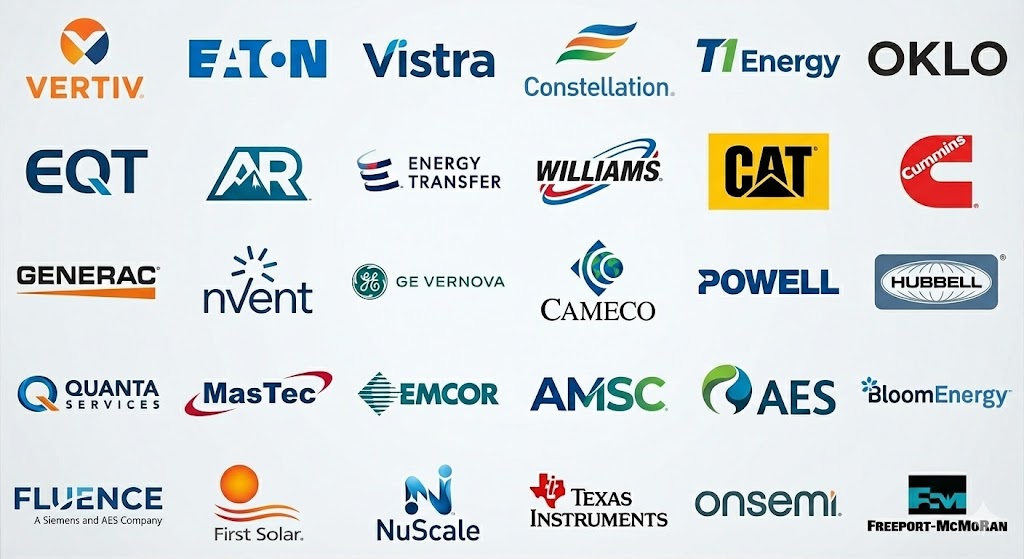
$VRT $ETN $VST $CEG $TE $OKLO
AI demand keeps climbing, and the strain is showing up everywhere
Power, thermal, transmission, fuel, and nuclear.
Here are some of the names that keep surfacing… and how I’m thinking about this sector moving forward.
$VST
Vistra is becoming one of the most closely watched power players in the U.S.
A fleet of gas + nuclear assets. Direct exposure to wholesale pricing.
And now… hyperscalers exploring long-term power arrangements around key units.
Their footprint puts them right in the middle of several emerging “AI load pockets.”
$EQT / $AR
Upstream gas sits at the beginning of the near-term AI power stack.
Appalachian supply touches multiple regions where AI development is accelerating.
If grid constraints persist, flexible gas remains one of the few tools utilities can lean on to balance rising baseload needs.
$ET / $WMB
Pipelines determine where hyperscalers can physically build.
Energy Transfer and Williams operate major systems feeding the exact regions seeing the most datacenter activity.
Throughput, contract mix, and siting constraints all matter here.
$CAT / $CMI
This is the industrial end of backup power.
When a hyperscaler builds a 50–100 MW campus they call Caterpillar. They call Cummins.
Both companies recently highlighted rising interest from AI-driven datacenter projects evaluating multi-MW diesel and gas gen-sets.
$GNRC
But Generac still matters, just in a different lane.
Commercial + distributed backup.
Campus-level resilience.
As reliability concerns surface across multiple regions, smaller-scale, fast-deploy options are drawing more attention.
$ETN
Eaton is embedded in the electrical spine of every datacenter: switchgear, UPS, PDUs, breakers.
Management keeps pointing to broad electrification strength, and datacenters are a visible contributor.
Extended lead times across the electrical stack continue to signal tight conditions.
$VRT
Vertiv is becoming a core part of the AI-thermal conversation.
Air cooling is hitting its limits.
Liquid loop systems are accelerating.
Bookings and customer planning suggest thermal density is moving into a new era and Vertiv is sitting in the middle of it.
$NVT
nVent is the connective tissue behind liquid cooling.
Manifolds, CDUs, valves, routing.
As racks move from 40 kW to 80 kW t0 100 kW+, fluid distribution becomes standardized.
nVent’s hardware is increasingly part of hyperscale cooling designs.
$GEV
GE Vernova touches almost everything:
Gas turbines. Wind repowering. Nuclear service. HV equipment.
Utilities have been vocal about load growth and grid strain.
GEV’s backlog reflects those long-cycle realities.
$CEG
Constellation is now in the center of the nuclear conversation.
Largest U.S. operator.
Carbon-free baseload.
And yes hyperscalers are exploring long-duration supply structures linked to assets like these.
The Microsoft–Three Mile Island deal was a big signal.
$CCJ
If nuclear becomes a bigger part of AI power planning, uranium enters the conversation too.
Cameco is the most investable Western supplier.
Supply remains tight. Geopolitics remain complex.
Fuel matters.
$POWL
Powell is a pure read-through on grid infrastructure stress.
Switchgear, motor-control centers, E-houses. All showing extended lead times.
Their backlog reflects one of the clearest multi-year pushes to expand T&D capacity.
$HUBB
Hubbell remains tied directly to transmission and distribution upgrades.
Connectors, insulators, HV components.
The parts utilities consistently cite as stretched.
If the grid keeps tightening, Hubbell stays relevant.
$PWR
Quanta builds the grid. Literally.
Transmission, substations, underground HV, fiber.
Interconnect queues are not slowing down.
Execution capacity becomes a differentiator and Quanta keeps showing up in these conversations.
$MTZ
MasTec sits at the intersection of pipelines, T&D, renewable EPC, and comms.
They’ve been referencing emerging “AI load pockets” in their commentary.
That’s a tell imo.
Multiple infrastructure layers are being pulled forward at once.
$EME
EMCOR is inside the walls of the datacenter.
Mechanical systems, electrical buildout, HVAC.
As liquid cooling expands, so does the complexity of MEP work.
EMCOR’s backlog has been reflecting this shift.
$AMSC
Grid stability is becoming a bigger topic as AI loads ramp unpredictably.
AMSC’s HTS cable and power-electronics systems offer one path to smoothing volatility.
Utilities are starting to explore more tools in this category.
$AES
AES continues building renewable + storage portfolios tuned for hyperscale buyers.
Their shift toward “24/7 matched” frameworks aligns with what the big players are now signaling.
A diversified, global footprint helps in regions where load is moving unevenly.
$BE
Bloom Energy provides modular SOFC systems that can supplement constrained utility feeds.
Not a full replacement, but a meaningful tool when interconnect timelines slip.
Several large buyers have evaluated these systems for capacity support.
$FLNC
Fluence remains tied to storage deployments across utilities and IPPs.
Multi-hour storage is becoming a standard part of grid planning as renewable penetration rises.
AI load spikes further reinforce that trend.
$FSLR
First Solar supports long-term procurement strategies and helps offset peak daylight load.
Domestic manufacturing and IRA alignment give them a differentiated position.
Not baseload, but still relevant to the energy mix hyperscalers assemble.
$SMR / $OKLO
Advanced nuclear is no longer a distant idea.
Federal programs, investor interest, and early hyperscaler conversations are all pulling this category forward.
Still early but meaningful traction is forming.
$TXN / $ON
Power semis decide how efficiently electricity moves from grid → PSU → accelerator.
As thermal envelopes expand, every percentage point of conversion efficiency matters.
Both companies have pointed to datacenter power management as an emerging driver.
$FCX
Copper sits underneath everything
Transformers, HV lines, motors, datacenter busbars, cooling hardware.
Long development cycles + rising demand = structural tightness.
FCX remains one of the clearer ways to express that constraint.
$TE
T1 is a high beta domestic manufacturing swing.
Solar modules, storage components, policy alignment.
Execution will matter, but the thematic tie-in is clean and the potential is big.
....
General thoughts on the trajectory -
AI demand may continue rising faster than new energy supply.
This creates localized pressure across multiple regions.
Unregulated power could see growing interest.
IPP models offer different exposure to wholesale price dynamics.
Grid hardware and labor remain tight.
Switchgear, transformers, HV line components, and skilled crews continue to show multi-year strain.
Gas likely stays in the mix near-term.
Upstream → pipelines → flexible generation remains a central bridge.
Thermal density keeps trending up.
Liquid cooling looks positioned for wider adoption.
Storage continues accelerating.
Utility-scale batteries appear in more planning cases each quarter.
Nuclear interest is expanding.
Policy, procurement, and long-range planning are increasingly referencing advanced nuclear.
AI’s footprint is pulling the entire energy ecosystem into a new phase
The companies closest to the physical constraints continue to attract attention.
Please keep in mind, I am not saying that all of these are good investments (none of this is FA)
I am simply disscussing the companies that I see alot of conversation around. I am sure that some names have been left out. The individual names that I am invested in do show up in this post however.
I will reveal those along with a full deep dive into this Layer (Layer 8) of my investment framework within the next few weeks
In the second part of a series, E&W student Will Forsyth details what he learned in his most recent quarter at Kellogg and how he has been able to apply that knowledge in a practical and impactful way in his current role at Amazon Web Services. kell.gg/iwc
FTX US is hiring for CS! We find that people who do best in this role come from a variety of backgrounds (including straight out of school), but share in common that they are passionate about crypto and FTX, are great at communicating, and enjoy working independently.
#NCAAB 1/14
🏀NEB-PUR U 155.5 (150.8)
🏀BUFF-BALL U 162.5 (156.2)
🏀Monmouth -3 (-4.8)
🏀Kent St -1.5 (-2.5) @LineProphetLLC
🏀Richmond -1 (-2.2)
Could be another.
#FOOS
#NCAAF WEEK 1 BIG BOY
🏈Kansas St -3
🏈WMU-MICH O 66
🏈Maryland +2.5 -105
🏈San Jose St +14.5 -118
🏈TTU-HOU 1H U 31.5
🏈ORST-PUR O 67.5
🏈UTSA +5
There will be adds and 2H plays.
#FOOS
Large cap that’s being slept on right now: $NYC
- 8 million people
- best bars, clubs, and restaurants in the world
- society on the verge of freedom
Send it
Just moved to the city. Let me know if you want meet up