Rajendran Vasudevan

13.3K posts

Rajendran Vasudevan

Rajendran Vasudevan

@Balanced_2016

Bergabung Şubat 2016
502 Mengikuti202 Pengikut
Rajendran Vasudevan
Rajendran Vasudevan@Balanced_2016·
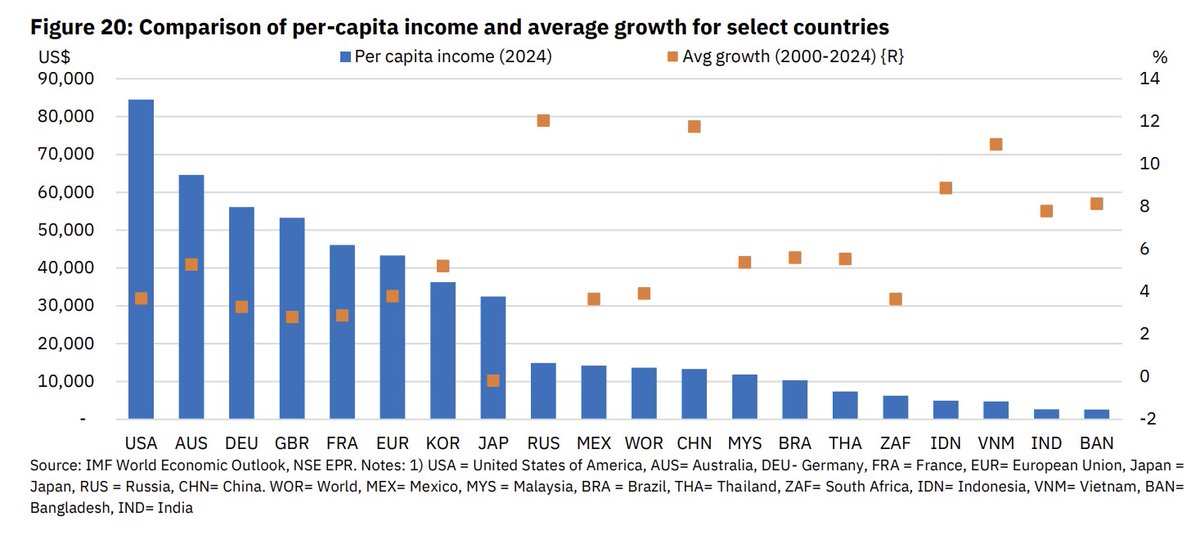
@moneyworks4u_fa In the last 14 years or so we have only grown at the global average in terms of per capita income. At that rate our rank won't go anywhere. You will need dig into the official numbers, remove the passing and then reestimate to triangulate this
English
0
0
1
61
Sandeep Kulkarni
Sandeep Kulkarni@moneyworks4u_fa·
Over time India's rank in Per capita will also rise due to higher GDP growth rate. What is astomishing is that developed countries per capita income has grown 3x on such big base, in that context India's growth is quite low. Even more astonishing is 2 authoritarian communist regimes have done extraordinarily well for their citizens compared to democracies as they have by far the highest growth rates for per capita Income. Source: NSE pulse
Sandeep Kulkarni tweet media
Steve Hanke@steve_hanke

#IndiaWatch🇮🇳: India boasts the WORLD'S 4th largest GDP. But, when it comes to income per person, India comes in at a lowly 126th in the world.

English
4
9
56
6.8K
Rajendran Vasudevan
Rajendran Vasudevan@Balanced_2016·
@tanvi_ratna @1shankarsharma Technical boundaries of icbms in terms of solid, liquid engines, heat shield for reentry, combined with controls for manoeuvre. ICBMs simply carry more fuel. For comparison, our pslv was an icbm prototype. And what do you recommend the donald do to N K or Iran or Russia?
English
1
0
1
19
Tanvi Ratna
Tanvi Ratna@tanvi_ratna·
There is debate about Iran lying about their nuclear program, but there is already proof they lied about having / building long range ballistic missiles. The attacks on Diego Garcia were not possible without them.
dan linnaeus@DanLinnaeus

On the heels of the JCPOA, under Obama in mid 2016 Iran began using the deal’s ambiguities to preserve and advance its centrifuge infrastructure while receiving sanctions relief. It resumed manufacturing of rotor tubes, removed their first gen IR1 centrifuges from Fordow for unauthorized R&D, conducted extra mechanical testing on IR8s, and fed uranium into an IR6 cascade, all in violation of JCPOA centrifuge R&D limits. That same year, there were repeated heavy water stockpile breaches and exploitation of quality assurance loopholes. Then in Jan 2018 Mossad exfiltrated the half ton of documents that revealed the AMAD Project. It was definitive proof that Iran lied, and that program was never halted but merely corporatized and dispersed under SPND. That haul was the proximate trigger for Trump’s withdrawal. The fact is JCPOA never fully dismantled Iran’s enrichment capability or its weapons related infrastructure. Once the US withdrew from the deal, Iran accelerated its installation of centrifuges in 2019 and by July they’d crossed the 300 kilo stockpile cap and the 3.67 percent low enrich limit. But it was only once Biden was elected that they began to aggressively install advanced centrifuge cascades and enrich to much higher levels. Two weeks before Biden’s inauguration Iran resumed 20% enrichment at Fordow. While the Biden admin was gearing up to revive the JCPOA, Iran was calculating that it can exploit their softer approach. In the final analysis, it appears Trump didn’t let anything out of a Pandora’s box as Blinken and Sullivan allege. He made a policy judgement people can disagree on, but facts matter. Iran never gave up its clandestine nuclear weapons program. At the time that the Iran nuclear deal was negotiated and entered into, the details of that program remained unknown. They were pushing beyond the limits of the agreement the same year they signed it while still under Obama. None of that dealt with undeclared sites, the secret weaponization and research programs sitting in SPND workshops dispersed across the ministry of defense. None of it dealt with the way the sanctions relief enabled the Iranians to build a shield of missiles, drones and proxies to enable a breakout sprint. But the JCPOA as framework did create visibility into their program and that ultimately improved our target bank and bolstered deterrence along the way. It undoubtedly helped to map their supply chains and established a clearer baseline for what breakout would look like. So Republicans are wrong that it was purely a mistake or counterproductive. At the same time, what Blinken has recently said about rolling the JCPOA at expiry into a new arms control agreement or militarily intervening if they refused is strategically blind. By that point, the costs of intervening would have been prohibitively high. Trump’s decision to walk away from the deal and pursue a maximum pressure campaign was critical for keeping them from achieving a zone of immunity to conventional intervention. In sum, neither Democrats nor Republicans are fully correct on this issue and certainly neither are fully correct about each other’s positions. But this looks much more like the left foot kicking the right foot when they should be coordinating on how to move forward with respect to the real problem and the real culprit here, which is Iran.

English
15
9
69
16K
Rajendran Vasudevan
Rajendran Vasudevan@Balanced_2016·
What else will be the objectives for ground operations?? Those 400 kgs of enriched uranium?? Forget it. Finally it is about destruction of infra like water, oil and energy on both sides. That is already underway.
English
0
0
0
24
Rajendran Vasudevan
Rajendran Vasudevan@Balanced_2016·
It is the same method used for bringing down the F 15 couple of days back. Warthog the air cover too won't survive where supersonic jets can't. In spite of that if the us Army takes Kharg Island, how long will they hold. Thousands of us soldiers will become sitting ducks.
English
1
0
0
59
Rajendran Vasudevan
Rajendran Vasudevan@Balanced_2016·
x.com/Balanced_2016/… Yes the donald won't commit body bag through a ground action. That is not what the generals have put their careers on the line for. ( 12 of them) He will continue to bomb water treatment plants, power and oil infra. Iran will retaliate in kind in
Rajendran Vasudevan@Balanced_2016

x.com/Balanced_2016/… Yes China has indeed waved the green banner. It is a matter of time before Iran too comes round. They are going to extract a heavy deal. Hmm and that is the loud salvo of entry into nifty that I have been talking about

English
1
0
1
74
Rajendran Vasudevan me-retweet
Donald J. Trump
Donald J. Trump@realDonaldTrump·
The United States has spent EIGHT TRILLION DOLLARS fighting and policing in the Middle East. Thousands of our Great Soldiers have died or been badly wounded. Millions of people have died on the other side. GOING INTO THE MIDDLE EAST IS THE WORST DECISION EVER MADE.....
English
16.4K
55.7K
159K
0
Rajendran Vasudevan
Rajendran Vasudevan@Balanced_2016·
Jobs report has forced the rate cut probability further down. The weakness is not far away. Cuts are coming
English
0
0
2
37
Rajendran Vasudevan
Rajendran Vasudevan@Balanced_2016·
@dugalira @ananthng Mine is what is called a minority view. I have watched him spout nonsense on Indian economy over the last 15 years. This one is no different from the the first few lousy takes. In other words he has not learned anything in the interim.
English
1
0
1
128
Ira Dugal
Ira Dugal@dugalira·
The monetary policy, external sector, financial market feedback loop so well articulated by @ananthng below.
Ananth Narayan@ananthng

The Monetary Policy Trilemma: When “Simple” Becomes Simplistic Revisiting my December 2025 Business Standard piece. The current context, from the Iran shock to the sharp INR REER correction, highlights a constraint we perhaps continue to underplay: the “Impossible Trinity” is binding. No economy can simultaneously run an independent monetary policy, maintain open capital flows, and have a stable currency. Choices must be made judiciously. India’s Flexible Inflation Targeting (FIT) framework was never meant to ignore this. The 2014 Urjit Patel Committee explicitly acknowledged the constraint, even as it prioritized anchoring inflation expectations at that point in time. Yet neither MPC statements nor the RBI’s August 2025 MPC framework review recognize these trade-offs. That risks reducing a complex, multi-variable problem into a simplistic single-variable framework. The past year illustrates the point. With headline inflation benign, policy leaned toward lower rates alongside large RBI bond purchases. Even before the Iran episode, outcomes were visible: • a sharp correction in INR REER (from ~107 to ~94, and now ~91) • weak net foreign investment flows These are not coincidences. They are consistent with external balance constraints becoming binding, amidst narrow interest rate differentials. The suggestion that the INR should simply “find its own level” while monetary policy "keeps it simple", is too casual. Markets are reflexive. If depreciation is perceived to be tolerated, it can become self-reinforcing. At some point then, the currency can drive fundamentals, not reflect them. The eventual cost breaking such a vicious loop with harsh regulations or monetary action can be significant. Equally, it is inconsistent to argue for a “free” currency while domestic liquidity and interest rates are being actively shaped through large-scale intervention. This is not a plea for diluting inflation targeting. If anything, recent experience argues for greater caution. There are phases where headline inflation metrics may permit easier policy on the surface, but financial stability and external balance require a tighter stance. It depends. Some argue that, within FIT, RBI & MPC members do implicitly consider all this. If so, the important question is this: if FIT was meant to enhance transparency and reduce policy errors or capture, why are these crucial trade-offs left opaque and implicit? Bottom line: FIT brought much-needed discipline to Indian monetary policy. The coincident decline in global energy prices certainly helped. But discipline is not completeness. Until we explicitly recognize the interaction between monetary policy, financial markets and the external sector, we risk operating a framework that is internally coherent, but externally incomplete. Eventually, we need more rigorous and transparent debate around this. Complexity in macroeconomics and markets cannot be wished away or simplified into irrelevance. bit.ly/4ds6GUa

English
5
5
36
10.3K
Rajendran Vasudevan
Rajendran Vasudevan@Balanced_2016·
@arrychary Arvind, this ananth fellow is one of those who should never comment on topics related to the economy.
English
1
1
2
106
Rajendran Vasudevan
Rajendran Vasudevan@Balanced_2016·
@arrychary As for your own piece, check out a longer term picture; delve deeper into the elasticities; consider the flow parameters from the vantage of reflexivity both on ex rate and actual on ground growth
English
0
0
0
90
Arvind Chari
Arvind Chari@arrychary·
Great piece Ananth.. As we know a lot of the market movement is also on policy signalling .. I remember Rajan’s comment on INR - ‘55 is way too strong, 70 is weak’ I wrote recently on the aspect of what is the signalling of the exchange rate policy x.com/91basispoints/…
Ananth Narayan@ananthng

The Monetary Policy Trilemma: When “Simple” Becomes Simplistic Revisiting my December 2025 Business Standard piece. The current context, from the Iran shock to the sharp INR REER correction, highlights a constraint we perhaps continue to underplay: the “Impossible Trinity” is binding. No economy can simultaneously run an independent monetary policy, maintain open capital flows, and have a stable currency. Choices must be made judiciously. India’s Flexible Inflation Targeting (FIT) framework was never meant to ignore this. The 2014 Urjit Patel Committee explicitly acknowledged the constraint, even as it prioritized anchoring inflation expectations at that point in time. Yet neither MPC statements nor the RBI’s August 2025 MPC framework review recognize these trade-offs. That risks reducing a complex, multi-variable problem into a simplistic single-variable framework. The past year illustrates the point. With headline inflation benign, policy leaned toward lower rates alongside large RBI bond purchases. Even before the Iran episode, outcomes were visible: • a sharp correction in INR REER (from ~107 to ~94, and now ~91) • weak net foreign investment flows These are not coincidences. They are consistent with external balance constraints becoming binding, amidst narrow interest rate differentials. The suggestion that the INR should simply “find its own level” while monetary policy "keeps it simple", is too casual. Markets are reflexive. If depreciation is perceived to be tolerated, it can become self-reinforcing. At some point then, the currency can drive fundamentals, not reflect them. The eventual cost breaking such a vicious loop with harsh regulations or monetary action can be significant. Equally, it is inconsistent to argue for a “free” currency while domestic liquidity and interest rates are being actively shaped through large-scale intervention. This is not a plea for diluting inflation targeting. If anything, recent experience argues for greater caution. There are phases where headline inflation metrics may permit easier policy on the surface, but financial stability and external balance require a tighter stance. It depends. Some argue that, within FIT, RBI & MPC members do implicitly consider all this. If so, the important question is this: if FIT was meant to enhance transparency and reduce policy errors or capture, why are these crucial trade-offs left opaque and implicit? Bottom line: FIT brought much-needed discipline to Indian monetary policy. The coincident decline in global energy prices certainly helped. But discipline is not completeness. Until we explicitly recognize the interaction between monetary policy, financial markets and the external sector, we risk operating a framework that is internally coherent, but externally incomplete. Eventually, we need more rigorous and transparent debate around this. Complexity in macroeconomics and markets cannot be wished away or simplified into irrelevance. bit.ly/4ds6GUa

English
1
1
9
2.5K
Rajendran Vasudevan
Rajendran Vasudevan@Balanced_2016·
@SantiagoAuFund @ArmstrongEcon Answers to whataboutry are more whataboutry... As for China, it is a long story... To begin with China has been around for close to 1000 years. Do you know how old America is ??
English
1
0
1
184
Martin A. Armstrong
Martin A. Armstrong@ArmstrongEcon·
Socrates is pointing towards separatist movements worldwide. Centralized power is always the demise of nations.
English
32
105
662
25.1K
Jim Bianco
Jim Bianco@biancoresearch·
@notkongming Who is we that is bombing Israel back to the Stone Age?
English
16
0
36
16.5K
kongming
kongming@notkongming·
ai slop cope the war will stop as soon as we withdraw or bomb israel back to stone age
Jim Bianco@biancoresearch

I am not a military analyst. I'm a financial analyst focused on macroeconomic risk. That different lens might explain why I see something most military strategists and investors are missing. --- The New Rules of Warfare—And Why We Can't Opt Out For nearly a century, warfare belonged to whoever controlled the biggest defense budget. Aircraft carriers. Stealth bombers. Multibillion-dollar weapons systems. That model is changing in ways many aren't appreciating. Ukraine and Iran are showing the West what 21st-century conflict actually looks like: decentralized, highly iterative, fast-changing, unmanned, and cheap. Neither the US nor Russia—beginning in 2022—appears prepared. We might now have no choice but to show we can fight and win such a war. The Ukraine Approach Faced with a small defense budget, a much smaller population, and a vastly outnumbered army, Ukraine had to get creative. They couldn't match Russia's industrial capacity or spending. So they abandoned that playbook entirely. They developed an entirely new way to fight, highly decentralized, iterative, and most importantly, cheap. They also created Brave1—a completely new way to conduct war. Frontline commanders log into an iPad and bypass central command entirely. They spend digital points to purchase equipment directly from hundreds of (Ukrainian) manufacturers. When they encounter a new threat, they message the manufacturer directly and work with the engineers to find a solution, even if that means they visit to the front. The result is hardware or software upgrades that once took months now take days. Here's the crucial part: hundreds of manufacturers compete fiercely for these dollars by offering the best possible product as fast as possible. This isn't centralized procurement. It's a market. Competition drives innovation at scale. Weapons evolve as the enemy evolves in real time. Units are also awarded points for confirmed kills, uploaded from drone video—a powerfully eloquent way to grade effectiveness. But the real innovation might be how they decentralized manufacturing itself. Instead of building weapons in massive, centralized factories that make perfect targets for Russian bombing, Ukraine distributed production across hundreds of small manufacturers—workshops, machine shops, garages, and yes, kitchens. Each produces components or complete systems. This approach serves two purposes: speed and survival. You can bomb a tank factory. You destroy production for months. You cannot bomb ten thousand kitchens. If one workshop gets hit, ninety-nine others keep producing. The network regenerates faster than Russia can destroy it. This is why the manufacturing process includes actual kitchens—it's not a metaphor. It's a strategy. The Metric That Defines a New Era The result is staggering: at least 70% of battlefield casualties now come from drones. This is the first time in over a century that the primary cause of combat death is neither a bullet nor an artillery shell. Since World War I, industrial warfare meant industrial killing. Ukraine has broken that equation entirely. As a result, Russia is now controlling less territory than at any point since 2022 and going backward. In March, Ukraine made gains while Russia recorded no gains for the first time in two and a half years, and Drone-led offensives recaptured 470 square kilometers while paralyzing 40% of Russian oil exports. Ukraine has lowered the "cost per kill" to less than $1,000 per casualty—a 99.98% reduction from the millions of dollars that were common in the post-9/11 wars. This isn't an incremental improvement. This is a complete inversion of modern military economics. Yet the Western defense establishment is not learning from this. Rheinmetall CEO Armin Papperger mocked Ukraine's entire approach. In The Atlantic, he called Ukrainian manufacturers "housewives with 3D printers," dismissing their work as "playing with Legos." They are not studying this revolution. They are mocking it. And the "housewives with 3D printers" are beating the Russian army! Ukraine Is Now in the Middle East The US Military and Gulf states face an eerily similar problem. Iran's Shahed drones threaten shipping in the Strait of Hormuz—a chokepoint that funnels 21% of global oil. They cannot fend off Iran by firing a $4 million Patriot missiles at $20,000 drones. They need what Ukraine has discovered: a decentralized, rapidly adaptive defense network that doesn't require centralized industrial capacity. That's why Ukraine just signed historic 10-year defense deals with Saudi Arabia, Qatar, and the UAE. Over 220 Ukrainian specialists are now on the front lines of the Persian Gulf—exporting not just weapons, but a completely new doctrine of how to fight. The precedent is set. The model works. Everyone is watching. Mosaic On April 1st, Trump threatened to bomb Iran "back to the stone ages" if they don't reopen the Strait within weeks. It's the classic 20th-century playbook: overwhelming offense force, massive bombardment, industrial-scale destruction. The problem? That playbook doesn't work against distributed, cheap, rapid-iteration systems—especially when your enemy is organized under a mosaic structure. Iran's "Mosaic Defense" doctrine is a decentralized command system where authority and capability are distributed across multiple geographic and organizational nodes. Each region operates semi-autonomously with overlapping chains of command and pre-planned contingencies. It's designed so that when you destroy the center, the edges keep fighting. You cannot decapitate a system with no head. You cannot out-bomb your way to victory when your enemy is not centralized; this was the solution for 20th-century industrial warfare. Defense Wins Championships 21st-century asymmetrical threats require defensive shields, not aggressive offenses. Ukraine has built exactly that: rapid-iteration defenses, decentralized manufacturing, commanders empowered to buy solutions in real time and rewarded for success. That same defensive model may hold the key to opening the Strait of Hormuz. Not through massive offense, but through the ability to adapt and defend quickly. Why We're Stuck Whether you viewed this as a war of choice or not, it has now become a war to keep global trade open. And that makes it inescapable. This is precisely why the US cannot declare victory and walk away from the Strait of Hormuz— or TACO. Every adversary on the planet will interpret American withdrawal as confirmation that cheap asymmetric systems work against powerful centralized platforms. And these adversaries might have sent us a message last month. In mid-March 2026, an unauthorized drone swarm penetrated Barksdale Air Force Base in Louisiana, home to the U.S. Air Force's Global Strike Command. The fact that this happened not overseas but in the United States, and that these tests occurred just weeks ago, underscores how close this threat is now. They didn't attack. They announced their presence. Every adversary watching learned that cheap drone networks can reach into the US. The Global Supply Chain Risk If the US abandons the Gulf while Iran holds the Strait contested, markets will price this as validation that cheap systems can hold global trade hostage. The current market disruptions will become permanent. Supply chains will have to pivot from "just-in-time" efficiency back to "just-in-case" redundancy. Inflation returns as safety costs money. Trade routes diversify away from vulnerable chokepoints. The global friction tax becomes permanent. The Unavoidable Truth Once you prove that cheap, asymmetric systems can hold global trade hostage, that knowledge spreads globally and irreversibly. Every adversary learns the same lesson: you don't need a $2 trillion Navy—you need $20 million in drones and the will to use them. Withdrawing while the Strait remains contested would permanently validate this model. Supply chains shift to "just-in-case" redundancy. Insurance costs rise. The friction tax becomes structural—baked into every global transaction for decades. The cost of staying is measured in months. The cost of leaving is measured in decades of economic drag. We cannot leave unfinished business.

English
3
0
21
27.6K