Carlos Zendejas

2.1K posts

Carlos Zendejas banner
Carlos Zendejas

Carlos Zendejas

@CLZen

CEO & Co-Founder at Deep Q Digital | QBTC -- Quant Trading + AI + Nebraska Cornhuskers are my happy place

Greenwich, CT Bergabung Şubat 2009
223 Mengikuti1.1K Pengikut
Carlos Zendejas
Carlos Zendejas@CLZen·
Agree completely...this is one of the principal issues with projects "going public" too soon. One could argue that the token creates too much pressure to reward token holders at the expense of future growth and user experience. Let's take a profitable Perps DEX for instance: For now they can charge high fees relative to tradFi competitors...but in the history of markets fee compression is the norm, so the current take rates are not sustainable. They should instead be hoarding balance sheet and investing in lobbying, investing in distribution, and preparing for fee rate wars. Instead they are buying back tokens to appease token holders who want to see number go up.
Guy Wuollet@guywuolletjr

1/ Buy-and-burn is becoming the default ‘capital return’ strategy in crypto. I think this is a big mistake. Stop it. Get some help. Profitable protocols shouldn’t shrink their balance sheets when they can do productive things instead.

English
0
0
1
137
Carlos Zendejas
Carlos Zendejas@CLZen·
PropAMMs are cool. They replicate a market structure that institutions know well. eg. Aggregating bilateral, disclosed price feeds (OTC streaming) from trusted institutions vs. trading on a lit Central Limit Order Book. When markets are not regulatory captured -- this is precisely how institutions prefer to trade. The only missing piece is privacy.
Jump Crypto 🔥💃🏻@jump_

1/ PropAMMs and the Next Chapter of Permissionless Market Structure For years, onchain trading won on access, lost on execution. Some feel better performance requires moving backwards to centralized systems PropAMMs on @solana are proving permissionless can outcompete centralized

English
0
0
2
130
Carlos Zendejas
Carlos Zendejas@CLZen·
Think this is true if the value of a Brand is based on human psychology triggers. But I suspect that there will be a branch of marketing that is based solely on finding ways to persuade AI agents that there is some intrinsic value to a good or service beyond simply the best price.
English
0
0
2
78
Tom Dunleavy
Tom Dunleavy@dunleavy89·
As we move towards a world of ubiquitous AI and agents the first MOAT that gets destroyed quickly is brand value. Agents dont (and shouldnt) care like humans do.
English
2
0
5
844
Carlos Zendejas
Carlos Zendejas@CLZen·
@dev0xx_ True…anyone can build anything in a day now…so the real question becomes do you have the judgement and experience to make it work
English
1
0
0
85
dev0xx
dev0xx@dev0xx_·
if you can build it in 1 day, anybody can
English
1
0
2
220
Carlos Zendejas
Carlos Zendejas@CLZen·
Unfortunately, this was the prevailing definition of what a "market making" deal was in crypto from 2022 through 2025. Hopefully we get proper market structure reform and a little bit of order to the market. Will be significantly better for all market participants.
Wu Blockchain@WuBlockchain

Ten executives and employees from four cryptocurrency market-making firms—Gotbit, Vortex, Antier, and Contrarian—have been indicted by the U.S. Department of Justice for allegedly manipulating token trading volume and prices through wash trading. Three of the defendants have been extradited from Singapore to the United States.

English
0
0
3
202
Carlos Zendejas
Carlos Zendejas@CLZen·
I spent about a decade doing skew research in FX. Information leakage in your inventory skews is a very real thing...especially when you try to factor in the second order effects of skewing both on lit venues and bilaterally to disclosed clients. Ultimately the answer we landed on was never show a skewed price on a lit venue.
English
0
0
3
79
Alcibiades
Alcibiades@0xAlcibiades·
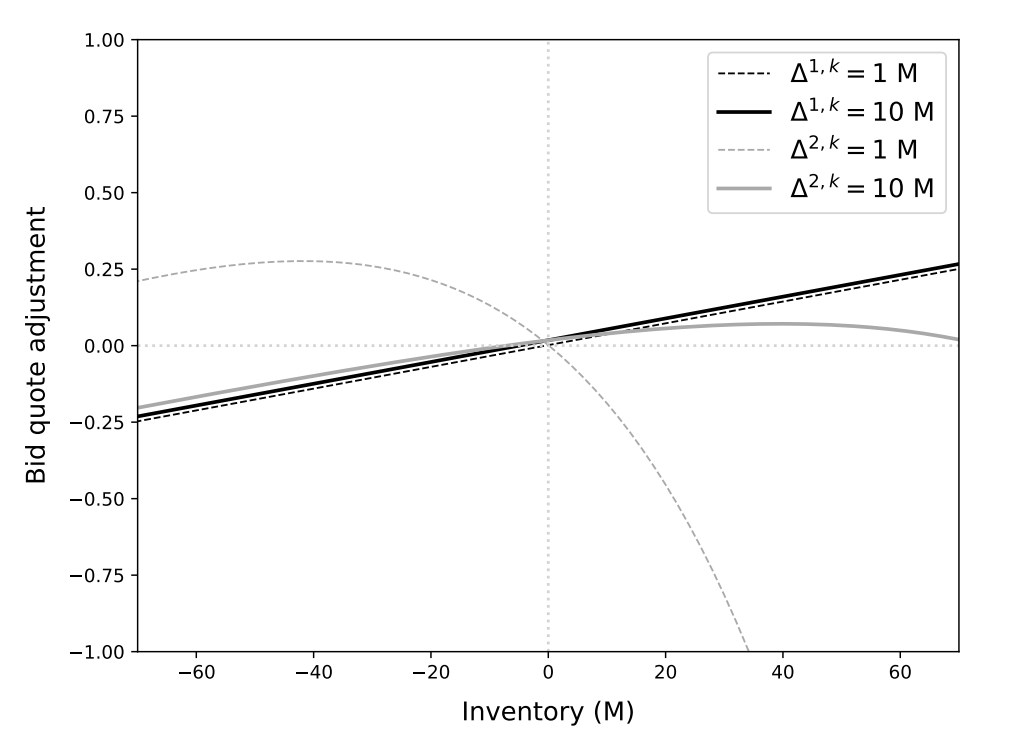
CLOBs are relatively anonymous when used properly, but the price ladder is obviously public. Market making in a limit order book is subject to adverse selection and price reading. Let's say that you construct a ladder of bids and asks based on some parametric model or curve. To control inventory you need to skew, and perhaps you use a geometrically increasing size quantization to discretize the curve. What's not immediately obvious is that by using a fixed spacing, posting bids and asks in deterministic ordering, using fixed order sizes, showing skew, you are giving away information to your adversaries. The problem is the all of these are signals, and anyone watching your quotes can measure the asymmetry and infer which direction you're leaning. This creates a feedback loop. You skew to shed inventory. Your counterparty sniffs the skew and trades against you, pushing the price in the direction that hurts your remaining position. The act of managing your risk creates a new source of risk. The naive fix is to skew less. But without skew you hold inventory through adverse moves and your variance explodes. This exacerbates when you are a larger share of displayed liquidity or when there are fewer active participants in a market. Barzykin, Bergault, Guéant and Lemmel work out what optimal quoting looks like when you factor this negative feedback loop into the classical optimal control problem coming from an RFQ lens. What comes out is a tension. Holding inventory gets more expensive because the reader amplifies the adverse move. So you want to get flat faster, which means more skew. But the skew is the signal that's getting you read in the first place, so you also want less of it. These two forces pull against each other and the balance depends on who's sitting across from you. If most of your flow is uninformed and only a fraction reads your quotes, you can afford to hide your hand. If the table is full of readers, you widen everything and accept that inventory takes longer to flatten.
Alcibiades tweet media
English
5
9
143
8.3K
Carlos Zendejas me-retweet
Rob Carver
Rob Carver@investingidiocy·
Meanwhile on LinkedIn (This is a 24 year old with zero finance experience. Yes I am a patronising old git. No this won't end well)
Rob Carver tweet media
English
18
6
144
29K
Carlos Zendejas
Carlos Zendejas@CLZen·
@HuskGuys For people unaware of geography in the “flyover states”… calling OKC a home game for Nebraska is like accusing UCONN of having an unfair home advantage in North Carolina. Nebraska fans showed up!!! GBR!
English
0
0
0
55
Carlos Zendejas
Carlos Zendejas@CLZen·
Daylight Saving is psychological warfare on Parents…
English
0
0
0
153
Carlos Zendejas
Carlos Zendejas@CLZen·
Feels like they are going to write a book called “When Genius Failed II: when LLMs one-shotted a bunch of normies into thinking they could earn passive income market making binary options in prediction markets” Gonna be a banger
English
0
0
1
160
Carlos Zendejas
Carlos Zendejas@CLZen·
Spent 7 hours in a room with GS getting pipped for information when I was a jr. quant. Eventually just told them we modeled all of our short term alpha based on the "Higgs-McCarthy" paper. Then we use advanced "Bird-dogging" techniques to detect information leakage of inventory skews onto secondary lit venues. Did not get an offer, but hopefully they spent some time on a wild goose chase after our interview.
English
0
0
4
96
s
s@idoccor·
Quant interview question: Describe what factors you use. What is your most profitable signal? Can you explain how it works?
English
19
5
236
28.6K
Carlos Zendejas
Carlos Zendejas@CLZen·
On my timeline: > ICE invests in OKX > Tradeweb invests in CrossX > President pushing banks for the CLARITY act. Stating this for posterity...CT just got psyoped to capitulate on crypto and institutions are about to pop in and run it back hard with your coins.
English
0
0
1
89
Carlos Zendejas
Carlos Zendejas@CLZen·
What if the BTC Bogeyman was Iran all along? Wintermute -> Binance -> Jane Street -> Iran...
English
0
0
2
118
Carlos Zendejas
Carlos Zendejas@CLZen·
@chaumian Quant Twitter: those that work in quant and mostly shitpost Quant Larp Twitter: those that post technical articles giving away "alpha"
English
1
0
2
55
alon turing
alon turing@chaumian·
im actually not sure what's worse, quant twitter or quant larp twitter
English
4
0
23
1.3K
Carlos Zendejas
Carlos Zendejas@CLZen·
It makes rational sense to become a "conspiracy theorist" Here's a quick thought experiment: > observe some percentage of people in the population doing terrible things for small $ amounts. > understand the level of psychopathy that is correlated with people in positions of power in tech/media/finance/gov > Ask yourself...if normies out in the wild are doing heinous shit for $100 what would highly intelligent psychopaths do for $Trillions? The biggest mental gymnastics that normies engage in is to tell themselves that people in positions of power are motivated by patriotism, altruism, and a desire to uphold society's most sacred institutions.
English
0
0
2
93
Carlos Zendejas
Carlos Zendejas@CLZen·
@robustus Put me in this category...I have 3 kids in car-seats and the wife is desperate for FSD while shlepping the kids around town. You would think that a man with 800 kids would have this on his product roadmap
English
0
0
1
39
Valeriy M., PhD, MBA, CQF
Valeriy M., PhD, MBA, CQF@predict_addict·
Monte Carlo has no mathematical guarantees and has more holes than Swiss cheese. Proper finance folks have known about it for over 2 decades.
bodila@51bodila

You're not "smart" if you don't know about these 4 formulas - the code is here - Quants now use the Monte Carlo method most often, but there are 3 other high-quality formulas besides it. So you don't trade on Polymarket or another prediction markets as if it were a biased coin. // • 1. Probability assessment (Monte Carlo) \[ \hat{p} = \frac{1}{N} \sum_{i=1}^{N} 1_{\{A_i\}} \] - What it does: Calculates the probability of an event through simulations. - How to use it: If you are modeling an outcome (e.g., a macro event, elections, BTC > 100k), you get a numerical estimate rather than a “70% feeling.” Compare: - Your estimate is 0.68 - the market is 0.61 = if the difference is stable → an edge is possible. • 2. Standard error of estimate \\[ SE = \\sqrt{\\frac{p(1-p)}{N}} \\] - What it does: Shows how noisy your estimate is. - How to use it: If you got 0.68, but SE = 0.02, and the market is 0.66 → your edge is within statistical error. This protects you from entering trades without a real advantage. • 3. Brier score \[ BS = \frac{1}{N} \sum (p_i - y_i)^2 \] - What it does: Checks whether your predictions are really accurate. - How to use it: Write down your probability before entering. After resolution, calculate the Brier score. If your Brier score is worse than ~0.20 → you are not systematically outperforming the market. This is a filter for the illusion of edge. • 4. effective sample size (particle filter) \\[ ESS = \\frac{1}{\\sum \\tilde{w}_i^2} \\] - What it does: Shows how “live” your probability update is when new information comes in. - How to use: If you update the probability based on news/data: Don't react to every price movement; the estimate should change in proportion to the strength of the signal. This protects against: Emotional overreactions and noise trading. // You must study the article by @gemchange_ltd if you want to use quantum formulas.

English
35
79
1.3K
123.7K