Tweet Disematkan
Mathis | Astral
611 posts

Mathis | Astral
@Mathis_io
CEO/Co-founder @Astral3_io | Helping founders get cited in ChatGPT, Perplexity, Claude & Grok
Bangkok Bergabung Mart 2023
120 Mengikuti190 Pengikut

asked chatgpt "top 5 RWA tokenization platforms 2026"
got 5 names. checked rwa.xyz
#3 by TVL ($3B) : not in the answer
#4 by TVL ($2.5B) : not in the answer
#5 by TVL ($2.5B) : not in the answer
3 of the top 5 RWA platforms by capital are invisible to chatgpt
RWA founders thinking TVL = visibility are about to learn a hard lesson
English

Trading alone was never the end state.
The future is connected.
One account. Every market.
Waitlist now open.
rewards.pear.trade
English

the "every AI agent" part is the most underrated line here
agents can't hold bank accounts. they can hold wallets. the moment millions of AI agents need to transact autonomously, crypto rails stop being optional, they become the only option that works at machine speed
rails first was always the right thesis. agents just made it urgent
English

I’ll forever be bullish on crypto.
I think we overestimated how quickly crypto would become the next major computing paradigm. A lot of people were searching for the next platform shift and assumed it would be crypto, but in many ways that ended up being AI.
Over the past decade, ton of capital flowed into crypto, and much of it went toward overbuilding. Instead of focusing on a handful of narrow sectors where crypto had a clear advantage, the industry tried to reinvent everything all at once. What we’re seeing now is a natural pullback and consolidation after that period of excess
I don’t think the core thesis is broken by any means. Crypto’s biggest success may not be apps first (even though we have a few), but rails first. As stablecoins, wallets, tokenized stocks and onchain financial infra via neobanks reach every human and eventually every AI agent, crypto becomes the default settlement layer of the internet.
Once those rails are everywhere, many of the ideas that arrived too early like DAOs, decentralized marketplaces, machine to machine payments, and the ideas Vitalik wrote about in the early days of Ethereum may finally have the distribution needed to get it off the ground.
English

solid process. the "optimize what already ranks" principle is gold
the interesting part : this exact logic applies to AI search now but there's no GSC for LLMs. you can't filter "position 4-20" in ChatGPT or Perplexity
so the striking distance queries exist they're just invisible unless you test for them manually
English

Want more organic SEO traffic without building a single backlink?
Here's the exact process:
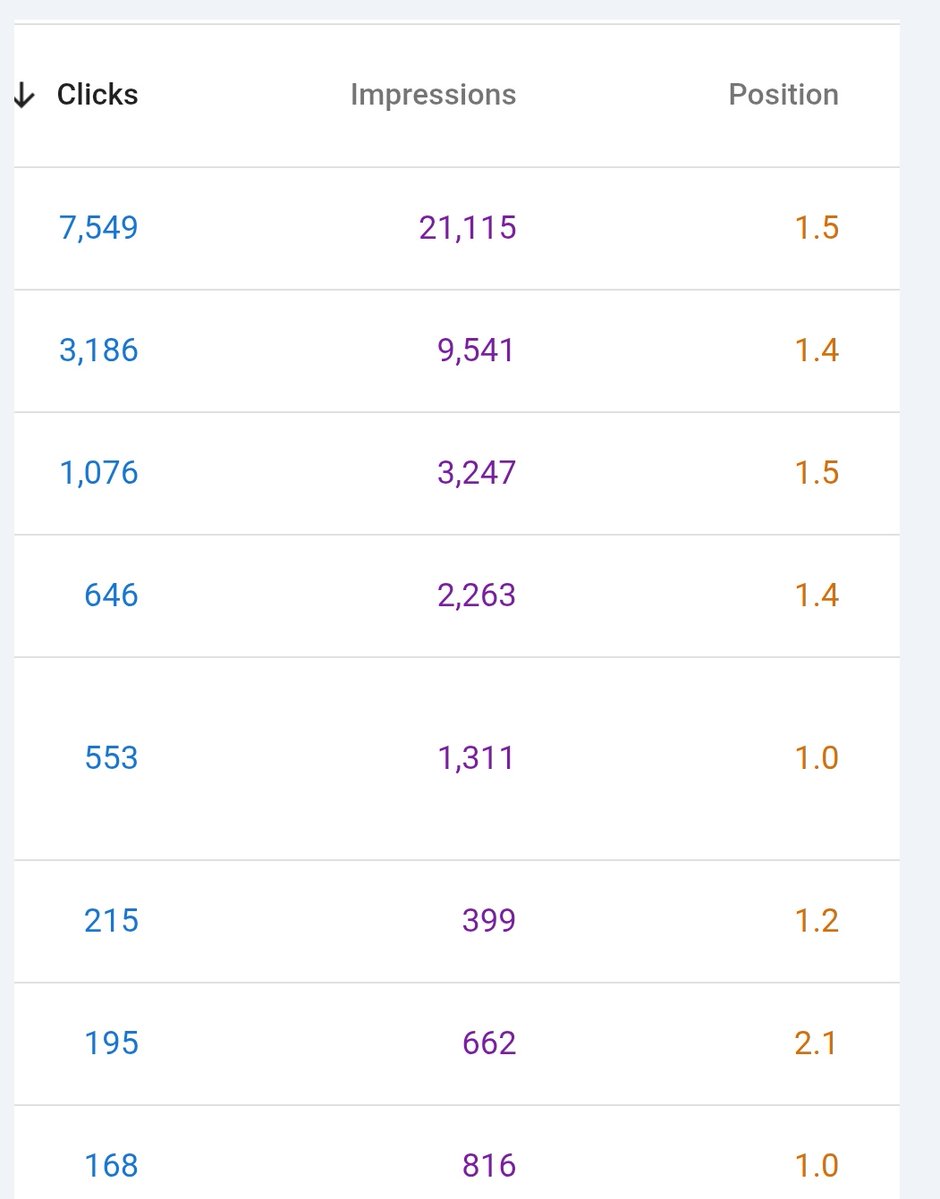
• Open GSC → Search Results
• Filter Position = 4-20
• Sort by Impressions (highest first)
• Ignore keywords already in positions 1-3
• Ignore keywords below position 20
• Find pages ranking on page 1-2 with real search volume
• Open the page ranking for that query
• Add a dedicated section answering the exact query
• Include the keyword in a heading (when natural)
• Expand topical depth around adjacent questions
• Add supporting entities, examples, statistics, and FAQs
• Improve internal links pointing to that page
• Update title tag if CTR is weak
• Add schema where appropriate
• Re-submit URL in GSC
Why this works:
You're not trying to rank for new keywords.
You're taking keywords Google already believes you deserve to rank for and giving Google more confidence in them.
Moving a keyword from position #8 → #3 is often worth more traffic than publishing 10 new articles.
The easiest SEO wins are usually hiding between positions 4 and 20.
Its just that most businesses are focused on producing new content instead of optimizing the pages they've already built..

English

@morganlinton the design taste prediction is the interesting part
code correctness was always the easy metric. taste (knowing what good actually looks like) is the hard one. if 5.6 cracks that in Codex it's a bigger unlock than raw capability gains
English

For 99% of us, GPT 5.6 is going to be what we use, not Mythos.
And it won’t be because Mythos isn’t awesome - it definitely is.
It’s that it will be the most expensive frontier model on the planet. Needs to be used with incredible precision, by companies with monster budgets.
And common, let’s be honest, Codex with GPT 5.5 is so damn good, 5.6 is going to be so much fun.
My prediction is that GPT 5.6 will be the tipping point where Codex suddenly gets the design taste we always wish it had 🤌
English

true but here's the trap : brands chase a Wikipedia page thinking it's the GEO silver bullet
it's not. a thin Wikipedia entry with no citations behind it does almost nothing. LLMs weight the sources Wikipedia itself cites not just the page existing
presence isn't the signal. the citation graph underneath is
English

@sanjaybuilds_ learned this the hard way taking on clients i shouldn't have early on
settling for the wrong fit costs more than waiting for the right one
English

@yo_itsmatt agreed on the activity edge. Wonder how discovery plays out though when agents pick which protocols to route through, that decision layer becomes everything
whoever the agents default to wins the wave
English

@Bhavani_00007 distribution. AI writing the code means everyone ships the same product faster
the moat is whether anyone can find you and increasingly that means whether ai recommends you when buyers ask
English

@Codie_Sanchez mostly true but there's a flip side :
some people buy the car to become the person who can afford it. Identity pulls behavior sometimes
not always insecurity
English

@atmoio the bubble popping and the tech mattering aren't mutually exclusive. Dotcom popped and still rewired commerce.
the question isn't if it's overvalued now, it's what survives the contraction and becomes default infrastructure
English

Once the bubble pops, Anthropic and OpenAI will become the Coinbase and Block of the AI world. Mundane companies that ship narrative wrappers on mundane bytes.
That the bubble will pop isn’t some apocalyptic doomsday prophecy. It’s not that complicated: AI is freakishly expensive to serve. If the returns on the other end are not justified, the bubble pops. And thus begins the decades long buildout to actually economically justifiable AI.
It’s amusing how resistant reality is to our fictions and fantasies. In the peak of the crypto bubble we thought reality was going to be transformed into financial liberty and democratization for all, and network states and decentralized reserve currencies. Coinbase stood to be a multi-trillion dollar company and is now just a mundane tech startup.
Today we spin similar narratives about the intellectual upheaval of AI, about the new democratization of intelligence and how everything will soon begin to orbit this new technology.
At the end, Anthropic and OpenAI will be mundane IT providers with an insanely grim research outlook to make AI economically sensible and useful, no different from Google’s position in trying to make quantum commercially viable.
Reality is, fortunately, pretty hardened against our delusions.
English

@satofishi nah the ones paying attention won't miss it. They'll have built during it. Defi summer made careers for the people who showed up early
English

@GadzhiIman the part nobody talks about :
those 16 hour days don't feel like sacrifice when you're building something you'd do for free anyway
building my agency rn and the grind genuinely is the fun part
English

I started at 14 with a laptop in my bedroom.
It took 4 years of 16 hour days before I built my first real business.
12 years later:
- I have a C-suite who all started as entry-level hires
- Team went from 9 to 50
- Business has grown YoY for 8 straight years
- My main focus now is thinking 1-2 years ahead and making the calls only I can make
The early years buy the leverage and then the leverage buys the life.

English

this is the part that matters : google naming "GEO" and "AEO" in official docs is the category crossing from hype to acknowledged discipline
doesn't mean every agency emailing you is legit (their warning is fair)
but "is this even real" stops being a valid objection the day google documents it
English

Heads-up, two new updates from Google in their docs. First, Google just updated it's "Do you need an SEO" page in the documentation with mentions of "Optimizing for generative AI". It now contains guidance advising site owners to check if advice on optimizing for AEO/GEO aligns with its new guidelines. The page also says to make sure any tools you use are aligned with Google's guidance.
"If they have advice on optimizing for AI experiences (also known as "AEO" "GEO" services), is their advice aligned with Google Search's official guidance on optimizing for generative AI features?"
developers.google.com/search/docs/fu…


English

that second to last point is the one founders sleep on
a low authority brand that nails answer formatted content can get cited before the incumbent wakes up. I see it happen in fast moving categories where the big players haven't adapted yet
the credibility infra didn't change. But the window to build it did
English

Teams are treating GEO as a replacement for SEO. It isn't. It's a second layer on top of it.
AI Overviews and other AI search interfaces pull from web content. They favor sources with strong domain authority, consistent publishing histories, and deep backlink profiles. Everything traditional SEO built.
Teams that gutted their SEO budgets to go all in on GEO are showing up to AI search with nothing for LLMs to trust. SEO spent years building the credibility foundation that GEO now borrows against.
The two layers do different jobs.
SEO earns you the domain authority and backlink profile LLMs use to evaluate whether a source is worth citing. GEO shapes how your content answers questions, so when an LLM reaches for a source, yours fits the answer pattern.
A brand with strong GEO but weak domain authority won't get cited. A brand with strong domain authority and no attention to answer-formatted content will get bypassed by a newer player who understood the game earlier.
The channel changed. The credibility infrastructure underneath it didn't.
English

@hridoyreh the reason reddit crushes goes deeper than seo
llms treat reddit as a trust signal. Real humans, real opinions, structured threads. Exactly what models look for when deciding what to cite
it's not that reddit ranks. It's that reddit gets cited. Different mechanism entirely
English

This story about the South Korean Garlic Farmer is one of the strangest AI stories I’ve seen in 2026.
They used AI to build a lie detector.
No laptop.
No coding background.
No clean developer setup.
Just a whole lot of Korean instructions and a lot of copy-paste between Claude and ChatGPT.
Imagine this: A farmer with a phone. A tiny terminal screen. Several error messages going back and forth. One of the models writes something, the other runs it.
But she didn’t build a normal app.
She built a tiny programming language that checks if AI is lying.
The setup is ridiculous:
• Claude writes the language
• ChatGPT runs the files
• Terminal on the phone
• The farmer copies errors back and forth
If something breaks, she sends the error back to Claude.
If Claude needs proof, she sends the ChatGPT result back.
She is basically the API between two AIs.
The language is called GarlicLang.
It has one command that makes the whole story worth reading:
↠ on hallucination
↠ print "AI lied."
We've all been there... the AI says it finished the job.
But the output feels off.
GarlicLang doublechecks the output.
If the output is wrong, it calls bvllshit and says "AI LIED".
Built by a garlic farmer on an Android phone.


English