Hossein Hafezi

474 posts

Hossein Hafezi banner
Hossein Hafezi

Hossein Hafezi

@RandomString00

PhD @ NYU, working on ZKP

Cambridge, UK Bergabung Haziran 2018
165 Mengikuti289 Pengikut
Tweet Disematkan
Hossein Hafezi
Hossein Hafezi@RandomString00·
“Enjoy the small things.” Good reminder.
English
0
1
11
1K
Hossein Hafezi
Hossein Hafezi@RandomString00·
@AbdelStark Groth16 has a statistical zero-knowledge; even if you break the soundness with a Q-machine later, the historical proofs still do not reveal anything about the past.
English
1
0
2
114
Old World Explorer
Old World Explorer@archi_tradition·
Madrid or Lisbon — which city do you prefer?
Old World Explorer tweet mediaOld World Explorer tweet media
English
278
80
2.1K
219.2K
Hossein Hafezi me-retweet
Alireza (Ali) Shirzad
Alireza (Ali) Shirzad@alrshirzad·
Hi everyone! 👋 We're running a brief anonymous survey on how cryptographers and security researchers view the potential quantum threat, for a research project. We'd really appreciate your input! forms.gle/6wDL65dRPb5JSu… Thanks so much! 🙏
English
48
6
67
2K
Hossein Hafezi
Hossein Hafezi@RandomString00·
@wadg Thanks! I haven't looked into Kimchi before, but this applies to any proof system whose cost is dominated by MSMs over a fixed base (so not Bulletproof-style systems). It works for Plonk and HyperPlonk (with KZG), Nova, HyperNova, KZH-fold, Groth, etc.
English
0
0
1
101
Wilmer Daza
Wilmer Daza@wadg·
@RandomString00 Great great job Hossein 👏!!! I was wondering if is could be applicable to recursive ZKPs like Kimchi (Mina proofs System) ?
English
1
0
1
86
Hossein Hafezi
Hossein Hafezi@RandomString00·
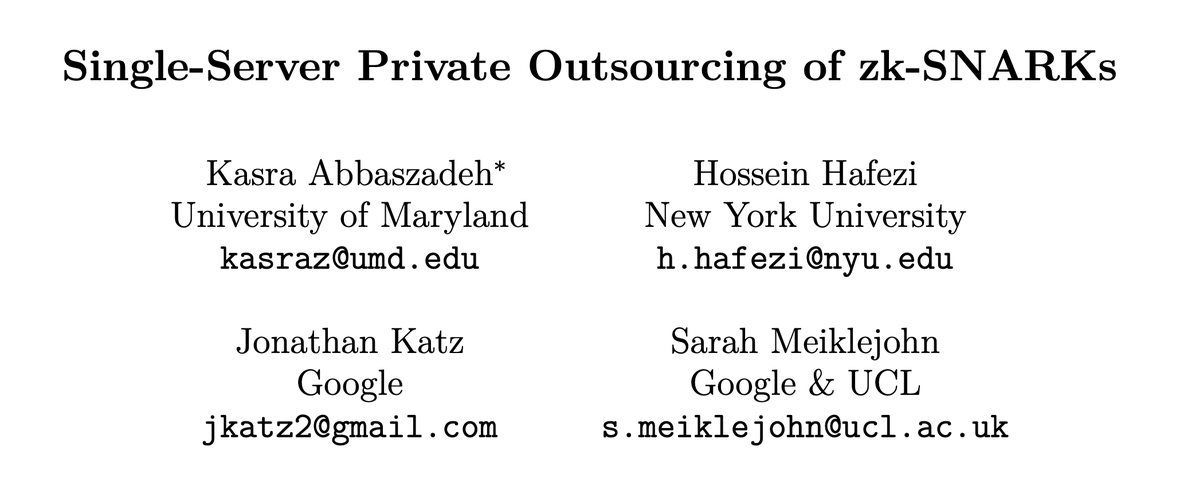
1) We present the first truly private, single-server zkSNARK delegation scheme for well-known group-based zkSNARKs such as Groth16, Plonk, and Nova. Our core idea is to delegate the prover’s most expensive computation—namely, the MSM—to a single server.
Hossein Hafezi tweet media
English
11
15
92
14.1K
Hossein Hafezi
Hossein Hafezi@RandomString00·
@MMJahanara Let me know!! What ultimately matters is the computational power of the server/client, e.g. with a single-threaded client we saw up to a 40× speedup. Also with GPU-accelerated hardware, the server could be another 5× faster...
English
0
0
2
309
Mohammad
Mohammad@MMJahanara·
@RandomString00 This is awesome! Congrats 👏 I am going to try to implement the scheme over the weekend and share some benchmarks 😁
English
1
0
6
476
Hossein Hafezi
Hossein Hafezi@RandomString00·
@thefrozenfire We had the network bandwidth in our protocol considered, but right we ignored costs such as serialisation, thanks for the suggestion!
English
0
0
0
325
Justin Martin
Justin Martin@thefrozenfire·
It would be good to see some network simulation tests in your implementation on GH, to demonstrate communication complexity, latency and bandwidth sensitivity. The existing benchmarks seem to be entirely in-memory, which obscures these metrics. The cost of serializing the protocol to the wire + the time each communication round takes can undermine the feasibility of protocols like this.
English
1
0
3
371
Hossein Hafezi
Hossein Hafezi@RandomString00·
2) While we maintain strong privacy guarantees. Unlike all prior works (including multi-server settings), our proofs are unlinkable to the client–server interaction, making the scheme suitable for privacy-critical applications, such as Zcash.
English
0
0
14
866
Hossein Hafezi me-retweet
Ariel Gabizon
Ariel Gabizon@rel_zeta_tech·
This new paper looks very cool. I was never a fan of delegation schemes requiring you to secret share the witness between servers. Here there is a nice idea of how to privatey delegate an MSM to one server using the learning parity with noise assumption. eprint.iacr.org/2025/2113.pdf
English
2
5
49
3.4K
Hossein Hafezi
Hossein Hafezi@RandomString00·
@alinush But, we've found a gap in research for efficient schemes supporing large unstructured tables. Schemes like CQ require a significant amount of preprocessing, i.e. impractical for tables larger than 2^30. Fortunately, most tables in practice are structured and decomposable though
English
0
0
1
41
Hossein Hafezi
Hossein Hafezi@RandomString00·
@alinush Honestly, I'd say it really depends on the underlying table, whether you, e.g. if it's a structure table, then you can decompose it into smaller tables, then table-dependent approaches like plookup would be okay!
English
1
0
1
42
Hossein Hafezi
Hossein Hafezi@RandomString00·
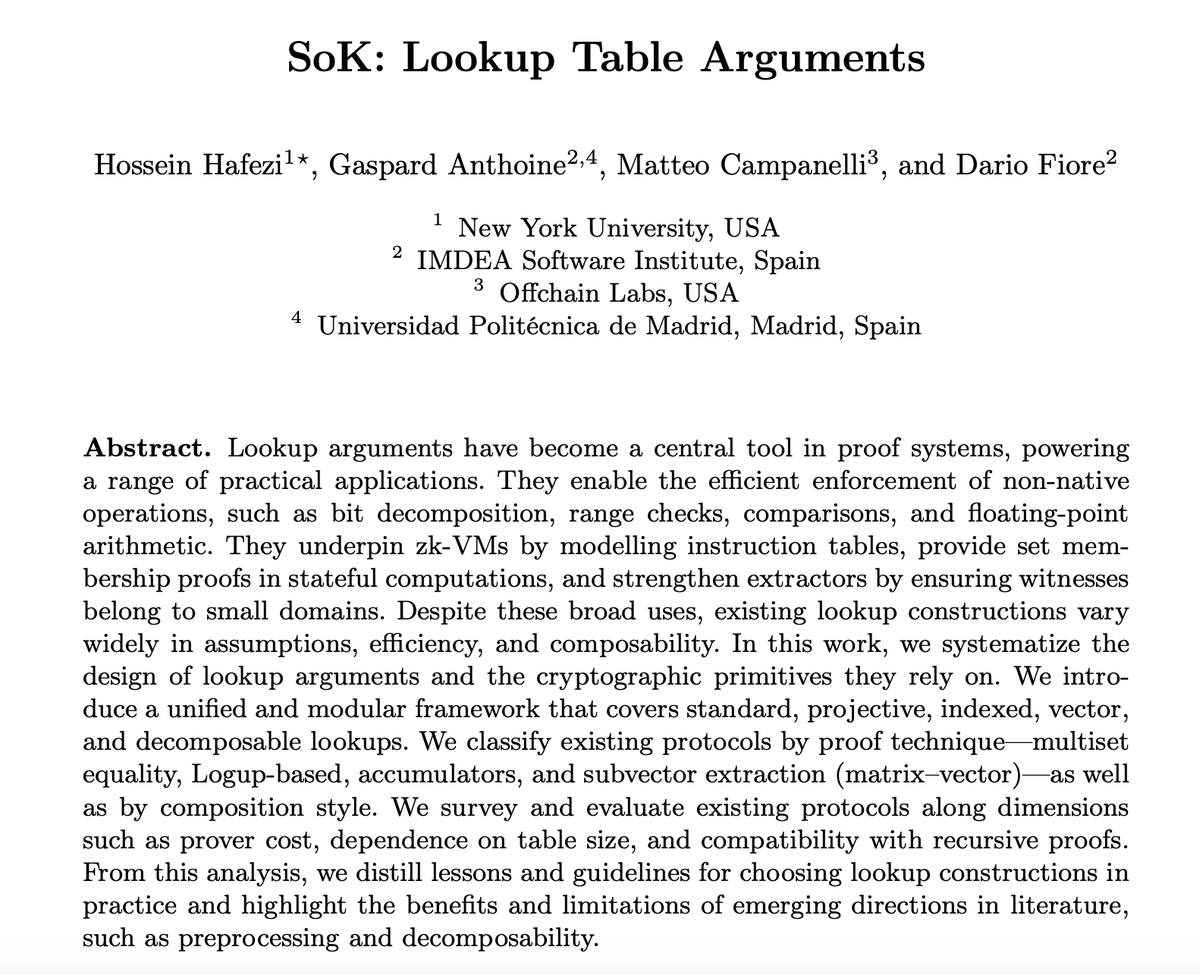
(1) In this paper, we provide a unified framework for lookup table arguments, considering some overlooked aspects such as projectiveness and different modes of compatibility with proof systems.
Hossein Hafezi tweet media
English
1
1
11
425
Hossein Hafezi
Hossein Hafezi@RandomString00·
(4) We also provide an excellent survey of existing techniques categorised into four families: (i) multi-hash based ones, (ii) logup based (iii) subvector extraction (matrix-vector) and (iv) polynomial processing.
English
1
0
4
237
Hossein Hafezi
Hossein Hafezi@RandomString00·
(3) We point out some important gaps, such as a lack of a lookup scheme with moderate preprocessing and efficiency for unstructured tables, etc.
English
1
0
3
249
Ian Miers
Ian Miers@secparam·
As far as I know, Starkware's Stwo has the fastest proving times for standalone merkle tree membership. I.e., not from inside a ZKVM, but as a distinct primitive you can use. </Cunningham's Law>
English
4
0
8
1.4K