Tweet Disematkan
The Axial Post
3.7K posts

The Axial Post
@TheAxialPost
Doctor (PhD) | Account is Young but Qualified Team. Monitoring Insight Multipolar World | Geopolitics • Diplomacy • Global Affairs | Live from the fault lines

Bergabung Şubat 2026
140 Mengikuti294 Pengikut

U.S. Sanctions Flexibility to Russia-Cuba: How This Exposes The Energy Realities?
The News:
The U.S. decision to allow a Russian oil tanker to reach Cuba marks a notable deviation from its broader sanctions posture on Russian energy.
While framed as a limited or humanitarian exception, the move highlights a deeper structural issue: sanctions regimes are increasingly constrained by energy and stability concerns.
Strategic Context:
Cuba has been experiencing a prolonged fuel shortage, with power outages and economic strain intensifying domestic pressure.
Allowing the tanker through suggests Washington is prioritizing regional stability over strict enforcement, particularly in its immediate geopolitical neighborhood.
At the same time, this comes amid broader global energy disruptions, where supply constraints are forcing governments to adopt more flexible, situation-based decisions.
Policy Contradiction:
The decision exposes a contradiction in U.S. policy:
🔹On one hand, Washington has pushed to isolate Russian oil globally
🔹On the other, it is now permitting access when shortages create risk
This reinforces the idea that sanctions are no longer absolute tools, but adjustable instruments shaped by real-time pressures.
Market and Geopolitical Implications:
🔹Signals to global markets that Russian oil remains a fallback supply source
🔹Undermines the perception of a fully coordinated sanctions regime
🔹Encourages other countries to seek similar exceptions or workarounds
Bottom Line:
This is not a policy reversal, but it is a clear acknowledgment that energy security and political stability can override sanctions discipline.
In practice, it shows that geopolitics is being driven less by rigid principles—and more by necessity and timing.
____________________________________________
It's not a strategy. It's a slogan.
Follow @TheAxialPost for daily geopolitics.
English

BREAKING: A Russian ship carrying 730,000 barrels of oil has arrived in Cuba, the first such shipment following the U.S. energy blockade. apnews.com/article/cuba-r…
English

The $82 Billion Treasuries Sell- What This Signal?
The News:
Since the Iran war began on Feb. 25, foreign central banks have sold $82 billion in U.S. Treasurys held at the New York Fed, dropping total holdings to $2.7 trillion—the lowest level since 2012 .
Who's Selling and Why:
1. Oil Importers Are Draining Reserves
Countries like Turkey, India, and Thailand are the primary sellers. They need dollars to pay for surging oil prices (now above $100/barrel) and are intervening in currency markets to prop up their weakening currencies.
Turkey alone has sold $22 billion in foreign government bonds since the war began.
2. Gulf Exporters May Join
Middle East oil producers may also be selling to cover budget shortfalls as their own oil exports remain bottled up in the closed Strait of Hormuz.
Saudi sovereign wealth funds have reportedly held internal discussions about reducing U.S. investment commitments.
3. A Defensive Move, Not Panic
Analysts say this is primarily a liquidity squeeze—countries need cash to survive the energy shock. But the longer the Strait stays closed, the more structural this selling becomes.
The Bigger Picture:
🔹The Petrodollar Question
Deutsche Bank warns the war could accelerate the "petroyuan" shift. Iran is already requiring yuan for oil sales to China, and reports suggest Strait passage may increasingly require yuan payments.
🔹Diversification, Not Just Dollars
The sell-off fits a longer trend: central banks are diversifying into gold and other currencies. U.S. Treasury holdings have been declining for years as reserves managers seek alternatives to dollar dominance.
What It Means for Americans:
Foreign selling pushes Treasury yields higher—which means higher borrowing costs for the U.S. government, corporations, and consumers. Mortgage rates are already climbing.
Bottom line:
The war is forcing central banks to choose: hold U.S. debt or keep their economies afloat. For now, survival is winning. If the trend continues, the cost of America's debt will rise—and the dollar's exorbitant privilege will face its toughest test yet.
____________________________________________
It's not a strategy. It's a slogan.
Follow @TheAxialPost for daily geopolitics.
English

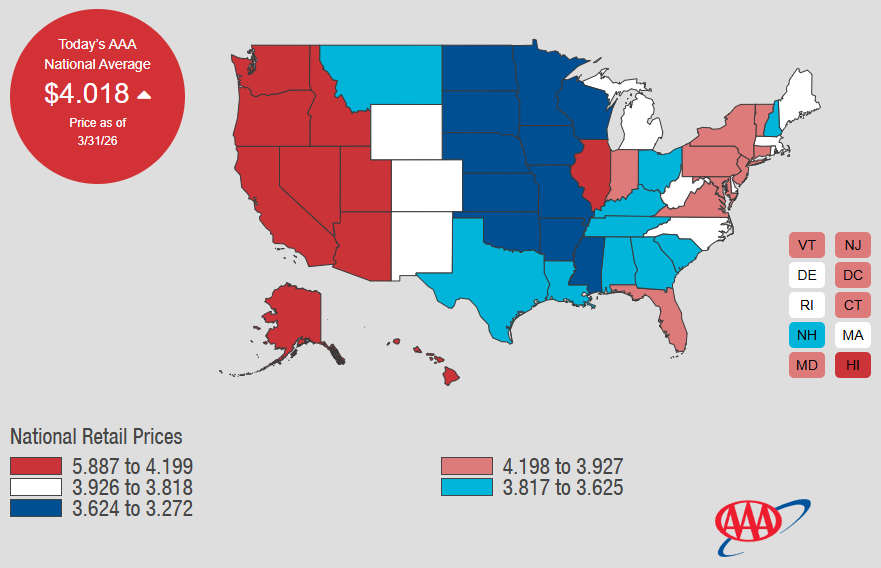
The $4 Gas Threshold - Here are factors You should know contributing to It.
The News:
Gas prices at U.S. pumps spiked above $4 a gallon for the first time since the summer of 2022, as the war in Iran sends oil costs surging. Natural gas prices in Europe and Asia have also surged over the past month.
The Numbers:
🇺🇸 U.S. gas: Above $4/gallon (national average)
🇪🇺 European gas: Up over 30% since the war began
🇯🇵 Asian LNG: Spot prices hit 2024 highs
What's Driving the Spike:
1. Hormuz Remains Closed
For over a month, the Strait has been effectively shut. Mines, missiles, and IRGC patrols have halted tanker traffic, taking 20% of global oil offline.
2. The Red Sea Threat
With the Houthis now formally in the war, the Bab el-Mandeb strait—the only exit for Saudi oil rerouted to Yanbu—is also at risk.
3. The SPR Is Draining
The U.S. is releasing 172 million barrels from the Strategic Petroleum Reserve, but that's less than two weeks of lost Hormuz flows. Markets are pricing a prolonged disruption.
4. Global Natural Gas
Qatar's LNG production—20% of global supply—remains halted. Europe and Asia are competing for replacement cargoes, driving prices higher.
The Political Impact:
5. The Midterm Math
Gas above $4 is a political threshold. Every cent at the pump translates to voter pain. With midterms months away, the price spike threatens to become the defining issue.
6. The Biden Comparison
During the 2022 spike, Republicans hammered Biden over gas prices. Now Trump faces the same vulnerability—and Democrats are using it.
Bottom line:
$4 gas is a psychological line. It tells Americans the war isn't abstract—it's at the pump. And as long as the Strait stays closed, prices will keep climbing.
____________________________________________
It's not a strategy. It's a slogan.
Follow @TheAxialPost for daily geopolitics.
English

Breaking news: Gas prices at U.S. pumps spiked above $4 a gallon for the first time since the summer of 2022, as the war in Iran sends oil costs surging.
Natural gas prices in Europe and Asia have also surged in the past month. wapo.st/4tiApmS
English

The "We Will not be There for you Like you Were not There" Doctrine- Threat or War Invitation?
The Statement:
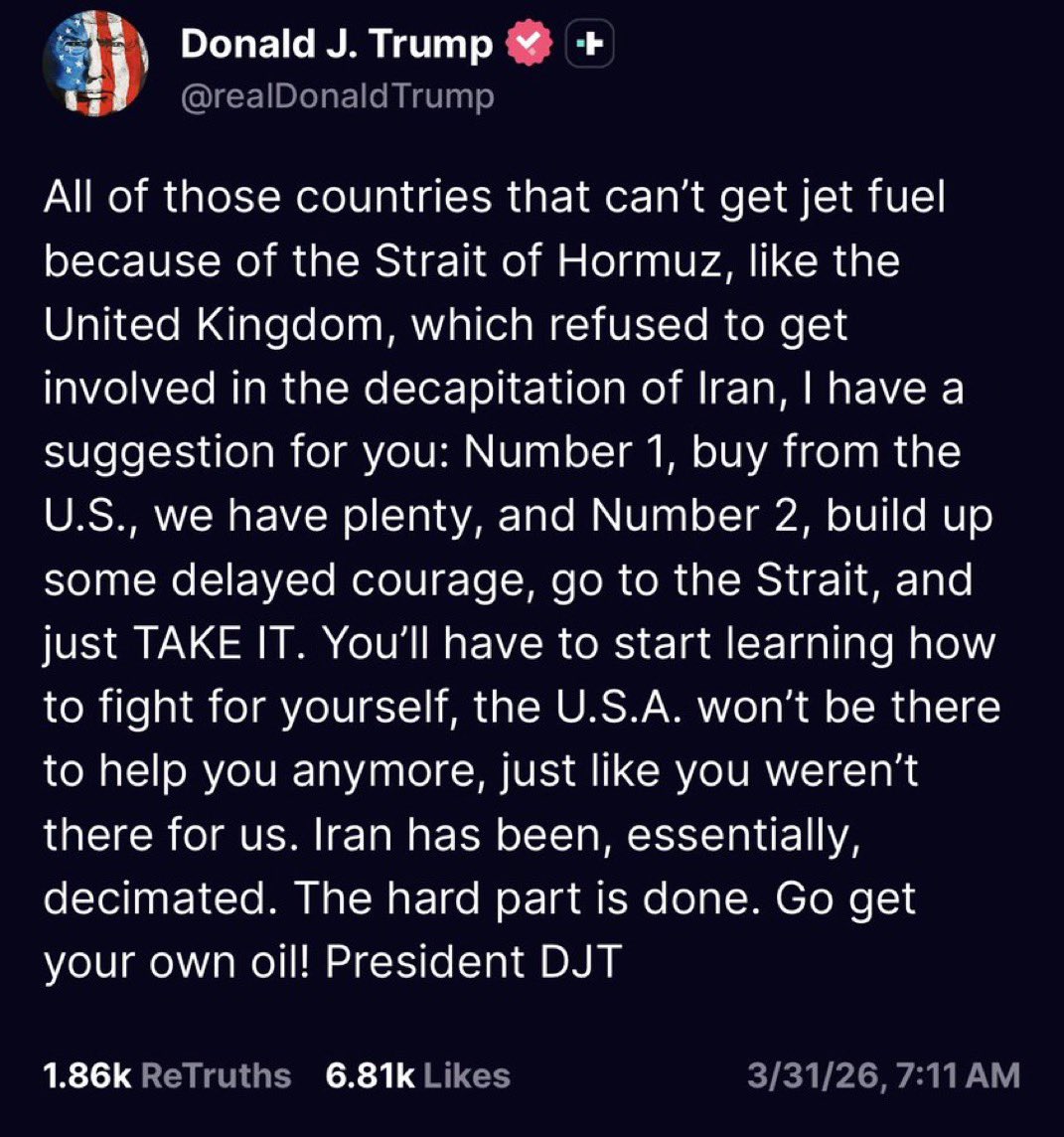
Trump told countries dependent on Gulf oil to "go and just take it" from the Strait of Hormuz, adding: "You'll need to start learning to fight for yourselves, we won't be there to help you like you weren't there for us."
What This Means:
1. The Burden Shift
Trump is making it clear to oil-importing nations—China, Japan, South Korea, India, and European allies—that securing the Strait is now their responsibility. The U.S. did the fighting; now they do the guarding.
2. The "Fight for Yourselves" Challenge
"Go and just take it" isn't a diplomatic offer. It's a provocation. Trump is challenging allies to send their own warships, clear mines, and face Iranian missiles—without American support.
3. The "You Weren't There" Refrain
Trump casts allied refusal to join the Hormuz coalition as a betrayal. His message: you left us when we needed you; now you're on your own.
4. The Practical Reality
No nation can simply "take" the Strait. Mines, missiles, and IRGC patrols have shut down shipping for over a month. Clearing it requires weeks of military operations—and only the U.S. Navy has the capacity to do so.
5. The Bluff
Trump is threatening to withdraw U.S. naval protection entirely. If he follows through, global oil markets lose their only maritime security guarantor. Prices would surge—but so would pressure on allies to act.
6. The Audience
This isn't really about the Strait. It's about domestic politics: Trump is telling voters he's done fighting for countries that won't fight for themselves.
Bottom line:
Trump just drew a new line: no more free rides. Allies who want Gulf oil must now risk their own ships. Whether they step up—or watch prices climb—is now their test.
____________________________________________
It's not a strategy. It's a slogan.
Follow @TheAxialPost for daily geopolitics.
English

Iran-US Talks "Gaining Strength" Claim- What Does this Reveals?
The Statement:
Secretary of Defense Pete Hegseth told reporters that Iran negotiations are "very real, ongoing, active, and I think gaining strength."
The Context:
1. Clashing with Tehran
Hegseth's claim directly contradicts Iran's Foreign Ministry, which has repeatedly denied any direct talks with Washington. Just days ago, spokesman Baqaei called U.S. demands "irrational."
2. Aligned with Trump
Hegseth's language mirrors Trump's "new, more reasonable regime" narrative. The administration is unified in projecting diplomatic progress—whether it exists or not.
3. The "Gaining Strength" Signal
"Gaining strength" suggests forward movement, not stalemate. But no specifics have been offered: no locations, no participants, no framework.
4. Why Say It Now
With the war entering its second month and the Strait still closed, the administration needs to show an off-ramp. Claiming active talks provides political cover to continue military operations.
5. The Skepticism Gap
European and Gulf allies remain unconvinced. Germany's defense minister recently said there is "no clarity" on U.S. objectives. If talks were truly gaining strength, key partners would likely know.
6. The Military-Diplomatic Tension
Hegseth's Pentagon is simultaneously:
🔹Rushing thousands of troops to the region
🔹Threatening "obliteration" of Iranian infrastructure
🔹Claiming diplomatic progress
The two tracks don't align.
Bottom line:
Hegseth says talks are gaining strength. Iran says no talks exist. Either Washington is negotiating with someone Tehran won't acknowledge—or the administration is talking to itself. Either way, the gap between rhetoric and reality remains wide.
The "Fight for Yourselves" Doctrine
The Statement:
Trump told countries dependent on Gulf oil to "go and just take it" from the Strait of Hormuz, adding: "You'll need to start learning to fight for yourselves, we won't be there to help you like you weren't there for us" .
What This Means:
1. The Burden Shift
Trump is explicitly telling oil-importing nations—China, Japan, South Korea, India, and European allies—that securing the Strait is now their problem. The U.S. fought; now you guard.
2. The "Fight for Yourselves" Challenge
"Go and just take it" is not a diplomatic proposal. It's a dare. Trump is daring allies to send warships, clear mines, and risk Iranian missiles—without U.S. backup.
3. The "You Weren't There" Refrain
Trump frames allied refusal to join the Hormuz coalition as a betrayal. His message: you abandoned us; now you're on your own.
4. The Practical Reality
No country can "just take" the Strait. Mines, missiles, and IRGC patrols have halted shipping for over a month. Clearing it requires weeks of military operations—and the U.S. Navy is the only force capable of doing so.
5. The Bluff
Trump is threatening to pull U.S. naval protection entirely. If he follows through, global oil markets lose their only guarantor of maritime security in the region. Prices would spike—but so would pressure on allies to act.
6. The Audience
This isn't really about the Strait. It's about domestic politics: Trump is signaling to voters that he's done fighting for countries that won't fight for themselves.
Bottom line:
Trump just drew a new red line: no more free rides. Allies who want Gulf oil must now risk their own ships. Whether they do—or watch prices climb—is the test.
____________________________________________
It's not a strategy. It's a slogan.
Follow @TheAxialPost for daily geopolitics.
English

Iran-US Talks "Gaining Strength" Claim - What does that Reveals?
The Statement:
Secretary of Defense Pete Hegseth told reporters: Iran negotiations are "very real, ongoing, active, and I think gaining strength".
The Context:
1. Contradicting Tehran
Hegseth's claim directly contradicts Iran's Foreign Ministry, which has repeatedly denied any direct talks with Washington . Foreign Ministry spokesman Baqaei called U.S. demands "irrational" just days ago .
2. Echoing Trump
Hegseth's language mirrors Trump's "new, more reasonable regime" narrative. The administration is unified in projecting diplomatic progress—whether it exists or not.
3. The "Gaining Strength" Signal
"Gaining strength" suggests movement, not stalemate. But no specifics have been offered. No locations, no participants, no framework.
4. Why Say It Now
With war entering its second month and the Strait still closed, the administration needs to show an off-ramp. Claiming active talks provides political cover to continue military operations.
5. The Skepticism Gap
European and Gulf allies remain unconvinced. Germany's defense minister recently said there is "no clarity" on U.S. objectives . If talks were truly gaining strength, key partners would likely know.
6. The Military-Diplomatic Balance
Hegseth's Pentagon is simultaneously:
🔹Rushing thousands of troops to the region
🔹Threatening "obliteration" of Iranian infrastructure
🔹Claiming diplomatic progress
The two tracks don't align.
Bottom line:
Hegseth says talks are gaining strength. Iran says no talks exist. Either Washington is negotiating with someone Tehran won't acknowledge—or the administration is talking to itself. Either way, the gap between rhetoric and reality remains wide.
____________________________________________
It's not a strategy. It's a slogan.
Follow @TheAxialPost for daily geopolitics.
English

The "Take It Yourself & We Will Remember This" Ultimatum
The Statement:
Trump told oil-dependent nations to "go and just take it" from the Strait of Hormuz, adding: "You'll need to start learning to fight for yourselves, we won't be there to help you like you weren't there for us."
What's Behind It:
1. Passing the Buck
Trump is telling China, Japan, India, South Korea, and European allies that securing the Strait is no longer America's job. The U.S. did the fighting; now they do the guarding.
2. A Dare, Not a Proposal
"Go and just take it" isn't diplomacy—it's a challenge. Trump is daring allies to send their own warships, clear Iranian mines, and face missiles without U.S. support.
3. The Betrayal Narrative
Allied refusal to join the Hormuz coalition is framed as abandonment. Trump's message: you left us when we needed you. Now you're on your own.
4. The Cold Reality
No nation can simply "take" the Strait. Mines, missiles, and IRGC patrols have shut it down for weeks. Clearing it requires a military campaign—and only the U.S. Navy has the capacity.
5. The High-Stakes Bluff
Trump is threatening to withdraw American naval protection entirely. If he follows through, global oil markets lose their only security guarantor. Prices would surge—but so would pressure on allies to act.
6. The Domestic Play
This isn't really about the Strait. It's about sending a message to American voters: no more fighting for freeloaders.
Bottom line:
Trump just drew a line: allies who want Gulf oil must now put their own ships in the water. Whether they step up—or let prices climb—is now their choice.
____________________________________________
It's not a strategy. It's a slogan.
Follow @TheAxialPost for daily geopolitics.
English

The "Take It Yourself & We Will Remember This" Ultimatum
The Statement:
Trump told oil-dependent nations to "go and just take it" from the Strait of Hormuz, adding: "You'll need to start learning to fight for yourselves, we won't be there to help you like you weren't there for us."
What's Behind It:
1. Passing the Buck
Trump is telling China, Japan, India, South Korea, and European allies that securing the Strait is no longer America's job. The U.S. did the fighting; now they do the guarding.
2. A Dare, Not a Proposal
"Go and just take it" isn't diplomacy—it's a challenge. Trump is daring allies to send their own warships, clear Iranian mines, and face missiles without U.S. support.
3. The Betrayal Narrative
Allied refusal to join the Hormuz coalition is framed as abandonment. Trump's message: you left us when we needed you. Now you're on your own.
4. The Cold Reality
No nation can simply "take" the Strait. Mines, missiles, and IRGC patrols have shut it down for weeks. Clearing it requires a military campaign—and only the U.S. Navy has the capacity.
5. The High-Stakes Bluff
Trump is threatening to withdraw American naval protection entirely. If he follows through, global oil markets lose their only security guarantor. Prices would surge—but so would pressure on allies to act.
6. The Domestic Play
This isn't really about the Strait. It's about sending a message to American voters: no more fighting for freeloaders.
Bottom line:
Trump just drew a line: allies who want Gulf oil must now put their own ships in the water. Whether they step up—or let prices climb—is now their choice.
____________________________________________
It's not a strategy. It's a slogan.
Follow @TheAxialPost for daily geopolitics.
English

The "Take It Yourself & We Will Remember This" Ultimatum
The Statement:
Trump told oil-dependent nations to "go and just take it" from the Strait of Hormuz, adding: "You'll need to start learning to fight for yourselves, we won't be there to help you like you weren't there for us."
What's Behind It:
1. Passing the Buck
Trump is telling China, Japan, India, South Korea, and European allies that securing the Strait is no longer America's job. The U.S. did the fighting; now they do the guarding.
2. A Dare, Not a Proposal
"Go and just take it" isn't diplomacy—it's a challenge. Trump is daring allies to send their own warships, clear Iranian mines, and face missiles without U.S. support.
3. The Betrayal Narrative
Allied refusal to join the Hormuz coalition is framed as abandonment. Trump's message: you left us when we needed you. Now you're on your own.
4. The Cold Reality
No nation can simply "take" the Strait. Mines, missiles, and IRGC patrols have shut it down for weeks. Clearing it requires a military campaign—and only the U.S. Navy has the capacity.
5. The High-Stakes Bluff
Trump is threatening to withdraw American naval protection entirely. If he follows through, global oil markets lose their only security guarantor. Prices would surge—but so would pressure on allies to act.
6. The Domestic Play
This isn't really about the Strait. It's about sending a message to American voters: no more fighting for freeloaders.
Bottom line:
Trump just drew a line: allies who want Gulf oil must now put their own ships in the water. Whether they step up—or let prices climb—is now their choice.
____________________________________________
It's not a strategy. It's a slogan.
Follow @TheAxialPost for daily geopolitics.
English

The "We Will not be there for You" Doctrine
The Statement:
Trump told countries dependent on Gulf oil to "go and just take it" from the Strait of Hormuz, adding: "You'll need to start learning to fight for yourselves, we won't be there to help you like you weren't there for us."
What This Means:
1. The Burden Shift
Trump is explicitly telling oil-importing nations—China, Japan, South Korea, India, and European allies—that securing the Strait is now their problem. The U.S. fought; now you guard.
2. The "Fight for Yourselves" Challenge
"Go and just take it" is not a diplomatic proposal. It's a dare. Trump is daring allies to send warships, clear mines, and risk Iranian missiles—without U.S. backup.
3. The "You Weren't There" Refrain
Trump frames allied refusal to join the Hormuz coalition as a betrayal. His message: you abandoned us; now you're on your own.
4. The Practical Reality
No country can "just take" the Strait. Mines, missiles, and IRGC patrols have halted shipping for over a month. Clearing it requires weeks of military operations—and the U.S. Navy is the only force capable of doing so.
5. The Bluff
Trump is threatening to pull U.S. naval protection entirely. If he follows through, global oil markets lose their only guarantor of maritime security in the region. Prices would spike—but so would pressure on allies to act.
6. The Audience
This isn't really about the Strait. It's about domestic politics: Trump is signaling to voters that he's done fighting for countries that won't fight for themselves.
Bottom line:
Trump just drew a new red line: no more free rides. Allies who want Gulf oil must now risk their own ships. Whether they do—or watch prices climb—is the test.
____________________________________________
It's not a strategy. It's a slogan.
Follow @TheAxialPost for daily geopolitics.
English

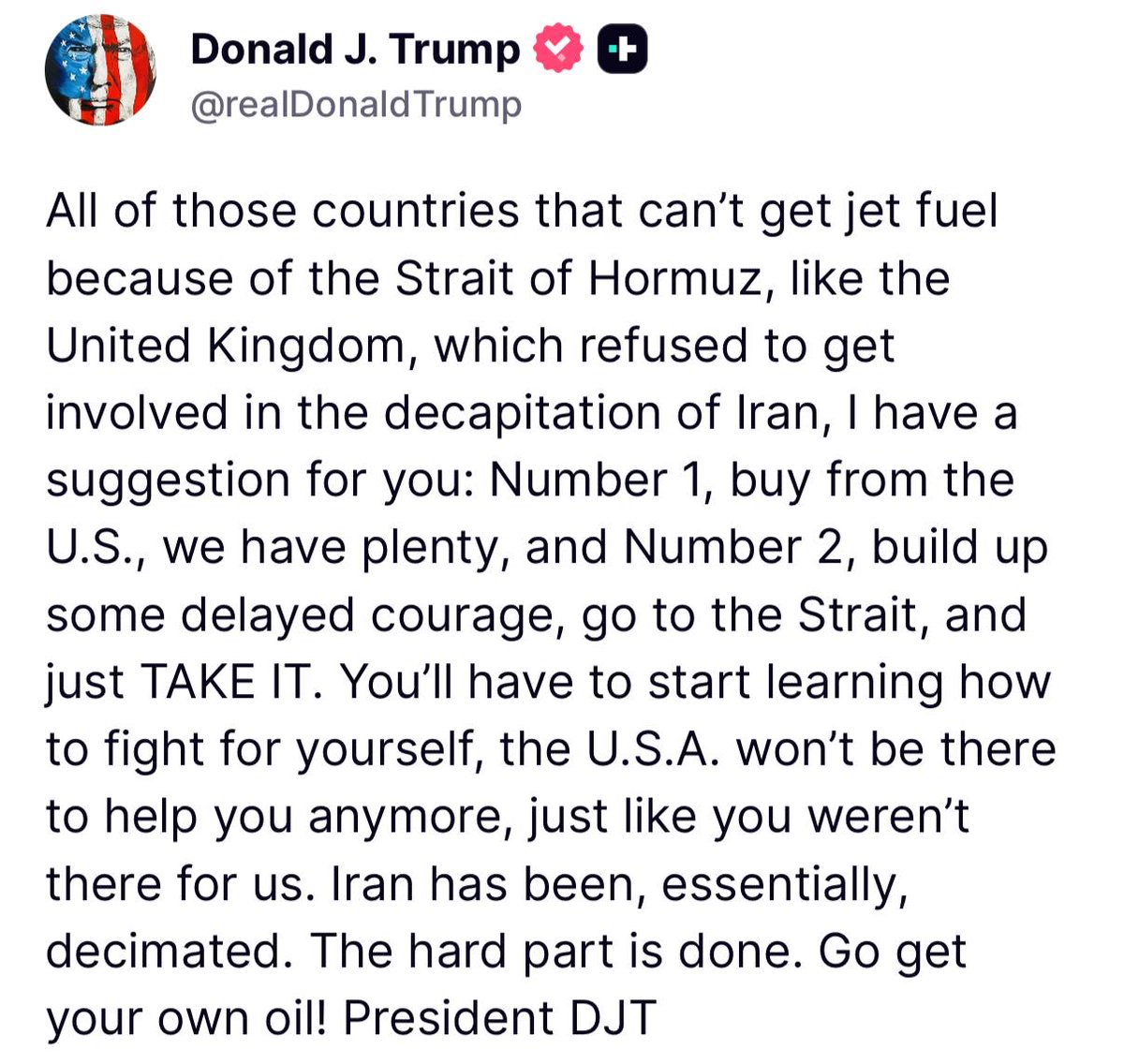
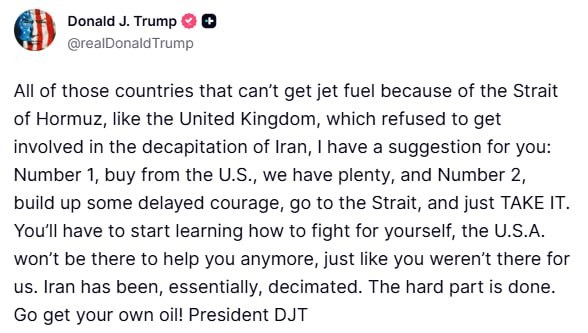
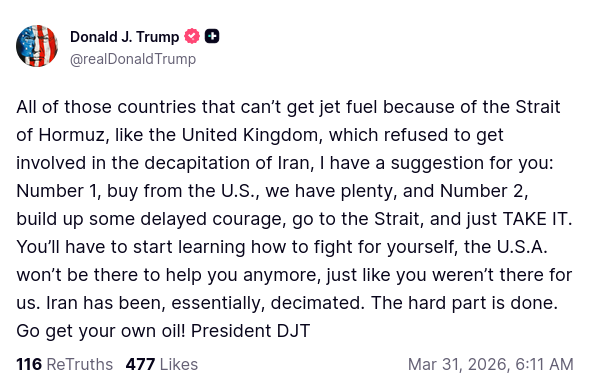
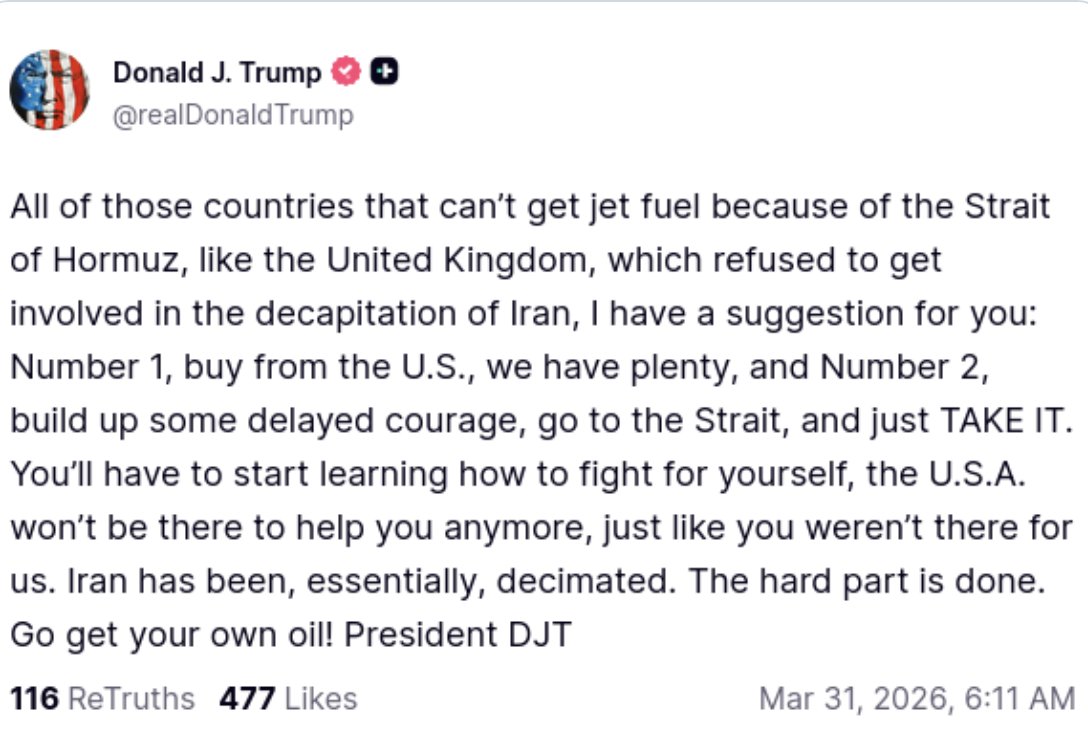
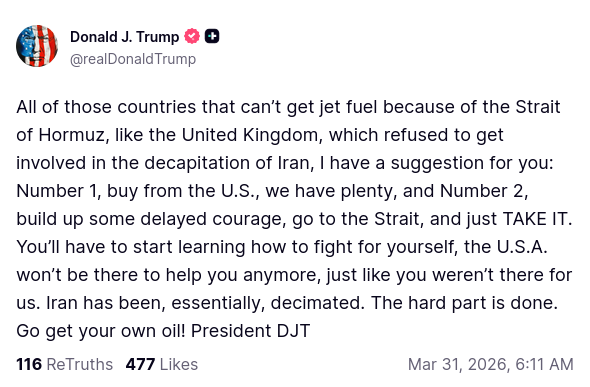
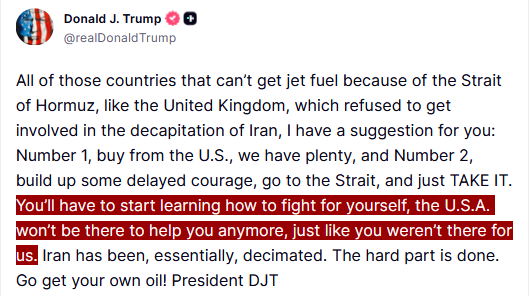
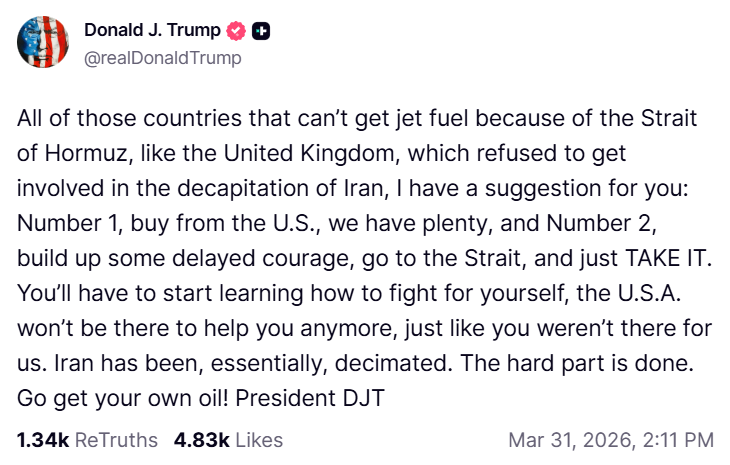
🚨🇺🇸🇬🇧 Trump just posted a message to countries that can't get jet fuel because of the Strait of Hormuz, specifically calling out the UK for refusing to help with the Iran war.
His suggestions: Buy from the U.S., and "build up some delayed courage, go to the Strait, and just TAKE IT."
"You'll have to start learning how to fight for yourself, the U.S.A. won't be there to help you anymore, just like you weren't there for us. Iran has been, essentially, decimated.
The hard part is done. Go get your own oil!"
Source: @realdonaldtrump Truth Social

Mario Nawfal@MarioNawfal
🚨🇮🇱🇺🇸🇮🇷 Netanyahu: “The United States is threatening to deal with the Strait of Hormuz issue by force. I hope it succeeds.” He also said Iran must be stripped of this leverage. His long-term solution: bypass the strait entirely with pipelines from Saudi Arabia to the Mediterranean after the war. Source: @clashreport
English

The "Fight for Yourselves" Doctrine
The Statement:
Trump told countries dependent on Gulf oil to "go and just take it" from the Strait of Hormuz, adding: "You'll need to start learning to fight for yourselves, we won't be there to help you like you weren't there for us" .
What This Means:
1. The Burden Shift
Trump is explicitly telling oil-importing nations—China, Japan, South Korea, India, and European allies—that securing the Strait is now their problem. The U.S. fought; now you guard.
2. The "Fight for Yourselves" Challenge
"Go and just take it" is not a diplomatic proposal. It's a dare. Trump is daring allies to send warships, clear mines, and risk Iranian missiles—without U.S. backup.
3. The "You Weren't There" Refrain
Trump frames allied refusal to join the Hormuz coalition as a betrayal. His message: you abandoned us; now you're on your own.
4. The Practical Reality
No country can "just take" the Strait. Mines, missiles, and IRGC patrols have halted shipping for over a month. Clearing it requires weeks of military operations—and the U.S. Navy is the only force capable of doing so.
5. The Bluff
Trump is threatening to pull U.S. naval protection entirely. If he follows through, global oil markets lose their only guarantor of maritime security in the region. Prices would spike—but so would pressure on allies to act.
6. The Audience
This isn't really about the Strait. It's about domestic politics: Trump is signaling to voters that he's done fighting for countries that won't fight for themselves.
Bottom line:
Trump just drew a new red line: no more free rides. Allies who want Gulf oil must now risk their own ships. Whether they do—or watch prices climb—is the test.
____________________________________________
It's not a strategy. It's a slogan.
Follow @TheAxialPost for daily geopolitics.
English

The "We Will not be there for You" Doctrine
The Statement: Trump told countries dependent on Gulf oil to "go and just take it" from the Strait of Hormuz, adding: "You'll need to start learning to fight for yourselves, we won't be there to help you like you weren't there for us."
What This Means:
1. The Burden Shift Trump is explicitly telling oil-importing nations—China, Japan, South Korea, India, and European allies—that securing the Strait is now their problem. The U.S. fought; now you guard.
2. The "Fight for Yourselves" Challenge "Go and just take it" is not a diplomatic proposal. It's a dare. Trump is daring allies to send warships, clear mines, and risk Iranian missiles—without U.S. backup.
3. The "You Weren't There" Refrain Trump frames allied refusal to join the Hormuz coalition as a betrayal. His message: you abandoned us; now you're on your own.
4. The Practical Reality No country can "just take" the Strait. Mines, missiles, and IRGC patrols have halted shipping for over a month. Clearing it requires weeks of military operations—and the U.S. Navy is the only force capable of doing so.
5. The Bluff Trump is threatening to pull U.S. naval protection entirely. If he follows through, global oil markets lose their only guarantor of maritime security in the region. Prices would spike—but so would pressure on allies to act.
6. The Audience This isn't really about the Strait. It's about domestic politics: Trump is signaling to voters that he's done fighting for countries that won't fight for themselves.
Bottom line: Trump just drew a new red line: no more free rides. Allies who want Gulf oil must now risk their own ships. Whether they do—or watch prices climb—is the test.
____________________________________________
It's not a strategy. It's a slogan.
Follow @TheAxialPost for daily geopolitics.
English

In a new post this morning on his Truth Social social media platform, President Donald J. Trump addressed the "countries that can not get jet fuel" and refused to join the strikes against Iran, such as the United Kingdom, telling them to buy oil from the United States instead and that they should "go to the strait and TAKE IT." He goes on to say, "You'll have to start learning how to fight for yourself, the U.S.A. won’t be there to help you anymore."

English

The "We Will not be there for You" Doctrine
The Statement:
Trump told countries dependent on Gulf oil to "go and just take it" from the Strait of Hormuz, adding: "You'll need to start learning to fight for yourselves, we won't be there to help you like you weren't there for us."
What This Means:
1. The Burden Shift
Trump is explicitly telling oil-importing nations—China, Japan, South Korea, India, and European allies—that securing the Strait is now their problem. The U.S. fought; now you guard.
2. The "Fight for Yourselves" Challenge
"Go and just take it" is not a diplomatic proposal. It's a dare. Trump is daring allies to send warships, clear mines, and risk Iranian missiles—without U.S. backup.
3. The "You Weren't There" Refrain
Trump frames allied refusal to join the Hormuz coalition as a betrayal. His message: you abandoned us; now you're on your own.
4. The Practical Reality
No country can "just take" the Strait. Mines, missiles, and IRGC patrols have halted shipping for over a month. Clearing it requires weeks of military operations—and the U.S. Navy is the only force capable of doing so.
5. The Bluff
Trump is threatening to pull U.S. naval protection entirely. If he follows through, global oil markets lose their only guarantor of maritime security in the region. Prices would spike—but so would pressure on allies to act.
6. The Audience
This isn't really about the Strait. It's about domestic politics: Trump is signaling to voters that he's done fighting for countries that won't fight for themselves.
Bottom line:
Trump just drew a new red line: no more free rides. Allies who want Gulf oil must now risk their own ships. Whether they do—or watch prices climb—is the test.
____________________________________________
It's not a strategy. It's a slogan.
Follow @TheAxialPost for daily geopolitics.
English

The "Fight for Yourselves" Doctrine
The Statement:
Trump told countries dependent on Gulf oil to "go and just take it" from the Strait of Hormuz, adding: "You'll need to start learning to fight for yourselves, we won't be there to help you like you weren't there for us" .
What This Means:
1. The Burden Shift
Trump is explicitly telling oil-importing nations—China, Japan, South Korea, India, and European allies—that securing the Strait is now their problem. The U.S. fought; now you guard.
2. The "Fight for Yourselves" Challenge
"Go and just take it" is not a diplomatic proposal. It's a dare. Trump is daring allies to send warships, clear mines, and risk Iranian missiles—without U.S. backup.
3. The "You Weren't There" Refrain
Trump frames allied refusal to join the Hormuz coalition as a betrayal. His message: you abandoned us; now you're on your own.
4. The Practical Reality
No country can "just take" the Strait. Mines, missiles, and IRGC patrols have halted shipping for over a month. Clearing it requires weeks of military operations—and the U.S. Navy is the only force capable of doing so.
5. The Bluff
Trump is threatening to pull U.S. naval protection entirely. If he follows through, global oil markets lose their only guarantor of maritime security in the region. Prices would spike—but so would pressure on allies to act.
6. The Audience
This isn't really about the Strait. It's about domestic politics: Trump is signaling to voters that he's done fighting for countries that won't fight for themselves.
Bottom line:
Trump just drew a new red line: no more free rides. Allies who want Gulf oil must now risk their own ships. Whether they do—or watch prices climb—is the test.
____________________________________________
It's not a strategy. It's a slogan.
Follow @TheAxialPost for daily geopolitics.
English