Via US Workers

34.8K posts

Via US Workers

Via US Workers

@ViaUSWorkers

The 2% solution to the 1% problem. Pick our own candidates instead of obediently accepting the ones that the donor class props up. by @RandellHynes

United States of America Bergabung Mart 2021
13.7K Mengikuti17.6K Pengikut
Tweet Disematkan
Via US Workers
Via US Workers@ViaUSWorkers·
We are ALL tired of picking the "least bad" candidate every election. The problem? We wait until the ballot is already set exclusively with corporate-party and big-donor-picked candidates, which the media chooses to cover based on their campaign contributions. The fix is obvious: If we want better candidates who actually get regular people, every community has to start now for 2028. Find someone among us. Support them early with time, money, and word-of-mouth. Make them clearly viable from community investment. The choice of whether to run as an Independent, a RINO, or a DINO would be made strategically by district. GOP and DNC primaries are low-turnout elections that could be exploited to secure the primary for the incumbent, or create a head-to-head race in the general election against the incumbent. Who's ready to build better options? #StartNow #BetterChoices
English
2
7
27
1.2K
Via US Workers
Via US Workers@ViaUSWorkers·
🚨 The Enemy Is Inside the Castle Walls American workers are being replaced from within — by a system our own institutions defend. Universities have no problem exploiting American students with crushing debt to keep their revenue flowing. But when do we demand real restrictions on OPT to stop the displacement of U.S. workers? They (and even some in the Administration) warn it will “destroy our entire university and college system.” President Trump said exactly that in November 2025: cutting foreign students sharply would destroy colleges because they “pay more than double.” Some people say the university system will implode due to its own greed and short-sightedness. Reality check: I lost my job in 2025 to an OPT participant. Schools openly recruit full-tuition foreigners using OPT as the golden hook. Current rules remain fully in effect while DHS rulemaking (RIN 1653-AA97) still hasn’t started — months after Secretary Mullin took office. The enemy isn’t just at the border. It’s inside the castle walls: universities profiting from the pipeline, employers saving on costs, and weak safeguards that let it continue. America First cannot mean “universities first” while American professionals are pushed aside. @realDonaldTrump @SenMullin @DHSgov @ICEgov — Start the OPT rulemaking now. Protect the workers who built this country. Reply with your stories of replacement or debt exploitation. Next week, we (@ViaUSWorkers) will compile ALL comments + this thread and send via email + physical mail to decision-makers. This double standard must end. #ProtectAmericanWorkers #EndOPTAbuse #AmericaFirst #EnemyInsideTheCastle
Via US Workers@ViaUSWorkers

Indians rolled a Trojan Horse into our country 36 years ago and have steadily replaced American tech workers with the H-1B visa program. What was sold as a “temporary” fix in 1990 has become permanent industry capture: Indian nationals take 71% of approvals, Indian IT bodyshops dominate, and Indian-origin CEOs now run Microsoft, Google, Adobe, IBM, and more. This thread lays out the 36-year playbook with the receipts.

English
1
3
14
188
Via US Workers
Via US Workers@ViaUSWorkers·
The American Dream thrived when immigration was managed, and unlawful entries were minimal, not during eras of unchecked low-skilled inflows. Policies that tolerate or encourage unlawful immigration prioritize short-term employer gains and foreign labor supply over citizens’ wage growth, housing access, and fiscal sustainability. Ending it (via enforcement) would tighten labor markets, ease housing pressure, and realign resources toward Americans, exactly as historical evidence from the 1950s–early 1970s showed was possible.
Chief_Engineer@ChiefEngineerCE

What were politicians thinking when they ruined it for us. Dwight D. Eisenhower enjoyed strong popularity as president, with an average approval rating around 65% and peaks as high as 79%. His firm opposition to illegal immigration coincided with a period when Americans were highly satisfied with their quality of life. Just imagine ... A Saturday in 1959, no mass immigration. You wake up in your house your dad bought on one paycheck. Mom is already making pancakes. The neighborhood is full of kids riding bikes, no parents hovering. Dad finishes his coffee, grabs his toolbox, and heads next door to help Mr. Johnson fix a fence. No charge, just neighbors. You tag along carrying the nails, ready to learn from the best. By 10 AM the whole block is outside. Men are washing cars, women are hanging laundry and chatting over the fence. Someone fires up a grill, boy it smells good. Dad says we are picking up something for later. By noon there’s a pickup game of baseball in the street. The girls not too far away are playing hopscotch and jacks. No phones, no apps, just kids yelling and laughing. After lunch you ride your bike to the corner store with a dollar in your pocket. You come back with a comic book, a Coke, and enough change left for candy. The owner knows your name and asks how your mom is doing. Evening comes. Dad grills burgers in the backyard while the neighbors bring potato salad and lemonade. Someone hauls out a record player. The adults talk about work, the kids run around catching fireflies. Nobody locks their doors. That was a normal Saturday in 1959 for millions of American families. One income, safe streets, tight communities, and time to actually live. We didn’t need millions of newcomers to make life good. We already had it.

English
0
0
2
54
Via US Workers
Via US Workers@ViaUSWorkers·
@The_JBS We'll be filing an FEC complaint at the end of the month to challenge foreign influence. May Day, May Day on Mayday!
English
0
0
0
12
John Birch Society
John Birch Society@The_JBS·
Beware of Foreign influence! George Washington cautioned that foreign influence would mean “the policy and the will of one country are subjected to the policy and will of another.” Sovereignty requires constant vigilance.
English
3
46
172
2K
Calvin
Calvin@RealCalvin1·
To save the country we are going to have to indiscriminately remove a lot of people. Visa holders, overstayed visas, refugees, anchor babies, etc. We can speed the process up by stopping all the freebies. No free healthcare, welfare, food, housing. Most will leave on their own.
English
33
193
1.3K
7.6K
Via US Workers
Via US Workers@ViaUSWorkers·
To all of the Indians stopping by for a snide comment: Did even one of you think the gravy train was going to last forever?
English
0
0
1
83
Via US Workers me-retweet
Via US Workers
Via US Workers@ViaUSWorkers·
Indians rolled a Trojan Horse into our country 36 years ago and have steadily replaced American tech workers with the H-1B visa program. What was sold as a “temporary” fix in 1990 has become permanent industry capture: Indian nationals take 71% of approvals, Indian IT bodyshops dominate, and Indian-origin CEOs now run Microsoft, Google, Adobe, IBM, and more. This thread lays out the 36-year playbook with the receipts.
Via US Workers@ViaUSWorkers

The Trojan Horse: The Indian Visa Invasion of American Tech – 36 Years in the Making In the heated debates over high-skilled immigration, few metaphors capture the critique as precisely as “Trojan horse.” What began as a well-intentioned fix for temporary labor shortages in the early 1990s has, over more than three and a half decades, delivered a demographic and economic transformation in U.S. technology that critics describe as a deliberate, long-term strategy of workforce replacement. Indian nationals and India-based IT firms have used the H-1B visa program as the primary vehicle, turning a capped guest-worker pathway into one of the most sustained patterns of industry capture in modern American history. The H-1B visa program itself was created by the Immigration Act of 1990. It allowed U.S. employers to bring in foreign workers for “specialty occupations,” initially capped at 65,000 visas per year (later raised temporarily). Almost immediately, staffing and consulting firms in India saw the opening. They began recruiting engineers and programmers in massive numbers, sponsoring them for H-1B visas, and placing them as lower-cost contract labor inside American companies.2 By 1998, the pattern was already unmistakable. The Dallas Observer published its investigative piece “Invasion of the Bodyshoppers,” detailing how Indian middlemen were combing India for talent, signing workers to contracts, and “dumping” them into U.S. firms via the H-1B program. One firm profiled had imported roughly 350 engineers and programmers since 1993—five years of activity by the time of publication. The article quoted critics from the Federation for American Immigration Reform and laid-off American programmers who saw the program as a backdoor for wage suppression rather than a genuine shortage solution. That was 28 years ago. The strategy has only scaled since. Official USCIS data shows Indian nationals have dominated H-1B approvals for well over a decade and continue to do so. In fiscal year 2024, Indians received 71% of all approvals—283,397 out of roughly 399,000 total petitions (including renewals). China followed a distant second at around 12%. This concentration is not new; it has been the consistent pattern across computer-related occupations, the largest H-1B category.615 The numbers add up to a clear long-term trajectory: •Early 1990s: H-1B launches; bodyshopping model takes root. •Mid-to-late 1990s: Documented “invasion” of contract labor begins in earnest, with tens of thousands of Indian H-1B entries annually. •2000s–2010s: Indian IT services giants (Infosys, TCS, Wipro, Cognizant) become top H-1B users, often filing thousands of petitions per year while simultaneously offshoring work back to India. •2020s: Indian nationals still claim ~70%+ of new approvals. The Indian-origin population in the U.S. has grown from roughly 815,000 in 1990 to more than 5.1 million today, fueled by H-1B-to-green-card pathways, family sponsorship, and chain migration. Critics argue this is no accident. Large Indian consulting firms learned early that H-1B was the perfect mechanism: bring in lower-wage workers on temporary visas, place them in U.S. client sites, train them on American systems, then either keep them here or rotate knowledge back to India for offshoring. American workers displaced in the process (documented in cases involving Disney, Southern California Edison, and countless tech layoffs) were often required to train their H-1B replacements before being shown the door.

English
22
347
1.2K
15.5K
pawinsky
pawinsky@bypawan84·
@ViaUSWorkers @nikitabier , another great content from So called content creators of X. This is plain violent speech “ invaded our country” .. we sure are enjoying this kind of incitement from unknown anonymous people
English
0
1
9
378
Via US Workers
Via US Workers@ViaUSWorkers·
H-1B Is a Ticking National Security Threat Every day, thousands of workers with uncertain visa status continue holding root access to America's most critical systems. Every day, foreign intelligence services have opportunities to recruit desperate workers. Every day, the fraud continues, and the vulnerability deepens. The recent crackdowns on H-1B abuse are necessary and overdue. But they must be accompanied by immediate security measures. We cannot simply deport thousands of workers with access to critical systems without securing those systems first. The question isn't whether this vulnerability will be exploited. It's when, and how much damage will be done before we act. The invisible workforce won't remain invisible forever. Neither will the consequences of handing America's infrastructure to workers who have every reason to resent how they were used, and nothing left to lose when the bill comes due.
Via US Workers@ViaUSWorkers

The Trojan Horse: The Indian Visa Invasion of American Tech – 36 Years in the Making In the heated debates over high-skilled immigration, few metaphors capture the critique as precisely as “Trojan horse.” What began as a well-intentioned fix for temporary labor shortages in the early 1990s has, over more than three and a half decades, delivered a demographic and economic transformation in U.S. technology that critics describe as a deliberate, long-term strategy of workforce replacement. Indian nationals and India-based IT firms have used the H-1B visa program as the primary vehicle, turning a capped guest-worker pathway into one of the most sustained patterns of industry capture in modern American history. The H-1B visa program itself was created by the Immigration Act of 1990. It allowed U.S. employers to bring in foreign workers for “specialty occupations,” initially capped at 65,000 visas per year (later raised temporarily). Almost immediately, staffing and consulting firms in India saw the opening. They began recruiting engineers and programmers in massive numbers, sponsoring them for H-1B visas, and placing them as lower-cost contract labor inside American companies.2 By 1998, the pattern was already unmistakable. The Dallas Observer published its investigative piece “Invasion of the Bodyshoppers,” detailing how Indian middlemen were combing India for talent, signing workers to contracts, and “dumping” them into U.S. firms via the H-1B program. One firm profiled had imported roughly 350 engineers and programmers since 1993—five years of activity by the time of publication. The article quoted critics from the Federation for American Immigration Reform and laid-off American programmers who saw the program as a backdoor for wage suppression rather than a genuine shortage solution. That was 28 years ago. The strategy has only scaled since. Official USCIS data shows Indian nationals have dominated H-1B approvals for well over a decade and continue to do so. In fiscal year 2024, Indians received 71% of all approvals—283,397 out of roughly 399,000 total petitions (including renewals). China followed a distant second at around 12%. This concentration is not new; it has been the consistent pattern across computer-related occupations, the largest H-1B category.615 The numbers add up to a clear long-term trajectory: •Early 1990s: H-1B launches; bodyshopping model takes root. •Mid-to-late 1990s: Documented “invasion” of contract labor begins in earnest, with tens of thousands of Indian H-1B entries annually. •2000s–2010s: Indian IT services giants (Infosys, TCS, Wipro, Cognizant) become top H-1B users, often filing thousands of petitions per year while simultaneously offshoring work back to India. •2020s: Indian nationals still claim ~70%+ of new approvals. The Indian-origin population in the U.S. has grown from roughly 815,000 in 1990 to more than 5.1 million today, fueled by H-1B-to-green-card pathways, family sponsorship, and chain migration. Critics argue this is no accident. Large Indian consulting firms learned early that H-1B was the perfect mechanism: bring in lower-wage workers on temporary visas, place them in U.S. client sites, train them on American systems, then either keep them here or rotate knowledge back to India for offshoring. American workers displaced in the process (documented in cases involving Disney, Southern California Edison, and countless tech layoffs) were often required to train their H-1B replacements before being shown the door.

English
0
10
37
312
Via US Workers me-retweet
Via US Workers
Via US Workers@ViaUSWorkers·
The Trojan Horse: The Indian Visa Invasion of American Tech – 36 Years in the Making In the heated debates over high-skilled immigration, few metaphors capture the critique as precisely as “Trojan horse.” What began as a well-intentioned fix for temporary labor shortages in the early 1990s has, over more than three and a half decades, delivered a demographic and economic transformation in U.S. technology that critics describe as a deliberate, long-term strategy of workforce replacement. Indian nationals and India-based IT firms have used the H-1B visa program as the primary vehicle, turning a capped guest-worker pathway into one of the most sustained patterns of industry capture in modern American history. The H-1B visa program itself was created by the Immigration Act of 1990. It allowed U.S. employers to bring in foreign workers for “specialty occupations,” initially capped at 65,000 visas per year (later raised temporarily). Almost immediately, staffing and consulting firms in India saw the opening. They began recruiting engineers and programmers in massive numbers, sponsoring them for H-1B visas, and placing them as lower-cost contract labor inside American companies.2 By 1998, the pattern was already unmistakable. The Dallas Observer published its investigative piece “Invasion of the Bodyshoppers,” detailing how Indian middlemen were combing India for talent, signing workers to contracts, and “dumping” them into U.S. firms via the H-1B program. One firm profiled had imported roughly 350 engineers and programmers since 1993—five years of activity by the time of publication. The article quoted critics from the Federation for American Immigration Reform and laid-off American programmers who saw the program as a backdoor for wage suppression rather than a genuine shortage solution. That was 28 years ago. The strategy has only scaled since. Official USCIS data shows Indian nationals have dominated H-1B approvals for well over a decade and continue to do so. In fiscal year 2024, Indians received 71% of all approvals—283,397 out of roughly 399,000 total petitions (including renewals). China followed a distant second at around 12%. This concentration is not new; it has been the consistent pattern across computer-related occupations, the largest H-1B category.615 The numbers add up to a clear long-term trajectory: •Early 1990s: H-1B launches; bodyshopping model takes root. •Mid-to-late 1990s: Documented “invasion” of contract labor begins in earnest, with tens of thousands of Indian H-1B entries annually. •2000s–2010s: Indian IT services giants (Infosys, TCS, Wipro, Cognizant) become top H-1B users, often filing thousands of petitions per year while simultaneously offshoring work back to India. •2020s: Indian nationals still claim ~70%+ of new approvals. The Indian-origin population in the U.S. has grown from roughly 815,000 in 1990 to more than 5.1 million today, fueled by H-1B-to-green-card pathways, family sponsorship, and chain migration. Critics argue this is no accident. Large Indian consulting firms learned early that H-1B was the perfect mechanism: bring in lower-wage workers on temporary visas, place them in U.S. client sites, train them on American systems, then either keep them here or rotate knowledge back to India for offshoring. American workers displaced in the process (documented in cases involving Disney, Southern California Edison, and countless tech layoffs) were often required to train their H-1B replacements before being shown the door.
English
9
73
239
18.3K
Via US Workers me-retweet
Via US Workers
Via US Workers@ViaUSWorkers·
Two thoughts: how long do they think the gravy train would last? Did they think it would last forever? And I don't see this ending quietly or peacefully. I'll advocate only for peaceful and Constitutional solutions, but people are going to get desperate and start lashing out like with the warehouse fire.
English
2
5
17
254
Via US Workers me-retweet
Matt Morse
Matt Morse@MattMorseTV·
In 2011, at 17 years old, I applied for a job at McDonald’s and got rejected because I couldn’t speak Spanish. I was ‘unqualified’ to flip hamburgers in the United States of America because I couldn’t speak Spanish. We need 100,000,000 deportations.
Steve Ferguson@lsferguson

High school kids used to have part time jobs. Where do they work now? Places like fast food restaurants and retailers are all staffed by foreigners. Am I missing something?

English
1.7K
5.4K
32.7K
643.1K
Via US Workers me-retweet
varrock
varrock@varrock·
If non-citizens can: - Get welfare - Not get deported - Get government loans - Get government grants - Get representation in the government What is the point of a US citizenship? What does it even mean to be a US citizen?
English
148
421
3.9K
26.3K
Via US Workers
Via US Workers@ViaUSWorkers·
Mr. President, I was Bobby's campaign manager in Nevada You say that you don't want to harm American universities by limiting visas— Consider the economic harm that will occur when American students can't get jobs after going deeply in debt, are left paying off debt on HS-level jobs, and future Americans lose faith in the higher education system. Your America First agenda must protect U.S. workers first. Please direct a firm NPRM date for OPT rulemaking now, so we can comment and end the abuse. Follow: @RandellHynes
Via US Workers@ViaUSWorkers

🚨 @realDonaldTrump @SenMullin @DHSgov @ICEgov Mr. President, American workers are still being replaced by OPT participants in 2026. I lost my job in 2025 to an OPT worker while universities keep recruiting full-tuition foreigners using OPT as the main selling point. DHS rulemaking (RIN 1653-AA97) has not started — no NPRM yet, even though Secretary Mullin was sworn in on March 24. This delay lets the damage continue: lost jobs, suppressed wages, and American talent pushed aside. Your America First agenda must protect U.S. workers first. Please direct a firm NPRM date now so we can comment and end the abuse. What do YOU think? Reply with your stories — we'll compile ALL comments next week and mail/email them to decision-makers. #ProtectAmericanWorkers #EndOPTAbuse #AmericaFirst

English
2
29
70
1.4K
Via US Workers me-retweet
nationalistnomad
nationalistnomad@nationalisnomad·
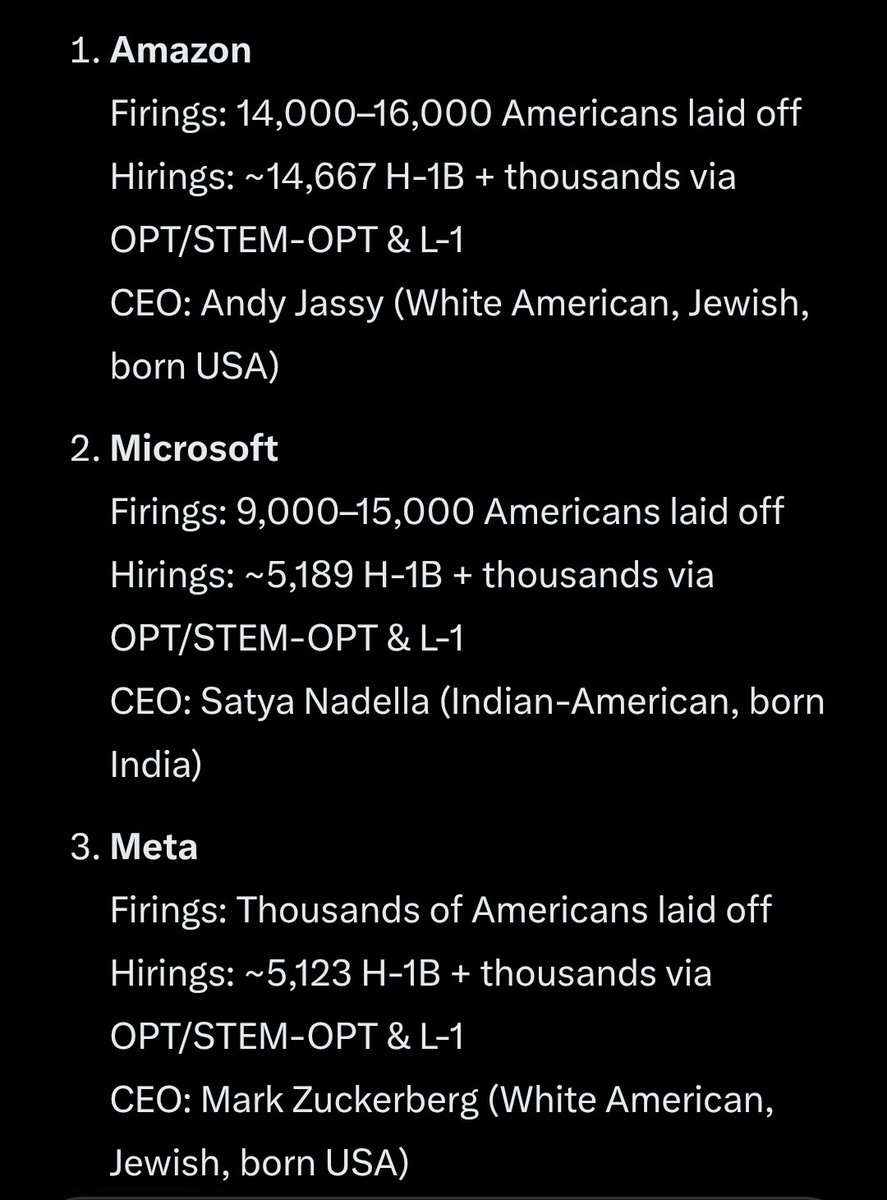
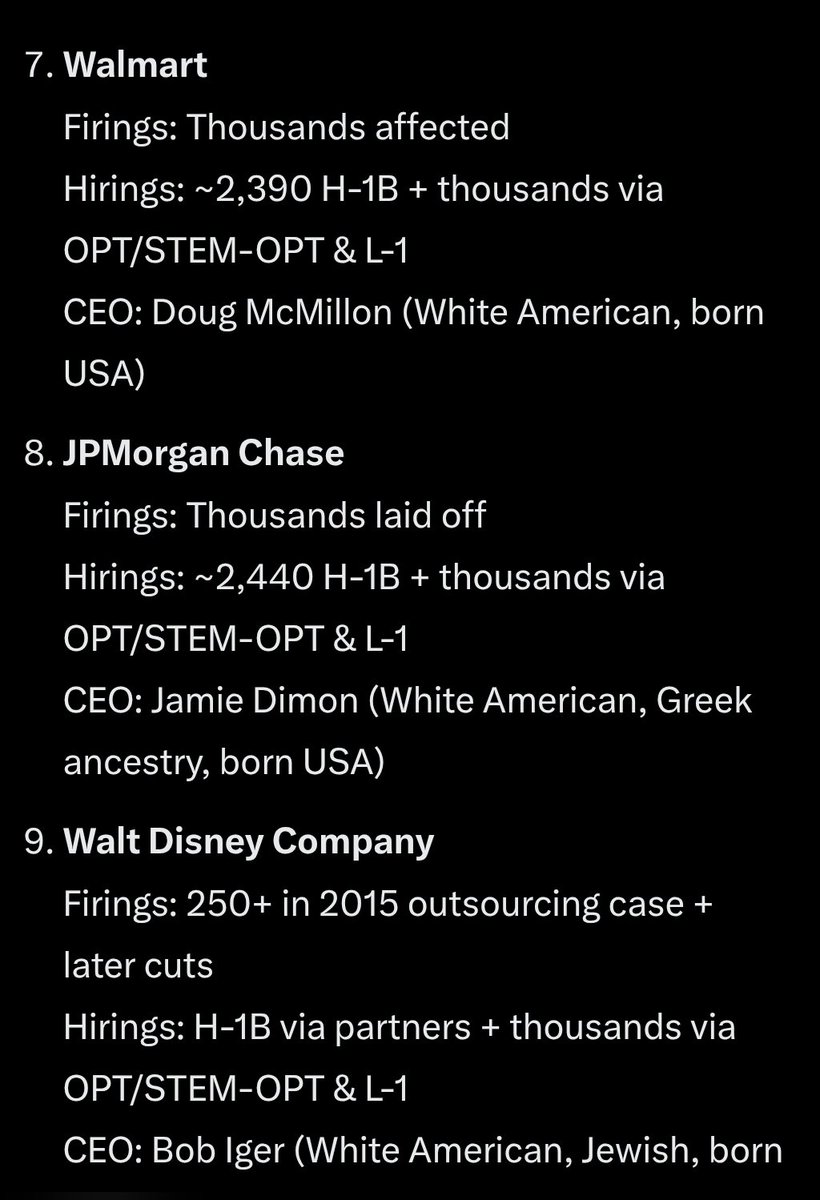
@RedPillRabbit Top ten companies who are illegally hiring foreign invaders after firing Americans. This is not the purpose of foreign work Visa's.
nationalistnomad tweet medianationalistnomad tweet medianationalistnomad tweet medianationalistnomad tweet media
English
7
52
155
1.9K
Via US Workers
Via US Workers@ViaUSWorkers·
@C579947C @realDonaldTrump @SenMullin @DHSgov @ICEgov That's an easy explanation, but the fact is, he had siblings with the same chances who didn't prosper as he did. There have been countless children of the wealthy, and none of them have reached his level of success.
English
1
0
0
72
Via US Workers me-retweet
Via US Workers
Via US Workers@ViaUSWorkers·
🚨 @realDonaldTrump @SenMullin @DHSgov @ICEgov Mr. President, American workers are still being replaced by OPT participants in 2026. I lost my job in 2025 to an OPT worker while universities keep recruiting full-tuition foreigners using OPT as the main selling point. DHS rulemaking (RIN 1653-AA97) has not started — no NPRM yet, even though Secretary Mullin was sworn in on March 24. This delay lets the damage continue: lost jobs, suppressed wages, and American talent pushed aside. Your America First agenda must protect U.S. workers first. Please direct a firm NPRM date now so we can comment and end the abuse. What do YOU think? Reply with your stories — we'll compile ALL comments next week and mail/email them to decision-makers. #ProtectAmericanWorkers #EndOPTAbuse #AmericaFirst
English
23
187
477
7.2K
KADKAD
KADKAD@usasince1964·
@ViaUSWorkers @realDonaldTrump @SenMullin @DHSgov @ICEgov My best friends daughter in law was about to go on maternity leave but Starbucks corporate said wait first train your Indian replacements. The whole department! Data Analysis etc. work from home job. Disgusting.
English
1
0
1
105
Via US Workers me-retweet
Via US Workers
Via US Workers@ViaUSWorkers·
Indians rolled a Trojan Horse into our country 36 years ago and have steadily replaced American tech workers with the H-1B visa program. What was sold as a “temporary” fix in 1990 has become permanent industry capture: Indian nationals take 71% of approvals, Indian IT bodyshops dominate, and Indian-origin CEOs now run Microsoft, Google, Adobe, IBM, and more. This thread lays out the 36-year playbook with the receipts.
English
1
18
69
718