Christophe Bouvard

426 posts

Christophe Bouvard banner
Christophe Bouvard

Christophe Bouvard

@cbouvard

GenAI Product Maker ⚡️ Cofounder & CTO of Wikit 🤖

Lyon, Rhône-Alpes Bergabung Ekim 2010
199 Mengikuti122 Pengikut
Christophe Bouvard
Christophe Bouvard@cbouvard·
🔥 @karpathy's lessons about Software 3.0, Agentic engineering, ... And the work reorganized around agents: - define the context - define the tools - define the feedback loop ➰ - define the guardrails - let agents work - preserve human understanding 🧠 karpathy.bearblog.dev/sequoia-ascent…
English
0
0
0
13
Christophe Bouvard
Christophe Bouvard@cbouvard·
Taste is becoming the new capital.
Brivael Le Pogam@brivael

Steve Jobs a dit un jour : "The only problem with Microsoft is they have no taste." Cette phrase va définir l'économie des 20 prochaines années. Voici pourquoi. 🧵 Mea culpa. Il y a deux mois je pensais que l'IA allait détruire la majorité des jobs. Je me trompais. Sundar Pichai a raison : l'IA n'a pas créé un nouveau jeu. Elle a débloqué tous les jeux en même temps. Plus j'avance, plus je suis convaincu que l'IA va créer un nombre incalculable de nouveaux métiers. Des métiers qu'on ne peut même pas imaginer aujourd'hui. Exactement comme personne n'imaginait "YouTuber" en 2004 ou "community manager" en 2008. Et ces nouveaux métiers auront deux points communs. Premier point : ils ressembleront à des jeux vidéo. Diriger des agents IA c'est du RTS en temps réel. Prompter un système complexe c'est du crafting. Orchestrer un workflow multi-agents c'est du raid management. Créer du contenu augmenté c'est du mode créatif. Les gamers sont les mieux préparés à l'économie qui arrive et personne ne le voit. Deuxième point, et c'est le plus important : ils seront tous connectés à une forme de plaisir artistique. Chaque nouveau métier aura une dimension de création, de goût, de sensibilité. On va passer d'une économie où 80% des gens font des tâches répétitives qui n'ont aucun sens à une économie où la majorité des activités humaines sont liées à la création, à l'esthétique, à l'expression. Et c'est là que la phrase de Jobs prend tout son sens. Le goût devient le nouveau capital. Dans un monde où l'IA exécute tout, la seule chose qui différencie un résultat médiocre d'un chef-d'oeuvre c'est le goût de l'humain qui dirige. Deux personnes avec le même outil IA produiront des résultats radicalement différents. La variable c'est pas l'outil. C'est la sensibilité de celui qui l'utilise. Jobs n'a pas battu Microsoft avec une meilleure technologie. Il l'a battu avec du goût. Avec la conviction que la technologie sans esthétique est morte. Que le "comment ça marche" ne vaut rien sans le "comment ça se sent". Microsoft avait les ingénieurs. Apple avait l'âme. C'est exactement ce qui va se passer dans chaque industrie transformée par l'IA. Les outils seront les mêmes pour tout le monde. Les modèles seront les mêmes. Les APIs seront les mêmes. La seule différenciation sera le goût. La sensibilité. La vision. Le truc qu'on ne peut pas mettre dans un prompt. Le goût ne s'automatise pas. Il se cultive. Par les livres, les films, les voyages, les conversations, les échecs, les expériences. C'est 20 ans de vie condensés en intuition instantanée. Et pour la première fois dans l'histoire, ce capital invisible va devenir le capital le plus valorisé de l'économie. Le travail va se reconnecter au sens. Pour la première fois depuis la révolution industrielle. Et c'est pour ça que le narratif "IA > Humain" est une idéologie de morts. C'est du nihilisme technologique. C'est regarder dans l'abîme et laisser l'abîme te convaincre que tu ne vaux rien. Les big labs qui vendent de la destruction comme stratégie marketing ont tort. "L'IA va remplacer tout le monde" c'est pas une prédiction. C'est un pitch de vente déguisé en prophétie. Ça crée de la peur. La peur crée de l'urgence. L'urgence crée des contrats. C'est du marketing apocalyptique. Pas de la science. L'IA ne remplace pas l'humain. L'IA libère l'humain de tout ce qui n'était pas humain dans son travail. Ce qui reste c'est le goût, la vision, la sensibilité, la création. Le noyau irréductiblement humain. La seule chose que la machine ne peut pas produire : une âme derrière la décision. Jobs le savait en 1997 devant un Microsoft sans goût. C'est encore plus vrai en 2026 devant une industrie IA sans goût. Le futur n'est pas humain VS machine. C'est humain + machine VS problèmes que personne ne pouvait résoudre avant. Et chaque solution sera teintée d'art, de beauté, de sens. Parce que quand la machine gère l'exécution, l'humain n'a plus que le beau à apporter. Quand tu regardes dans l'abîme, l'abîme regarde en toi. Arrêtez de regarder l'abîme. Regardez le terrain de jeu. Il est immense. Et la partie vient de commencer. Cultivez votre goût. C'est le seul actif que l'IA ne commoditisera jamais. Jobs l'avait compris avant tout le monde. A nous de l'appliquer.

English
0
0
1
20
Brivael Le Pogam
Brivael Le Pogam@brivael·
Steve Jobs a dit un jour : "The only problem with Microsoft is they have no taste." Cette phrase va définir l'économie des 20 prochaines années. Voici pourquoi. 🧵 Mea culpa. Il y a deux mois je pensais que l'IA allait détruire la majorité des jobs. Je me trompais. Sundar Pichai a raison : l'IA n'a pas créé un nouveau jeu. Elle a débloqué tous les jeux en même temps. Plus j'avance, plus je suis convaincu que l'IA va créer un nombre incalculable de nouveaux métiers. Des métiers qu'on ne peut même pas imaginer aujourd'hui. Exactement comme personne n'imaginait "YouTuber" en 2004 ou "community manager" en 2008. Et ces nouveaux métiers auront deux points communs. Premier point : ils ressembleront à des jeux vidéo. Diriger des agents IA c'est du RTS en temps réel. Prompter un système complexe c'est du crafting. Orchestrer un workflow multi-agents c'est du raid management. Créer du contenu augmenté c'est du mode créatif. Les gamers sont les mieux préparés à l'économie qui arrive et personne ne le voit. Deuxième point, et c'est le plus important : ils seront tous connectés à une forme de plaisir artistique. Chaque nouveau métier aura une dimension de création, de goût, de sensibilité. On va passer d'une économie où 80% des gens font des tâches répétitives qui n'ont aucun sens à une économie où la majorité des activités humaines sont liées à la création, à l'esthétique, à l'expression. Et c'est là que la phrase de Jobs prend tout son sens. Le goût devient le nouveau capital. Dans un monde où l'IA exécute tout, la seule chose qui différencie un résultat médiocre d'un chef-d'oeuvre c'est le goût de l'humain qui dirige. Deux personnes avec le même outil IA produiront des résultats radicalement différents. La variable c'est pas l'outil. C'est la sensibilité de celui qui l'utilise. Jobs n'a pas battu Microsoft avec une meilleure technologie. Il l'a battu avec du goût. Avec la conviction que la technologie sans esthétique est morte. Que le "comment ça marche" ne vaut rien sans le "comment ça se sent". Microsoft avait les ingénieurs. Apple avait l'âme. C'est exactement ce qui va se passer dans chaque industrie transformée par l'IA. Les outils seront les mêmes pour tout le monde. Les modèles seront les mêmes. Les APIs seront les mêmes. La seule différenciation sera le goût. La sensibilité. La vision. Le truc qu'on ne peut pas mettre dans un prompt. Le goût ne s'automatise pas. Il se cultive. Par les livres, les films, les voyages, les conversations, les échecs, les expériences. C'est 20 ans de vie condensés en intuition instantanée. Et pour la première fois dans l'histoire, ce capital invisible va devenir le capital le plus valorisé de l'économie. Le travail va se reconnecter au sens. Pour la première fois depuis la révolution industrielle. Et c'est pour ça que le narratif "IA > Humain" est une idéologie de morts. C'est du nihilisme technologique. C'est regarder dans l'abîme et laisser l'abîme te convaincre que tu ne vaux rien. Les big labs qui vendent de la destruction comme stratégie marketing ont tort. "L'IA va remplacer tout le monde" c'est pas une prédiction. C'est un pitch de vente déguisé en prophétie. Ça crée de la peur. La peur crée de l'urgence. L'urgence crée des contrats. C'est du marketing apocalyptique. Pas de la science. L'IA ne remplace pas l'humain. L'IA libère l'humain de tout ce qui n'était pas humain dans son travail. Ce qui reste c'est le goût, la vision, la sensibilité, la création. Le noyau irréductiblement humain. La seule chose que la machine ne peut pas produire : une âme derrière la décision. Jobs le savait en 1997 devant un Microsoft sans goût. C'est encore plus vrai en 2026 devant une industrie IA sans goût. Le futur n'est pas humain VS machine. C'est humain + machine VS problèmes que personne ne pouvait résoudre avant. Et chaque solution sera teintée d'art, de beauté, de sens. Parce que quand la machine gère l'exécution, l'humain n'a plus que le beau à apporter. Quand tu regardes dans l'abîme, l'abîme regarde en toi. Arrêtez de regarder l'abîme. Regardez le terrain de jeu. Il est immense. Et la partie vient de commencer. Cultivez votre goût. C'est le seul actif que l'IA ne commoditisera jamais. Jobs l'avait compris avant tout le monde. A nous de l'appliquer.
Français
51
204
886
85K
Jonathan Pacifico
Jonathan Pacifico@_jpacifico·
Chocolatine 2.1 is now available on @ollama : a compact 4B open-weight model optimized for French with strong cross-lingual performance, designed for local inference and agent-oriented workflows. ollama.com/jpacifico/choc…
English
8
20
136
12.3K
Jerry Liu
Jerry Liu@jerryjliu0·
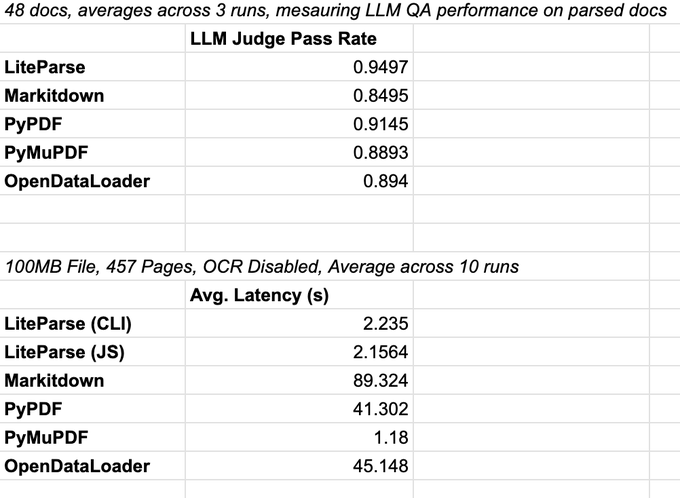
There’s not that many fast, free, non-VLM document parsers out there: there’s PyPDF, PyMuPDF, Markitdown, OpenDataLoader. Last week, we launched LiteParse ⚡️📄: a fast, free, and non-VLM based document parser that provides the highest quality context to AI agents compared to other tools out there. ✅ It extracts document text into an interpretable spatial representation ✅ It has native screenshotting capabilities to let agents (e.g. Claude Code) to do a “fast and light” text parsing step, and then a “deep-dive” into specific page content by feeding the screenshot into itself. ✅ It supports out-of-the-box integrations with other tools like PaddleOCR (@PaddlePaddle) Check out our benchmark below against the other tools. We use LLM QA performance to measure the ability for LLMs to semantically understand the parsed text, and also measure latency. If you try it out, we’d love to get your feedback. The repo is here: github.com/run-llama/lite… If you’re looking for a more accurate, VLM-native solution that can parse any document at scale, LlamaParse might be better for you! cloud.llamaindex.ai/?utm_source=xj…
Jerry Liu tweet media
English
23
39
357
27.8K
Christophe Bouvard
Christophe Bouvard@cbouvard·
=VLOOKUP('spreadsheets', future_of_work, 1, FALSE) // #N/A. AI deleted the table
andrew chen@andrewchen

prediction re the end of spreadsheets AI code gen means that anything that is currently modeled as a spreadsheet is better modeled in code. You get all the advantages of software - libraries, open source, AI, all the complexity and expressiveness. think about what spreadsheets actually are: they're business logic that's trapped in a grid. Pricing models, financial forecasts, inventory trackers, marketing attribution - these are all fundamentally *programs* that we've been writing in the worst possible IDE. No version control, no testing, no modularity. Just a fragile web of cell references that breaks when someone inserts a row. The only reason spreadsheets won is that the barrier to writing real software was too high. A finance analyst could learn =VLOOKUP in an afternoon but couldn't learn Python in a month. AI code gen flips that equation completely. Now the same analyst describes what they want in plain English, and gets a real application - with a database, a UI, error handling, the works. The marginal effort to go from "spreadsheet" to "software" just collapsed to near zero. this is a massive unlock. There are ~1 billion spreadsheet users worldwide. Most of them are building janky software without realizing it. When even 10% of those use cases migrate to actual code, you get an explosion of new micro-applications that look nothing like traditional software. Internal tools that used to live in a shared Google Sheet now become real products. The "shadow IT" spreadsheet that runs half the company's operations finally gets proper infrastructure. The interesting second-order effect: the spreadsheet was the great equalizer that let non-technical people build things. AI code gen is the *next* great equalizer, but the ceiling is 100x higher. We're about to see what happens when a billion knowledge workers can build real software.

English
0
0
0
34
Christophe Bouvard
Christophe Bouvard@cbouvard·
🎁🤔💭 At the intersection of culture & deep technology, the product thinker builds products that feel inevitable 🔥
signüll@signulll

the most underrated hire right now is a great product person. when i say product person i'm def not talking about a product manager. perhaps i think there has to be somewhat of a new role. i don't have a good name for it yet but maybe something like "product thinker".. someone with an intuitive grasp of the product as it exists, where it's soft, where it sings, & how to iterate it toward something even sharper. in some sense, this person has to cohesively hold in their head where this product should be 2 years from now & work backwards from that. i say this cuz when building was hard, engineering was the bottleneck & the status hierarchy often reflected that. building is no longer hard. which means the variance in outcomes has shifted almost entirely to judgment on what to build, how to sequence it, & how to talk about it. & the story matters as much as the thing. internally, it organizes the team around a shared model of why. externally, it shapes the interpretive frame users bring to their first experience. you can't retrofit narrative onto a product & expect it to land, it has to be load bearing from the start. the rarest version of this person sits at the intersection of culture & deep technology. someone genuinely bilingual. they know what's technically possible & they know which cultural currents are real vs. ephemeral. that combo is what separates products that feel inevitable from products that feel assembled. before ppl clap back with this person has always been valuable, i know.. i am just saying now they might be the most *important* person in the room. their value compounds like never before.

English
0
0
0
21
Godefroy
Godefroy@Godefroy·
Gradium text-to-speech integration is now available in Micdrop.dev, which allows to build entirely French voice AI 🇫🇷, when used with Gladia and Mistral.
English
2
2
6
1.7K
Christophe Bouvard
Christophe Bouvard@cbouvard·
🔀 LLM Routing 101: The Missing Layer in Your AI Architecture for Maximum Performance at Lower Costs: @wikit-tech/llm-routing-101-the-missing-layer-in-your-ai-architecture-for-maximum-performance-at-lower-costs-ebe5b8949d83" target="_blank" rel="nofollow noopener">medium.com/@wikit-tech/ll…
Christophe Bouvard tweet media
English
0
1
0
61
Christophe Bouvard
Christophe Bouvard@cbouvard·
"In the era of generative Al, businesses and individuals have important work ahead to organize their data to be Al-ready."
Andrew Ng@AndrewYNg

AI agents are getting better at looking at different types of data in businesses to spot patterns and create value. This is making data silos increasingly painful. This is why I increasingly try to select software that lets me control my own data, so I can make it available to my AI agents. Because of AI’s growing capabilities, the value you can now create from “connecting the dots” between different pieces of data is higher than ever. For example, if an email click is logged in one vendor’s system and a subsequent online purchase is logged in a different one, then it is valuable to build agents that can access both of these data sources to see how they correlate to make better decisions. Unfortunately, many SaaS vendors try to create a data silo in their customer’s business. By making it hard for you to extract your data, they create high switching costs. This also allows them to steer you to buy their AI agent services — sometimes at high expense and/or of low quality — rather than build your own or buy from a different vendor. Unfortunately, some SaaS vendors are seeing AI agents coming for this data and working to make it harder for you (and your AI agents) to efficiently access it. One of my teams just told me that a SaaS vendor we have been using to store our customer data wants to charge over $20,000 for an API key to get at our data. This high cost — no doubt intentionally designed to make it hard for customers to get their data out — is adding a barrier to implementing agentic workflows that take advantage of that data. Through AI Aspire (an AI advisory firm), I advise a number of businesses on their AI strategies. When it comes to buying SaaS, I often advise them to try to control their own data (which, sadly, some vendors mightily resist). This way, you can hire a SaaS vendor to record and operate on your data, but ultimately you decide how to route it to the appropriate human or AI system for processing. Over the past decade, a lot of work has gone into organizing businesses’ structured data. Because AI can now process unstructured data much better than before, the value of organizing your unstructured data (including PDF files, which LandingAI’s Agentic Document Extraction specializes in!) is higher than ever before. In the era of generative AI, businesses and individuals have important work ahead to organize their data to be AI-ready. P.S. As an individual, my favorite note-taking app is Obsidian. I am happy to “hire” Obsidian to operate on my notes files. And, all my notes are saved as Markdown files in my file system, and I have built AI agents that read from or write to my Obsidian files. This is a small example of how controlling my own notes data lets me do more with AI agents! [Original text: deeplearning.ai/the-batch/issu… ]

English
0
0
0
22
Christophe Bouvard me-retweet
Leonie
Leonie@helloiamleonie·
Memory in AI agents seems like a logical next step after RAG evolved to agentic RAG. RAG: one-shot read-only Agentic RAG: read-only via tool calls Memory in AI agents: read-and-write via tool calls Obviously, it's a little more complex than this. I make my case here: leoniemonigatti.com/blog/from-rag-…
Leonie tweet media
English
54
288
2K
145.8K
Christophe Bouvard
Christophe Bouvard@cbouvard·
My preferred actionnable tactic: "Build Defensibility From Day One" 🏰 Write your moat in one sentence. Rules: - Can't include the words "our algorithm" or "our AI" - Must be something that gets stronger over time - Must be something a competitor can't buy or build in 6 months
English
0
0
0
20
Christophe Bouvard
Christophe Bouvard@cbouvard·
"Using Subagents allows us to create a focused environment for the #LLM with a clear, isolated context, specific system instructions, and a limited set of tools for the task." #ContextEngineering is everything. #AgenticAI 🧠🔥
Philipp Schmid@_philschmid

Subagents are specialized AI agents mostly used in combination with an orchestrator to solve one specific tasks, both Claude Code and Poke use them to achieve user goals. Here is an overview on how they work and why they might be the future. philschmid.de/the-rise-of-su…

English
0
0
0
41