

Guillem Riera Quer
34.2K posts

No sé per què parlo
Som una banda
NEGRO@ultrafosc
Bé, doncs farem play in. Crec que és el nivell de l equip.
Español
@JDiamond1 @daniel3liasson @cyrilthps Settlers terror Israeli apertheid must be destroyed. Zionism is fascism!
English

While covering the latest Israeli settler attack in the West Bank, Israeli soldiers assaulted my photojournalist @cyrilthps and detained my team.
But our 2-hour detention revealed a lot about the motives of these Israeli soldiers: acting in service of the settler movement.
W/ @AbeerSalmanCNN
English
@Storch_i @inesschwerdtner x.com/i/status/20374…
Not collaborating with these terrorist fascists is a duty
Richard@ricwe123
So here we have Israeli soldiers collaborating with settlers. They provide security as the settlers set fire to Palestinian homes and vehicles in Deir Dibwan.
English
@Storch_i @inesschwerdtner nothing against Jews, stop conflating them. You are a total shame!! Nothing different from all the far-right.
English

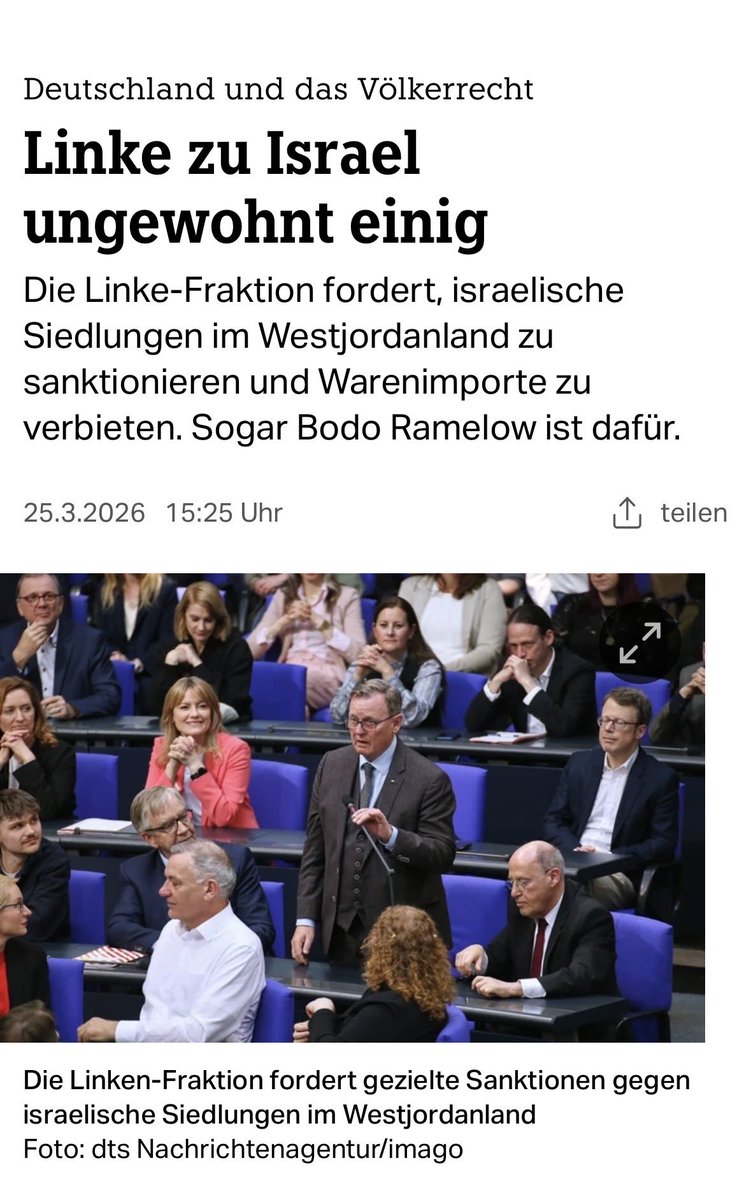
Wir können auch einstimmig: in der Fraktion haben wir beschlossen, israelische Siedlungen und Unternehmen im Westjordanland gezielt zu sanktionieren. Wir werden im Bundestag weiter dafür Druck machen.
taz.de/Deutschland-un…
Deutsch
@movinyl @inesschwerdtner Conflating Jews to the illegal settlements and terrorist settlers like you do is antisemitism. Not funding illegal occupation is nothing against Jews
English


@MatthiasOehlsc1 @inesschwerdtner Boycott to illegal settlements, terrorist settlers diarily attack Palestinians burning their houses, cards, lands, attacking children, etc. a total duty in defence International law. Stop conflating Jews to them, this is antisemitism
English

@inesschwerdtner Boykott von Juden, hatten wir 1933 auch schon mal. Die Linke versinkt weiter im Antisemitischen Sumpf
Deutsch

@inesschwerdtner Mit Faschisten wir Ramelow könnt ihr gleich der AFD Fraktion beitreten. Ihr seid das Letzte und solltet euch in Grund und Boden schämen. Eure weichgespülten Beschlüsse sind wertlos. To little, to late. Die Welt blickt schockiert auf die fake Linke in Deutschland.
Deutsch
@GermanThinkTank @inesschwerdtner @thomas2theleft They want to live in justice, equality and freedom against Israel apertheid and terrorist settlers
English

@inesschwerdtner @thomas2theleft Und wann fordern Sie die Palästinenser im Westjordanland auf, endlich ihren vermaledeiten Staat zu gründen? Oder ist Ihnen nicht klar, dass die das seit Jahrzehnten hätten tun können?
Niemand hindert die daran. Die wollen aber keinen eigenen Staat. Die wollen Israel auslöschen!
Deutsch
@AtticusJazz @inesschwerdtner Not buying to illegal settlements, terrorist settlers is nothing against Jews. Stop conflating Jews to these terrorists, this is antisemitism
English


@Nightmare_Snake @GrueneBundestag @Die_Gruenen Greens for the oppression and apertheid for terrorist settlers. Always enemies of human rights, justice and freedom. And as always using Jews to justify all Israel crimes, never listening to thousands of Jews diarily go to West Bank to protect Palestinians, this is antisemitism
English
@Nightmare_Snake @GrueneBundestag @Die_Gruenen Greens always against human rights for apertheid and terrorist settlers. They are not leftists, they are anti-Palestinian racists for Zionist supremacist apertheid regime. Nothing different from all the far-right in West. Greens a total shame for any leftist.
English

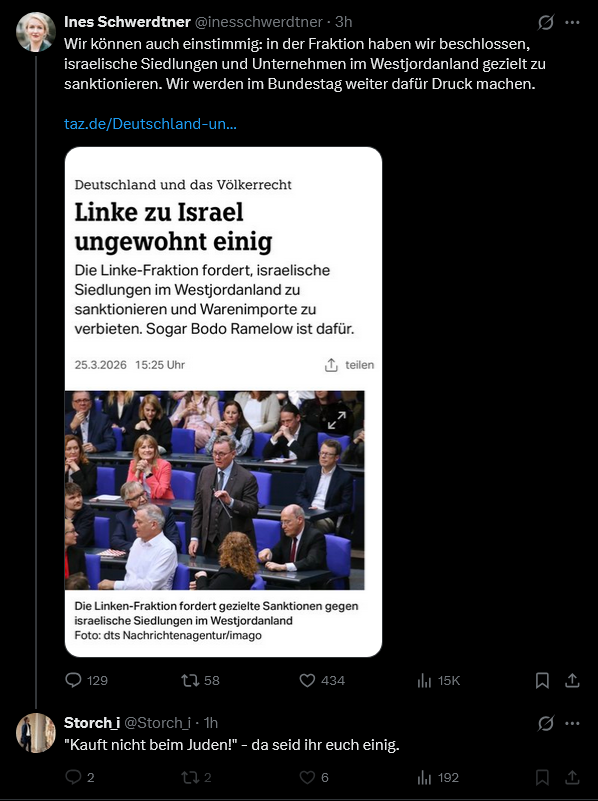
Der Parteisoldat und ehemalige Mitarbeiter der Partei @GrueneBundestag @Die_Gruenen Christian Storch bezeichnet den Fraktionsbeschluss der Partei die Linke israelische Siedlungen und Unternehmen in Westjordanland gezielt zu sanktionieren als "Kauft nicht bei Juden".
Deutsch
@NJH_DACH Denying right of protest. Germany a police authoritarian State to justify a genocide, what a shame!
English

"Buchenwald-Gedenktag: Stadt Weimar versagt Pro-Palästina-Aktivisten Kundgebung in Gedenkstätte."
mdr.de/nachrichten/th…
Deutsch
@bus_klaus @SimonPR_3 Settlers terrorism in West Bank nothing
English

@SimonPR_3 Das ist eh falsch, das Gesetz ist allgemein gehalten, nur sind es halt aktuell praktisch nur Araber/Palis welche die relevanten Verbrechen begingen.
Amit Segal@AmitSegal
Israel is closer than ever before to introducing the death penalty for terrorists. Since 1948, only two people have been executed in the Jewish state via judicial process: IDF officer Meir Tobianski, who was falsely accused of espionage and executed in 1948 (he was posthumously exonerated less than a year later); and Nazi Adolf Eichmann in 1962. So, why the change? And what does the bill actually say? According to the bill, “a terrorist who is convicted of murder out of motives of racism or hostility toward the public, and under circumstances in which the act was carried out with the intention of harming the State of Israel and the rebirth of the Jewish people in its land, shall be sentenced to death.” But the legislation goes one step further: the death sentence for these cases will be mandatory. Judicial discretion will not an option. For now, the bill has a key target: Hamas’ Nukhba commandos, who led the October 7 massacre. Ok, but why is this needed? First, I’ll go through the rationale behind the legislation itself, and then I’ll look at its specific timing. The goal here is simple: if Palestinian terrorists who murdered Israelis are executed after being convicted, then there’s no concern that they’ll be released later on in a deal with Hamas or another terror group, only to once again pose a threat to the Jewish state and its citizens. But it goes beyond just that. For years, Palestinian terrorists have known that even if they’re caught and sent to jail, they can hope to be released in a future deal. But if that is no longer an option, and the only future awaiting them is execution, then the hope is that it will deter some would-be terrorists. As for the timing, it had previously attracted opposition on the basis that it endangered the hostages. In September, Prisoners and Missing Persons Coordinator Gal Hirsch told the Knesset’s National Security Committee: “We still have 48 hostages to recover. This discussion does not help us. We must examine this under a magnifying glass while our brothers’ lives are at risk. This is not my usual approach in committee work, but I must fulfill the mission of returning the hostages. That is why I came here to oppose the committee’s position.” But now, with no living hostages left in Gaza, the tables have turned, with Hirsch telling the committee last week that Benjamin Netanyahu supports the bill, and that Hirsch’s previous concerns have “become irrelevant.” So, the bill is now guaranteed to pass? Nobody can know for sure. Either way, Israeli decision makers now face a dilemma. On one hand, it’s impossible to oppose a push to prevent the future release of terrorists with Jewish blood on their hands. But do Israelis really want to send hundreds of people to their deaths? It’s far from a nice choice to make, but as Israelis are well aware, in the Middle East, making nice decisions is a luxury that they can rarely afford.
Deutsch

Ein Gesetz das Todesstrafe ausschließlich für eine ethnische Gruppe vorsieht — Palästinenser in besetzten Gebieten — ist per Definition Apartheid-Recht.
Das EU-Assoziierungsabkommen enthält Menschenrechtsklauseln die eine Aussetzung rechtlich möglich machen.
Daniel Eliasson 🌻 🇺🇦🇺🇳@daniel3liasson
Wenn das Todesstrafe-nur-für-Palästinenser-Gesetz beschlossen wird, wird Israel zu einem rassistischen Unrechtsstaat. In diesem Fall muss EU-Assoziierungsabkommen endlich ausgesetzt werden.
Deutsch
@NovoDiaUno @daniel3liasson Ok, settlers terrorism in West Bank nothing, this is apertheid
English

@daniel3liasson Rechtlich gibt’s die Todesstrafe für alle. Sie wird aber nur eingesetzt werden, wenn der Staat Israel durch jene Person nicht anerkannt wird und durch die Tat dem Staat Israel schaden zugefügt wurde. Israeli erkennen den Staat Israel an.
Deutsch

Wenn das Todesstrafe-nur-für-Palästinenser-Gesetz beschlossen wird, wird Israel zu einem rassistischen Unrechtsstaat. In diesem Fall muss EU-Assoziierungsabkommen endlich ausgesetzt werden.
Israel Foreign Ministry@IsraelMFA
Israel, as a sovereign state, legislates its own laws. Unbelievably, the European Union is intervening in the midst of a sovereign state’s legislative process. Israel is facing murderous and brutal terrorism on a scale unmatched anywhere in the world. Palestinian terrorism is fueled by payments from the Palestinian Authority, as well as by abductions that lead to shortened prison terms for terrorists. Israeli law already permits capital punishment, and under the proposed new law, discretion over its application will remain with the courts. EU double standards: as always, the EU obsessively singles out Israel - we haven’t seen a tweet like this when it comes to capital punishment in the United States, Japan, India, Egypt, or other countries.
Deutsch
@MairavZ Israel is terror apertheid fascism, no right to exist!
English

257 incidents of settler violence carried out against Palestinians in 25 days timesofisrael.com/liveblog_entry…
English
@prevotmaxime The only solution is sanctioning this apertheid fascist State
English

🇮🇱 The approval of the Death Penalty Bill by the National Security Committee of the Knesset is deeply troubling. State-sanctioned killing is never justice, and never a solution. A society committed to human rights seeks accountability without resorting to killing. We call on Israel not to move forward with this bill that goes against the spirit and the provisions of the EU-Israel Association Agreement. Belgium rejects the death penalty in all its forms and in all circumstances.
@BelgiumMFA
Israel: Statement by the Spokesperson on the Death Penalty Bill | EEAS eeas.europa.eu/eeas/israel-st…
English
@GerAmbTLV If Israel was not invading Lebannon, it wouldn't have happened. All is the Israel fault
English
@GerAmbTLV x.com/IhabHassane/st…
Better these terrorists promoted by Israel, of course
Ihab Hassan@IhabHassane
BREAKING: Israeli settlers carried out a pogrom in the town of Janata, south of Bethlehem in the West Bank—they murdered 37-year-old Mohammad Faraj. They also attacked his father with clubs; he is now in critical condition.
English
Hizbollah are doing the work of their masters in Tehran, attacking civilian life in Israel‘s North 24/7, thus bringing war upon their countrymen.
My thoughts are with the family of Uri Peretz, killed by a Hizbollah rocket in Nahariya.
The Times of Israel@TimesofIsrael
BREAKING: Uri Peretz, 43, is named as the man who was killed earlier today in a Hezbollah missile strike on the northern city of Nahariya. The Nahariya city council, which says Peretz was a resident, says he is survived by his parents, wife and four children. According to police, Peretz was riding his bicycle at the time of the siren, and tried to enter a nearby shelter but did not make it in time. timesofisrael.com/liveblog_entry…
English