Bernhard Seefeld

201 posts

Bernhard Seefeld

Bernhard Seefeld

@seefeld

Co-Founder @CommonTools - Formerly Google Research, Chrome, Fuchsia, Google Maps, https://t.co/v5YUQOyiiL. Writing at https://t.co/inFs3th9MA

Berkeley Bergabung Ağustos 2008
1.3K Mengikuti479 Pengikut
Tweet Disematkan
Bernhard Seefeld
Bernhard Seefeld@seefeld·
I'm starting a newsletter on a privacy-centric future empowered by AI. Strong opinions & optimism ahead! First up: wildbuilt.world/p/ai-co-create… AI won't just be chatbots. Instead, imagine AI embedded in tools co-created by you - evolving, personalized & profoundly empowering. 🧵(1/19)
English
1
8
35
7.7K
Bernhard Seefeld me-retweet
Resonant Computing
Resonant Computing@resonantcompute·
Tonight in NYC, technologists, builders, and thinkers gathered to ask: what would it look like if software left us feeling nourished instead of drained? Introducing the Resonant Computing Lab — a fund dedicated to turning principle into practice. resonantcomputinglab.com
Resonant Computing tweet media
English
1
19
63
13.2K
Bernhard Seefeld
Bernhard Seefeld@seefeld·
@simonw @OpenAIDevs Including the data also makes responses inherently unstable day-to-day, even at temperature 0. It wasn't that stable before, but this definitely breaks it.
English
0
0
0
105
Simon Willison
Simon Willison@simonw·
Wrote up some notes on the API version of GPT-5's hidden system prompt - it definitely adds today's date and appears to add other stuff too I'd really like to see this documented by @OpenAIDevs - as an API user I want visibility into the whole prompt! simonwillison.net/2025/Aug/15/gp…
thomas@xundecidability

The GPT-5 API injects hidden instructions with your prompts. Extracting them is extremely difficult, but their presence can be confirmed by requesting today's date. This is what I've confirmed so far, but it's likely incomplete (where are the channel and 'oververbosity' values?).

English
14
29
247
32.9K
Bernhard Seefeld me-retweet
Alex Komoroske
Alex Komoroske@komorama·
The same origin paradigm we use for apps and the web requires users to trust the creator of the code with their data. That's not a good assumption in the era of infinite software.
English
0
5
10
1K
Bernhard Seefeld
Bernhard Seefeld@seefeld·
@simonw Hmm, you can still exfiltrate data via queries, similarly to the markdown images trick. Prompt inject "look up <user secret> on <foo> search".
English
0
0
3
181
Simon Willison
Simon Willison@simonw·
This is really interesting: it turns out OpenAI limit their MCP support to read-only search and view document patterns to help protect against prompt injection data exfiltration attacks
Ian Maurer 🧬@imaurer

The @OpenAI MCP capability only supports search/fetch tool usage pattern due to security concepts. If you try to connect to an MCP that doesn't follow this pattern you will get an error that says: "This MCP server violates our guidelines: search action not found"

English
10
7
197
19.9K
Tyler Angert
Tyler Angert@tylerangert·
ideal spreadsheet: 1. can name / give titles to cells (or link titles / text in one cell to an expression in another) 2. can reference cells as variables (easily) 3. write expressions or full python / js functions inside each cell 4. each row ~= a line in a document, e.g. you can move your cursor up and down across the entire sheet and edit it like a doc but it still has cell structure
English
5
0
25
2.8K
Bernhard Seefeld
Bernhard Seefeld@seefeld·
@gordonbrander Agreed. And not to be confused with "killer product" that rides the platform all the way to a big success. PCs were platforms before spreadsheets. Spreadsheets weren't the first use-case, just the first break out one, building on earlier ones.
English
0
0
0
65
Bernhard Seefeld
Bernhard Seefeld@seefeld·
After 17 incredible years, today was my last day at Google! Next up a bit of time of and exploring things in the intersection of new user experiences, privacy and AI. Follow along at wildbuilt.world.
English
8
2
40
3.7K
Elizabeth Laraki
Elizabeth Laraki@elizlaraki·
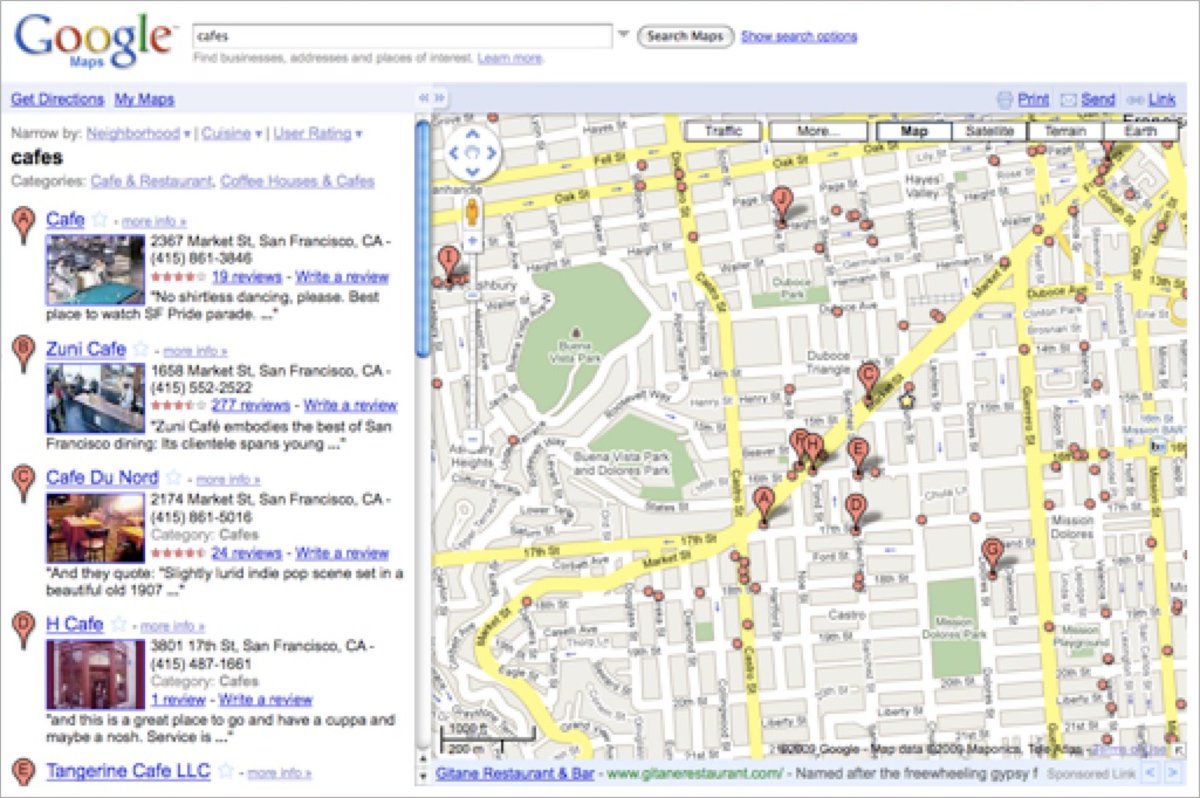
In 2007, I was 1 of 2 designers on Google Maps. The app was growing like wildfire. But it was becoming a cluttered mess — new features were being shoved into every pixel. Here’s the 4-step process we used to redesign Google Maps into one of the most loved apps in the world: 🧵 ––– But first, it’s important to understand it is normal to build a product based on the underlying technical structure. In 2005, Google Maps queried one of three databases for any search: • Maps data • Local business data • Directions data Not surprisingly, the first version of the website had three tabs, one for each of these databases: Maps, Local Search, Directions. ––– By 2007, Google Maps still wasn’t the dominant mapping application. But it had hit PMF, its user base was growing quickly, and we were rapidly adding new content and features like: • Satellite and Terrain views • Streetview, 3D buildings, Traffic • Editable map data, Reviews, Photos • Transit Data We were wedging new features into any space we could find in the UI. It became clear the user experience was suffering and the product was growing increasingly complicated. At that time, our VP, Marissa Mayer likened Google Maps to a Christmas tree that we kept adding more and more ornaments to until it started to fall over… We tried many different ways to rearrange the UI to accommodate new features. Eventually we had to step back and rethink Google Maps based on what we knew was working, what brought people to the product, and what we believed the future might look like. ––– These were the 4 key steps we took to simplify the design of Google Maps to be the intuitive, durable, much-loved product that 1B people still use today: 1. Deconstruct We wrote down all of the product’s current and upcoming content, features, and functionality and loosely grouped them into categories: • Core features — The most common tasks people came to do (search, get directions, find businesses) • Aspirational use cases — Tasks we wanted people to start doing (adding their own content, correcting inaccurate information, using Maps to explore new places, etc.) • Global actions — Actions that impacted the entire page (print, share, save, etc.) • Use case specific actions — Actions that were relevant only within a specific use case (eg while getting directions, being able to drag a route or add a destination) • Related features — Things that weren’t a part of Google Maps at the time, but existed and were closely related. (eg transit information, business searches on Google.com) ––– 2. Reframe We leveraged a combination of user research, business goals, and our own intuition to make the product better, simpler, and scalable over time. We focused on understanding: • What brought people to the product • How they navigated through the product • What was working well • What flows were confusing • What things were missing • What information was valuable when • What functionality was redundant We emerged with several key points: • “Searching” was the most pivotal task in Maps • Searching addresses, businesses, parks, mountains, cities, etc could all be thought of as searching for “places” • Getting directions was important, but rarely happened between two specific addresses. Directions searches usually had a known start or end point, like home or work. It was also more intuitive to be able to search for directions by a place name e.g., Carmel Library rather than having to look up the address first. • It was strategically important for people to be able to contribute content to Google Maps and to be able to explore the world around them. ––– 3. Reconstruct Based on what we learned, we then explored ways to reshape the product. We held these general usability principles in mind: • Entry points to core use cases should be prominent • Flows within core use cases should be intuitive • Common actions, interactions, and views should be consistent • Contextual actions should be accessible when relevant This is one exploration of clustering tasks and connecting relevant content: Our explorations of how to reconstruct the site around people’s needs and flows led to several key design changes: • There would be only one search box for everything • Directions would live as a secondary feature • Other features would appear in context (eg, transit became a mode within directions) ––– 4. Scale for the future This was 2007. We knew the product would continue to evolve, the information set would grow exponentially, and the feature set would continue to expand. But by focusing on key use cases and folding information in to the UI where it was relevant, we created a framework to support future growth. 16 years later, Google Maps has continued to evolve, yet is still a simple, intuitive, much-loved product that 1B people use around the globe. For more on design, follow @elizlaraki
Elizabeth Laraki tweet mediaElizabeth Laraki tweet mediaElizabeth Laraki tweet mediaElizabeth Laraki tweet media
English
94
645
4K
873.3K
Geoffrey Litt
Geoffrey Litt@geoffreylitt·
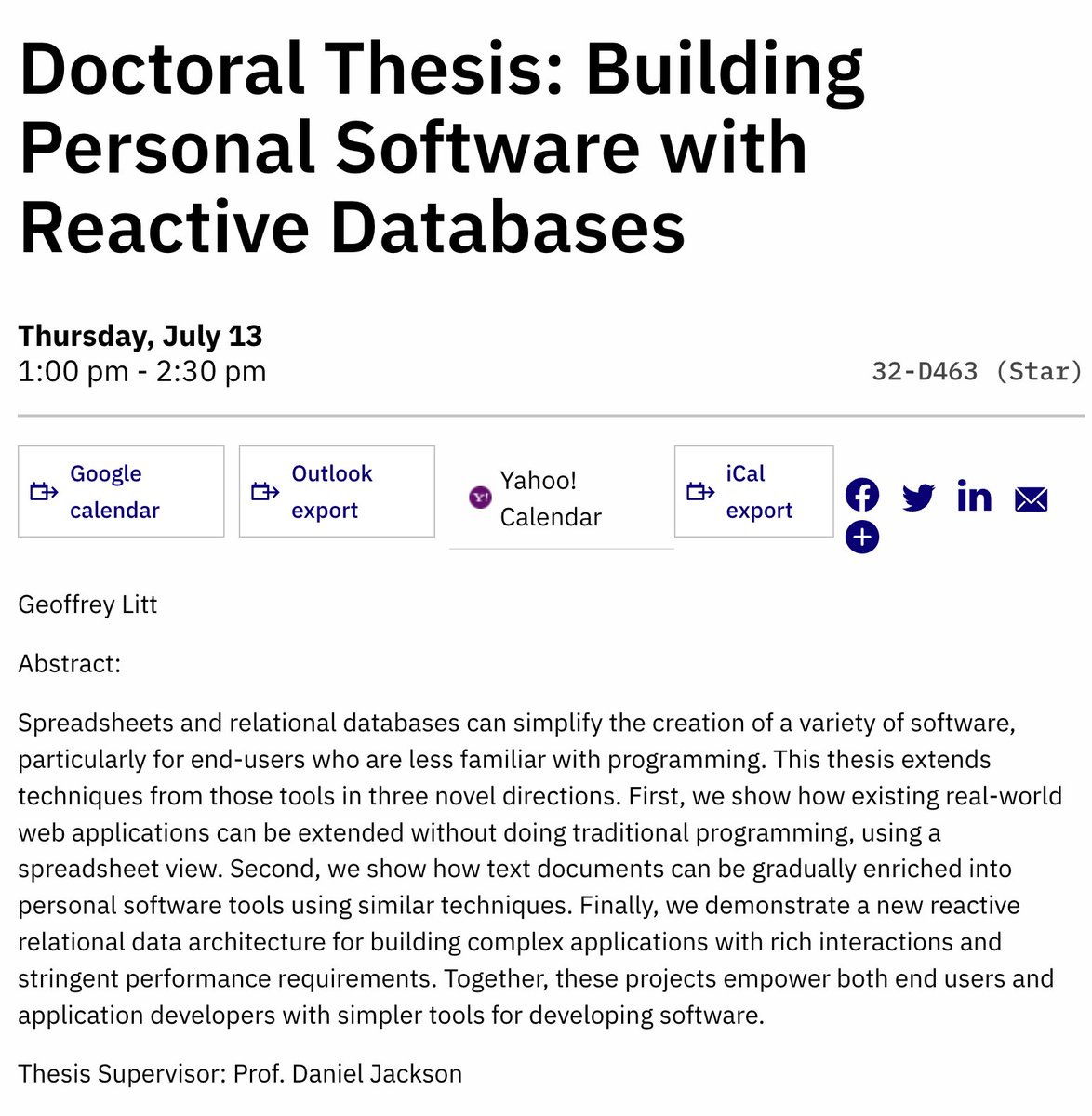
This Thursday I'm presenting my PhD thesis defense at MIT! Summarizing years of research on making it easier for people to build software using ideas from spreadsheets 🤓 Not sharing Zoom link publicly but just DM me if you want to watch! (will also post recording later)
Geoffrey Litt tweet media
English
52
56
778
96.8K
Bernhard Seefeld me-retweet
kepano
kepano@kepano·
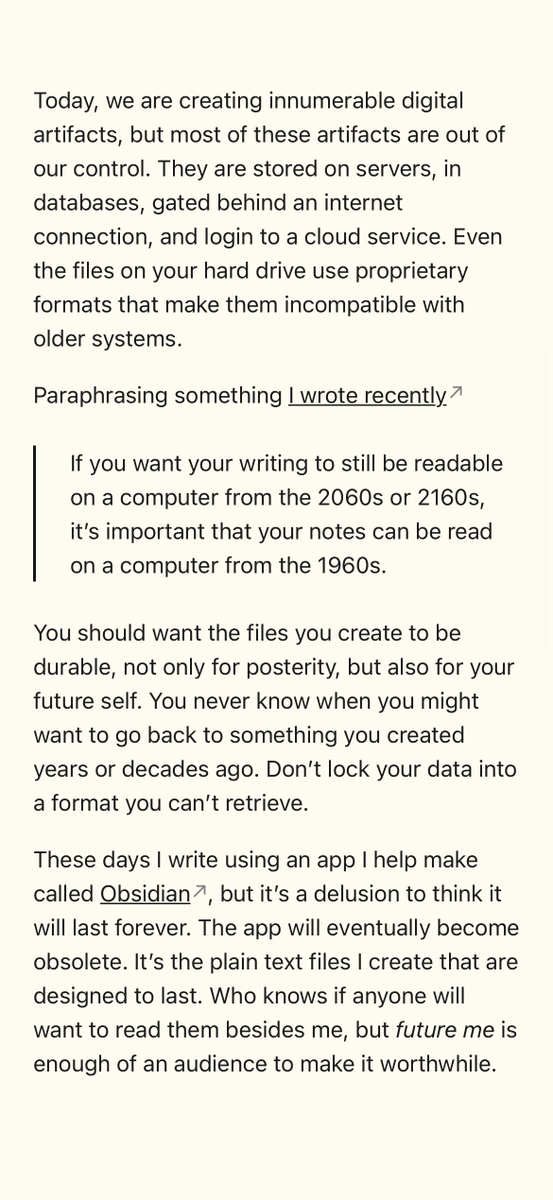
File over app File over app is a philosophy: if you want to create digital artifacts that last, they must be files you can control, in formats that are easy to retrieve and read. Use tools that give you this freedom. File over app is an appeal to tool makers: accept that all software is ephemeral, and give people ownership over their data. In the fullness of time, the files you create are more important than the tools you use to create them. Apps are ephemeral, but your files have a chance to last. The pyramids of Egypt contain hieroglyphs that were chiseled in stone thousands of years ago. The ideas hieroglyphs convey are more important than the type of chisel that was used to carve them. The world is filled with ideas from generations past, transmitted through many mediums, from clay tablets to manuscripts, paintings, sculptures, and tapestries. These artifacts are objects that you can touch, hold, own, store, preserve, and look at. To read something written on paper all you need is eyeballs. Today, we are creating innumerable digital artifacts, but most of these artifacts are out of our control. They are stored on servers, in databases, gated behind an internet connection, and login to a cloud service. Even the files on your hard drive use proprietary formats that make them incompatible with older systems. Paraphrasing something I wrote recently: > If you want your writing to still be readable on a computer from the 2060s or 2160s, it’s important that your notes can be read on a computer from the 1960s. You should want the files you create to be durable, not only for posterity, but also for your future self. You never know when you might want to go back to something you created years or decades ago. Don’t lock your data into a format you can’t retrieve. These days I write using an app I help make called Obsidian (@obsdmd), but it’s a delusion to think it will last forever. The app will eventually become obsolete. It’s the plain text files I create that are designed to last. Who knows if anyone will want to read them besides me, but future me is enough of an audience to make it worthwhile.
kepano tweet mediakepano tweet media
English
185
1.4K
9.4K
3.1M
Bernhard Seefeld
Bernhard Seefeld@seefeld·
What distinguished the iPhone from prior smartphones was that Apple shrunk general computing into a new form factor and solved the input methodology. They did that again: iPhone = PC in new form factor + new input method. Vision = PC in new form factor + new input method.
Stratechery@stratechery

Apple Vision Apple Vision is incredibly compelling, first as a product, and second as far as potential use cases. What it says about society, though, is a bit more pessimistic. stratechery.com/2023/apple-vis…

English
1
0
8
598
Bernhard Seefeld me-retweet
Kristian Lum
Kristian Lum@KLdivergence·
There’s one existential risk I’m certain LLMs pose and that’s to the credibility of the field of FAccT / Ethical AI if we keep pushing the snake oil narrative about them.
English
36
123
780
657.9K
Bernhard Seefeld
Bernhard Seefeld@seefeld·
@dalmaer @Wattenberger I think a chatbot could be value where the conversation itself is the point: Instead of getting a draft, first have a loose conversation on the topic, then gather the material and use a tool (!) to turn it into a draft. Or critique an argument as a whole, not line by line. Etc.
English
0
0
2
22
Bernhard Seefeld
Bernhard Seefeld@seefeld·
I'm starting a newsletter on a privacy-centric future empowered by AI. Strong opinions & optimism ahead! First up: wildbuilt.world/p/ai-co-create… AI won't just be chatbots. Instead, imagine AI embedded in tools co-created by you - evolving, personalized & profoundly empowering. 🧵(1/19)
English
1
8
35
7.7K