
Nicholas Sofroniew

5.1K posts

Nicholas Sofroniew banner
Nicholas Sofroniew

Nicholas Sofroniew

@sofroniewn

math/neuroscience - AI

San Francisco, CA Bergabung Aralık 2014
1.1K Mengikuti2.6K Pengikut
Nicholas Sofroniew me-retweet
Science Magazine
Science Magazine@ScienceMagazine·
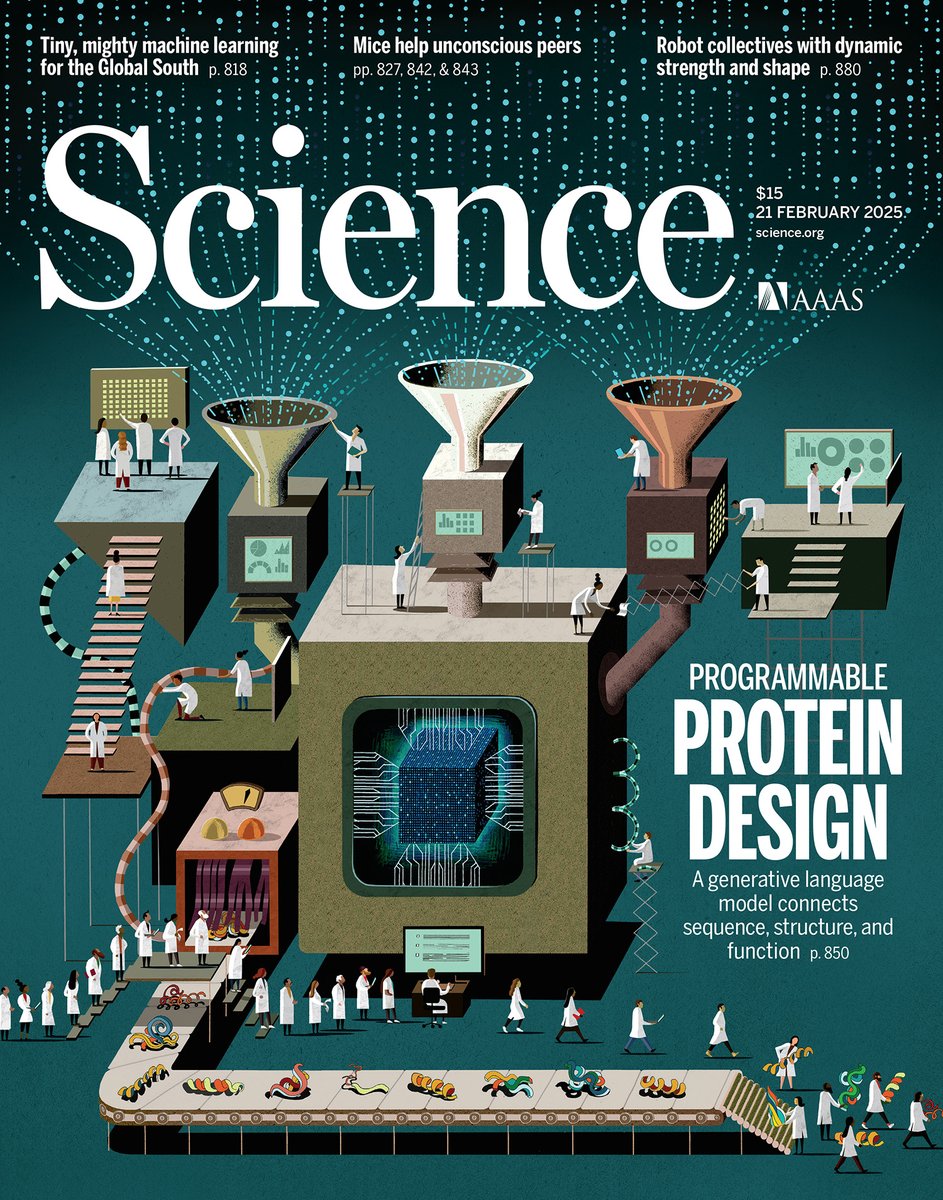
Researchers have developed a deep learning protein language model, ESM3, that enables programmable protein design. Learn more in this week's issue of Science: scim.ag/4b5IlQu
Science Magazine tweet media
English
32
162
544
239K
Patrick Hsu
Patrick Hsu@pdhsu·
AI provides a universal framework that leverages data and compute at scale to uncover higher-order patterns Today, @arcinstitute in collaboration with @nvidia releases Evo 2—a fully open source biological foundation model trained on genomes spanning the entire tree of life 🧵
Patrick Hsu tweet media
English
90
566
2.6K
462.9K
Jerry Tworek
Jerry Tworek@MillionInt·
Best way to move science forward is to make experiments cheaper and faster
English
13
10
177
8.9K
Nicholas Sofroniew
Nicholas Sofroniew@sofroniewn·
So excited to be part of this work and programming biology! 🤖🧬🧫
Alex Rives@alexrives

We're thrilled to present ESM3 in @ScienceMagazine. ESM3 is a generative language model that reasons over the three fundamental properties of proteins: sequence, structure, and function. Today we're making ESM3 available free to researchers worldwide via the public beta of an API for biological intelligence. Trained with over a trillion teraflops of compute, this is the first time a model of this scale has been trained for biology, pushing the frontier of AI for biological discovery and engineering. ESM3 learns to represent the immense complexity of protein biology, learning from billions of natural proteins. From this training it developed the capability to design proteins, responding to complex prompts combining atomic level details and high level instructions to generate new proteins. ESM3 can explore protein space far beyond natural evolution. We prompted ESM3 to generate a fluorescent protein at a far distance from any known fluorescent proteins, searching an unknown region of protein space, to discover a new fluorescent protein. We estimate this is equivalent to simulating five hundred million years of evolution.

English
0
1
31
2K
Nicholas Sofroniew me-retweet
Alex Rives
Alex Rives@alexrives·
We're thrilled to present ESM3 in @ScienceMagazine. ESM3 is a generative language model that reasons over the three fundamental properties of proteins: sequence, structure, and function. Today we're making ESM3 available free to researchers worldwide via the public beta of an API for biological intelligence. Trained with over a trillion teraflops of compute, this is the first time a model of this scale has been trained for biology, pushing the frontier of AI for biological discovery and engineering. ESM3 learns to represent the immense complexity of protein biology, learning from billions of natural proteins. From this training it developed the capability to design proteins, responding to complex prompts combining atomic level details and high level instructions to generate new proteins. ESM3 can explore protein space far beyond natural evolution. We prompted ESM3 to generate a fluorescent protein at a far distance from any known fluorescent proteins, searching an unknown region of protein space, to discover a new fluorescent protein. We estimate this is equivalent to simulating five hundred million years of evolution.
English
24
243
856
225.6K
Nicholas Sofroniew me-retweet
Hannes Stark
Hannes Stark@HannesStaerk·
New paper with Bowen :) "Generative Modeling of Molecular Dynamics Trajectories" arxiv.org/abs/2409.17808… A "video diffusion" model but for MD trajectories. Different conditioning solves different tasks. E.g. condition on first and last frame => transition path sampling 1/4
Hannes Stark tweet media
English
11
53
272
27.7K
Nicholas Sofroniew me-retweet
Yunha Hwang
Yunha Hwang@Micro_Yunha·
What does gLM2 learn in non-protein-coding sequences?🧬 Using the Categorical Jacobian and the latest gLM2, we detect incredible regulatory signals in the non-protein coding regions -- all without any supervision!🪄 a quick 🧵
Yunha Hwang tweet media
English
3
23
190
22.1K
Nicholas Sofroniew me-retweet
Sergey Ovchinnikov
Sergey Ovchinnikov@sokrypton·
Exciting new work from Qian Cong's group on predicting human protein interactome. Leveraging new eukaryotic genomes, new RoseTTAFold2 trained on +/- pairs of PPI and large distilled dataset of domain-domain interactions! 🤩 biorxiv.org/content/10.110…
Sergey Ovchinnikov tweet media
English
8
77
362
27K
Nicholas Sofroniew me-retweet
Martin Pacesa
Martin Pacesa@MartinPacesa·
Have you ever wanted to design protein binders with ease? Today we present 𝑩𝒊𝒏𝒅𝑪𝒓𝒂𝒇𝒕, a user-friendly and open-source pipeline that allows to anyone to create protein binders de novo with high experimental success rates. @befcorreia @sokrypton biorxiv.org/content/10.110…
English
27
425
1.8K
300.4K
Nicholas Sofroniew
Nicholas Sofroniew@sofroniewn·
@TrackingActions It took ~3 hours, and was the only time in my life where I really felt I taught a mouse anything and saw a mouse think. There was a clear transition of < 1 minute where it went from not getting it to getting it which was pretty magical
English
0
0
4
185
Nicholas Sofroniew
Nicholas Sofroniew@sofroniewn·
@TrackingActions Not sure if I ever told you about this one, but it's unpublished (>10 years old now!), but I taught a mouse to do a navigate my winding corridor task with full "-1" gain inversion - e.g. think wearing prism glasses, but with the whisker system
English
1
0
3
465
Mackenzie Weygandt Mathis, PhD
Mackenzie Weygandt Mathis, PhD@TrackingActions·
What are some of your favorite examples (papers) of within-session learning in animal models (with neural recordings ideally)? This could be zero-shot learning, continual learning, motor adaptation, cognitive dynamic-decision making, etc! Thanks #neuroTwitter #neuroX (Don't hesitate to share your own work! ⬇️)
English
17
9
74
18.3K
Nicholas Sofroniew me-retweet
John Cumbers
John Cumbers@johncumbers·
Great AI meets Bio event in Boston with @mkoeris @geochurch and @alexrives 🧬🧬🧬🔥🔥🔥
Michael Koeris@mkoeris

Great fireside chat with @geochurch and @alexrives moderated by @johncumbers here at AI🧬BTO East at @MIT! 1) 3D printing with trillions of printers and billions of inks - what is that? That’s 1 mm^3 of cells assembling products!!! That’s the power of biology - thank you @geochurch for the metaphor

English
1
3
27
3K
Nicholas Sofroniew me-retweet
OpenAI
OpenAI@OpenAI·
OpenAI o1 solves a complex logic puzzle.
Română
32
155
1.6K
254.1K
Nicholas Sofroniew me-retweet
Andrew White 🐦‍⬛
Andrew White 🐦‍⬛@andrewwhite01·
We had a lot to announce, but want to highlight we're building a PaperQA2-version of Wikipedia covering the human proteome. The 240 articles that were graded by experts as better than existing Wikipedia are already viewable - we're generating the rest over the next few weeks!
Andrew White 🐦‍⬛ tweet media
English
5
29
206
17.1K
Nicholas Sofroniew me-retweet
Sam Rodriques
Sam Rodriques@SGRodriques·
Introducing PaperQA2, the first AI agent that conducts entire scientific literature reviews on its own. PaperQA2 is also the first agent to beat PhD and Postdoc-level biology researchers on multiple literature research tasks, as measured both by accuracy on objective benchmarks and assessments by human experts. We are publishing a paper and open-sourcing the code. This is the first example of AI agents exceeding human performance on a major portion of scientific research, and will be a game-changer for the way humans interact with the scientific literature. Paper and code are below, and congratulations in particular to @m_skarlinski, @SamCox822, @jonmlaurent, James Braza, @MichaelaThinks, @mjhammerling, @493Raghava, @andrewwhite01, and others who pulled this off. 1/
English
78
752
3.3K
554.8K
Nicholas Sofroniew me-retweet
Andrew White 🐦‍⬛
Andrew White 🐦‍⬛@andrewwhite01·
We used PaperQA2 to extract claims from papers and then see if they're contradicted anywhere in literature. This task is time consuming for humans, but we were able to use this for hundreds of papers to look for trends in disagreement in fields, decades, and journals.
Andrew White 🐦‍⬛ tweet media
English
10
56
445
47.1K
Nicholas Sofroniew me-retweet
Jeff Nivala
Jeff Nivala@jeffnivala·
Published today in @Nature, we describe an approach for single-molecule protein reading on @nanopore arrays. By utilizing ClpX unfoldase to ratchet proteins through a CsgG nanopore, we achieved single-amino-acid sensitivity. nature.com/articles/s4158…
English
19
284
992
87K