Halloworld

117 posts

Halloworld

Halloworld

@thirdthrowaways

Bergabung Ocak 2022
330 Mengikuti116 Pengikut
Halloworld
Halloworld@thirdthrowaways·
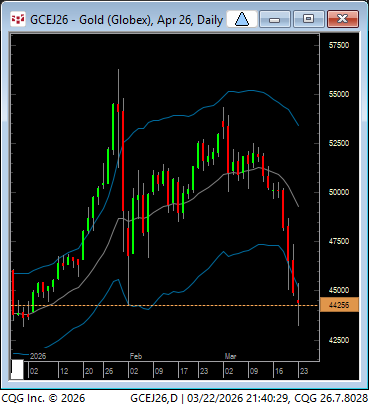
when i look at weekly volume profile, there's hardly any volume that occured between 4600-5500 range (3months range), whereas i see huge fat volumes between 4000-4400, and consolidated in that range for 1 year. So, isn't it better to view it as the price will now go back into 4000-4400 range? thank you
English
0
0
12
3.3K
Linda Raschke
Linda Raschke@LindaRaschke·
GOLD: BUY beneath a key previous swing low when in a long-term uptrend.
Linda Raschke tweet media
English
15
84
957
79.1K
Halloworld me-retweet
The White House
The White House@WhiteHouse·
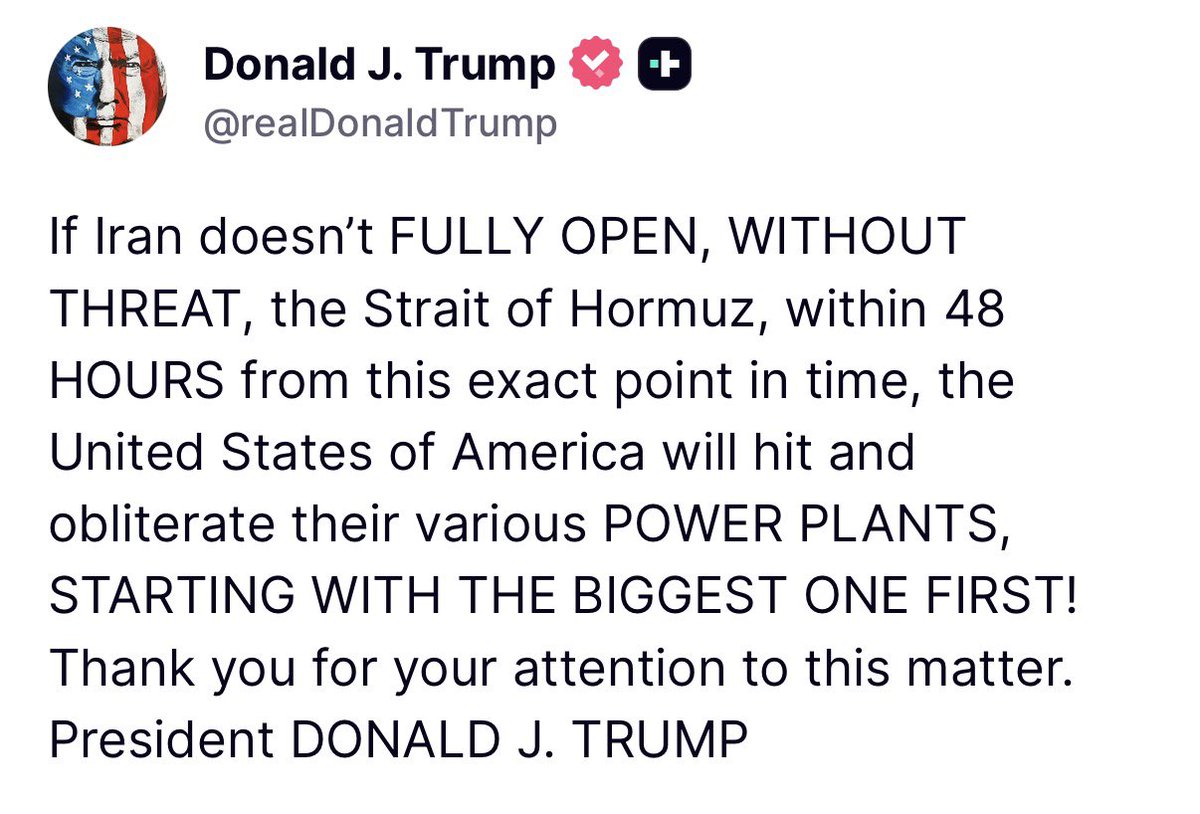
🚨 “If Iran doesn’t FULLY OPEN, WITHOUT THREAT, the Strait of Hormuz, within 48 HOURS from this exact point in time, the United States of America will hit and obliterate their various POWER PLANTS, STARTING WITH THE BIGGEST ONE FIRST…” - President DONALD J. TRUMP
The White House tweet media
English
24.2K
20.8K
98.4K
16.8M
Halloworld me-retweet
Tobias Carlisle
Tobias Carlisle@Greenbackd·
ROIC, and ROA and ROE are the strongest predictors of stock performance. Each measures how efficiently a company converts capital into profits. Interest Coverage (EBIT / interest expense) captures financial strength and ability to service debt. Markets reward companies that: • generate high returns on capital • are financially resilient • require less capital to grow This is essentially the economic moat + capital efficiency signal. Gross margin is the weakest quality metric.
Rene Sellmann@ReneSellmann

This is my favorite chart from last year ⬇️ In a nutshell, clearly not all "Quality" is created equal. Since 1985, the "most alpha" has been found in two places: ✅ Capital Efficiency: ROIC, ROE & ROA ✅ Solvency: Interest & Debt Coverage Buying "High Gross Margin" sounds sexy, but the market rewards those who actually generate returns on their capital.

English
13
58
345
41.9K
Arnaud Bertrand
Arnaud Bertrand@RnaudBertrand·
@xdrewmiko Not "accidentally": they put immense efforts into it, very much helped by the U.S. export controls. As the saying goes "necessity is the mother of invention"...
English
3
5
107
3K
Arnaud Bertrand
Arnaud Bertrand@RnaudBertrand·
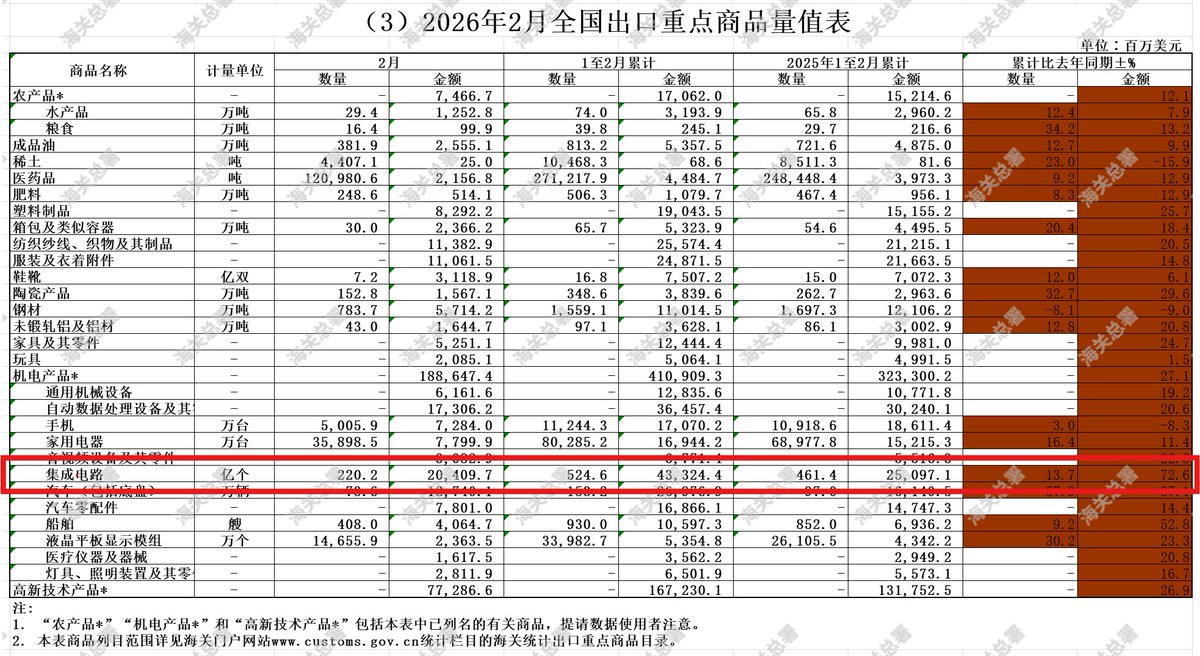
This is fascinating from China's customs data (customs.gov.cn/customs/2026-0…). All its exports are rising very rapidly but the one export that's rising the fastest, at a crazy +72.6% growth year on year, is... semiconductors! As you can see in the trade data China sold $43.32 billion worth of 集成电路 ("integrated circuits") in Jan-Feb 2026, vs $25.10 billion for Jan-Feb last year. Interestingly, volume is "only" up 13.7% year on year, which means the increase in revenue is mostly driven by higher prices per chip, which probably suggests that a) China is climbing up the value chain (selling more expensive chips) b) demand for their chips far exceeds supply - which is the exact opposite of "overcapacity". You don't get +53% price increases per unit in a market with overcapacity And all in all, it goes to show that China is definitely a force to be reckoned with in the semiconductor world. Global semiconductor sales were $791.7 Billion in 2025 (semiconductors.org/global-annual-…) and projected to be ~$975 billion this year. China selling $43.32 billion in 2 months means its doing $260 billion annualized: that's over a quarter of the entire global semiconductor market. So much for the idea that export controls would freeze China out of the semiconductor industry...
Arnaud Bertrand tweet media
English
17
198
943
137K
Marhelm
Marhelm@MarhelmData·
We've received word that London insurance underwriters will shortly resume Hormuz passage insurance
English
200
680
3.1K
1.4M
Halloworld
Halloworld@thirdthrowaways·
@herrmann_l0578 I dont get it. I thought it has no choice but to be silent and they are hurting bad as a result? the big winner is the US from all this?
English
0
0
0
13
Halloworld me-retweet
Lars Herrmann
Lars Herrmann@herrmann_l0578·
If Hormuz stays closed, the world loses ~450 million barrels per month. That exceeds the entire US Strategic Petroleum Reserve. Not a supply interruption. A structural reset. The reserve was built for disruption. The disruption just exceeded the reserve.
English
1
2
4
103
Halloworld
Halloworld@thirdthrowaways·
@MPelletierCIO I really liked your g7 suddenly supporting trump post, can you expand on that please
English
0
0
1
123
Martin Pelletier
Martin Pelletier@MPelletierCIO·
I’ve spent the past week thinking carefully about what has unfolded, not just in markets, but beneath them. This is not simply another geopolitical headline or a short‑term volatility spike. It is a convergence of energy, politics, and macro fragility that exposes where the system is most vulnerable. The risks are real, the margin for error is thin, and the next two weeks are going to be very, very important. Hormuz: The Single Point of Failure in Global Energy Markets The Strait of Hormuz is more than a regional chokepoint. It is systemically critical to global energy pricing because the volumes involved are enormous and the alternatives are extremely limited. In 2024, roughly 20 million barrels per day of crude oil and refined products moved through the Strait, equivalent to about 20 percent of global petroleum liquids consumption and nearly one quarter of global seaborne oil trade, with the overwhelming majority of these flows destined for Asia. This is not merely a supply interruption, it is a disruption to the infrastructure that underpins both physical energy flows and global price discovery. Spare Capacity Trapped Behind the Chokepoint What makes Hormuz even more consequential is that it sits directly in front of the Gulf producers that still matter most for global supply balancing. The Strait remains the primary export route for Saudi Arabia, Iraq, the United Arab Emirates, Kuwait, Iran, Qatar, and Bahrain, with Saudi Arabia alone accounting for nearly 40 percent of the oil exports that transit the passage. These same countries also hold virtually all of the world’s meaningful spare capacity, estimated at roughly 3.5 to 4.0 million barrels per day in 2025. In a prolonged disruption, that spare capacity is not missing. It is effectively trapped behind the very chokepoint markets are relying on to stabilize prices. Limited Bypass Options and an Unprecedented Setup There are bypass options, but the math is unforgiving. Pipeline routes capable of avoiding Hormuz can move roughly 3.5 to 5.5 million barrels per day, a meaningful number in isolation but small relative to the approximately 20 million barrels per day that normally transits the Strait. At the producer level, storage constraints quickly become binding. Gulf producers can last on the order of 25 days before full tanks force widespread shut-ins. Saudi Arabia has substantial buffer storage, but it is not unlimited, while Iraq has already cut roughly 1.5 million barrels per day. This configuration is unprecedented. The Strait of Hormuz has never been fully closed in modern history, which makes duration risk especially difficult for markets to price. Floating Storage: A Temporary Shock Absorber Floating storage is one reason prices have not gone completely vertical. An estimated 90 to 120 million barrels of oil are currently held offshore, heavily concentrated in Asia and disproportionately tied to sanctioned flows from Russia and Iran, with Iranian crude alone accounting for tens of millions of barrels. This inventory can cushion the initial phase of a disruption, providing well less than 30 days of partial relief for key importers. But it is not a solution. Once floating storage is drawn down, the market confronts the same hard constraint as before: physical deliverability through the Strait of Hormuz. LNG: The Underappreciated Accelerant Natural gas is the underappreciated accelerant in this equation. In 2024, about 20 percent of global LNG trade transited Hormuz, primarily from Qatar, which alone exported roughly 9.3 billion cubic feet per day through the Strait. A disruption would strand LNG exports from Qatar and the United Arab Emirates that together represent nearly one fifth of global LNG supply, and there are no meaningful bypass routes for these cargoes. This is why gas markets can reprice faster than oil. The oil market has buffers. The LNG market has far fewer. Financial Spillovers and Political Constraints From an investment perspective, the second-order effects matter as much as the barrel count. Higher energy import bills pressure the trade balances of major importing nations, and when currencies come under stress, central banks often defend them by drawing down reserves. In practice, that can mean selling liquid reserve assets, including U.S. Treasuries, putting upward pressure on yields at the margin. For the United States, higher yields compound the challenge of financing large deficits at elevated interest rates, tightening financial conditions just as policymakers would prefer to ease. At the same time, U.S. consumers experience energy shocks faster than almost any other inflation channel because gasoline prices are visible and paid weekly. Even when broader inflation measures are mixed, sustained increases at the pump can hit consumer confidence quickly and intensify political pressure to contain the shock. This political constraint matters because markets price duration, not headlines. The longer prices stay high, the stronger the incentive becomes for containment through diplomacy, tactical de‑escalation, or policy actions designed to stabilize markets. Globally, the more difficult question is not supply, but price elasticity. How high do prices actually need to go to destroy enough demand to offset the volume at risk? That is the real crux of the problem. Even oil at $150 or $200 per barrel may not be sufficient to curtail demand by the magnitude required, at least not quickly enough. Energy demand is remarkably inelastic in the short term. The adjustment mechanism is not lower consumption, but economic damage. Prices may eventually rebalance the market, but only after inflicting significant harm on growth, inflation, and financial stability. Conclusion: A High-Stakes Standoff We are now in a high‑stakes standoff, with Iran holding its most powerful lever by threatening the Strait of Hormuz. Oil prices are up roughly 34 percent this week, the largest weekly move since at least 1985, reflecting not just supply risk but duration risk. As long as spot prices surge without a corresponding repricing of the forward curve, energy equities will continue to lag crude, signaling that markets still view this as a geopolitical shock rather than a durable structural reset. However, the longer Hormuz remains impaired, the less this resembles volatility to be traded and the more it becomes a systemic risk to growth, inflation, and financial stability. In an era defined by trade wars, deglobalization, and fragmented supply chains, the world increasingly operates on an every‑country‑for‑itself basis. Those unprepared for sustained disruption will suffer far more than those with real assets, fiscal flexibility, and resilient balance sheets. I am not a fan of high‑stakes poker, particularly when the downside risks are asymmetric. Further large spikes in oil prices are unlikely to materially curb demand quickly enough to rebalance the market, but they would inflict significant damage on the global economy. Critically, this is a shock that would not be cushioned by traditional hedges such as U.S. Treasuries. Instead, prolonged economic stress would likely push governments toward renewed stimulus and, ultimately, aggressive monetary expansion to fund continued deficit spending to support the broader economy. And as history has shown repeatedly, when confidence in paper assets erodes and policy responses converge on money creation, all roads tend to lead back to gold.
English
19
24
160
19K
Halloworld me-retweet
Martin Pelletier
Martin Pelletier@MPelletierCIO·
My spider senses really tingling here. Something is up. China suddenly halts refined product exports. US military asks critical mineral producers for support. Trump admin facilitates a large gold order between the U.S. and Venezuela, with up to 1,000 kilograms of gold to be shipped to the U.S. And PM Carney does a huge and suddenly shift and offers strong support of Trump’s attack on Iran.
English
107
417
4.9K
774.4K
Halloworld me-retweet
Ted Zhang
Ted Zhang@TedHZhang·
When you study Druckenmiller's 13Fs (even though they are delayed) and look at his cost basis, he is almost always buying within a base, whether in an established uptrend or looking to catch the change in momentum from a downtrend into an uptrend. That is why focusing on big weekly and monthly bases coupled with a fundamental, growth and/or thematic backdrop leads you to the new big themes. Bases form from smart money accumulating the stock.
English
23
79
1.1K
95.7K
Halloworld me-retweet
Warren Pies
Warren Pies@WarrenPies·
Remember, in oil Extreme contango marks bottoms. Extreme backwardation marks tops.
English
62
90
1.2K
182.4K
Halloworld
Halloworld@thirdthrowaways·
@KontraInvest But why price is going down(?) am a holder but curious whether im missing more important piece
English
2
0
3
573
Kontra
Kontra@KontraInvest·
$NVO: The Oral revolution is real 🚀 The latest IQVIA data (week ending Feb 13, 2026) confirms what we've been waiting for: The Wegovy pill is indeed a massive market expander. Total Wegovy TRx hit 319,621 (+11.9% week over week), driven largely by the pill's HUGE growth in its sixth week. Key Insights: Pill power: Wegovy pill TRx reached 56,943, a +49% jump week-over-week. This accounted for nearly 18% of total Wegovy prescriptions. Market share shift: Wegovy’s share of weekly TRx rose to 36.6% (up from 33.2%), while Zepbound saw a -3.8% decrease to 552,809. Expansion, not cannibalization: Injectable volume is still growing alongside the pill. The oral form factor is bringing in sidelined patients who were needle-avoidant, not just switching existing users. Starter dose dominance: Novo gained 16k in starter dose TRx while Lilly lost 4k. This is the lead indicator for future long-term volume. These are very strong numbers and indicators! $NVO $LLY $VKTX
English
8
7
79
11.2K
Halloworld me-retweet
Brett Caughran
Brett Caughran@FundamentEdge·
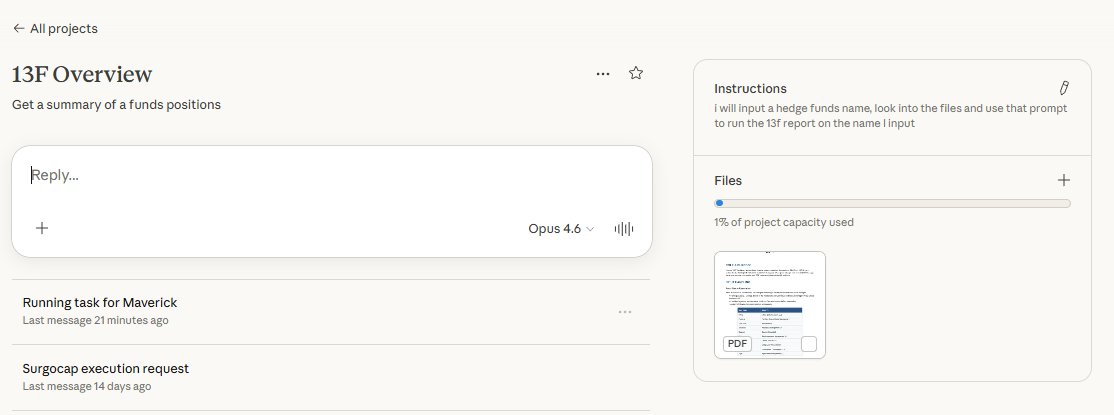
With 13Fs for Q4 out, retweeting this AI workflow (which I quite like). I will be building a stack of a couple dozen funds I follow to get a quick look at their portfolios: new additions, size ups/downs and portfolio themes. I do this in a Claude Project, upload the prompt as a system document (I shared prompt in this thread) then just type in the firm name. Very easy. Mostly I've been spending MORE money will all these incremental subscriptions, but I just cancelled my WhaleWisdom account (Factset UI on ownership has always been maddening...but I can do what I did in WhaleWisdom before, and better, with Claude).
Brett Caughran tweet media
Brett Caughran@FundamentEdge

AI Workflow: 13F Top Holdings Report One thing I like to do when I'm looking for new ideas is to check the 13Fs of a few dozen hedge funds I respect for new & high conviction ideas. While I don't want to outsource my thinking, there is no copyright protection on a great idea, and the funds I choose I know to have strong due diligence and a thoughtful portfolio inclusion process. Which is a positive signal, on balance. (And one of my favorite personal strategies is a biotech 13F overlay which has a crazy good 15 year back test...post-COVID hangover notwithstanding...though XBI breaking out...???). This is sort of a clunky process in FactSet (and in Bloomberg) where even getting to the right legal entity can be a pain. Pretty much just for UI purposes, I have been a Whale Wisdom subscriber for years (which still isn't great, but better than Bloomberg/FactSet). I've long been searching for a better alternative. So I've been playing around with an AI workflow solution to this problem, seeking to create: - A short PDF I can read in 5-10 minutes - Starting with 13F-sourced data on top 20 holdings - AI generated summary thesis on those top 20 holdings (i.e. why the fund likely owns the position) So in 5-10 minutes I can get a quick check on the highest conviction names at a fund and quick analysis on the position. Efficiency is important when doing this ~35 times, 4 times per year. 35 x 45 minutes (i.e. see the position, read 1-2 sell-side notes on the name) is a lot different than 35 x 10 minutes (i.e. quick AI-generated thesis). The cool part is I can take this report then drop it into my AI "Up to Speed" workflow and go even deeper, such as identifying dates for binary catalysts for biotech ideas, or asking for the 3 key drivers for a name. This is a pretty challenging task for AI, because I am demanding the LLM identify the correct legal entity from the generic name (which FactSet mostly cannot do) go to EDGAR XML filings, integrate some market data, format it well, the write "Why This Position Makes Sense", "Recent Developments Supporting the Thesis", and "Position Sizing Context". From my prompt: I tried this a few months back and it didn't work. I decided to try it again this morning, and here are my results. ChatGPT 5.2: Awful, and awful in an annoying way. Finally admitted it couldn't do it in a single normal churn task. Overly, annoyingly apologetic, then just keeps not doing what you ask. Gemini 3: Better, but lazy. Gave me a summary of position 1, 4 and 7, but completely skipped the other ideas. Fail. Grok: Better, but still not good. I'd say close, but still fail. Claude Opus 4.5: SHOCKINGLY GOOD. Missed on some of the market data requests (% of ADV), but pretty much fulfilled the request exactly as I requested, creating an easy to read summary of a fund's Top 20 holdings and a guess as to why they hold the idea. I will drop the prompt and a few sample reports in the replies if you want to re-create this.

English
9
16
260
46K
Halloworld me-retweet
Mark Minervini
Mark Minervini@markminervini·
One of the best pieces of trading advice you will ever hear. 👇 I've termed it Progressive Exposure.
English
69
663
3K
379.1K
Halloworld me-retweet
Ted Zhang
Ted Zhang@TedHZhang·
Here is a YouTube playlist I created of 14 long-form Stanley Druckenmiller interviews I’ve found. I’ve seen most of them and am working through them again. There is never enough listening to Stan and his wisdom. youtube.com/playlist?list=…
English
54
346
2.1K
481.8K
Halloworld me-retweet
Michael Every
Michael Every@TheMichaelEvery·
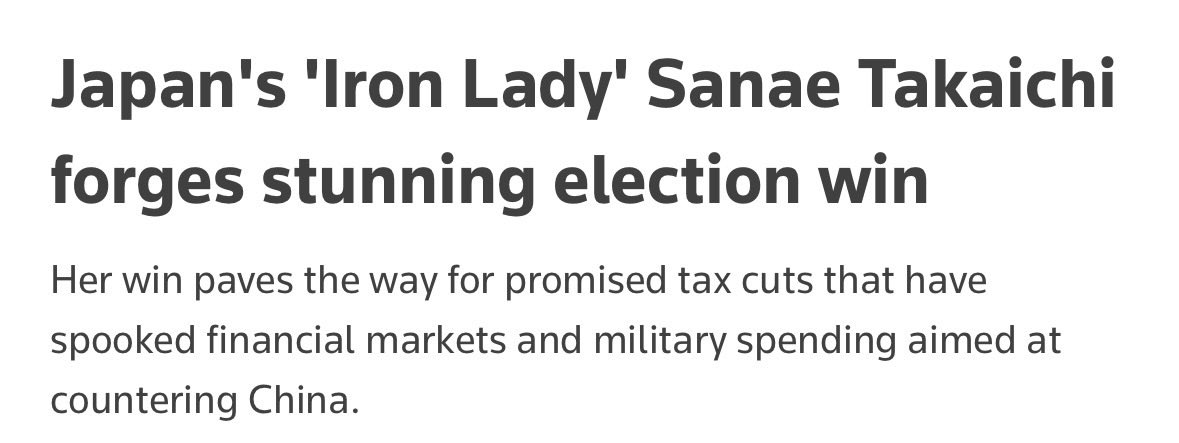
2026, day 40 Good morning from Asia. ‘Israel warns Trump: We may act alone if Iran crosses ballistic missile red line’ (JPost); ‘Iran again rules out giving up uranium enrichment, suggests US not taking talks seriously’ (ToI); ‘Iran arrests leading reformist politicians’ (FT); ‘Mashaal to Al Jazeera Forum: Hamas disarming risks making Gazans ‘easy victims to be eliminated'’ (JPost); ‘Security cabinet okays deepened Israeli control of West Bank; Hamas urges ‘escalation’’ (ToI); ‘As IDF and Hamas dig in, interim Gaza armistice line risks hardening into lasting border’ (ToI); ‘Algeria begins to cancel air services agreement with UAE’ (Reuters); ‘Ukraine urges acceleration of peace talks, says only Trump can broker deal’ (Reuters); ‘Ukraine to open 10 weapons export centers in Europe in 2026 in major wartime policy shift’ (Kyiv Independent); ‘Japan’s Takaichi Scores Landslide Win in Election Gamble’ (WSJ) - “Increased majority empowers her to draw Japan closer to the U.S. and spend more on defense and industrial policy”; ‘Takaichi Triumphs With Japan’s Biggest Post-War Election Victory’ (Bloomberg) - “The outcome gives Takaichi a mandate to push ahead with bold spending plans and a more assertive stance on the international stage, which has put investors on edge and may fuel market volatility”; ‘‘Playing with fire’: Taiwan defense spending battle rattles China hawks’ (The Hill); ‘Japan’s heavy metal rock star PM could wreck Labor’s China strategy’ (AFR) - “Sanae Takaichi’s thumping election victory means her brand of unapologetic China hawkishness is likely to collide with Labor’s delicate project to stabilise relations with our largest trading partner”; ‘Lighter, simpler, faster: could this thrust device give Chinese drones an edge over F-35s?’ (SCMP); ‘Starmer in fight to reassert control over Labour party after McSweeney exit’ (Guardian) - “Allies hope aide’s departure can quell anger over Mandelson scandal but others say it leaves PM dangerously exposed”; ‘Meloni slams ‘enemies of Italy’ for railway sabotage and anti-Olympics protests’ (Politico) - “Protesters took to the streets in Milan on Saturday, while railway infrastructure was damaged”; ‘Center left beats far right to Portugal’s presidency’ (Politico); ‘Thai Election Win for Anutin Gives Royalists Chance at Stability’ (Bloomberg); ‘SAVE America Act becomes catch-all for Trump's election demands: Here's what's actually in it’ (Axios); In geoeconomics, ‘TSMC to Make More-Advanced Chips in Japan as Part of AI Push’ (WSJ); ‘Japan to invest in thermal power, diamonds and ports in the U.S.’ (Japan Times); ‘Carney’s ‘art of the deal’: Canada leverages subs contract for auto investment’ (FT) - “Ottawa pits Germany against South Korea as it looks to strengthen non-US trade ties”; In markets, ‘Warsh’s Cryptic Call for Fed-Treasury Accord Rattles Bond Market’ (Bloomberg); ‘Bessent Suggests Warsh Nomination Hearings Alongside DOJ Probe’ (Bloomberg); ‘Beware AI bubble if productivity boom fails to deliver, warns Bailey’ (Telegraph) - “Governor voices risk of market ‘complacency’ and artificial intelligence overvaluation”; ‘Bitcoin is still about $70,000 too high’ (FT) - “The crypto crash is coming — and the landing won’t be pretty”; ‘UBS banked Ghislaine Maxwell for years, moving her money after Epstein's arrest’ (Reuters)
Michael Every tweet mediaMichael Every tweet mediaMichael Every tweet mediaMichael Every tweet media
English
4
11
95
6.1K
First Squawk
First Squawk@FirstSquawk·
Japan’s Nikkei 225 surged 6% to a record high following PM Takaichi’s election victory.
English
1
5
23
9.6K
Rob Anderson, CFA
Rob Anderson, CFA@_rob_anderson·
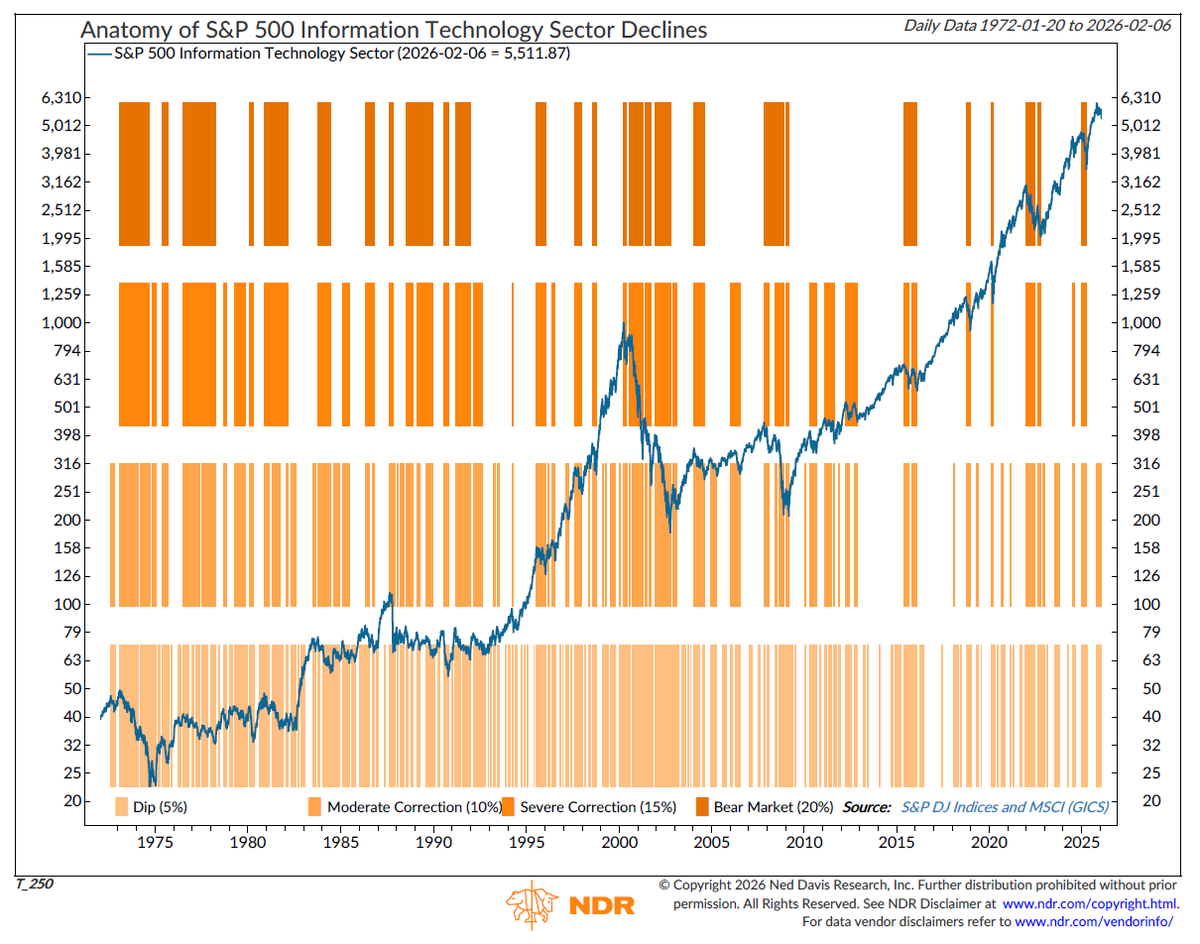
Time will tell if the tech selloff is the start of a long-term rotation from Growth or a blip. But for perspective, Technology has averaged six declines per year greater than 5%, two greater than 10%, and one greater than 15%. Declines of 20%+ occur about once every two years.
Rob Anderson, CFA tweet media
English
1
11
57
2.7K