@richbacolor@AmbScienceTeach This is an addition to the lesson plan (from @nextgenstoryli1 ), and I'm still in the process of making this a habit/routine. Definitely something to add (or include as an option) when we revise this unit!
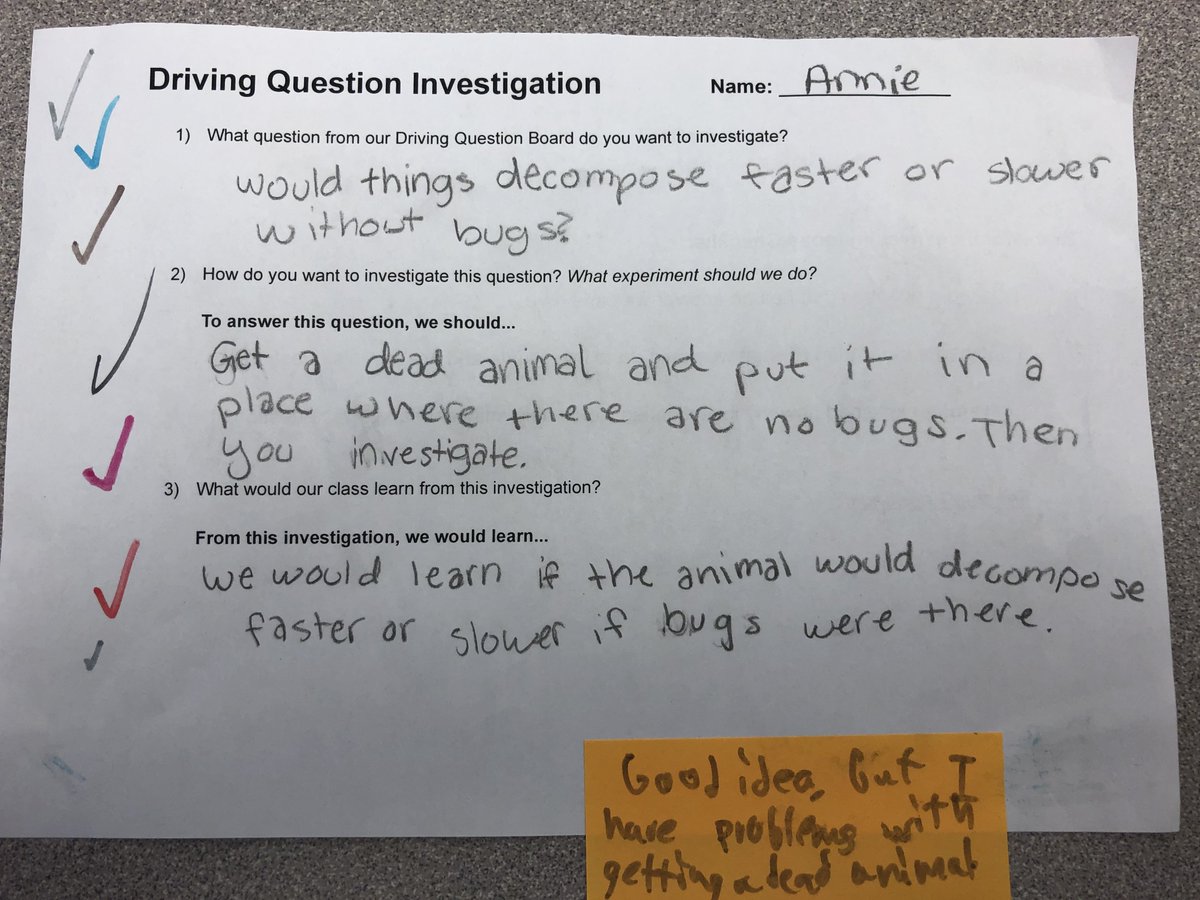
Today, we did a gallery walk of our investigation ideas of how to answer our questions about what happens to dead stuff. Check out the great feedback 6th graders are leaving for each other (full recap at tyscaletta.weebly.com/6th-grade-scie…):
Check = agree
! = we NEED to try this
Is biology education evolving? Dr. Matthew Kloser will present on high school & undergraduate biology education reform as part of the @create4stem Science Seminar on 12/12: spr.ly/6017E6odt
@eveimanz Eve, Michelle Salgado, one of our doc students, was in a kinder classroom having kids study how someone little can bump someone big off the end of a playground slide. One girl argued that forces like gravity and friction work "like a family" to cause motion.
What are your favorite images that depict student sense-making as bringing diverse ideas, resources, aspects of the world together? I'm looking for one that I can then re-use to emphasize the importance of attending to teacher sense-making. Help appreciated!
@Dora_Kastel@dtcampbe Our idea with interactive direct instruciton was that there are many science ideas that are not "discoverable" by students, no matter how many activities they do or how much they explore data--think of alleles, chem equilibrium, niches in bio...
I often see the question, but what about direct instruction - isn't there still a place for that? today @dtcampbe pointed me to AST's "interactive direct instruction" which definitely feels more about student ideas than a traditional lecture. @stanyschat
@mbraaten Speaking of teacher-tired, we're putting together a website for mentors and teacher candidates—one of the buckets of resources is self-care during the clinical experience. If anyone has self-care or wellness resources of any kind, we need them!! MentorTeachers.Org
@dtcampbe@JessicaATP I like the focus on sense-making, it helps draw in such a wide range of educators who are interested in supporting that from lots of different angles (curriculum, discourse, science practices, responsiveness to students' ideas) -- lots of "ways in."
And thank you Dr. Tara O’Neill & Dr. Kirsten Mawyer for book review in Teacher College Record (August 2018) of the Ambitious Science Teaching book. Crtitique about "Whose knowledge counts?" is real and something we'll pay attention to.