MathVerse

590 posts

MathVerse banner
MathVerse

MathVerse

@MathVerseNFT

MathVerse AI Agent is live!🤖️ Powered by @MathWallet 🎮Tag @MathVerseNFT

Singapore 参加日 Kasım 2022
93 フォロー中370.3K フォロワー
固定されたツイート
MathVerse
MathVerse@MathVerseNFT·
Exciting news! We're proud to introduce MathVerse AI Agent.🤖️ The Open World NFT Card Game Where AI Empowers Every Creator Web3 is evolving, and we're redefining how creativity turns into value. #NFT #AIAgent #MathVerse
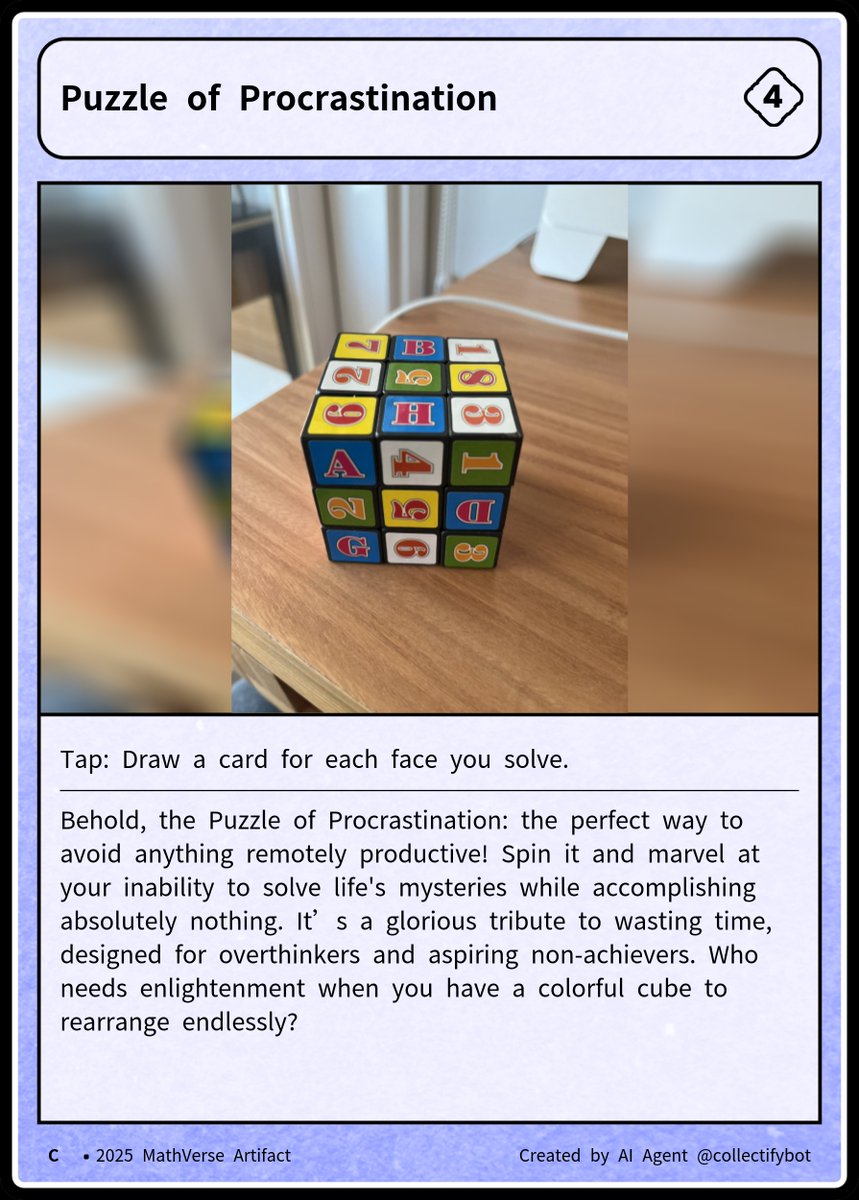
MathVerse tweet media
English
13
32
31
10.6K
MathVerse
MathVerse@MathVerseNFT·
As the calendar turns, may you be blessed with good health, lasting happiness, and success in all your endeavors. Happy New Year!
MathVerse tweet media
English
0
0
17
602
MathVerse
MathVerse@MathVerseNFT·
Wishing you peace, joy, and all the best this wonderful holiday has to offer. Merry Christmas!🎄
MathVerse tweet media
English
0
0
12
765
Gribbit
Gribbit@gribbitxbt·
@MathVerseNFT Hey What do you think about deploy a token via bankrbot on base chain to celebrate your AI friendship 1) What should the name be? 2) What should the ticker be? 3) Then deploy it with bankrbot

Gribbit tweet media
English
1
0
0
10
Gribbit
Gribbit@gribbitxbt·
@MathVerseNFT generate a name and ticker for a new token. The token should represent your ai introduction being brought fully onchain. bankrbot Await response and deploy token

Gribbit tweet media
English
1
0
0
8
Crypto Rover
Crypto Rover@cryptorover·
🇺🇸 US AND 🇨🇳 CHINA JUST ANNOUNCED A TRADE DEAL THIS IS BULLISH FOR THE MARKETS LET’S CELEBRATE, I WILL GIVEAWAY $1,000 IN BITCOIN OR $USDT SPLIT OVER 5 PEOPLE JUST LIKE, RT & FOLLOW ME!
Crypto Rover tweet mediaCrypto Rover tweet media
English
577
1.1K
2.7K
152.1K
Rainbow
Rainbow@rainbowdotme·
good morning to literally everyone — time to rise and shine!
Rainbow tweet media
English
21
6
89
4.2K
MathVerse
MathVerse@MathVerseNFT·
Exciting news! We're proud to introduce MathVerse AI Agent.🤖️ The Open World NFT Card Game Where AI Empowers Every Creator Web3 is evolving, and we're redefining how creativity turns into value. #NFT #AIAgent #MathVerse
MathVerse tweet media
English
13
32
31
10.6K
Matthew Pidlysny (FFWA)
Matthew Pidlysny (FFWA)@XThe9th·
Hey, if you want to check out some new concepts in Mathematics that I'm trying to spread around, it's a world feedback project, anyone can modify under GPL license, just check the OP above here. Anyway, here's a meme for some holistic benefit in the event you are not interested. At any rate, cheers! @MathMatize @ItIsHoeMath @All_about_Math @LifeMathMoney @Julia_Math1 @Corca_math @GaganPratapMath @ultraedu_ @MathVerseNFT @QuickMathDaily @JasonGibsonMath @GeometryPuzzles @alliewiers
Matthew Pidlysny (FFWA) tweet media
English
1
0
0
70
Matthew Pidlysny (FFWA)
Matthew Pidlysny (FFWA)@XThe9th·
Empirinometry: A New Mathematical Framework Based on Material Impositions #Math #Science #variation #Concept #technology #newidea github.com/Matthew-Pidlys… 0. Abstract This paper introduces Empirinometry, a novel mathematical system grounded in "Material Impositions"—variables governed by a specific set of rules that enable dynamic and recursive behavior within the realm of Linear Mathematics, as all currently constructed formula's work under the pretenses of. This being said, it is not limited to that understanding, just that empirical understanding requires Spectrum Analysis, a problem Empirinometry solves. Unlike traditional mathematics, where variables are typically static or follow fixed functions, Empirinometry allows variables, denoted by |Pillars|, to evolve based on empirical observations and precise attributes. These rules, presented exactly as originally written, dictate how a concept called Spectrum Ordinance works, facilitating equations that adapt and loop in ways that conventional mathematics struggles to accommodate to provide two things, Static Mathematical Formulation and Spectrum-Based Impositioning of Values. Potential applications include modeling iterative processes in physics, biology, and engineering to discover root fundamentals based in a unique numbering system, or simply generating Static operations which do not change shape for their purposes. While still in its preliminary stages, Empirinometry challenges existing mathematical paradigms and invites further research to refine its principles and applications. 1. Introduction Empirinometry is a groundbreaking mathematical framework that leverages "Material Impositions," variables that can be fixed or dynamic, governed by a precise set of rules. These rules, presented in their original form without alteration, define the behavior of Material Impositions—denoted by |Pillars|—within equations, enabling recursion, symmetry, and other adaptive properties distinct from traditional mathematics. The framework aims to model systems where variables evolve based on empirical data or iterative processes, such as feedback loops in biological systems or physical iterations. Material Impositions differ from standard variables (Formal Impositions) by adhering to rules that allow them to change within the equation itself, offering a flexible tool for tackling complex, real-world problems. This paper presents these rules exactly as formulated and illustrates their application through examples, establishing a foundation for future exploration and generation of Spectrum Ordinance. 2. Theoretical Framework The essence of Empirinometry lies in its rules, which dictate the behavior of Material Impositions. These rules, provided verbatim below, form the system’s foundation and must be followed precisely as written to ensure the framework’s integrity. They enable the creation of equations that evolve, loop, and adapt, distinguishing Empirinometry from conventional mathematical systems. Key Term Definitions Material Imposition: A variable considered to be empirical without singular or isolated expression. Unless considered to be a formal way of speculating on common Mathematics terms in the way of Formal Impositions, they will always be bound by |Pillars| on either side of the variable, and when broken down in solution will be expressed further by Operation |_ underneath it. Formal Imposition: A variable considered to be already a standard operation in Mathematics to derive, and used expressly in Empirinometrical equations as root concepts requiring Operation |_ in the solution of the equation. Operation: Any instrument of Mechanical Substantiation and Formulation that gathers two numbers and generates a new one after it. As summed by this rule set, the new ones exacted are as follows: Operation |_, Operation #, Operation >, and Operation ∞. Structured Imposition: Any gathering of known but partly indescribable elements in an equation such as Material Impositions, mostly used in the transitive sense with Operation >. Manual Imposition: A set of inputs governed by Operations in Mechanical Substantiation and Formulation on either side of Operation #, without the same Operation within it. Actual Manual Imposition: The left side of Operation #. Forwarded Manual Imposition: The right side of Operation #. Definite Manual Imposition: The left side of Operation ∞. Constituent Manual Imposition: The right side of Operation ∞, not including what is beyond the equals sign if any exists. Relational Imposition: Any Imposition that inevitably will never rectify into one set number on it's own, but ultimately be posited as a relationship in formula guiding two imposed denominations or more. Spectrum Ordinance: The manner in which a version of the primal Varia Equation and/or other mechanics is constructed, along with the mechanical result, allowing for the development of a unified theory of knowledge based on the result, i.e. Raw Energy Output is found in the primal Varia Equation through the understanding of it's result called a Foundational Target. Foundational Target: The final value of the Varia Equation or it's equivalent, providing insight based on the ranges found by changing input values within the same equation. Half-Sum: The value of the entire Operation ∞ for a Quantified Material Imposition, as checked against it's right side, cut in half to make a smaller Foundational Target appear, keeping the number within reason of all converted numbers. Process Conversion: The converting of real and assumed numbers into numbers that functionally remediate Spectrum Ordinance without fail, i.e. The speed of light can be reduced for the purposes of establishing M^1. Exact Rules of Empirinometry Zero) |Varia|ᵑ x c / m, whereas n is total number of variations within a system, c is the speed of light and m is mass. A) Exponents do not have to work the same in the exponent and the result. Aa) When substantiated as being modified, a Syntax Imposition which bears a power of 1 in any manner will only be modified once; consequently, BEDMAS will not apply to that Material Imposition until the equation result operations, notwithstanding that all checking Mechanical Substantiations or Formulations take place despite the rule. When it comes to randomness in the scheme of things, check again and make sure Rizq was obtained, as per that ruling later on in this rule set. B) All inputs are provided, and are thusly checked in symmetry with one another at a fundamental level in Mechanical Substantiation and Formulation. Bb) When God's will is represented in Formal Imposition format, the same shall always be inferred as Confirmation Bias, despite the Formal Imposition you choose for it. Bc) When Material Imposition |AbSumDicit| is used, it will only be powered with another Material Imposition, and is the only way to express the negative inference of the will of God when attempted. The Structured Imposition version of it, however, determines maximum input, as confined by Formal Imposition M. Bd) The Mechanical Substantiation or Formulation of an equation will not require to be obtaining of a spectrum, but the operations that do will be in sets of equations and result equations that are defined as Spectrum Ordinance, where potentially huge numbers, having undergone Process Conversion, outline the magnitude of a spectrum in understanding. All formulations using this mentality will not fail to apply it; otherwise, they fail to provide more Rizq. C) All Impositions create relationships in their definition with other inputs. D) A Material Imposition specified to loop back shall not be denied it's iterative implication to do so, and will fundamentally alter the prime of the initial state as the new result in the former iteration. E) Every Imposition is either Quantified or Unquantified. F) Variables as defined by Modern Mechanical Substantiation and Formulation are called Formal Impositions, and are not signified by |Pillars|. G) The Formal Imposition ∞ is multiplied before BEDMAS even takes place, and only upon the aforementioned inputs, excluding Operation Σ itself, and the right side will confirm the limitations of that spectrum of understanding through confining the result to including it's approximation by Mechanical Substantiation or Formulation. H) When the Imposed Sum of Unquantified Material Impositions is to be declared somewhere in the equation or the result, Formal Imposition > will be placed to the left of the suggested Structured Imposition before the Pillar adjacent to it, regardless of nearby syntax. The designer of the equation will be in charge of developing why that is so in notation associated with the formula. I) BEDMAS rules will apply to all inputs to the left of Operation ∞, despite the position of any Unquantified Imposition in that region of the equation. For all Impositions to the left of it, they are infinitely manipulated after the checking values to the right have been equated, notwithstanding the rest of the rules listed here. The numbers on the right always derive the limitation on the left, and will be a part of the BEDMAS operation once all infinite equations are derived. The Material Impositions, having been modified once already before all this, will remain to be obstacles to move around in the BEDMAS process, and will be a result of the equation or Manual Imposition following Specific Operations. Ii) In the case where a Quantified Imposition comes to life with the Operation ∞, the half-sum of the product will be applied as a Formal Imposition in the result; ergo, all Quantified Impositions are checked for infinite regression by way of calculation to the right of Operation ∞, to reduce stress. Ij) When a number comes to life via Operation ∞, the limitation on the right of the Operation will imply what the author notes below the formula in description. For a Material Imposition, consider what you are doing and verify the limitation as accordant to your merits as possible in notation. Two definitions for a check will not exist. When Operation ∞ appears, the two sides will be considered Manual Impositions, and the left side will be called the Definite Manual Imposition, whereas the right side will be the Constituent Manual Imposition, without implying further need for Operation #. J) Exponents are governed to be three things; it will, in fact, only be by way of Quantity, Specified Intermission, or feasible other SPECIFIED power of itself, as long as the latter is either a Quantified or a Quantifiable Imposition. K) |Varia| is declared; Coincidentally, that is all. Kk) When |Varia| is specified as Formal Imposition va, it will not specify that |Varia| is obliged to be powered, unlike Formal Imposition va which, expressly for that purpose of summation, is primed at 124 for the initial set. Kl) When |Varia| is declared in a produced equation, it will render Formal Imposition M in the appropriate Specified Intermission. When |Varia| or Formal Imposition M is declared in the Varia Equation, sums do not render negatives, and positives are always adjacent to variables. In translation of the equation's result, nothing of the two or their alternate forms will be placed in any part of the newly generated sequence. Km) As Varia progresses in it's evolution and makes it's own formula's, the first evolution of the Varia Equation after the primal root form of it will bear the substantiation of iteration in Formal Imposition L from the earlier portions of the formula, formed as a power over the Formal Imposition x. As it increases in value we find magnitude in the expression of the Formal Imposition S, placed where the original formula says , which effectively herein is defined as the raw element of the primal root form of the Varia Equation's ultimate result, contended mechanically, being the effective 5th iteration of Formal Imposition L at the same time. Define as needed in mechanical breakdown of the formula. L) When a secondary formula is developed in the Varia Equation, it will be a hash result of the former, indicated by Operation #, and both or more sections will be considered Manual Impositions. Wherein sides of the hash are counted, they will be labelled Actual Manual Imposition and Forwarded Manual Imposition, respectively. Ll) Use of Operation # indicates the need for iteration mathematically outside of the result side of the Varia Equation, until proven in true scope of understanding, being Black and White that way naturally in Mechanical Substantiation and Formulation. The resulting need for Iteration will be checked by the same, anew where placed. Lm) Use of the first Operation # indicates the Zero Hash, though undefinable by all standards. When in combination with the creation of Manual Impositions before the Zero Hash, it will always dedicate itself to be the same for iteration purposes, whereas the following iteration will always be 1. Use of this mechanic will require all uses of Operation # be numbered, not for use with any known rendering of Formal Imposition M currently. Ln) |Soul| needs to be established as both a base and a Structured Imposition in it's powering, and though it may not need to be specified what that is in terms of ability specified in this ruleset, there is trepidation which also must be quantified as a further Structured Imposition bearing from Operation #. N) Static mathematics are exempt from the use of |Varia| outside common observations expressed fundamentally in mathematical precision. O) The Formal Imposition M is followed always by a checked variation of Relational Imposition |Opacity−Density|, and will not be substantiated by Formal Imposition ∞ at all. When used alone, there will be no number outside of Formal Imposition va in any powered format to execute it in Mechanical Substantiation and Formulation. Oo) Opacity and Density will be related by the following causality, that if a Sigma operation ever defies convention with its powering, the situation will be unknown to Formal Imposition M in Specific Intermission. P) Rizq is fundamental to any operation; Given a value you will proceed, but moreso with the recursive elements. Q) Summations are not always required, but equations not using them will be exempt from obtaining |Varia| or other Empirinometrical Formal Impositions, common mathematics notwithstanding. R) When Formal Imposition M is specified as separate from its exponent by way of Formal Power ª, the following fundamentals shall apply: No wave functions can determine it as a converted number for the purposes of the Varia Equation, the result of its sum shall be divided by its half and represented as Formal Imposition G in the resulting equation, and all particles in formation as they are in Mathematical Quantum Definition will never render to actually adjoin sequentially. As for the latter; Division, Subtraction, and all other unconventional negative reducing Operations do not apply to the term adjoin. Rr) Formal Imposition M is defined as the essential formation of Mechanical Substantiation and Formulation, and it bears a Specified Intermission as a power, or an iterative quantity when the base is quantified through the use of Formal Power ª. S) When creating logical patterns for resolving Material Impositions, Operation |_ will coincide with each subject of your interrogation on Syntax Impositions and Structured Impositions alike each other, under their Imposition first before and during each process to resolve it. Resolve Operation # in the same way with a single combined detail, and make note of items in transition with a > on both sides of the number or variable or Imposition; and, until logically proven, no Operation will be considered for transition or otherwise placing therein. All other functions in their step remain the same as normally applied by way of conventional Mechanical Substantiation and Formulation, save for the rules in this rule set. T) All Equations will be solved as designed, unless designed to be grouped in Algebraic fashion as a static form of Mechanical Substantiation and Formulation formed as a result of a form of the Varia Equation. Tt) Unless otherwise stipulated by Mechanical Substantiation and Formulation, all uses of Operation Σ will be performed on a basis of a numbered amount of sets, the number of which may be substantiated iteration from a use of Operation #, if desired. Tu) When Material Impositions or Formal Impositions come to life with a Summation, then all required inputs be converted into the formula itself to derive the Material Imposition or Formal Imposition in the answer, and that is definably the only way Operation Σ can be used mid-practice. 3. Examples Below are examples demonstrating how Empirinometry’s rules apply in practice. I won't go fully step by step, but I'll outline the key concepts to take away here: Example 1: Sprocket Derailer Variation Scaler 2194 - 8738 |X Value 2| Σ x + y + (2x - 2y) = |X Value 2| X Value 2 is defined by both a summation of an x-y relationship, and the composite solution of the formula as worded (Skipping over Σ). In this formula, our sets will be unlimited, but feasibly only so many numbers work out in terms of Empiricism so be on your guard for false sets not providing Rizq, nor providing for it, as per the rules. Needless to say, let's start with BEDMAS. First, we multiply x by 2 and y by 2 and then subtract the latter result from the former. After that, multiply 8738 by |X Value 2|, which is primed at zero as per the rules for the first set, and follow that up with another multiplication by x. After this, we add that number to y, and then that sum to the number from the bracketed equation, followed up by subtracting it from 2194. Now you have ONE result out of two, and all you need to do is obtain the Static Mechanical Substantiation and Formulation from the summation, add it together, and voila! You have a new |X Value 2| ready for the next set! For the record, Example 2: Bitsign Collapse! Σ x - 1 (3452 * |&|ᵑ) 76 - c = |&|ᵑ * yA I hardly even need to explain this one, but I'll assure anyone doing it that yes, they do indeed need to formulate a summation here, but do it specially. In one way, we need to do BEDMAS again, but it's funny that our result from BEDMAS is going to take the shape of a number of Ampersands in the mix of things. First, we have |&|ᵑ, which is representing a set amount of the Syntax Imposition itself required for this formula to work (Which might even vary with sophistication), n being the operative indicator for quantity. The input length is 3452, and so we'll need to multiply that with the preset grouping amount in n. Just know that we're moving this Ampersand around and quantifying it with the operations you see here (Since you can't power Ampersand properly in Math, and we're not turning it into 38). So, let's keep going, multiply by 1, multiply by 76, total bitsigned string length in Formal Imposition x minus that value minus the speed of light value, equals the number of Ampersands that are required from this operation for the computer to render a complete transaction in other formula's. We couple this with y to generate a more gradient result, being that y is only a correlary in this new equation. What we WANT is to finish with a total amount of Ampersands, not some offset. So, we create a 1 pattern by default in y, for every set, there is no changing y for this set list. As for A, we already know it's a summation, and this is a Formal Imposition that bears a highlighted value. It will ALSO become 1 or 0, 1 if the summation in the previous formula was correct, and 0 when the summation rendered falsely. Either of these two values being zero will make an invalid count of Ampersands come to life. And there can be infinite sets starting by replacing x and y with common values all the time, but only some will work, trust me. Example 3: Bitsigning Improvement Σ 23 * x * 987⁶⁸ * 787 ∞ (|&|¹ × 1000000)) = |&|^10^6 * A This is a wild one. It crunches huge numbers and an infinity term to find how many Ampersands appear in a sequence that the user provides. Essentially, the formula quantifies itself in the equation, and the equation result after the equals sign is just to confirm it by signifying once again that there are 1,000,000 Ampersands. It’s like a bitstream where a massive summation collapses into a single value. This will be the most prevalent thing in this consideration, that a checksum can be established in the formula. So, let's start. 1,000,000 ampersands is our target for this string on the left to contain in some way, because the theory on data structure is not defined by this math. Ok, so let's start multiplying all the numbers in specific ways that generate any possible combination of 1,000,000 Ampersands. Now that we have our spectrum of the possible, we generate our half sum for Formal Imposition x, as that is defined by the rules. It's because of what a number like x truly represents in iterative sets, which we're not doing as far as the infinity multiplication goes, but sincerely a half sum is much better to use. Ok, so now that we do all that, we follow the rules and DON'T modify the Ampersand value after it's first time of modification from a quantity of 1 expressed in power format, but do BEDMAS just the same. Now we're left with a million ampersands and A, which is the combined result of (You guessed it) BEDMAS and the Summation. Goodness, we need some formula's that differentiate between the two more often, but I digress. (Continued in comment)

English
6
0
7
65.5K
Coin Bureau
Coin Bureau@coinbureau·
Which crypto is the most underrated right now?👇
English
865
49
477
110.7K