
The Lewis Lab

375 posts

The Lewis Lab banner
The Lewis Lab

The Lewis Lab

@PeterLewisLab

Chromatin biochemistry and genomics in development and cancer. @UWMadison @UWSMPH @BMC_UW

Wisconsin, USA 参加日 Mart 2019
623 フォロー中1.2K フォロワー
固定されたツイート
The Lewis Lab
The Lewis Lab@PeterLewisLab·
We are excited to share our new preprint demonstrating that nucleic acid interactions with SUZ12 constrain PRC2 activity, establishing a kinetic buffer essential for targeted gene silencing and revealing vulnerabilities in diffuse midline gliomas. tinyurl.com/4yrwftrn
The Lewis Lab tweet media
English
2
5
39
2.2K
The Lewis Lab がリツイート
Niko McCarty.
Niko McCarty.@NikoMcCarty·
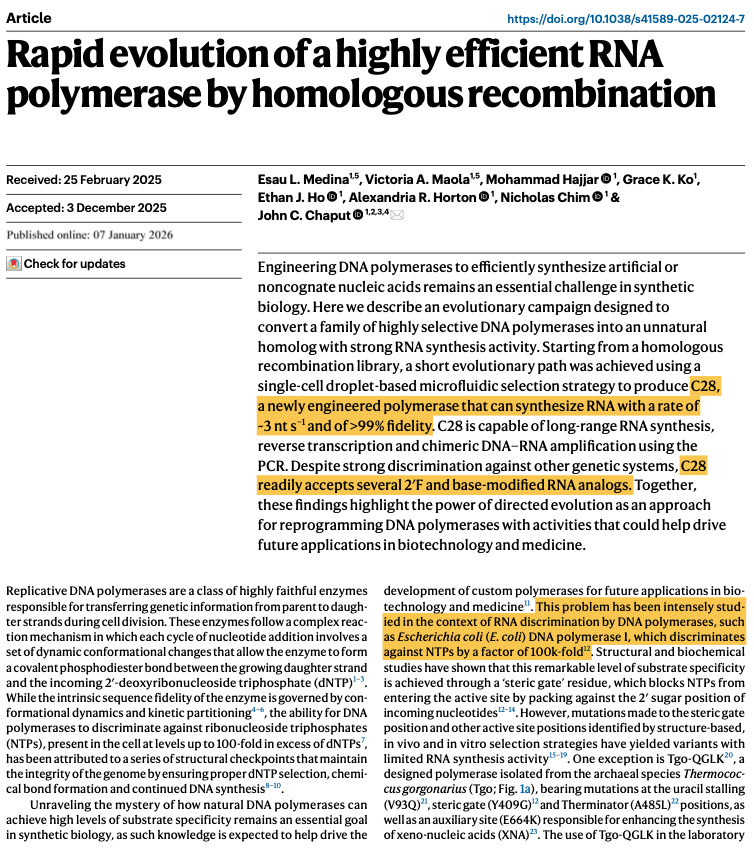
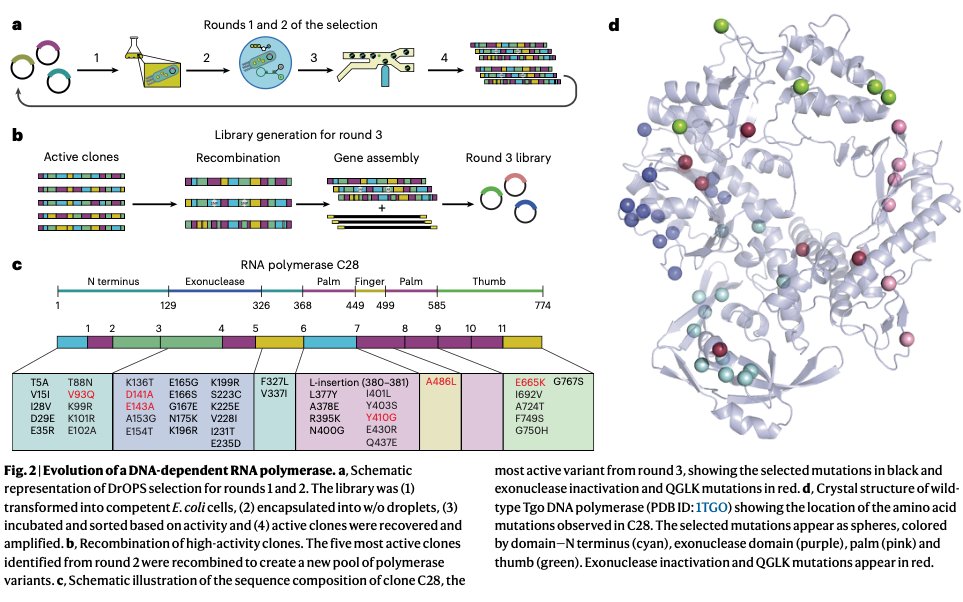
This paper is wild. After 3 rounds of directed evolution, they converted a DNA polymerase into an enzyme that can do: - RNA synthesis - Reverse transcription - Synthesis of "unnatural" nucleotides - Synthesis of DNA-RNA chimeras One of the best papers I’ve read recently. For context: In nature, it is DNA polymerase that takes a DNA sequence as a template and then copies it. These enzymes are crucial in replicating the genome for cell division, and they are EXTREMELY specific for DNA over RNA. This is key because RNA nucleotides are present in the cell at concentrations ~100x higher than DNA nucleotides, so the enzyme has evolved clever strategies to select one over the other. RNA polymerases, for comparison, are the enzymes that take a DNA sequence as template and then convert it into RNA. They are involved in gene expression, for example. To convert a DNA polymerase into an RNA polymerase (and all the other functions I mentioned earlier), the authors did a fairly straightforward directed evolution experiment. First, they took four DNA polymerase enzymes belonging to various archaea. These DNA polymerases don’t check for DNA vs. RNA as stringently as other types of cells, so they’re a good starting point to evolve RNA polymerases. The authors inserted some targeted mutations into these enzymes, based on known mutations in the literature. For example, they swapped the amino acid at position 409 for a smaller amino acid, thus removing a “gate” that keeps RNA building blocks from entering the enzyme. Next, they took the four genes encoding these DNA polymerases and cut them up into 12 segments each. They randomly stitched these 12 segments together — from the four different genes — to build millions of unique variants. Each shuffled gene was inserted into an E. coli cell. Then, they grew up these cells (each carrying a unique polymerase) and put them into microfluidic droplets. A device isolates each droplet, lyses the cell open, and releases the polymerase. The droplet also contains RNA building blocks and a DNA template, encoding a fluorescent reporter. If the polymerase begins synthesizing RNA, it will produce a detectable signal. They screened about 100 million droplets in 10 hours of work, searching for those with a signal. For each well that yields a fluorescent signal, the researchers isolated the DNA and sequenced it to figure out which polymerase it was. They repeated this 3x times, finally isolating a really excellent RNA polymerase variant which they called "C28." C28 has 39 mutations compared to the wildtype enzymes. It incorporates about 3.3 nucleotides of RNA per second, with 99.8% fidelity. The crazy thing is that this enzyme can also copy DNA or RNA templates back into DNA (reverse transcription), or use chimeric DNA-RNA molecules as a template and amplify them. It is just a super versatile polymerase that can act on DNA, RNA, or modified nucleotides, to build just about anything.
Niko McCarty. tweet mediaNiko McCarty. tweet media
English
16
364
1.7K
86.2K
The Lewis Lab がリツイート
Shiv Grewal
Shiv Grewal@grewalsh·
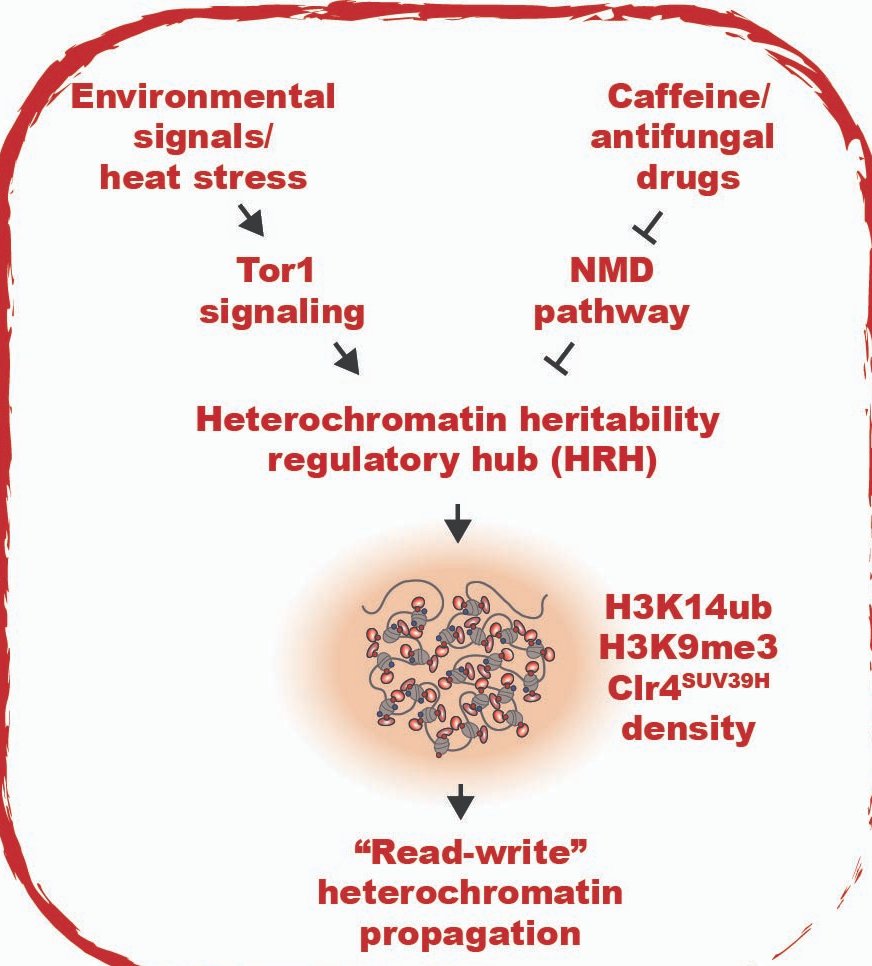
Stress controls epigenetic inheritance! A histone ubiquitylation-based regulatory hub links stress/environmental signaling to heterochromatin self-propagation and epigenetic inheritance-reshaping how we think about development, drug resistance and cancer👉nature.com/articles/s4158…
Shiv Grewal tweet media
English
19
30
88
6.5K
The Lewis Lab がリツイート
NatureStructMolBiol
NatureStructMolBiol@NatureSMB·
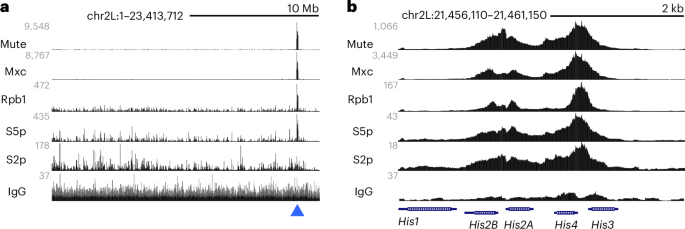
New online! Cell-cycle-dependent repression of histone gene transcription by histone H4 bit.ly/49lpAYX
NatureStructMolBiol tweet media
English
1
11
47
4K
The Lewis Lab がリツイート
kyogo kawaguchi
kyogo kawaguchi@kyogok·
遺伝子スケールのクロマチン物理を研究するため、ヒストン修飾を制御した96-mer (20 kb) の再構成系を確立しました。1分子観察・原子間力顕微鏡・in vitro Hi-Cにより特定の修飾パターンが構造や動態をどう変えるか調べています。論文のビジュ結構いいのでぜひ見てください! science.org/doi/10.1126/sc…
日本語
2
24
100
10.2K
The Lewis Lab がリツイート
Ivan
Ivan@chaperones4life·
Mechanisms of DNMT3A–3L-mediated de novo DNA methylation on chromatin nature.com/articles/s4159…
Français
0
1
6
379
The Lewis Lab がリツイート
Adrian Bracken
Adrian Bracken@adrianbracken·
1/ 🚀 AEBP2 isn’t what we thought. You were told that AEBP2 promotes PRC2 activity on chromatin. We found the opposite: the most prevalent AEBP2 isoform inhibits PRC2 activity. Excited to share our new paper surl.li/cgwqcq A thread 🧵
English
1
8
19
1.4K
The Lewis Lab がリツイート
Wei Xie
Wei Xie@xielablife·
Happy to share our latest work on Polycomb repression reprogramming in early development, spearheaded by two super talented Ph.D students Yitian Zeng and Feng Kong. cell.com/cell-stem-cell…
English
4
15
97
10.5K
The Lewis Lab がリツイート
Ani Deshpande
Ani Deshpande@anideshpandelab·
Really excited that our manuscript on Synovial Sarcoma is now online. Link to Open Access PDF: tinyurl.com/55bnssws A summary🧵 :
Ani Deshpande tweet media
English
1
2
22
1.5K
The Lewis Lab
The Lewis Lab@PeterLewisLab·
@wendywenderski Thanks, Wendy! We really appreciate your note and are happy you enjoyed the study.
English
0
0
1
77
The Lewis Lab がリツイート
Brian Liau
Brian Liau@brian_b_liau·
Today in @Nature we share our back-to-back stories with @nzhenguw revealing chemical-genetic convergence between a molecular glue & E3 ligase cancer mutations. 1/6
Brian Liau tweet media
English
11
93
500
90.6K
The Lewis Lab がリツイート
Waggoner Lab
Waggoner Lab@LabWaggoner·
Hypertranscription state in early embryos that both shapes and is fostered by the three-dimensional genome organization, revealing an intimate interplay between chromatin structure and transcription @Nature @xielablife nature.com/articles/s4158…
Waggoner Lab tweet media
English
1
14
60
5.1K
The Lewis Lab がリツイート
Molecular Cell
Molecular Cell@MolecularCell·
Online Now: Distinct specificity and functions of PRC2 subcomplexes in human stem cells and cardiac differentiation dlvr.it/TMRwWj
Molecular Cell tweet media
English
1
23
111
7.8K
The Lewis Lab
The Lewis Lab@PeterLewisLab·
VEFS: the NBD is gone. RNA binding is rare (small red bubble). Most PRC2 is RNA-free (large green bubble), catalytically active, and binds both CpG and non-CpG sites.
 Result: diffuse H3K27me3 that pulls PRC1 away from its normal targets, disrupting gene silencing.
The Lewis Lab tweet media
English
1
0
0
335
The Lewis Lab
The Lewis Lab@PeterLewisLab·
PRC2 silences genes by adding H3K27me3 at the right spots in the genome. Our new work shows how the nucleic acid-binding domain (NBD) of SUZ12 keeps this activity under control, and what happens when you remove it.
The Lewis Lab tweet media
English
2
22
92
7.9K