
Timothy Sweeney

11.8K posts

Timothy Sweeney banner
Timothy Sweeney

Timothy Sweeney

@Tim_Sweeney_TAR

参加日 Kasım 2022
73 フォロー中8K フォロワー
固定されたツイート
Timothy Sweeney
Timothy Sweeney@Tim_Sweeney_TAR·
$sofi MY PROFILE A few people have asked me to post my career background. I will pin this post because I don't want to lose my blue check mark. University of Illinois - BS Accounting -Highest Honors Elijah Watt Sells Award - top 20 out of 65,000 ON THE May 1980 CPA EXAM University of Michigan - Accounting Instructor - Highest Student Rated Teacher at the University 2 years University of Michigan Law School - Cum Laude Pillsbury Winthrop (Major Law Firm) - Corporate and Tax Partner Deloitte (Major Accounting Firm)- Senior Partner - Office of the Chairmen Clients Wealth Management Firm - Managing Director Corporate Restructuring Consulting - Fortune 500 and other large companies Forensic Accounting Expert Witness Valuation Expert Witness CEO of a company providing care and services to autistic and disabled adults CEO of a private real estate management company
English
44
5
329
90K
Timothy Sweeney
Timothy Sweeney@Tim_Sweeney_TAR·
FYI The Enron comparison is fundamentally flawed and misleading because Enron's off-balance-sheet structures (like the special purpose entities, or SPEs, such as Chewco, LJM, and Raptors) were built on completely fabricated transactions with no real economic substance or third-party risk transfer. Enron created these entities to hide massive debt and losses by recording "fake" sales of assets to SPEs it still controlled, often using its own stock as collateral, guaranteeing returns, and intentionally not following specific accounting rules to avoid consolidation. The underlying "deals" were illusory or circular. In stark contrast, SoFi's loan sales, LPB forward-flow arrangements, and securitizations involve genuine transfers of real, originated consumer loans to independent third-party buyers or investors (e.g.Blue Owl, institutional securitization noteholders) who bear the actual credit risk, with full derecognition under ASC 860 confirmed by Deloitte's audits, true-sale legal opinions, bankruptcy-remote SPEs, and transparent SEC disclosures showing cash proceeds and no hidden recourse or control retention that would require re-recognition. Enron's schemes were outright fraud with nonexistent economics and fake transactions; SoFi's are standard, regulated, arm's-length structured finance practices in the lending industry. It's comparing apples-to-oranges, and invoking Enron here is just inflammatory rhetoric rather than based on any trained analysis or specific supportable substantive critique.
English
0
0
1
17
Timothy Sweeney
Timothy Sweeney@Tim_Sweeney_TAR·
$sofi People here need to stop giving any credit or time to the Muddy Waters report There's virtually nothing that they concluded that has any basis in fact and is pure conjecture and emotional provocation. By reasserting their claims for content clicks, you actually assist their false narrative
English
16
5
144
5.7K
Timothy Sweeney
Timothy Sweeney@Tim_Sweeney_TAR·
Servicing fees are a matter negotiated in each transaction separately. The buyer actually prefers more servicing fees because 1. It protects against prepayment risk because you no longer have to pay servicing fees on amounts that are prepaid 2. You put down less up front cash for the purchase 3. It's easier to hedge For Sofi, under asc 860 they get to capitalize the pv of the servicing feesas income so it's not comparable to selling for premium but it also shows them to monitor and update their hedging So if negotiated servicing fees are falling while loans and premiums are exploding, it's typically because the buyer perceives less risk of prepayment redirect in low intest rates environments with the possibility that rates may stagnate or go up
English
1
0
2
26
Tevis
Tevis@FunOfInvesting·
THOUGHTS ON $SOFI vs. MUDDY WATERS SHORT REPORT I've been fairly quiet on this topic thus far, and there's been some terrific analysis by the community. I read the report and will be putting out a video on it soon. Here's some raw thoughts... To me, this is a "show me the incentives & I'll show you the results" type of argument. Banking is one of the most heavily regulated industries in the world. Since obtaining its bank charter, SoFi has faced constant, rigorous oversight from the OCC, the Federal Reserve, and the FDIC. If Muddy Waters is correct, it doesn't just mean a "mistake" was made. It's not a one-time accounting error. It would mean SoFi executives are committing systemic, daily fraud. For a "misstatement" of this magnitude to exist, it would have to slip past internal risk teams, armies of lawyers, the federal regulators who have a permanent window into their books, and their external auditors at Deloitte. Either this is a global conspiracy involving the most powerful financial watchdogs in the U.S., or the claim is wildly overblown. MW claims management is "cooking the books" to inflate their own pay, but the math and the behavior don't add up. If the goal were simply to trigger their massive performance bonuses, they could have easily manipulated the numbers to hit the $45 stock price target required for their largest payouts. Instead, Noto is doing the exact opposite of someone who knows the ship is sinking: he is putting more of his own skin in the game. Noto literally bought another $500,000 of SoFi stock on the open market, following a $1 million buy earlier this month. He has never sold shares on the open market. Seems strange he would be using his personal bank account to willingly buy into the next "Enron"... And on that point, if Muddy Waters TRULY thought SoFi was a modern-day Enron, why rush to the exits instead of holding their short position for a collapse to zero. They explicitly disclosed in the report's own fine print that they intended to begin covering a “substantial majority, possibly all” of their short positions immediately upon publication. If this were a genuine case of systemic fraud, a short seller would dig their heels in to maximize the downfall. Instead, they published a report designed to trigger algorithmic selling and then used that very panic as exit liquidity to lock in their own profits. If you panic-sold on the news, congrats - you were the exit liquidity. This was not a long-term conviction play from MW. It was a calculated move to profit from the chaos of the salacious headlines. The document is shrouded in “weak” language: “we believe,” “if we are correct,” and “in our opinion.” These aren't statements of fact; they are legal "weasel words" designed to shield Muddy Waters from the very defamation laws they are flirting with. Each of their core arguments -- whether it's the personal loan charge-off rates, the alleged $312M in unrecorded debt, or the "disguised borrowing" in the Loan Platform Business --has been dismantled by analysts and the community as a fundamental misunderstanding of U.S. GAAP accounting. These claims often rely on misinterpreting Standard Commercial Code (UCC) filings and regular investor disclosures that have been public for months. This isn't a "discovery" of fraud; it’s a repackaging of known, audited financial data into a salacious narrative for a quick profit. Not to mention that many of their "arguments" have been recycled from other hit pieces published by other short reports in 2022-2023. Muddy Waters and its founder, Carson Block, have been central targets in broad government crackdowns on short-selling tactics over the last few years. While the DOJ and SEC spent years investigating "activist" short sellers for potential market manipulation, it’s worth noting that by late 2024, Block was officially cleared of wrongdoing in those specific probes. They have been sued by many of the companies they've targeted over the years. This history shows that for MW, the goal isn't necessarily to win in a courtroom years later, but to create enough immediate doubt to profit from the volatility today. SHOULD SOFI PURSUE LEGAL ACTION? While SoFi has already signaled its intent to explore a lawsuit for what it calls "factually inaccurate and misleading" claims, the legal mountain is incredibly steep. In the U.S., a public company must prove "actual malice". This means they must show by clear and convincing evidence that Muddy Waters either KNEW their data was false or acted with a "reckless disregard" for the truth. Because Muddy Waters frames its reports as subjective "opinions" and "analysis" based on public filings, they are heavily protected by the First Amendment. This is potentially one of the reasons for the weak language in the actual report. SoFi has already regained the losses from this report as I believe its clear now that the market largely sees this for what it is. SoFi demonstrating their willingness to pursue legal action goes a long way to dispelling the claims MW made in their report - after all, if SoFi was in fact Enron, they would not be rushing to invite even more legal scrutiny on the back of ego alone. Video to follow.
Tevis@FunOfInvesting

$SOFI RESPONDS TO MUDDY WATERS

English
10
7
147
17.9K
ChrisK3861
ChrisK3861@ChrisK3861·
@Tim_Sweeney_TAR My comment in another chat. Scaring ppl into having to waste time to debunk their nonsense is part of their strategy
ChrisK3861 tweet media
English
1
0
1
319
Timothy Sweeney
Timothy Sweeney@Tim_Sweeney_TAR·
It's not that you can't prove malice or actual disregard... that's almost obvious.. it's the anti- slapp statutes that make you prove it without any discovery or get your case dismissed in 60 days The report itself has almost no accuracy in any of the claims it makes and only makes conclusiory statements based on minimal or irrelevant claimed evidence
English
0
0
7
394
MarketswithMay
MarketswithMay@marketswithmay·
$SOFI... Morning folks. This one goes to @indraredde comment on the short reports. I wanted to address that I don't think they are necessarily acting in poor faith so much as there are some confusions for me in what they are using to describe and compare numbers. I'm tagging @VadimKotlarov @Tim_Sweeney_TAR @DataDInvesting @averagedipbuyer b/c I won't have time to do the work. If this already exists, tag me. Core Point Made by Shorts: He's really focused on the 2022/2023 vintages and how they are aging. I think they might be off on the impact of total defaults relative to the replenish/reinvest clause and the long prepayment period. What I mean to say is this: If you have a high pre-payment and are using Face Value in the denominator of a structured vehicle that has reclamation/reinvestment than your math is off when you go to calculate default. More Detail on Why FV is potentially a problem In other words, in a declining rate environment (high re-fi potential) you get a higher pre-payment rate. A reclamation clause would re-up the vehicle but not change the face value of the instrument. Hence, you can have a higher total write-down, but a relatively low default rate. Prepayment risk is about your cash flows. But the risk is a problem IF AND ONLY IF you aren't able to add more loans in line with the reinvestment clause. But this doesn't appear to be a problem for $SOFI by definition of the growth of the loan book and loan related activities. Similarly, you'd need to adjust the calc for default rate by the total loans that were put into the instrument, not the face value. I can't tell the nature of the things he's looking at, mostly b/c I'm exhausted and partially b/c I don't have an easy way to look up the comparable debt instruments right this minute. Possibly someone else can. Conclusion This might - in other words - be a simply misunderstanding. And TBH, it's not obvious. Hence, why I'm saying we should stay kind to each other in investigating this. Anywho, if the 3 tagged folks or another of the boys could investigate this, that would be great. Likely, $SOFI will address this either sooner or on the call. They end up in the Quiet period at some point, so IDK the timing here. Happy Thursday, fellow $SOFI investors and interested parties. Thx for the help on this.
Indra reddy@indraredde

@marketswithmay We seem similar reports and sell rating in 2022 when market is volatile these guys are bumbarded with same narration on SOFI to take advantage of the situation.

English
4
0
30
5.2K
AverageDipBuyer
AverageDipBuyer@AverageDipBuyer·
You are correct Tim. You always pull it off to explain these insanely complex topics in such an easy to understand way. Indeed, as I said for the economics part, it's more of an alert than a real issue. It's just part of the business. Reputable sources also told me this wasn't the first time a CNL trigger was breached.
English
2
0
7
425
AverageDipBuyer
AverageDipBuyer@AverageDipBuyer·
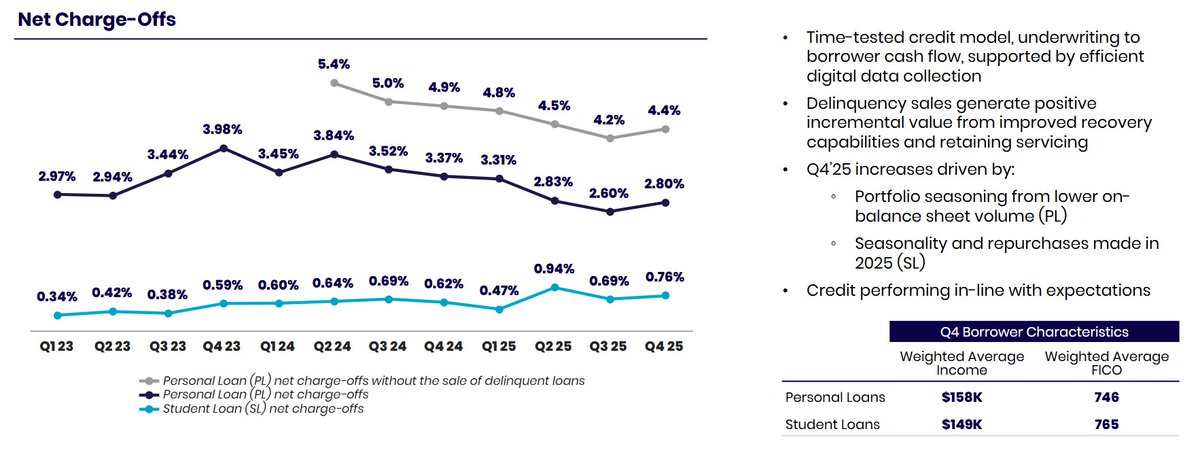
I tried writing a deep dive on the $SoFi ABS situation but I have decided not to publish it. It became far too technical and would likely only spread confusion. I'm pretty sure this correlated to SoFi heavily underperforming every other financial in the past few weeks. Institutional investors got access to this information way before we did. I bet 99% of you didn't even know what I'm about to share. The short version is that SoFi Consumer Loan Program 2025-1 has breached its cumulative net loss trigger of 2.60 percent. I'm pretty sure that this is the first time this has ever happened to SoFi. The December 2025 distribution report already showed cumulative net charge offs at 2.15 percent on a pool amortized down to 60.11 percent of original balance. Subsequent performance has now crossed the line. No matter your perspective, this is not a good sign. However, it does not mean this is devastating for $SoFi's Loan Platform Business or even the personal loans they keep on their own balance sheet. SoFi’s corporate level personal loan net charge off ratio actually improved to 2.86 percent in 2025 from 3.54 percent the prior year. The 2025 1 trust is one specific vintage under pressure, not a proxy for the entire book. What this means is more technical but still important. When a trigger like this is breached, the securitization structure shifts into a more defensive mode. Excess spread is diverted away from subordinate tranches and residual holders. Senior note amortization accelerates through turbo principal paydown. Overcollateralization steps up further and cash is trapped to protect the bond stack. Current senior credit enhancement stands at approximately 14.04 percent, meaning the senior AAA notes now have significantly more protection than they did at issuance. Importantly, rating agencies have not changed their ratings. Morningstar DBRS continues to rate the senior Class A notes AAA(sf), confirming that the structure still provides strong protection to bondholders even after the trigger breach. In other words, the structure is doing exactly what it was designed to do when credit performance weakens. Economically, the impact for SoFi would likely be real but indirect. It touching servicing valuations, future gain-on-sale economics, repurchase liabilities, and new LPB pricing. In a market this fragile, I do not want to throw highly technical credit analysis into the timeline and watch it get turned into panic and FUD. Once people see phrases like trigger breach, deteriorating credit, nuance dies immediately. My draft was not a bearish article. It was about the technical explanation and the broader warning on capital markets dependence, while highlighting that SoFi’s on-balance-sheet personal loans continue to perform well and distribution to private credit buyers remains robust. But I know how this platform works. So rather than contribute to confusion, panic, or oversimplification, I would rather hold it back. Sometimes the responsible move is not posting. And btw, that short report was ridiculous. Always funny when people discover fair value accounting. Must've been an intern writing that short thesis. But yeah, I'm just buying the dip and not selling a single share. I'm still spending time on the Private Credit article I promised you guys, it's way more work than I expected, but a deal is a deal! It actually reminds me of my Master's thesis lol. Anyway, have a great day everyone.
AverageDipBuyer tweet media
English
16
7
84
17.1K
Timothy Sweeney
Timothy Sweeney@Tim_Sweeney_TAR·
@roger_sach Typical bs It bounced back but people just see uncertainty of war etc So that in top of it scares people so it takes earnings before it moves and maybe some war relief
English
1
0
5
498
Roger Sach
Roger Sach@roger_sach·
@Tim_Sweeney_TAR Tim, Muddy Waters published a shorts report which you find very faulty but how much damage has it caused? Many who read only the headlines are creating FUD to keep the stock depressed. $SOFI can’t catch a break from the shorts.
English
1
0
4
755
Timothy Sweeney
Timothy Sweeney@Tim_Sweeney_TAR·
$sofi ONLY WATCH ACTUAL DEFAULTS The only relevant issue for any bank is actual defaults and how much they receive. These arguments about hidden defaults and discount rates and fair values and now loan structures have been made for 5 years. They keep saying that there are or will be massive defaults that are understated. Most personal loans are 2 to 5 years. Well, it's been 5 years. Where are these projected massive defaults? There's been tons of loans paid and termed out. None of this made up bs about all these issues has been accurate because they haven't resulted in material defaults. Defaults are down actually. I guess if they say it enough and a nuclear bomb hits New York they can claim they were right
English
7
14
163
14.4K
Timothy Sweeney
Timothy Sweeney@Tim_Sweeney_TAR·
@Dboybruh They cover the short immediately so you can't argue they were using it to get clients. Which could hurt them in litigation, just like they claim they are journalism company
English
1
0
18
580
market(ing)man
market(ing)man@Dboybruh·
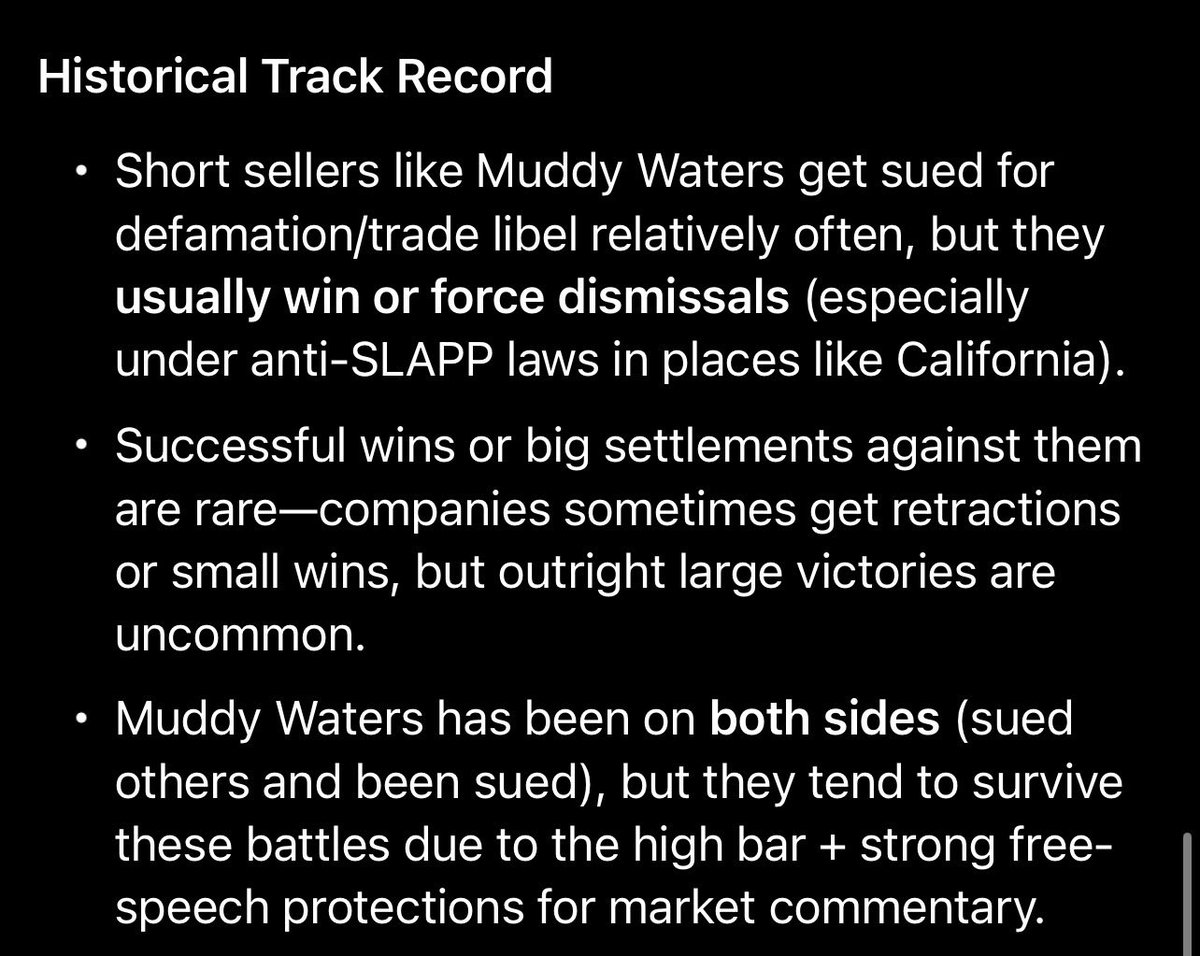
- Muddy water 🤡s apparently get sued often, they know that they spew non sense also stated theyd be covering their short positions following the report, how convenient manipulation right in your face $SoFi got the bears playing dirty to support their failing thesis
market(ing)man tweet media
English
5
1
25
2K
Timothy Sweeney
Timothy Sweeney@Tim_Sweeney_TAR·
@Frugalbuck That's there in case credit has problems or private credit buyers have issues.. they can park more loans on the balance sheet for a long time until credit gets better or even buy back good loans at a discount... it's a back up
English
0
0
7
699
Eddie
Eddie@Frugalbuck·
@Tim_Sweeney_TAR Tim, what do you think plans are with 20% capital ratios? Do they lever back up or not until fee revenue is higher?
English
1
0
3
891
Furkan Gözükara
Furkan Gözükara@FurkanGozukara·
Iran is brilliantly launching drones on short range flights across water making them incredibly hard to detect. The US is being forced to destroy cheap drones with weapons that are much more expensive and harder to replenish. The math is brutal.
English
8
144
718
23.9K
Kris Patel 🇺🇸
Kris Patel 🇺🇸@KrisPatel99·
At this point it should be abundantly clear that the US was forced into this conflict by Israel. While the US and Iran were negotiating, Israel was ready to take unilateral action as they did not trust the Iranians to live up to any agreement they might have made with the US. They were able to convince people close to Trump that this could be resolved quickly and that the US involvement would be minor. This is why the US was not ready for the current escalation that we are seeing today. Israel understands that agreements on pieces of paper can be violated but a Nuclear Iran would result in Israel living in constant fear. This was unacceptable to them. They are way more exposed to the risk of a Nuclear Iran than the US is and did what they believed would be best for their people and their security. What Israel and the US did not count on was Iranian willingness to escalate this into a full blown MAD, Mutually Assured Destruction, scenario. Now we're left with 2 choices. Option #1... Leave and also certainly bolster the remnants legitimacy and give them a proven framework on how to apply leverage on the US, Israel and the GCC. Everyone would see this as a defeat of the US and its ability to defend its allies. Option #2... Ground war.
Kris Patel 🇺🇸@KrisPatel99

Called it... now can yall get off my back... Jeeze..

English
53
3
132
34.5K
Tannor Manson
Tannor Manson@Futurenvesting·
@Jake__Wujastyk Many reasons for insiders to sell, only one reason to buy... (Because of a short seller report 😂)
English
5
0
41
2.1K
Timothy Sweeney
Timothy Sweeney@Tim_Sweeney_TAR·
@indraredde Lol until the sec does something about it.. like they are with citron accusing them of criminal fraud
English
0
0
2
136
Indra reddy
Indra reddy@indraredde·
@Tim_Sweeney_TAR Look at the coordinated timing of shorting and sell ratings, we have seen worst than this from 2022 but how long will this continue ?
English
1
0
2
144
Timothy Sweeney
Timothy Sweeney@Tim_Sweeney_TAR·
To me, you'd have to assume that their lawyers don't know how to draft conditions and restrictions to achieve sale treatment through asc 860... that's a leap in an argument that has no merit or possibility... then also the audit by their accountants So who is going to challange that accounting. The sec hasn't challenged it and don't you think their attorneys draft and reviewd these structures everyday. Fv marks are based on market metrics and projected defaults etc not company specific historical data. The sales of loans are used to support the market metrics, but they have plenty other market transactions. Furthermore, they actually receive the 105 from the first buyer but part of it is from servicing rights which is slowed in calculating fvs and in the ASC 860 determination... then the intermediary likely makes a spread on the second sale. The same type of transactions have been done for years and withheld legal challange almost exclusively in insolvency proceedings There's literally no support provided in the report for their conclusion that a review of these transaction documents fail it from qualifying as a true sale.
English
0
0
2
37
Timothy Sweeney
Timothy Sweeney@Tim_Sweeney_TAR·
Timothy Sweeney@Tim_Sweeney_TAR

$sofi MORE ON SOFI'S UCC FILING Someone asked me about ASC 860 and how its provisions apply to the Sofi $750 million transaction discussed in the Muddy Waters report based on it's review of UCC filings. Section 860 provides 3 conditions to treat a loan as a true sale. Whenever a bank wants to sell loans under any various terms, the attorneys structuring the sale and agreements are well aware of these conditions and draft all the necessary agreements and language in a manner that it satisfies all conditions of a sale, as opposed to a financing, and the attorneys issue a True Sale Legal Opinion. Then the auditors review not only that opinion but all the facts surrounding that opinion and terms of on that True Sale Opinion treatment. The filling of a bill of sale and a UCC financing statement are two small parts of that transaction and cannot be used alone to warrant any conclusion that the loan sales are disguised financings. You would need to review the following documents to make that determination: 1. The Master Loan Purchase Agreement 2. The Credit/Loan Agreement 3. The Security Agreement 4. Master Servicing Agreement 5. Flow of Funds Memo 6. True Sale Opinion Letter (confirming assets are "legally isolated" for bankruptcy purposes) 7. Non-Consolidated Opinion Letter (Stating buyer's assets would not be pooled with Sofi's assets in a bankruptcy 8. Officers Certificate confirming reps and warranties in the Master Agreements. The bill of sale and UCC filings are simply extra protections. Protective UCC-1 filings are commonly made with conditional or "protective" language to expressly state that the filing does not indicate a secured loan exists, but rather covers the contingency of recharacterization, typically to perfect claims in case of bankruptcy recharacterization. They are filed with almost every loan sale. Section 860 requires three conditions to be a sale. 1. The assets must be LEGALLY ISOLATED from the transfer (relating to bankruptcy) 2. The TRANSFEREE’S RIGHTS include the ability to freely sell or exchange or pledge the assets 3. The transferor did not maintain EFFECTIVE CONTROL over the assets There are also provisions in section 860 that state you should review the transactions together to determine if the true terms and economic substance of the transactions differs from the result of applying the conditions separately. However, these issues can only be determined by reviewing the numerous provisions, conditions and restrictions in all of the above documents. The agreements are drafted by highly qualified and experienced attorneys with this issue specifically in mind. They insert numerous conditions and restrictions so that the transaction qualifies as a sale, even if the transaction includes two separate but related transactions. This true sale issue is an issue in almost all loan sales and the idea that the UCC protective filing changes the intentionally created rights, conditions, restrictions and duties that establish a true sale under 860 is not worth a response. This is similar to the bear arguments based on fair value.... where some of them simply say they THINK fair value accounting sofi not be allowed because it doesn’t comport to what they think should be the correct treatment. If you follow the rules and structure transactions properly, what they think doesn't matter. There's an old tax adage cited by courts-- you're under no obligation to structure a particular transaction so it results in the highest tax or any tax. A similar adage applies to loan sales... These transactions are structured in a way to qualify for true sale treatmentall the time. This isn't some one off transaction only done by Sofi The UCC filing has almost no evidentiary bearing on whether a loan sale satisfies the conditions of ASC 860

English
0
0
8
661
Kris Patel 🇺🇸
Kris Patel 🇺🇸@KrisPatel99·
$SOFI The problem isnt that $SOFI is selling these loans, its that they are selling to to Cantor Fitzgerald that then sells them to another entity. This entity allegedly uses those same loans as collateral to borrow 90% of the value of the purchase from $SOFI. This is an off balance sheet transaction to make the charge off rate look better than it really is. What MW is saying is that Sofi still retains control but doesnt have to take ownership of the increasing charge off rate. Is this legal? probably... is it dubious... idk... thats up to investors to decide.
Kris Patel 🇺🇸 tweet media
TopSecretStocks 🤫@topsecretstocks

Muddy Waters vs. $SOFI Accusations Check - A Thread 🧵👇 1/ Accusation 1: Personal Loan Charge-Off Rate is Really ~6.1%, Not 2.89% MW's Claim: Muddy Waters asserts that SoFi manipulates its charge-off rate by disposing of loans just before they reach the charge-off threshold and by "parking" defaulted loans in unconsolidated entities. Why It's Misleading: - SoFi emphasized that it operates under strict regulatory oversight and adheres to established accounting standards, with financial disclosures prepared in accordance with U.S. GAAP and complying with SEC rules. Any loan sales or off-balance-sheet treatment would have to be disclosed and approved under these frameworks. - SoFi is regulated as a bank holding company supervised by the Federal Reserve and the OCC. Misrepresenting charge-off rates to these regulators, not just to public investors, would be an extraordinary and career-ending fraud, not a management bonus trick. - Selling loans before they charge off is a standard, entirely legal practice in consumer lending. It's not manipulation, it's portfolio management. The loans are sold at fair market value, and any gains/losses flow through the income statement. - Muddy Waters alleged the charge-off data contains a "mathematical impossibility," yet didn't account for how SoFi's loan vintage mix, rapid origination growth, and loan sale activity interact with the charge-off denominator, a common error in short-seller charge-off math. 👇

English
23
6
66
41.9K