
Timothy Sweeney
11.8K posts


$SOFI RESPONDS TO MUDDY WATERS


@marketswithmay We seem similar reports and sell rating in 2022 when market is volatile these guys are bumbarded with same narration on SOFI to take advantage of the situation.


Called it... now can yall get off my back... Jeeze..


New short report on $SOFI called them the modern-day Enron. LOL SoFi CEO Anthony Noto says thank you for the dip opportunity and bought more! 28,900 shares @ $17.32 (only possible after the short report), totalling a $500k purchase!


$SOFI TIMOTHY SWITZER RETURNS🚨 Tim Switzer @ KBW today reiterated his sell rating and maintained his PT of $20? He says “the short report by MuddyWaters took a thorough look at SoFi’ accounting, tying together some previously unknown information from uniform commercial code filings and bills of sale with the company’s regular investor disclosures” KBW believes the street is already aware of these issues and think that the report “raises some new questions.” He keeps an underperform rating on SoFi.


$sofi MORE ON SOFI'S UCC FILING Someone asked me about ASC 860 and how its provisions apply to the Sofi $750 million transaction discussed in the Muddy Waters report based on it's review of UCC filings. Section 860 provides 3 conditions to treat a loan as a true sale. Whenever a bank wants to sell loans under any various terms, the attorneys structuring the sale and agreements are well aware of these conditions and draft all the necessary agreements and language in a manner that it satisfies all conditions of a sale, as opposed to a financing, and the attorneys issue a True Sale Legal Opinion. Then the auditors review not only that opinion but all the facts surrounding that opinion and terms of on that True Sale Opinion treatment. The filling of a bill of sale and a UCC financing statement are two small parts of that transaction and cannot be used alone to warrant any conclusion that the loan sales are disguised financings. You would need to review the following documents to make that determination: 1. The Master Loan Purchase Agreement 2. The Credit/Loan Agreement 3. The Security Agreement 4. Master Servicing Agreement 5. Flow of Funds Memo 6. True Sale Opinion Letter (confirming assets are "legally isolated" for bankruptcy purposes) 7. Non-Consolidated Opinion Letter (Stating buyer's assets would not be pooled with Sofi's assets in a bankruptcy 8. Officers Certificate confirming reps and warranties in the Master Agreements. The bill of sale and UCC filings are simply extra protections. Protective UCC-1 filings are commonly made with conditional or "protective" language to expressly state that the filing does not indicate a secured loan exists, but rather covers the contingency of recharacterization, typically to perfect claims in case of bankruptcy recharacterization. They are filed with almost every loan sale. Section 860 requires three conditions to be a sale. 1. The assets must be LEGALLY ISOLATED from the transfer (relating to bankruptcy) 2. The TRANSFEREE’S RIGHTS include the ability to freely sell or exchange or pledge the assets 3. The transferor did not maintain EFFECTIVE CONTROL over the assets There are also provisions in section 860 that state you should review the transactions together to determine if the true terms and economic substance of the transactions differs from the result of applying the conditions separately. However, these issues can only be determined by reviewing the numerous provisions, conditions and restrictions in all of the above documents. The agreements are drafted by highly qualified and experienced attorneys with this issue specifically in mind. They insert numerous conditions and restrictions so that the transaction qualifies as a sale, even if the transaction includes two separate but related transactions. This true sale issue is an issue in almost all loan sales and the idea that the UCC protective filing changes the intentionally created rights, conditions, restrictions and duties that establish a true sale under 860 is not worth a response. This is similar to the bear arguments based on fair value.... where some of them simply say they THINK fair value accounting sofi not be allowed because it doesn’t comport to what they think should be the correct treatment. If you follow the rules and structure transactions properly, what they think doesn't matter. There's an old tax adage cited by courts-- you're under no obligation to structure a particular transaction so it results in the highest tax or any tax. A similar adage applies to loan sales... These transactions are structured in a way to qualify for true sale treatmentall the time. This isn't some one off transaction only done by Sofi The UCC filing has almost no evidentiary bearing on whether a loan sale satisfies the conditions of ASC 860


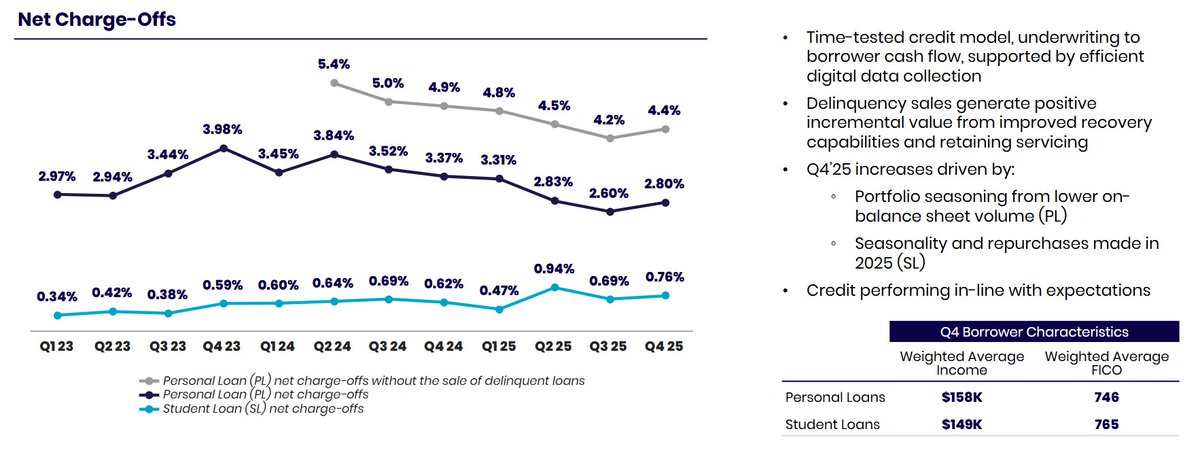
Muddy Waters vs. $SOFI Accusations Check - A Thread 🧵👇 1/ Accusation 1: Personal Loan Charge-Off Rate is Really ~6.1%, Not 2.89% MW's Claim: Muddy Waters asserts that SoFi manipulates its charge-off rate by disposing of loans just before they reach the charge-off threshold and by "parking" defaulted loans in unconsolidated entities. Why It's Misleading: - SoFi emphasized that it operates under strict regulatory oversight and adheres to established accounting standards, with financial disclosures prepared in accordance with U.S. GAAP and complying with SEC rules. Any loan sales or off-balance-sheet treatment would have to be disclosed and approved under these frameworks. - SoFi is regulated as a bank holding company supervised by the Federal Reserve and the OCC. Misrepresenting charge-off rates to these regulators, not just to public investors, would be an extraordinary and career-ending fraud, not a management bonus trick. - Selling loans before they charge off is a standard, entirely legal practice in consumer lending. It's not manipulation, it's portfolio management. The loans are sold at fair market value, and any gains/losses flow through the income statement. - Muddy Waters alleged the charge-off data contains a "mathematical impossibility," yet didn't account for how SoFi's loan vintage mix, rapid origination growth, and loan sale activity interact with the charge-off denominator, a common error in short-seller charge-off math. 👇