Mike Robbins

122 posts

Mike Robbins

Mike Robbins

@compumike

Co-Founder @ @CircuitLab

San Francisco, CA 参加日 Ocak 2009
77 フォロー中127 フォロワー
Alfonso
Alfonso@alfongj·
I can't believe Pager Duty is the most used tool for on-call management. It's got horrible UX, and it's extremely overpriced. Is there any alternative that just has the ability to page ppl in their phone number with a predetermined schedule? Easy to use and <$500 a seat?
English
4
1
7
1.3K
Paul P. 🇨🇦
Paul P. 🇨🇦@pauld_fgc·
API & Platform Results: Rails: @Railway wins. Render wakeup boot extremely slow (~1m). Flyio cannot run Rails for free. Crystal: @Render wins. 5-10s wakeup boot time. Railway & Fly keep growing memory infinitely. Node: @flydotio + Railway both win. Very slow boot on Render.
English
2
2
6
0
Mike Robbins
Mike Robbins@compumike·
Number one on Hacker News 🎆💥🙂
Mike Robbins tweet media
English
0
0
1
0
Mike Robbins
Mike Robbins@compumike·
... doing the deep dive today puts new tools in your toolbox, and new tools expand your reach for future projects. The expected payback period is surprisingly short. But this doesn't fit with the conventional sprint/ticket model of software development teams.
English
0
0
0
0
Mike Robbins
Mike Robbins@compumike·
My first Kubernetes controller: hairpin-proxy:v0.1.0 github.com/compumike/hair… solves a kubernetes/nginx-ingress/cert-manager problem reported on GitHub issues for years. It's fun to dive one or two layers deeper and figure out how the magic works so I can fix it. More importantly,
English
1
0
0
0
Mike Robbins
Mike Robbins@compumike·
@rubiety Thinking carefully & analytically is hard work! Does society appropriately reward those who do that hard work? Does the reward encourage others to think critically too? Do those suffering from a lack of analytical thinking have a viable alternative?
English
0
0
1
0
Ben Hughes
Ben Hughes@eigen_ben·
I increasingly believe that a lot of our problems are rooted in vigorous aversion to even *trying* to think carefully & analytically. Congruent with cognitive psychology research, but I still struggle to accept it.
English
2
0
3
0
Mike Robbins
Mike Robbins@compumike·
@AaronLCannon Good point! And that means you might be able to relocate offices out of expensive core downtowns as well. (Public transit / bike-to-work fans might be unhappy.) Or use shared space that 5 companies rent out on different days of the week.
English
1
0
1
0
Aaron Cannon
Aaron Cannon@AaronLCannon·
@compumike True, but at one day a week, I’d be willing to drive pretty far. So maybe a mixed model extends the radius of living to a city center
English
1
0
0
0
Aaron Cannon
Aaron Cannon@AaronLCannon·
I agree with the skepticism. we shouldn’t assume full-remote is our future. But a ton of people (probably not CEOs/execs/founders) would prefer remote. I believe the future is partial-remote. A complex system of in-person and remote schedules, with small offices.
Jack Altman@jaltma

I continue to feel skeptical about remote work as the future. Colocated work still strikes me as more fulfilling and productive for most people over the long term. If it were safe to go back to work tomorrow, I think most of us would.

English
2
0
3
0
Mike Robbins
Mike Robbins@compumike·
@AaronLCannon Definitely. They probably have a relatively weak revenue-driven motive: increasing Meet adoption probably only slightly reduces G Suite customer churn. Most of the customer lock-in is still elsewhere (documents and emails). But Zoom/Quip/etc threaten that integration.
English
2
0
0
0
Aaron Cannon
Aaron Cannon@AaronLCannon·
Im sure a PM at google meet has been trying to increase user adoption for years. It only took a pandemic to convince the Gmail execs to carve out massive real estate to siphon traffic to meet. That PM must be stoked.
Aaron Cannon tweet media
English
3
0
8
0
Mike Robbins
Mike Robbins@compumike·
"For a good conversation about ideas both sides should share a single motive — finding the truth. I'd like to believe this is the only motive anyone has when discussing ideas but it's not the case." harj.posthaven.com/conversations-…
English
0
2
4
0
Mike Robbins
Mike Robbins@compumike·
The good news is that behavior seems heterogeneous. Heterogeneous behavior (both geographically, and between more-careful and less-careful households) leads to better overall outcomes than the homogenous models suggest. But those rewards are distributed heterogeneously as well.
English
0
0
0
0
Mike Robbins
Mike Robbins@compumike·
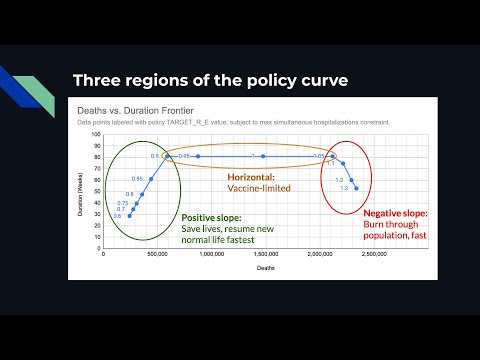
A month ago, I published my analysis of the pandemic as a feedback control system twitter.com/compumike/stat…. (I didn't model shorter-term oscillations because I was focused on long-term strategy outcomes.) The bad news is that strategically, the US does seem to be targeting R=1.
Mike Robbins@compumike

"Surprising COVID-19 Strategy: Reduce Economic Damage and Deaths Simultaneously" youtube.com/watch?v=NuNrkG… I analyze pandemic as a feedback system and show the policy frontier is concave down. Counterintuitive! There is no tradeoff between saving lives & reducing economic damage.
English
1
0
0
0
Mike Robbins
Mike Robbins@compumike·
Feedback systems pop quiz! What happens when you combine: (1) a process with open-loop exponential growth behavior (2) a feedback signal with lots of delay and noise (3) a not-very-smart controller that's targeting R=1? Answer: oscillations and (unfortunately lethal) overshoot.
English
1
1
0
0
Mike Robbins
Mike Robbins@compumike·
@youyanggu @youyanggu Short-term forecasting is important for risk assessment and policy feedback, but I really like your "what if" scenarios. It would be great to start a public conversation about long-term strategy, and that strategy will probably be driven by health & economic modeling.
English
0
0
0
0
Mike Robbins
Mike Robbins@compumike·
@youyanggu Small variations in transmission lead to incredible reductions in human suffering. We're still in the horizontal region of the deaths-vs-duration strategy curve. If we go a bit further we can reduce economic disruption simultaneously. (slide from youtube.com/watch?v=NuNrkG…)
YouTube video
YouTube
Mike Robbins tweet media
English
1
0
2
0
Youyang Gu
Youyang Gu@youyanggu·
I ran a simulation on what would happen if just 20% of infected individuals reduced their own transmission by 25% (such as by self-quarantining immediately after showing symptoms). Deaths would be 30% lower by today, and up to 50% lower by September. covid19-projections.com/us-self-quaran…
Youyang Gu tweet media
English
18
78
188
0
Mike Robbins
Mike Robbins@compumike·
"Surprising COVID-19 Strategy: Reduce Economic Damage and Deaths Simultaneously" youtube.com/watch?v=NuNrkG… I analyze pandemic as a feedback system and show the policy frontier is concave down. Counterintuitive! There is no tradeoff between saving lives & reducing economic damage.

YouTube video
YouTube
Mike Robbins tweet mediaMike Robbins tweet media
English
0
2
6
0
Mike Robbins
Mike Robbins@compumike·
@AaronLCannon @triple_byte bucket_low = 20*floor(actual_percentile_int / 20.0); bucket_high = bucket_low + 20; Ship it! 🚀 (Dear engineering team: I doubt this is actually the issue...)
English
1
0
1
0
Mike Robbins
Mike Robbins@compumike·
"You scored between the 100th and 120th percentile" -- looks like I broke @triple_byte's cool new software engineer skills report! Please don't fix, I'm happy to be in that bracket :)
Mike Robbins tweet media
English
2
0
2
0