Max LeValley

1K posts

Max LeValley banner
Max LeValley

Max LeValley

@mt_levalley

CLO @ GFX Labs (Oku Trade). Michigan Man from Kansas. DeFi + law. Views my own.

参加日 Haziran 2022
222 フォロー中170 フォロワー
固定されたツイート
Max LeValley
Max LeValley@mt_levalley·
Financial regulations are just protocols carried out by inherently self-interested human beings who routinely mess up the rule at each stage of the process--and often do so intentionally to their benefit. Smart contract protocols carry out the rule exactly as stated. While harm may result from, for example, a bug in the code, it still operated as it stated it would. This is a much different risk and belies the absurdity of regulators--who have a duty to understand the tech they seek to regulate--continuing to argue that financial regulations designed to mitigate human deceit should apply, exactly as they are, to open-source computer code.
English
4
9
33
3.5K
Justin Slaughter
Justin Slaughter@JBSDC·
This tax probably won’t raise much revenue but the real lesson for folks in crypto is that knowledge of how the industry works remains poor for most legislators. This is the kind of tax proposal you’d see raised ten years ago in a bull market just because folks see a money tree.
English
7
1
11
2.2K
Justin Slaughter
Justin Slaughter@JBSDC·
It’s a bad law, but I think folks are missing how it was inserted basically in the final hours of the session before sine die & passed with minimal analysis/hearings. The legislature has no idea what impact this will have on crypto trading in Illinois? So why do it? Revenue.
miles jennings@milesjennings

This is one of the most anti-crypto laws in the U.S. It taxes the exchange, transfer, or storage of digital assets—you buy BTC, you pay a tax; you hold your BTC on Coinbase, you pay a tax; and so on. There is effectively no comparable state financial transaction tax on stocks, bonds, or derivatives anywhere in the country. That means crypto is being singled out in violation of several federal laws. Further, the approach makes little sense—you aren’t taxed if you exchange a stock, bond, or derivative in paper form, but you are taxed if they happen to be recorded on a blockchain? That’s like taxing email. So, rather than embracing innovation and the cost efficiencies blockchains can deliver for ordinary people in Illinois, the state is poised to punish its entrepreneurs and citizens that want to use crypto. This is a shame—it was only just recently that Illinois embraced a constructive approach to blockchain technology through the adoption of the effectively-scoped Digital Assets and Consumer Protection Act. This new tax is a complete 180. When states adopt discriminatory, asset-specific taxes that drive builders and users elsewhere, we all lose.

English
5
1
62
6K
Teddy
Teddy@TeddyRoosevalt·
@JBSDC I have a hard time seeing this survive a legal challenge Max has a great write up here. I’d also throw in the question of federal preemption. Wonder how this tax interfaces with the GENIUS Act (and Clarity assuming it passes)
Max LeValley@mt_levalley

x.com/i/article/2062…

English
1
0
1
148
Max LeValley
Max LeValley@mt_levalley·
@cryptodotnews I’m “certain” Treasury will provide us all “clarity”by interpreting section 302 to require full AML/KYC for all noncustodial frontends
English
0
0
0
25
The Digital Chamber
The Digital Chamber@DigitalChamber·
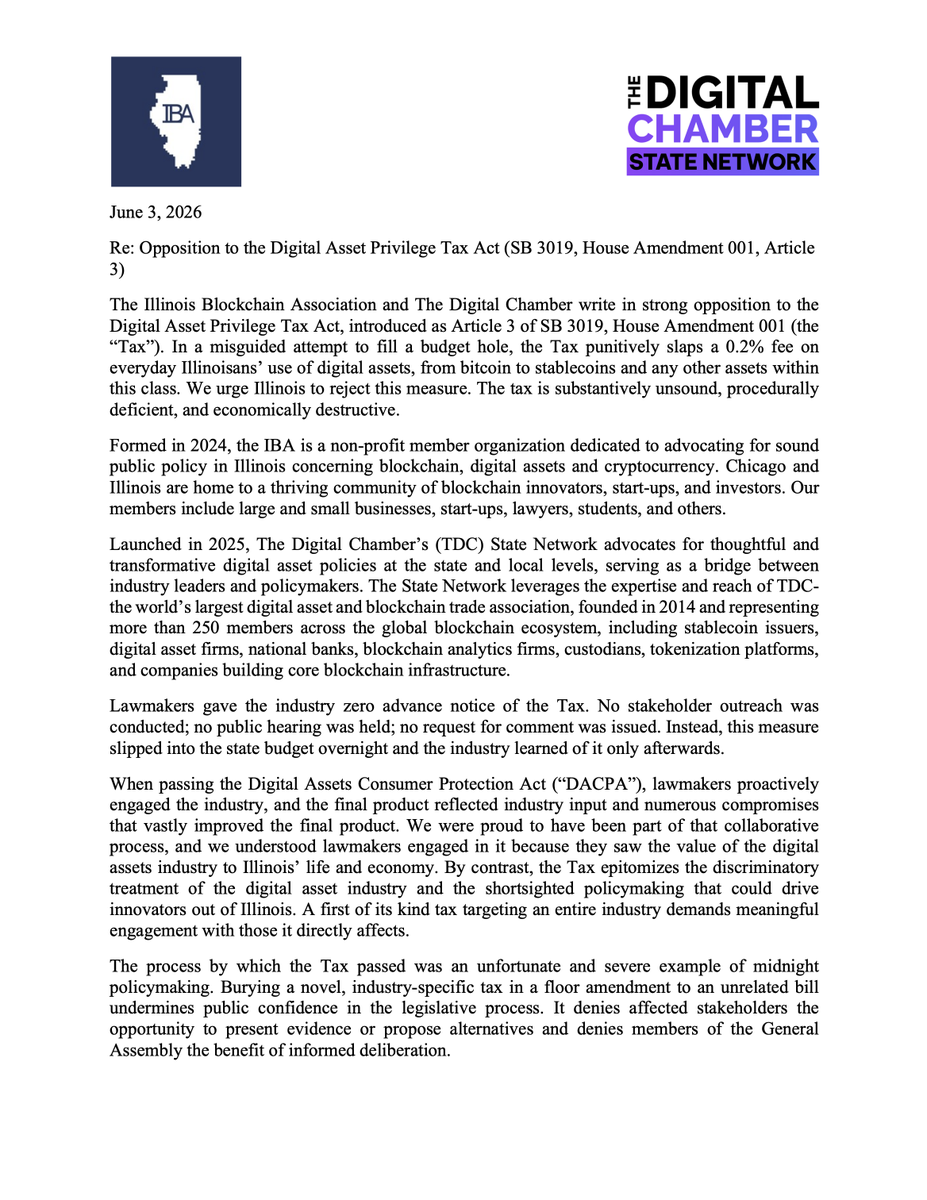
Illinois' proposed 0.2% digital asset tax would negatively impact residents and businesses at a time when digital asset adoption and innovation are accelerating. No other state has imposed a similar tax, and the lack of stakeholder engagement surrounding this proposal raises significant concerns. The Digital Chamber recently joined the Illinois Blockchain Association in a letter urging the legislature to reconsider this measure. Read our full letter: bit.ly/4ujZWfE
The Digital Chamber tweet media
English
5
6
23
9K
CoinDesk
CoinDesk@CoinDesk·
NEW: Illinois Governor Pritzker has signed a 0.2% tax on crypto transactions into law including transfers between personal wallets, with the Crypto Council for Innovation calling it "the most punitive digital asset tax in the country."
CoinDesk tweet media
English
2K
655
3.7K
4.6M
mert
mert@mert·
i am going to crash out over how roman and tornado cash are still being charged *criminally* for *self-custodial and immutable* code while barely anyone who has *literally* robbed people in crypto have faced any issues roman is facing up to 45(!!!) years in prison for OSS
English
64
47
563
28.3K
Max LeValley
Max LeValley@mt_levalley·
@NYcryptolawyer Are AML reporting obligations for noncustodial DeFi wallets and interfaces with no customer relationships in service of self-sovereignty? Because Clarity does that in § 302.
English
0
0
1
23
Nick Anthony
Nick Anthony@EconWithNick·
Despite an executive order instructing the Federal Reserve to cease CBDC development, the New York Fed continues to push forward. cato.org/blog/fed-worki…
English
1
3
6
288
Max LeValley
Max LeValley@mt_levalley·
@SenLummis What does § 302 do to DeFi? It subjects it to AML reporting designed for TradFi where the ledger is otherwise private. Treat it like a worthy innovation instead of just tweeting about it.
English
0
0
2
37
Senator Cynthia Lummis
DeFi is not a loophole. It's a worthy innovation. The Clarity Act treats it that way.
English
206
557
4K
105.8K
Max LeValley がリツイート
Laz
Laz@LazPieper·
There is an art to prompting such that you actually learn the substance and not just receive the answers. I don’t believe all of these students are attempting to just get the homework done and be done with it, they just don’t know how to prompt AI to be a tutor. This is an educational opportunity, and schools that are outright banning AI-use will see more of this than those that are teaching students how to properly use it.
Ethan Mollick@emollick

More evidence, from a large-scale study in China, that using AI hurts learning if it undermines mental effort. When homework time drops due to AI use, so do test scores. Across studies, a theme: AI tutoring in support of classes is good, using AI to "help" with homework is bad.

English
0
1
1
162
Brian Armstrong
Brian Armstrong@brian_armstrong·
The fact that orbital compute is (soon) the most efficient way to build datacenters says a lot about how much excessive regulation has harmed progress on earth. It’s more efficient to fly to outer space than to try and build on land. Freedom is always on the frontier. The U.S. constitution was a breakthrough in that it protected citizens from tyrannical government. What it missed, and what we should try to integrate into the next constitution (on Mars, special economic zones, etc), is restraint against unchecked growth of regulation and government spending. I’ve been slowly collecting proposals for how that could work. Might do a post on it at some point.
English
605
493
6.7K
565.5K