Neel Doshi

64 posts

Neel Doshi

Neel Doshi

@nldoshi414

Hi

参加日 Ocak 2022
158 フォロー中25 フォロワー
Neel Doshi
Neel Doshi@nldoshi414·
@sandipsabharwal Luckily prices are below that level too now so maybe they’re doing good now ? Unless you think everyone sold at the top
English
0
0
0
173
sandip sabharwal
sandip sabharwal@sandipsabharwal·
People who sold during the #Covid selloff regretted in the next 6 months and some never got the guts to invest higher The same will happen to those panicking now
English
26
9
258
14.7K
Margin of Safety🇮🇳
Margin of Safety🇮🇳@InvestorOfJAMMU·
Happy that he is raising the voice of Investors. I want Mutual Fund sleeping managers to speak up on this issue and not just count their crores of rupees as fee from Retail investors pocket.
Margin of Safety🇮🇳 tweet media
Margin of Safety🇮🇳@InvestorOfJAMMU

I do my best to raise the voice of Retail investors to the policy makers but seems like Retail investors are not interested. Even big accounts are not helping raising the voice. Sad affairs. Keep crying then. Best of &uck👍

English
11
29
159
6.3K
Neel Doshi
Neel Doshi@nldoshi414·
@equities_samjho No , NOP is to curb speculative position , if bank is doing it hedged for another institution that’s a different story.
English
1
0
0
601
Tushar Pandey
Tushar Pandey@equities_samjho·
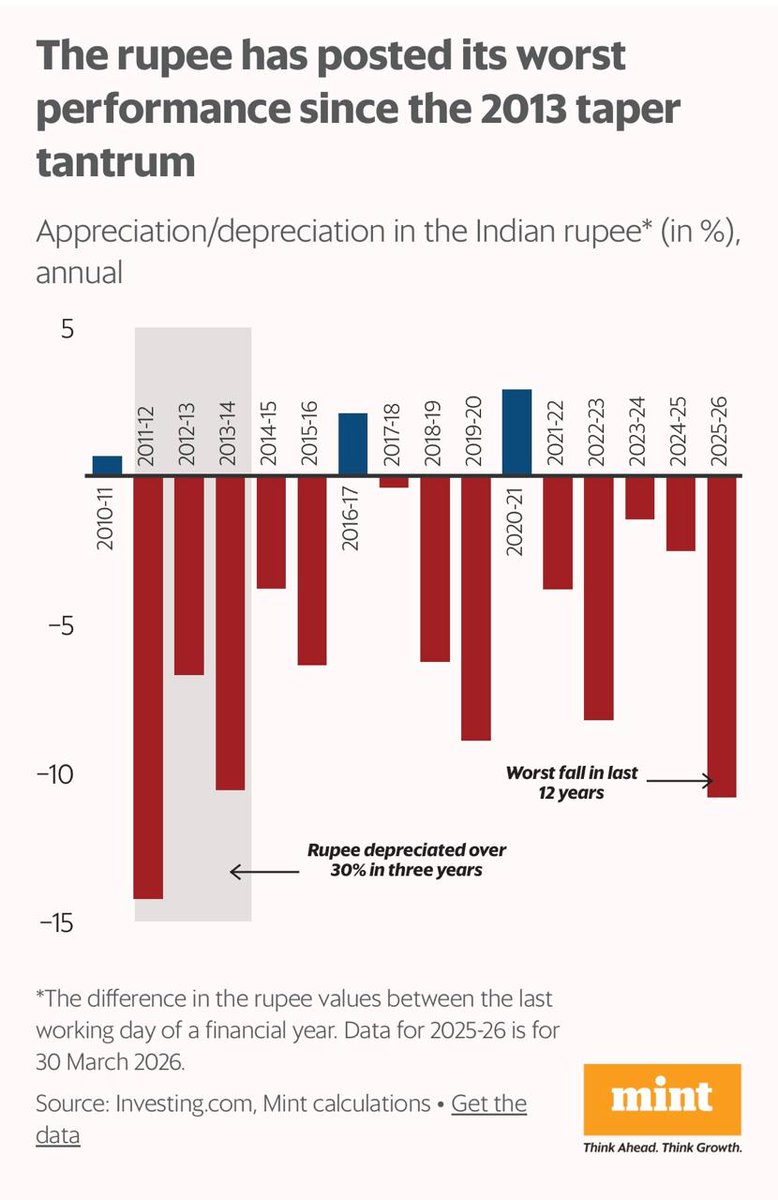
The rupee is in free fall even after RBI intervenion, which led to a bloodbath in Bank Nifty today. It is down by ~4% as I write this. In this post, I’ll explain everything that you need to know. To understand this, you’ve to first know that every Bank has a Treasury. You can think of it as the bank’s own internal hedge fund. This department is responsible for managing the bank's cash and making profits by trading currencies and bonds. Now, you might also be hearing that the RBI has pulled the plug on Rupee’s speculation machine. If you’ve looked at the Rupee today, you’ve seen a violent tug-of-war. To understand why the bank stocks crashed and why the Rupee is acting like a roller coaster, you need to understand how the RBI fundamentally changed Treasury’s plumbing after a decade. The Old Game It was where a bank’s treasury made easy money. Until Friday, big banks were playing a double game. In Mumbai (onshore market), they would buy massive piles of dollars hoping that it would rise. In other words, they were Long USD. Simultaneously, since these bank’s Treasury can’t just randomly take Long bets, what they used to do was in offshore markets like Dubai or Singapore (also called Non-Deliverable Forward (NDF) market), they would Short those dollars immediately (making a bet that the dollar would fall). This would complete the cycle and make their bets risk free. If USD rises, they earn in India, and lose in Dubai. If USD falls, they lose in India, but then gain in Dubai. So, net net, no speculative risk. But why take that trade in the first place when the end result is no gain or loss? Because the price in Dubai was usually higher than in Mumbai (called as Spread). By holding dollars in India and betting against them abroad (to cancel the speculative risk), they locked in a risk-free profit called a Spread. It was easy money for treasuries (let’s say they bought at 93 and sold it at 93.10) even though the overall position remains hedged. The Problem was that to make this profit, banks were hoarding billions of dollars inside India. This hoarding made the Dollar scarce and the Rupee weak. When the Rupee hit 95 on Friday, the RBI realized the banks' profit machine was actually pushing the country toward a currency crisis. The New Rule This led RBI to introduce the $100 Million limit on the Net Open Position (NOP) of banks. Over the weekend, the RBI slapped this limit on how many dollars a bank can hold unbalanced on its books (the difference between what a bank owns and what it owes). Imagine having $800 million in arbritage trade that now must be reduced to $100 million. The result is forced selling. This forced every major bank in India to dump their multi-billion dollar piles into the market starting this morning to bring their NOP within $100 million. This morning, banks were selling their dollars at Fire Sale prices (around 93.60) just to follow the law. Once they sold their Mumbai dollars this morning, they were left with those Short bets in Dubai (that they earlier took to hedge their speculative trade) but no longer had any dollars left in Mumbai to back them up. They were Naked. If the dollar rose, they would be wiped out (as they had shorted it in Dubai). Banks obviously panicked. They rushed to Dubai to Buy Back (cancel) their short bets. But the offshore traders knew the Indian banks were desperate. They jacked up the price. Banks were selling cheap in Mumbai (93.60) and being forced to buy expensive in Dubai (95.00+). This was a double whammy. The 135-paisa gap you saw today is the physical cost of banks being forced to exit a safe trade at suicide prices. They lost on the way out of Mumbai, and they lost again on the way into Dubai. Impact on Rupee Because banks were legally forced to sell USD, the Rupee gapped up this morning to 93.53 (pure demand and supply). It looked like a recovery, but it was artificial. As I write this, the Rupee has already slipped back toward 94.70. This might be because the real buyers (which are oil companies and importers) saw the cheap prices and swallowed every single dollar the banks dumped. Importers just love when currencies appreciate (95 —> 93). The banks took a massive ₹4,000 Crore loss today (according to Jefferies) just to follow the rules, but the Rupee is still under extreme pressure because the fundamental reasons (high oil and war) haven't changed. This loss is however, one time and will reflect in Q4 Treasury earnings for Banks. Liquidity Crunch Again There is also an important angle to this, which is where I am concerned. The economy was already reeling under liquidity crunch, this move will undo all those efforts taken in the last few months. This is where it also tends to hit the real economy. By capping banks at $100M, the RBI (knowingly) killed Liquidity (the ease of trading). For instance, if a big company like Reliance needs $500M to pay for oil, no single bank can handle that trade anymore because it would blow past their $100M limit. The company now has to go to 10 different banks, causing a stampede that spikes the price. Then comes the increased hedging price. An importer buys a Forward Contract to lock in a price for the future (hedging 101). But since banks now have a tiny limit of $100M, that space is incredibly scarce. Banks are now charging double the premium to provide this insurance. So, an importer is now either paying a scarcity tax just to protect his business or is not hedging at all, which is also very risky during a volatile currency phase. The Bottom Line The bottom line is that the RBI has successfully kicked the speculators out of the room, but they’ve also made the room very small for everyone else. We have moved from a market driven by greed to one driven by regulation. The Rupee might be steadier in the short term, but the cost of doing business and liquidity crunch are likely to stay here for a while. This is the short term pain I was referring to in my earlier posts. It is a necessary pain because the alternative is currency crisis, which is even more brutal for the economy.
Tushar Pandey tweet media
English
7
70
275
23.7K
Margin of Safety🇮🇳
Margin of Safety🇮🇳@InvestorOfJAMMU·
Surprised to know that biggest Oil Billionaire is not from the Saudi, Russia or from US. He is none other than Mukesh Ambani and that too from last 11 years. Ambani ji is making India proud🇮🇳 Just wow.
Margin of Safety🇮🇳 tweet media
English
39
37
544
10.3K
Neel Doshi
Neel Doshi@nldoshi414·
@Iamsamirarora Sir ji , why waste mental energy + time to reply to these trolls ? We respect you that’s why we invest in Helios❤️👌🏻
English
0
0
5
731
Neel Doshi
Neel Doshi@nldoshi414·
@avasthiniranjan Not totally wrong , don’t rush to buy thinking this is the last dip , let some money recover as well. No need to be over invested , no ones going to reward you , and who knows maybe the implications of this war may last 2-3 quarters. You’ll get a chance again to enter
English
0
0
1
323
Niranjan Avasthi
Niranjan Avasthi@avasthiniranjan·
Forget convincing others, the real challenge is at home now 😅 Tried convincing my wife to invest more… but now after investing 2-3 times in this correction, she said: “Pehle jo invest kiya hai, woh green ho jaaye… phir baat karte hain.” Markets recover fast. Confidence… takes its own sweet time.
English
11
2
77
9.9K
Margin of Safety🇮🇳
Margin of Safety🇮🇳@InvestorOfJAMMU·
How someone can give Buy trading calls in the morning when you know market is going to Gap down heavily??
Margin of Safety🇮🇳 tweet media
English
16
0
42
4K
Neel Doshi
Neel Doshi@nldoshi414·
@piyush_trades I disagree , many a times old funds are stuck in stocks which were good maybe 3-4 years ago like IT, ITC, IEX etc
English
1
0
0
188
Piyush Trades
Piyush Trades@piyush_trades·
If you want to do an SIP successfully for the long term, invest only in those mutual funds that are more than 10 years old. Those who disagree will end up sending their money to funds that invest in stocks like Lenskart and Ola Electric. Thank me later.
English
8
1
52
5.9K
Margin of Safety🇮🇳
Margin of Safety🇮🇳@InvestorOfJAMMU·
Eberybody was predicting big fall for market today and it opened flat. I will not be surprised if Market closes positive today. 25150 has to come.
English
82
7
285
25.6K
Vijay Shekhar Sharma
Vijay Shekhar Sharma@vijayshekhar·
The COBOL machine cracked.
Shanaka Anslem Perera ⚡@shanaka86

A blog post just wiped $30 billion off IBM in a single afternoon. Not a product launch. Not an earnings miss. Not a competitor undercutting on price. A five-minute blog post explaining that Claude can read COBOL. IBM dropped 13%. Worst single-day loss since October 2000. Twenty-five years of stock resilience ended by one AI company publishing a capability update. Here’s what happened: 95% of ATM transactions in America run on COBOL. Hundreds of billions of lines power banking, airlines, and government systems. The developers who built them retired decades ago. The knowledge left with them. Finding engineers who can even read COBOL gets harder every quarter. IBM’s moat was never the technology. It was the fact that nobody else could understand it. Entire consulting empires existed because the code was too old, too tangled, and too critical to touch. Companies paid IBM billions because the alternative was catastrophic system failure. Then Anthropic published a blog post saying Claude Code can map dependencies across thousands of lines of COBOL, document workflows, identify migration risks, and translate legacy logic into modern languages. Modernization in quarters instead of years. The market heard: the priesthood just lost its monopoly on the sacred language. And this isn’t the first time. Last week Anthropic announced Claude Code Security for vulnerability scanning. CrowdStrike dropped. Okta dropped. Cloudflare dropped. One company is serially destroying legacy moats with blog posts. Now here’s where it gets surreal. This same company, on the same day, also published evidence that three Chinese AI labs ran 24,000 fake accounts and 16 million exchanges to steal Claude’s capabilities. DeepSeek used it to build censorship tools. MiniMax pivoted within 24 hours when a new model dropped, redirecting half its traffic to steal the latest version. And yesterday, the Pentagon summoned this same company’s CEO for what officials called a “sh*t-or-get-off-the-pot meeting,” threatening to blacklist them like Huawei for refusing to let the military use Claude without safety restrictions. Three stories. One company. Twenty-four hours. The company destroying legacy moats faster than the market can reprice them is simultaneously being threatened by its own government and looted by foreign competitors. Anthropic is valued at $380 billion. Its CEO says a 12-month delay in AI would make him bankrupt. The Pentagon wants to designate it a supply chain risk. Chinese labs are running industrial espionage against it. And it just proved it can vaporize $30 billion in market cap with a Monday morning blog post. Whatever you think about AI disruption, IBM’s stock just settled the argument. Full institutional analysis on my Substack. open.substack.com/pub/shanakaans…
English
33
48
482
159.4K
Mr. Wadhwa
Mr. Wadhwa@sourabhwadhwa22·
Less than 180 won’t be a challenging total
English
1
0
1
98
Margin of Safety🇮🇳
Margin of Safety🇮🇳@InvestorOfJAMMU·
What is your biggest worry in the current market condition??
English
64
0
78
55.1K
Shiladitya
Shiladitya@shiladitya4u·
What is the biggest theme you see in Q3 results? For me, it is clearly asset quality improvement in banks, particularly - PSUs, Microfinance, small-midcap banks. Also, this is one sector where valuations are reasonable. No wonder market is rewarding them handsomely.
English
4
1
84
4.9K
Neel Doshi
Neel Doshi@nldoshi414·
@nixxin Should’ve sold if don’t like the founder
English
0
0
0
102
Nikhil Pahwa
Nikhil Pahwa@nixxin·
Eternal/Zomato's financial results are being announced today. The company should answer why a board member, who is thus a company representative, has created a long term political risk for the company by attacking a Rajya Sabha member personally on Social Media, in response to the Members criticism of the company's practices. Was this outburst on behalf of the company? Was it sanctioned by the company? If not, then what is Eternal/Zomato going to do prevent such risk from arising in the future. In the least, it should have a Code of Conduct for its Board. Disclosure: I have shares of Eternal and Info Edge.
English
24
18
190
64.5K
Rajat Sharma
Rajat Sharma@SanaSecurities·
So far corporate earnings are much better than what everyone had expected. Stocks recommended, which reported post market: HDFC Bank - up 12% Can Fin Homes - up 25% Tomorrow: It will be interesting to see how HDFC Bank opens, and how ICICI bank closes.
English
3
3
94
8.5K
Neel Doshi
Neel Doshi@nldoshi414·
@InvestorOfJAMMU Labour law impact on PAT, otherwise EBITDA & EBITDA Margin improving , along with AI revenue contribution
English
0
0
1
485
Margin of Safety🇮🇳
Margin of Safety🇮🇳@InvestorOfJAMMU·
It is clear from IT companies result that this sector is not going to support Nifty for 29k journey. HCL & TCS result PAT is down for whatever reason, not helping Nifty to deflate its PE. Hopes shifted to other sectors🤞
English
23
12
458
33.5K
Safir
Safir@safiranand·
If cerc lawyer is asking for more time to consider withdrawing order it means things are going in favour of IEX as of now. As of now as matter is still on
English
6
2
90
14.3K