oneatom12

545 posts

oneatom12

oneatom12

@oneatom1201

参加日 Aralık 2016
121 フォロー中90 フォロワー
oneatom12 がリツイート
Guv999
Guv999@Guv999·
Date stamped : April 15 2026 $NOK at USD 10.19 Free stock tip for Follows. NOKIA $NOK is having a strong break out after many years, looks like going to do v well in coming months . USD 8.50 was the level to break. You can still buy even now a small position at USD 10.19 , never bet the farm on any single stock , buy only what you can lose friends. 😎👍
English
0
1
31
1.7K
oneatom12 がリツイート
Guv999
Guv999@Guv999·
We all need just two guiding ideas in life : If we are v smart , efficient and totally ethical , word will get around and we will do v well in life. If we are over smart , efficient & crooked, word will get around and we will def. not do well in life over the long term. It is that simple but most cannot see it at all. Fact. 😎👍
English
0
2
20
1.5K
oneatom12
oneatom12@oneatom1201·
@hafatrdr @Guv999 Yeah, now she asks me daily about the market. Huge mistake on my part l.
English
0
0
2
40
Rafael
Rafael@hafatrdr·
@Guv999 This is why I don’t tell the wife what happens 🤫 🤐
English
1
0
2
74
Guv999
Guv999@Guv999·
Shop as you like as we are making the moolah now 🤣👍🏻
oneatom12@oneatom1201

@Guv999 Thank you again for all the call outs. My wife is now asking me if she can go shopping……

English
1
0
8
1.3K
oneatom12
oneatom12@oneatom1201·
@Guv999 Thank you again for all the call outs. My wife is now asking me if she can go shopping……

English
0
0
1
1.3K
DeepValue Signals
DeepValue Signals@DVSignals·
You do not just "flip a switch" and blockade Hormuz. That is not a clean policy move.. That is a messy/high-risk military operation in one of the world’s most critical shipping chokepoints. You can disrupt traffic. You can threaten traffic. You can slow traffic... But "stop every ship immediately"? That is fantasy talk...
Disclose.tv@disclosetv

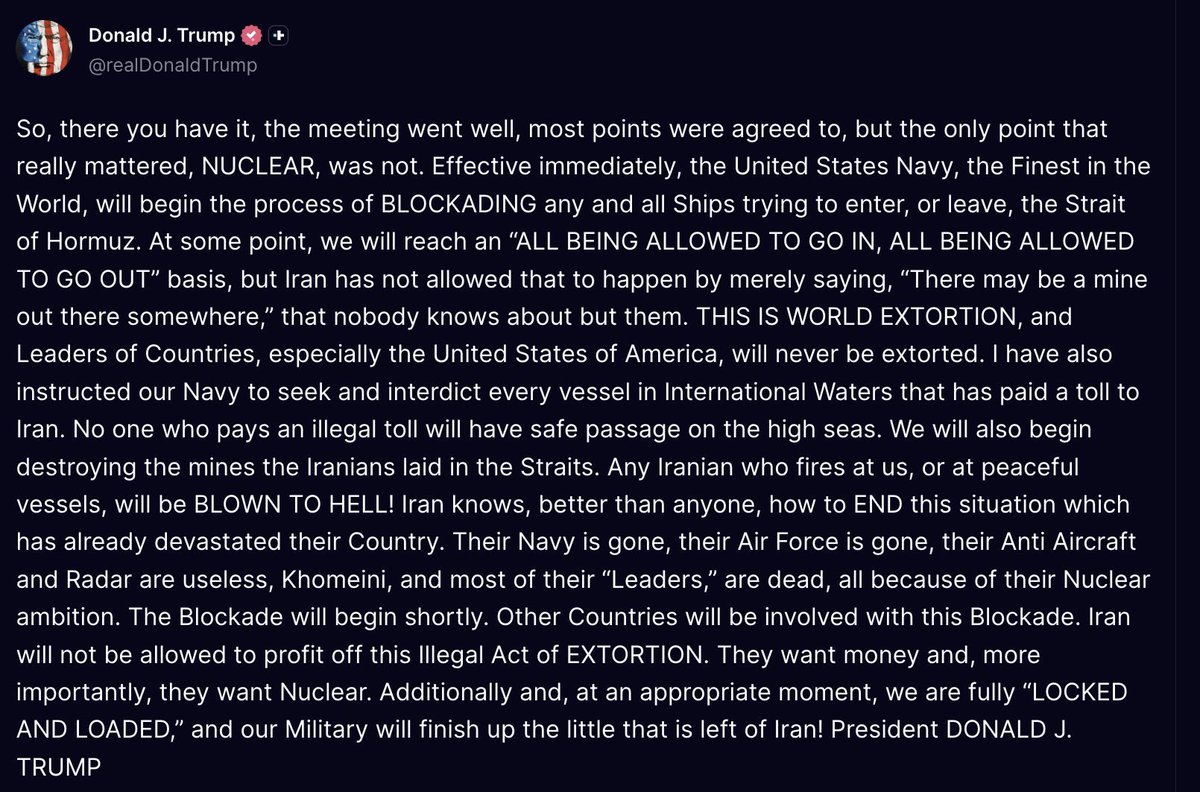
JUST IN - Trump orders the U.S. Navy to blockade the Strait of Hormuz to "any and all ships trying to enter, or leave." Also instructing the U.S. Navy to seek and interdict every vessel in international waters that has paid a toll to Iran: "No one who pays an illegal toll will have safe passage on the high seas."


English
11
0
28
8.3K
oneatom12 がリツイート
Brandon Beylo
Brandon Beylo@marketplunger1·
Me explaining to my wife why 100% of our net worth is invested in junior mining stocks.
English
46
76
1.3K
103.8K
CrediBULL Crypto
CrediBULL Crypto@CredibleCrypto·
Looking very constructive here on LTF for $CRV. Our purple zone was cleared and we are now consolidating between our previous local supply (already tested) and new local demand (untested) that formed after taking our key swing lows just under .20. Dips into green would make for a good long opp with defined risk.
CrediBULL Crypto tweet media
CrediBULL Crypto@CredibleCrypto

There is our sweep of the .20 lows and a beautiful reaction thus far. We can see that the purple zone acted as resistance (as expected) three times, ultimately leading us to that sweep we were looking for, and now we are testing the purple zone for the 4th time. Clearing this zone could trigger a strong move up as we have now built up liquidity all the way up to .27-.30 and we have finally taken the liq to our downside. $CRV

English
32
26
378
158.3K
Sean Dekmar
Sean Dekmar@DekmarTrades·
Trump is now sending the US NAVY to blockade the Strait of Hormuz
Sean Dekmar tweet media
English
9
4
15
2.1K
oneatom12 がリツイート
Guv999
Guv999@Guv999·
Coming 12-15 years are meant for independent thinkers, risk takers, free lancers and guys who can think & boldly act totally out of the box, they all can make huge wealth and also avoid major financial wipe outs in the periodic mega purges going to come every few years across all asset classes. If you are HNWIs, you may want to explore with me what the above means & how you can protect and grow your wealth. 😎👍
English
0
5
34
3.4K
.
.@RoyalsPlsWin·
ZXX
5
2
93
5.7K
Guv999
Guv999@Guv999·
When does the FOMO start for crypto sector fence sitters ? I gave ya all clear indication on March 1 , 2026 But X folks won’t believe a guy with 12K Follows , they will only believe a scammer with 250K+ Follows 😎🤣👍🏻
English
9
1
42
4.3K
Yellowbull
Yellowbull@Yellowbull11·
In the scenario that a ceasefire even lasts, it's not the only part of the global energy market equation that needs to be taken into account, because over the course of the past month a lot of oil & gas infrastructure has been taking a beating. How much of a beating? I spent an unhealthy amount of time to get you all a detailed overview and strap in (for those who have already read this, thank you for the support and I just wanted to share it in straight post form rather than article form), because it's a lot of data and let me walk through what has actually been broken since this entire conflict kicked off and how long it will take to fix. Again it took me a lot of time to put this together and the list is long and the timelines are not flattering. The single most consequential strike of the entire war, in my view, was the March 18 and 19 missile attack on QatarEnergy's Ras Laffan Industrial City. Saad Sherida Al-Kaabi, the QatarEnergy CEO, came out and confirmed that LNG Trains 4 and 6, totaling 12.8 million tons per annum of liquefaction capacity, were damaged. Train 4 is the joint venture with ExxonMobil at 66/34, and Train 6 is the joint venture with Exxon at 70/30. Together they represent approximately 17 percent of Qatar's LNG exports, or roughly 10 percent of global LNG supply once you account for Qatar's share of the seaborne market. Al-Kaabi said the repairs will take between three and five years and that QatarEnergy will be compelled to declare force majeure on long-term contracts to China, South Korea, Italy, and Belgium for up to five years. The lost annual revenue is estimated at roughly $20 billion. The associated product losses are even more underappreciated than the LNG headline. The same attack took offline 18.6 million barrels of condensate (around 24 percent of Qatar's exports), 1.281 million tons of LPG (around 13 percent), 0.594 million tons of naphtha (around 6 percent), 0.18 million tons of sulfur (around 6 percent), and 309.54 million standard cubic feet of helium (around 14 percent). The condensate loss in particular will ripple through Asian splitter economics for years, and the helium hit will be felt acutely by the semiconductor and medical imaging supply chains. There is no spare helium capacity sitting on a shelf somewhere, and the Russian projects that were supposed to backfill the global market are not running at anything close to plate capacity. The Pearl GTL facility, which is operated by Shell under a production sharing agreement and converts 1.6 billion cubic feet per day of feed gas into 140,000 barrels of oil equivalent per day of cleaner-burning synthetic fuels, base oils, and waxes, was hit in the same window. Train 1 escaped damage I believe, but Train 2 will be offline for at minimum a year per Shell's own statement, and the open question that I think the market is missing is whether the eight Air Separation Units (ASUs) built by Linde at Schalchen and Dalian are intact or whether the brazed aluminum plate-fin heat exchangers at the core of those cold boxes were destroyed. If the BAHX modules took critical damage, the lead time on replacements is three to four years from contract award through commissioning, given the engineering precision and manufacturing constraints involved. Shell's one-year estimate suggests the cores are probably intact, and that is the more optimistic scenario, but I would not consider that question settled until satellite imagery and an independent assessment confirm it. Moving down the western side of the Gulf, Habshan is the part of this that I think few outside the gas market is paying attention to yet and it is the part I would personally watch closely over the coming weeks. Please correct me if I got some of the details wrong here, but I believe that the complex comprises five separate processing plants with a combined nameplate capacity of 6.1 billion standard cubic feet per day, which makes it not only the largest gas processing facility in the UAE but one of the largest in the entire Middle East. ADNOC suspended the entire complex around the start of April after the strike, and the fact that they shut down all five plants rather than just the affected one is, in my reading, a strong signal that the damage was meaningful enough to require an integrated safety review. If I assume that one of the five plants took a direct hit and that ADNOC restarts the other four within a few weeks once they have done their assessment, the sustained loss is roughly 1.2 bcf/d for the duration of the repair on the affected plant. If two plants are involved (which I would not rule out), that doubles to roughly 2.4 bcf/d. Either of these numbers is in the same league as the Qatari LNG hit, and the cascading effects matter even more here because Habshan supplies the gas that runs the UAE's power and desalination grid, the feedstock for the Ruwais petrochemical complex, and the input for several adjacent gas-to-liquids and ammonia plants. A clean repair of a single damaged train at a sour gas plant typically runs 9 to 18 months. A repair that involves the amine sweetening units, the sulfur recovery units, or the cryogenic NGL recovery columns runs 18 to 30 months. I would put my central case at roughly 12 to 24 months for full restoration and would not be shocked by longer. In boe/d terms, the central case sustained loss from Habshan is somewhere in the range of 200,000 to 400,000 boe/d for the better part of two years. Moving on, Ruwais has 922,000 barrels per day of crude and condensate processing capacity, which makes it the fourth-largest single-site refinery in the world. The aforementioned March 10 drone strike already closed the facility once and the April 5 incident with multiple fires from intercepted debris hit it again before it had fully stabilized. The complex includes Ruwais West (417,000 bpd) and Ruwais East (505,000 bpd), and it houses the world's largest residue catalytic cracking unit at 127,000 bpd of heavy residue upgrading capacity, plus a hydrocracker, a delayed coker, an aromatics complex, and a base oils plant. The product slate covers gasoline, diesel, naphtha, jet, LPG, propylene, and specialty products like calcined coke and carbon black. Quantifying Ruwais is harder than Qatar because ADNOC has not given a damage statement, but my read of the situation is that the facility has been operating at significantly reduced throughput since March and that the April fires likely impaired specific process units rather than taking down the whole refinery permanently. A central case in my view is somewhere around 300,000 to 500,000 bpd of impaired throughput for the next 6 to 12 months, with full restoration probably another 6 months on top depending on what specific units were affected. The propylene supply chain is the part to keep an eye on, because Ruwais provides the feedstock for the Borouge polyolefins complex right next door, and a Ruwais slowdown alone is enough to throttle Borouge regardless of whether Borouge itself is operational. Borouge, after the merger with OMV's Borealis to form Borouge International, runs at roughly 4.5 million tons per annum of polyolefin and olefin production. Operations at the entire complex were suspended on April 5 after the multiple fires (seeing a theme here), and in petrochemicals a fire that triggers a full unsplanned shutdown is rarely the kind of thing you restart in a week. Polyolefin train repairs typically run 6 to 18 months for moderate damage and longer for cracker damage, so I would put the realistic Borouge outage at somewhere between 9 and 18 months for whatever portion of the 4.5 mtpa took the hit. If half the complex is affected, that is roughly 2.25 mtpa of polyolefins gone from the market for the better part of a year and a half, which the global packaging and infrastructure plastics chains will feel all the way down to consumer prices. The Saudi situation is, by comparison, mild (if one could describe anything in this situation mild to begin with). Ras Tanura's 550,000 bpd processing capacity took an early-war hit and restarted, so the sustained loss there is essentially a few weeks of throughput, call it 5 to 10 million barrels of product over the outage window rather than a multi-year structural problem. SAMREF Yanbu is reported as minimal damage. The bigger Saudi problem is not damage to the refineries, in my view, but the throughput constraint on the East-West pipeline, which has a nameplate capacity of about 5 million bpd but has been running well below that as the country scrambles to redirect Gulf-bound exports overland to Yanbu. Bahrain is in worse shape it would seem. The Bapco Energies refinery at 400,000 bpd is in force majeure, and the Sitra storage and petrochemical complex was hit on a separate occasion. Sitra is a particularly painful target for Bahrain because, from what I can tell, roughly 80 percent of the country's total oil exports are refined products from that single facility, which means a structural Sitra outage is essentially an export crisis for the country. My base case is that Bapco's 400,000 bpd is impaired for 6 to 12 months, with significant uncertainty around what specifically was damaged. In boe/d terms that is the better part of a third of a million barrels per day of refined product outflow lost. Kuwait has had Mina Al-Ahmadi (346,000 bpd) and Mina Abdullah (roughly 454,000 bpd) hit in repeated waves since March 19, with the most recent strike on Mina Al-Ahmadi happening on April 3. KPC declared force majeure on delivery contracts last month. My central estimate is that Kuwait is running its refining system at somewhere between 50 and 70 percent of normal throughput, which translates to a sustained loss of roughly 240,000 to 400,000 bpd of refining capacity for at least 6 months, and probably longer given that the strikes have been recurring rather than one-and-done. Iraq's Lanaz refinery in Erbil is small at roughly 30,000 bpd, so the direct refining loss is rounding error. The bigger Iraq story is the upstream production shut-in driven by the Strait closure, which I covered yesterday, and which is well over 4 million bpd on its own. What about IRN itself? Because they certainly need to be included in this picture as well. IRN's downstream is feedstock-starved rather than physically destroyed in most cases, which is an important distinction. The Bandar Abbas refinery at 320,000 bpd of crude and condensate processing capacity is running below nameplate because Kharg-linked feedstock flows have been disrupted. Persian Gulf Star, the largest condensate splitter in the world at roughly 360,000 bpd, is running below capacity for the same reason. The Shahran depot near the capital was hit early in the war and is essentially gone. The South Pars strikes on March 18 took some processing units offline at what is, by some distance, their most important gas asset, and the more recent strikes on power infrastructure at South Pars are the kind of thing that compounds over weeks rather than days I think. Putting numbers on the South Pars hit is harder because their disclosure on damage is unreliable, but the field accounts for roughly 70 to 80 percent of national gas production, which in raw terms is somewhere around 600 to 730 million cubic meters per day depending on which year you reference. If even 10 percent of that processing capacity is offline for repair, that is 60 to 73 mmcm/d, or roughly 2.1 to 2.6 bcf/d of gas equivalent. Most of this is consumed domestically rather than exported, so the global market impact is muted, but the knock-on effect on their power generation, petrochemical feedstock, and reinjection into aging oilfields is significant for their production over a 12 to 24 month horizon. Replacement timeline for damaged compressor stations and processing modules at South Pars is, in my view, 12 to 24 months under sanctions, and longer if the equipment requires Western suppliers who cannot legally provide it. The single most important fact about their energy picture, which I touched on earlier and want to repeat here because it really matters for the global supply outlook, is that Kharg Island is intact. The Pentagon has confirmed it. State media has confirmed it. Tankers are still moored there from what I can tell. If and when the Strait reopens, their 1.5 to 1.7 million bpd of crude exports can theoretically restart almost immediately, and the 90-plus percent of those exports that go to CHN teapot refineries on heavily discounted terms will be the first barrels back into the system. This is, paradoxically, one of the few stabilizing factors in the entire picture. When I add it all together, what I get is roughly the following picture for sustained energy supply removed from the global market for at least the next 12 months, and in many cases much longer. On the gas side, somewhere between 4 and 6 bcf/d of effective processing or liquefaction capacity is offline. Qatar accounts for roughly 1.7 bcf/d of LNG-equivalent for three to five years. Habshan accounts for somewhere between 1.2 and 2.4 bcf/d for 12 to 24 months. South Pars accounts for an additional 2 to 3 bcf/d for 12 to 24 months, though most of that is domestic consumption rather than global export. In LNG market terms specifically, the loss is roughly 12.8 mtpa for years, which is about 10 percent of global LNG trade and the single largest supply shock that market has ever experienced. European TTF and Asian JKM benchmarks were already pricing this in before the ceasefire, and I see no path for them to fully unwind even if Hormuz reopens cleanly tomorrow, because the Qatari capacity is physically destroyed regardless of what the headlines say. On the refining side, my central estimate of sustained capacity impairment is somewhere in the range of 1.5 to 2.0 million barrels per day for the next 6 to 12 months, with a longer tail at lower volumes. Ruwais alone accounts for 300,000 to 500,000 bpd. Bapco accounts for 400,000 bpd. Kuwait's two damaged refineries account for another 240,000 to 400,000 bpd. Bandar Abbas, Persian Gulf Star, and miscellaneous smaller facilities round it out. Replacement timeline for the bulk of this damage is 6 to 18 months for moderate cases and 18 to 36 months for the more serious ones. Refinery margins, in my view, are going to compress hard from the input side for the rest of the year as the system struggles to balance, and the global jet fuel and middle distillate markets specifically are going to feel this acutely. The IATA chief was in my opinion exactly right when he said jet fuel will take months to normalize even after Hormuz reopens. On the petrochemical side, somewhere between 5 and 7 mtpa of polyolefin and olefin capacity is offline for 9 to 18 months, between Borouge, Pearl GTL Train 2, Sitra in Bahrain, and Shuaiba in Kuwait. This is the part of the damage that is going to bleed slowly into global plastics, packaging, automotive, and construction supply chains over the next year, and it is the part that I do not think anyone outside of specialist chemical analysts or other associated analysts is even tracking yet. On the associated liquids side, the 106,000 bpd of Qatari condensate, LPG, and naphtha that is gone for three to five years adds an additional structural deficit at the light end of the barrel that will be felt in Asian splitter economics specifically. China and South Korea are the most exposed. If I collapse all of this into a single number for the headline before I collapse myself after going through all these numbers for god knows how long and if that's even possible and who knows this entire report could become outdated the moment it is released, the sustained energy supply impairment from infrastructure damage alone (setting aside the Strait closure entirely, which is a separate and larger issue that I have already discussed at length to the extend you can't even call it a broken record anymore, but rather a destroyed record at the very least) is somewhere in the range of 1.5 to 2.0 million boe/d on a sustained 12-month basis, with a tail of roughly 0.5 million boe/d that persists for 3 to 5 years until the full force of Qatari LNG capacity comes back. That is the floor under what the global system has lost and even though it may seem like it, it is not a small number, although it could of course have been higher. The replacement cost for all of this, if I had to put a rough dollar figure on it, which is very very difficult to do so I would take this with a container of salt (as I would the rest of this report given that there is still a lot of uncertainty) runs into the high tens of billions and probably crosses $100 billion once you account for the LNG trains, the Pearl GTL train, the Habshan modules, the Borouge complex, the multiple refinery units, and the associated downtime costs. Shell paid $18 to $19 billion to build Pearl GTL in the first place, and that was at 2006 prices for a project that took the better part of a decade to design and execute. The original EPC contract for the eight ASUs at Pearl alone was $800 million to $1 billion in 2006 dollars, and replacement cost today, even assuming Linde could deliver them in a hurry, would be substantially higher. Time for a conclusion and if you made it this far, congrats as that was a lot of data to get through. As you all know I have been writing a lot on this conflict and positioning accordingly over at the Codex (link in bio), to the tune of 17 seperate macro updates, two extra newsletters of 10+ pages and two more newsletters clocking in at around ~70 pages over just the past month, which I hope will have helped get through this macro storm we have seen and in today's update I will also further discuss positioning, but that can be found on the Codex and I hope to see you there. Now, where does this all leave us? The way I see it, this is the structural floor under oil, gas, refined products, and petrochemicals for at least the next year. It remains to be seen how the market will end up settling in, but we will cross that bridge when we get to it and work with the numbers we got right now. Anyone modeling a quick return to pre-conflict prices is, in my opinion, ignoring this entire physical infrastructure layer of the picture. The proverbial damage really is, as I wrote before as well, measured in months to years rather than weeks, and now that I have actually run the numbers I am still a bit concerned about that. Again, how the market will eventually price all this remains to be seen, but the picture is not as black and white as 'ceasefire or no ceasefire equates to full flows or no flows' and it's important to remember that as we move into the next phase of these developments. Thank you for reading and I hope you have a good and health rest of your day!
*Walter Bloomberg@DeItaone

IRAN'S PRESIDENT PEZESHKIAN SAYS ISRAELI STRIKES ON LEBANON VIOLATE CEASEFIRE AGREEMENT IRAN'S PRESIDENT PEZESHKIAN SAYS ATTACKS ON LEBANON WOULD DEEM CEASEFIRE NEGOTIATIONS MEANINGLESS

English
7
17
76
12K
Megatron
Megatron@Megatron_ron·
BREAKING: 🇺🇸🇮🇷 President Trump: “If they don’t make a deal, we’re gonna blow everything up and take the oil”
Megatron tweet media
English
809
483
3.2K
643.2K
oneatom12
oneatom12@oneatom1201·
@Guv999 Thank you for the crypto, PM and oil call outs. Sincerely provide an amazing service!
English
0
0
3
3K
oneatom12
oneatom12@oneatom1201·
@DekmarTrades I call BS. Cheeto doesn’t know what to do when people don’t bend the knee.
English
1
0
0
46
Sean Dekmar
Sean Dekmar@DekmarTrades·
Iran has 6 hours to respond...
English
8
1
11
2.7K
Sean Dekmar
Sean Dekmar@DekmarTrades·
Buying a lot tomorrow in my long term accounts.
English
7
1
33
17.8K
oneatom12
oneatom12@oneatom1201·
@Guv999 Nice to see one of your picks up 60% + today.
English
0
0
4
2.4K