Tena 🎒

261 posts

Tena 🎒 banner
Tena 🎒

Tena 🎒

@tena_codes

building out of a spaceship 🚀 🎒

Remote 参加日 Ocak 2022
289 フォロー中170 フォロワー
Tena 🎒
Tena 🎒@tena_codes·
If you build in Solidity and are curious about Soroban, read this first. The mental model shifts are subtle but important: No msg.sender. No msg.value. No inheritance. Typed storage. Native upgrades. I wrote a concise breakdown + cheat sheet. @devs_92491/5-key-distinctions-between-evms-and-soroban-a-breakdown-and-cheat-sheet-for-builders-48bb37118402" target="_blank" rel="nofollow noopener">medium.com/@devs_92491/5-…
English
0
2
4
643
Tena 🎒 がリツイート
Real Fun
Real Fun@RealFunLaunch·
Ever bought a meme coin… and watched it implode? It’s not bad luck. It’s bad launch design. 🎙Stop Getting Rugged: Our First-ever X Space🤩 We’re breaking down: ✅ Why most meme launches fail ✅ What funding goals actually signal ✅ The red flags nobody checks ✅ How lock rules change outcomes ✅ What traders should look at before they ape Set a reminder. Pull up live. It’s gonna be Real Fun🤘 x.com/i/spaces/1ldgl…
English
0
2
2
226
Tena 🎒
Tena 🎒@tena_codes·
@Argona0x @PolymarketTrade Strategies are legit but I think its more realistic to expect 2-5% returns, not 10x. imo its better to build for this space than trade in it
English
0
0
0
7
Argona
Argona@Argona0x·
programmers are making $10k-200k monthly on polymarket here's how they actually do it /// 1. arbitrage bots buy YES + NO when combined price < $1 example: YES at 48¢ + NO at 49¢ = 97¢ total you lock $0.03 profit per $1 no matter who wins trader "distinct-baguette" made $242k in 1.5 months doing this targets 15-min crypto markets where prices move fast python script polls API every 1-3 seconds, executes when sum < 99¢ /// 2. statistical arbitrage find correlated markets that drift apart "trump wins" vs "GOP senate control" should move together when spread hits 4-7%, short expensive one, long cheap one close when they converge trader "sharky6999" made $480k scanning 100+ markets per minute /// 3. AI probability models train ML models to estimate real odds from news/social data if your model says 60% YES but market at 50¢, buy trader "ilovecircle" made $2.2M in 2 months with 74% accuracy uses ensemble of 10 AI models, retrains weekly /// 4. spread farming buy at bid (5¢), sell at ask (6¢), repeat or hedge across platforms (short polymarket, long binance) trader "cry.eth2" made $194k with 1M trades high-frequency loop via CLOB API /// 5. copy-trading automation mirror successful whale traders automatically scan profiles, execute proportional trades one bot made $80k in 2 weeks copying near-resolved markets /// tech stack: python + requests library for API calls web3-py for blockchain interactions deploy on VPS for 24/7 operation polymarket has REST APIs for everything: gamma markets API (prices/volumes) CLOB API (place orders) data API (track positions) /// starting point: > build simple arbitrage bot first > fund with $100-1k for testing target high-volume markets (politics/crypto) > expect 50-70% win rate but focus on positive EV
Argona tweet mediaArgona tweet media
English
327
858
10.7K
1.9M
Tena 🎒 がリツイート
RealSafe
RealSafe@RealSafeLP·
The easiest way to kill a token is to pull the liquidity. The easiest way to prove you won’t is to lock it. We just shipped the first LP locker on Monad that works with both Uniswap V2 and V3 (including fee claiming on V3 while locked). Testnet is live → realsafe.app 🧵👇
RealSafe tweet media
English
2
2
2
242
Tena 🎒 がリツイート
Shapeshifter
Shapeshifter@hexshapeshifter·
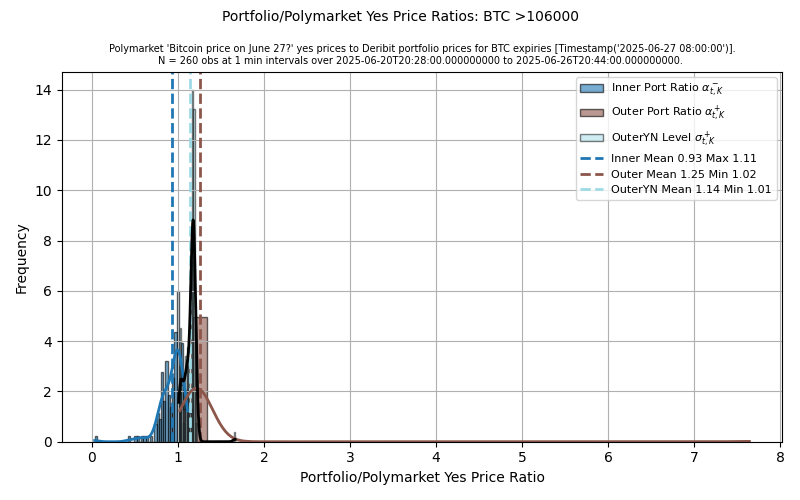
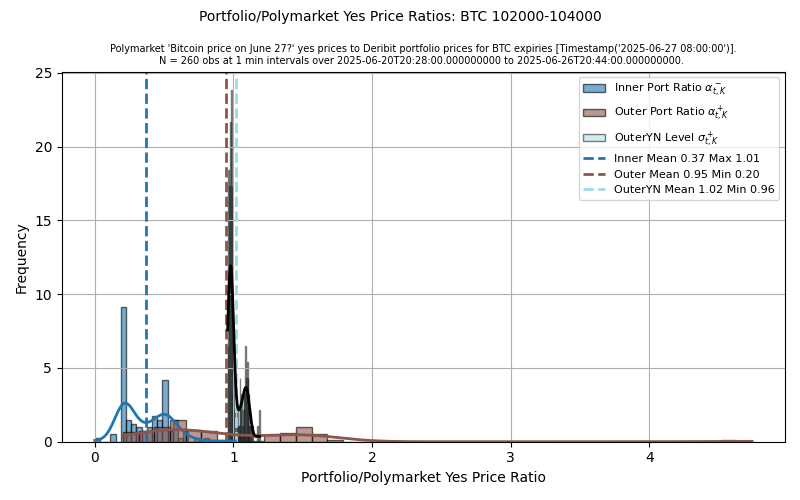
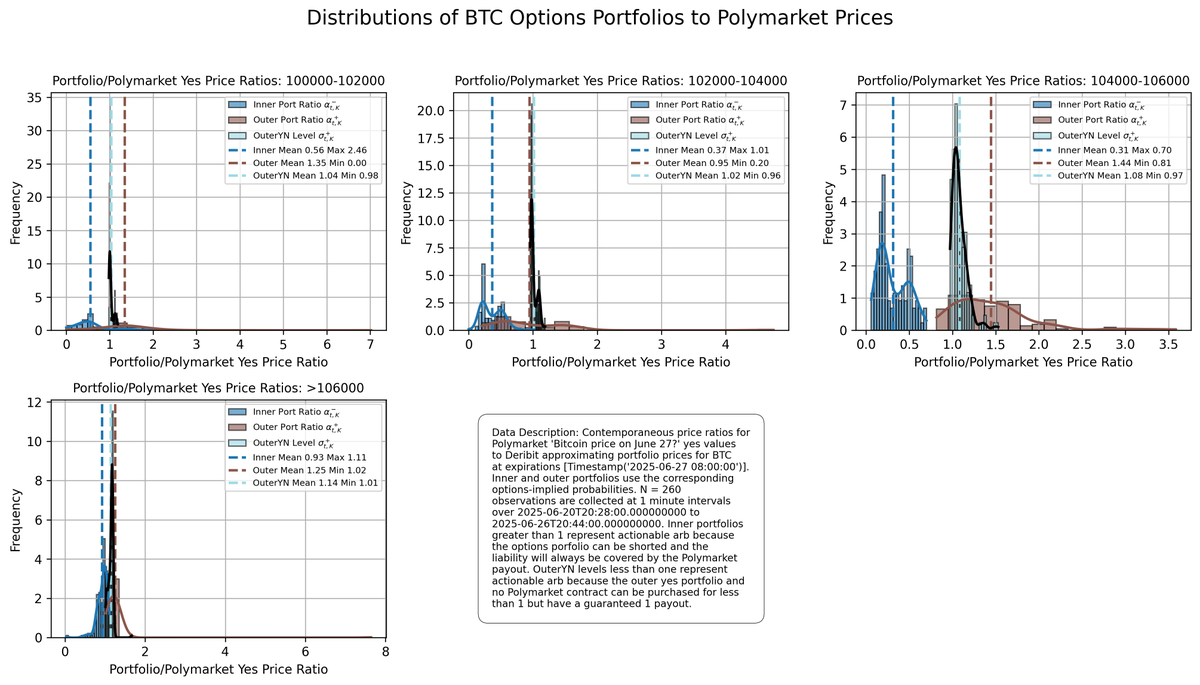
Based on approximating portfolio prices, we see occasional but nontrivial arbitrage opportunities between @Polymarket and @DeribitOfficial. Most prediction markets and options replicating portfolio prices we checked are consistent with no-arbitrage. We're keeping an eye on them and looking at additional markets and venues. These data are from the week of June 22. OuterYN less than one and inner portfolio greater than one are arbitrage opportunities. Full description: x.com/hexshapeshifte…
Shapeshifter tweet mediaShapeshifter tweet mediaShapeshifter tweet media
English
0
2
5
1.3K
Tena 🎒
Tena 🎒@tena_codes·
As a Docker‑heavy dev on macOS, resource bloat and slow startups are real headaches. Apple’s new Containerization in macOS 26 introduces Swift-powered micro‑VM containers—fast, native, isolated. This could redefine Linux workflows on Mac. 🌟 #WWDC25 #DevOps #AppleSilicon
English
0
0
1
146
Tena 🎒 がリツイート
Arx Locker
Arx Locker@arx_locker·
Crypto losses reached $2.2 billion last year — and text-message phishing keeps climbing. medium.com/p/five-ways-to…
English
0
1
1
65
Tena 🎒 がリツイート
Arx Locker
Arx Locker@arx_locker·
Zero-knowledge proofs let you lock crypto, prove the rules are met, and keep balances private. Here’s how the tech is reshaping digital saving—use cases, limits, and what comes next. The breakdown: @arx_locker/the-future-of-zero-knowledge-proofs-in-digital-saving-be9525489527" target="_blank" rel="nofollow noopener">medium.com/@arx_locker/th… #ZeroKnowledge #CryptoSecurity #DigitalSaving
English
0
1
1
95
Tena 🎒 がリツイート
Arx Locker
Arx Locker@arx_locker·
Cyber threats evolve every day. Credentials that aren’t properly protected can expose your entire network. At Arx Locker, we use time-locked encryption so your keys stay safe until you need them. Follow us for practical security insights.
English
0
1
2
45
Tena 🎒 がリツイート
Arx Locker
Arx Locker@arx_locker·
Hello world
English
0
1
2
50
Tena 🎒
Tena 🎒@tena_codes·
Exciting news from Base! Their new Flashblocks tech on the Sepolia testnet slashes block confirmation times from 2 seconds to just 200ms—a 10x boost in speed that's set to redefine blockchain performance. Flashblocks work by streaming preconfirmation blocks every 200ms, offering early confirmations with built-in revert protection. This means transactions are processed almost instantly while maintaining security and integrity. With near-instant confirmations, we’re looking at a new era where unchained gameplay becomes truly responsive, and decentralized exchanges (DEXs) can operate at speeds rivaling centralized platforms—all while keeping fees low. This breakthrough also makes front-running significantly harder. Faster processing and early confirmation help level the playing field, improving trading experiences by reducing the window for manipulative strategies. But that’s not all—Base is also introducing Base Appchains, which offer dedicated block space for high-traffic apps. These customizable Layer 3 chains come with options for custom gas tokens and fee logic, providing scalability tailored to each application's needs. In parallel, Smart Wallet Sub Accounts are on the way. They’re designed to streamline user experience by reducing the number of transaction signatures needed and enhancing overall account security. These innovations mark a pivotal moment for Base, as they blend speed, scalability, and user-centric design. The combined effect could set new standards for decentralized ecosystems, bridging the gap between traditional and decentralized finance. With plans to roll out Flashblocks and Sub Accounts to the mainnet in Q2, the future looks bright for developers and users alike. Base is paving the way for blockchain tech that’s faster, fairer, and more flexible than ever before.
Tena 🎒 tweet media
English
0
0
0
89
Tena 🎒 がリツイート
Brian Armstrong
Brian Armstrong@brian_armstrong·
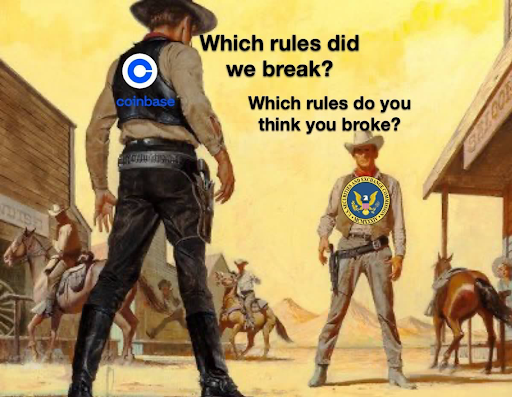
Great news! After years of litigation, millions of your taxpayer dollars spent, and irreparable harm done to the country, we reached an agreement with SEC staff to dismiss their litigation against Coinbase. Once approved by the Commission (which we're told to expect next week) this would be a full dismissal, with $0 in fines paid and zero changes to our business. This is hugely vindicating, especially because many people questioned my decision to engage in litigation with the SEC on this matter in 2023. People told me the courts would give a lot of leeway to the government. They said public market investors wouldn't like it. They said it would take years and cost us tens of millions of dollars in legal fees (which it did). They said the agency would use mafia tactics like trying to pressure other companies not to work with us while the lawsuit was underway (which they did). But I knew a few truths that helped make it an easy decision to fight them in court: 1. The SEC was wrong on the law. They were exceeding the authority given to them by congress by asking us to delist a number of assets that were not securities. We had taken a conservative approach to ensure we weren't listing any securities, and the SEC itself had allowed us to go public in 2021 after reviewing our listing standards in depth. We tried to “come in and register” but it turned out it was a fake offer, as every crypto company discovered. Regulators are supposed to enforce the law, but they can't make up new laws on the spot if they don't like the current ones, or weaponize a lack of clarity in the law. 2. Caving to their demands could have killed the crypto industry in America. The SEC made it clear to us that the only way to avoid litigation was to delist the many assets they falsely claimed were securities. It was a bullying tactic, pure and simple, driven by Gensler's own political agenda. And if we had caved, it would have dramatically limited the scope of which crypto assets were allowed in the US, and pushed the industry further offshore, into the shadows. Never forget how close a few activists in government came to unlawfully killing an entire industry in America! It could have easily gone the other way. Thank goodness the founding fathers created the judicial branch, as a check and balance on executive power. 3. It was the right thing to do for our customers and the industry. At the end of the day, it didn't matter what our chance of success was. I had to stand up for our customers’ and our industry’s rights. I also knew it would serve as a deterrent for future bad actors around the world we may have to engage with, for them to know that we won't be bullied or pressured. We are comfortable engaging in litigation across multiple fronts, indefinitely, while continuing to build. This is business as usual. As Bain in The Dark Knight says, "you merely adopted the dark; I was born in it". Growing up I had a naive view that regulators exist to hold companies accountable. What I realized in this ordeal is sometimes, companies must hold regulators accountable who are painting outside the bounds of the law, to preserve freedom. Accountability can actually happen both ways. At Coinbase, our mission is to increase economic freedom, and I initially thought we could achieve this solely through our crypto products. But I'm increasingly realizing that we can move the needle on economic freedom in the courts and through our policy efforts as well, when we see bad actors in government around the world. We plan to do more of this. I have to give credit here to the Trump administration, for winning the election, and for the departure of the activist head of the SEC, Gary Gensler, who orchestrated this unlawful action along with Elizabeth Warren, and a handful of their lackeys in congress. I feel confident we would have won this case in the courts either way, given our facts were so strong, but it certainly helped accelerate the process and drive accountability. I called out the sketchy behavior of the SEC back in 2021, and I believe this comment turned out to be prescient. I want to give a shout out to all the other crypto companies who fought back with their own lawsuits (we certainly were not the only ones). I want to give a shout out to all the crypto startups who couldn't afford the legal fees, and went bankrupt due to the administration's abusive tactics. Your company may have died, but crypto lives on. Don't stop building. I want to give a shout out to both Democrat and Republican members of congress, who are working hard to ensure America leads on crypto. I know that Gary Gensler and Elizabeth Warren do not represent the entire Democratic party. And I want to give a shout out to all the crypto holders in the US who elected pro-crypto candidates, on both sides of the aisle, to make sure your rights were preserved. It turns out the crypto voter is real, and showed up in the millions. Finally, I expect we'll continue working productively with the SEC on any number of items over the years, just as we do with every agency around the world where we operate. I look forward to the SEC being reformed under Paul Atkins, Mark Uyeda, Hester Peirce, and DOGE, and new more sensible personnel coming into leadership roles. I commend the new leadership that is already in place for working to right this wrong - it's a great step in the right direction, and took courage. Now let's get some crypto legislation passed in the US to finally clarify the rules, and really kick off this next phase of building.
Brian Armstrong tweet media
English
1.8K
2.8K
18K
3.1M
Tena 🎒 がリツイート
Shapeshifter
Shapeshifter@hexshapeshifter·
Shapeshifter is pleased to announce our partnership with @Kinetic_Markets , the leading lending protocol on @FlareNetworks, to provide risk assessment and automation consulting services. As a first step, we put together an overview of Kinetic including a breakdown of how we think about risk assessments, linked at the end of this post. Calibrating Lending Protocol Parameters Several parameters governing risk for lending markets need to be set at the protocol level. Typically parameter values like the per-transaction borrowing limit, collateral factor and reserve factor are set - to a first order approximation - based on practical mechanics like sizes of supply pools, dex liquidity, and liquidation route availability. Once those criteria are met, parameter fine tuning recommendations should be connected to specific objectives. Changing parameter values can have implications for the distributions of outcomes of market participants, like the distributions of liquidation fees or health factors. In this post we’ll focus on the collateral factor. There are several defensible objectives that capture features of the distributions of market outcomes relevant for the collateral factor. We show CVaR for borrower liquidation losses, lender returns and the distribution of health factors, but others are possible. Given the objectives, to assess parameter proposals we can compare objective values at different parameterizations. To evaluate the objectives we built a protocol simulator that uses fitted models from data on price dynamics, borrow and lend dynamics, liquidation dynamics and liquidity dynamics. We fit Poisson-Normal and Jump Diffusion models. These simple models do surprisingly well, but it’s worth emphasizing: the point is not to fit the best model to return dynamics, rather: evaluate a useful economic problem. Once the economic analysis checks out, time to optimize likelihood ratios and buy yourself a third or fourth order correction. To illustrate some of the tradeoffs at play for setting the collateral factors, the first plot shows simulated protocol outcomes for a change in collateral factor for ETH, from 70% to 85%. The red outcome distributions correspond to a “base” case of an ETH collateral factor of 70%. The blue outcome distributions correspond to the ETH collateral factor of 85%. Let’s call that the “alternative” case since it is high for a risky asset. By increasing the collateral factor, the distribution of liquidation penalties shifts right, reflecting increasing liquidation frequencies and increased average liquidation size. The close factors are fixed at 50% across all examples, so for users who borrow up to their collateral factor limit, their average liquidation sizes are larger. The CVaR of the liquidation penalty distribution bumps up by 25%, but may not capture certain critical features of the distribution like the mean or bimodality. The distribution of health factors concentrates slightly left reflecting increased riskiness of borrowing more against collateral from the higher collateral factor. Lender PnL is riskier, captured by the lower Sharpe ratio, but the mean is higher. The next plot shows wider parameter changes - from 55% to 85%. The effect on the distribution of liquidation penalties is amplified. The effect on the CVaR is substantial, with an increase of over 50%. The bimodality almost entirely vanishes. Systematizing this type of analysis for real-time, automated parameter tuning is ongoing. These tools make decisions about parameter recommendations sufficiently fine grained to assess implications of multiple lending protocol user categories, like lenders, borrowers and liquidators. Automation At Shapeshifter we believe an increasing fraction of financial workflows will be delegated to blockchains. We also believe that as competitive forces play out, markets for on-chain risk monitoring and optimization will move toward automation. Assessing incremental costs and benefits of parameter changes based on features of the user outcome distributions should be a component of emerging automated circuits. Another key element of risk monitoring is real-time anomaly detection. There are a handful of things protocols keep their eyes out for ahead of time, like sudden changes in pool sizes or large borrower positions. Beyond these, there are tools for detecting anomalies without having to guess the anomaly ahead of time. The rough approach is to fit a model for the state transitions for the protocol - with a sufficiently rich state specification - and then flag an observed state transition as anomalous if it is sufficiently unlikely to have been generated by the transition model. To capture nonlinearities, autoencoders are commonly used, but the intuition carries over. In a robust automated risk assessment system this type of workflow is probably an important component. There are several giants in on chain lending and risk assessments, to note a few: @compoundfinance, @BenqiFinance , @chaoslabs, @gauntlet_xyz . Our role is to shine a fresh economic lens and to contribute to the evolution of risk monitoring and tuning automation infrastructure. Stay tuned for details about how we are shaping this frontier. Kinetic Markets Review: drive.google.com/file/d/1SckGRw…
Shapeshifter tweet mediaShapeshifter tweet media
English
3
14
30
2.3K
Tena 🎒
Tena 🎒@tena_codes·
Ethereum’s ability to solve this bottleneck will define its future as the dominant blockchain ecosystem.
English
0
0
0
59
Tena 🎒
Tena 🎒@tena_codes·
Some argue L2s don’t contribute enough to the L1, while others point out that affordable scaling is essential for Ethereum to compete with alternative Layer 1s offering cheaper fees. However, as L2s grow, increased transaction volumes could eventually offset reduced fees.
English
1
0
0
56
Tena 🎒
Tena 🎒@tena_codes·
Ethereum Layer 2s are on the brink of a major scalability challenge: Blob space exhaustion. Blobs, temporary storage units critical for data availability (DA), are in high demand but severely limited.
English
1
0
0
87