@oSocode@JolanHuyvaert There were so many applications this year and a very few selected. It is not nice of @oSocode to select those who have already participated. 😪
@rdegges Can you tell me how can I use 'client-sessions' in a cross-origin manner?
I mean how can I set sessions on a static webpage (where user logs in) through API (which logs in the user).
I am using node+express and 'client-sessions'.
a and x both should update. right?
function foo (x) {
x.push(4);
console.log(x);
x=[4,5,6];
x.push(7);
console.log(x);
}
var a = [1,2,3];
foo(a);
console.log(a)
//THIS IS THE OUTPUT
VM23:3 (4) [1, 2, 3, 4]
VM23:7 (4) [4, 5, 6, 7]
VM23:12 (4) [1, 2, 3, 4]
undefined
@getify
@getify
What happens if we do this (see "marked")?
if(!Obj.create)
{
Obj.create=function(o){
function F(){}
F.prototype=o;
return F(); // "mark" what happens here (I am not returning new F();)
};
}
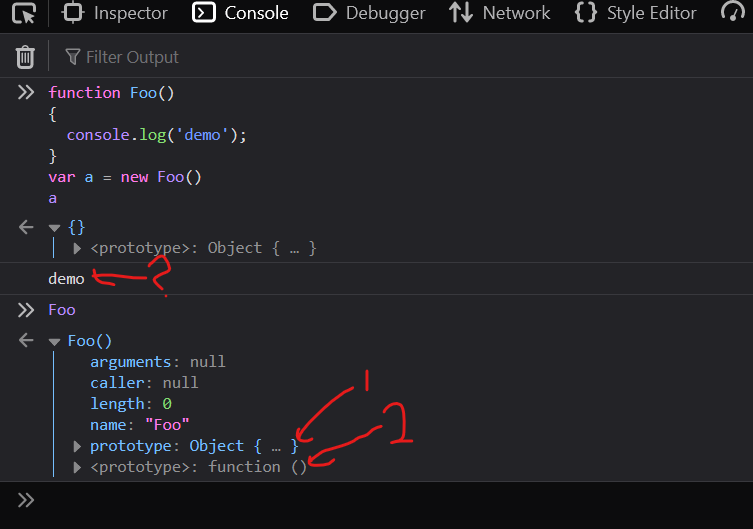
@uInstinctdev I dunno for sure what Chrome is doing there, but here's my guess: "prototype" is the public `.prototype` property of that function, whereas "<prototype>" is the internal "[[Prototype]]" linkage of that function to its __proto__
@getify Okay.
I got it <prototype> is the chain prototype linkage which can be traversed while prototype is just the property on Foo().
Well, it's not chrome but Firefox Developer Edition. :P