When civilians are harmed during war, moral judgment is obvious. It's bad and enraging, full stop. It doesn't matter who did it or where it happened. This is a violation of international law and thus is, in principle, universally condemned.
Or is it?
A large body of research (as always, based mostly on Western samples) indeed shows that wartime violations reduce public support for military action and carry reputational costs for aggressors (Eichenberg, 2005; Dill & Schubiger, 2021; Morse & Pratt, 2022). In the West, legality is expected to prevail (Nuñez-Mietz, 2018). But, as it turns out, these attitudes depend on how publics around the world interpret violations. And outside the West, the picture may look different.
Take India — the world’s largest democracy. During the Russia–Ukraine war, India abstained in multiple UN votes condemning Russia, despite what seemed like international consensus (UN, 2022). Public opinion about the war has also been more divided than in the U.S. or Europe (Pew, 2023). From a Western lens, this seems puzzling. But maybe we’re just asking the wrong question.
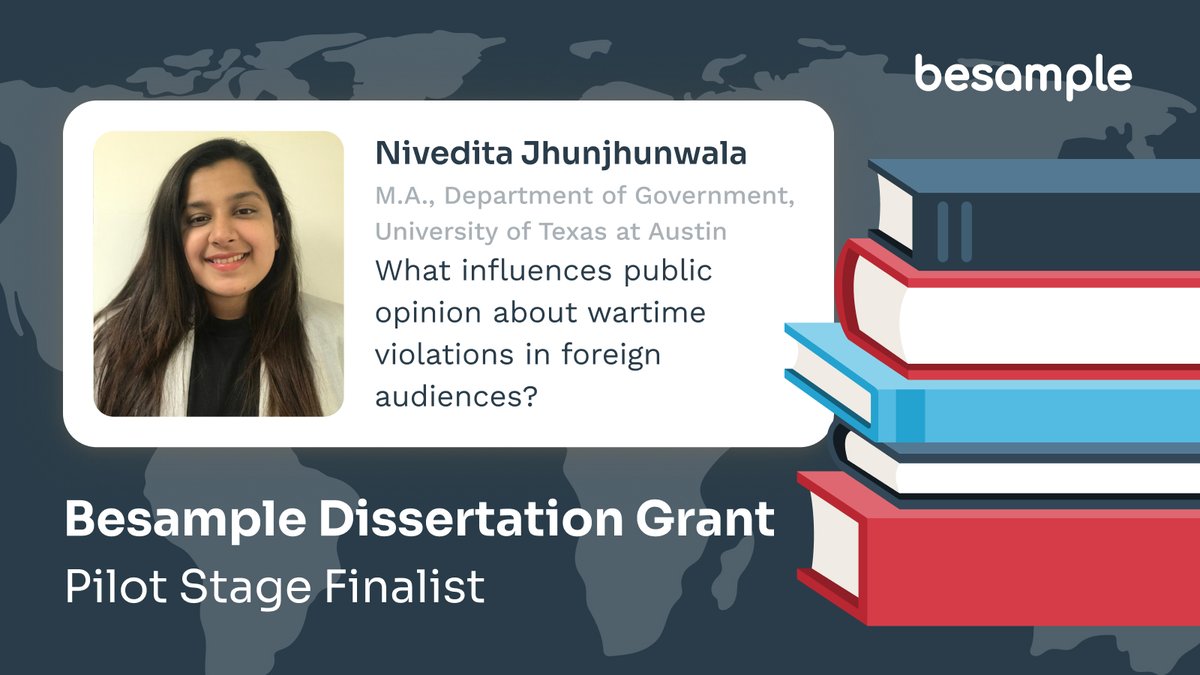
Besample Dissertation Grant finalist, Nivedita Jhunjhunwala (@NiveditaJhunjh2), is working at The University of Texas at Austin (@UTAustin) with Dr. Terrence Chapman, studying public opinion about wartime violations. Having grown up in India and trained in Western academia, Nivedita saw how differently conflicts are discussed across these environments. Western debates emphasize universal legal principles. Indian discussions often incorporate strategic autonomy, history, and skepticism toward selective enforcement.
So are humanitarian norms truly universal — or filtered through national identity and geopolitics?
To answer this, Nivedita is running a large-scale survey experiment in India. Participants evaluate conflict scenarios where she varies:
• type of violation (e.g., civilian harm vs. site destruction)
• countries involved
• whether the act is explicitly labeled illegal
This allows her to test whether moral condemnation reflects universal principles — or depends on who did what to whom. This is a question that may feel obvious until you realize we don’t actually know the answer beyond the West.
We're proud to support Nivedita in her dissertation research and look forward to seeing what she discovers!
#PhDResearch #PhDGrant #CrossCulturalResearch #GlobalResearch #BesampleDissertationGrant
English