
Debit 리트윗함
Debit
13.4K posts


Debit
@Debit319
rejoined Twitter after Elon. Regardless Love God, my family & my country. Believe in the Rule of Law and Accountability. Pray for our country daily.
가입일 Ekim 2022
356 팔로잉522 팔로워


@C_3C_3 @AAGDhillon - A proven fighter! She put together a great team at @CivilRights that has been repeatedly WINNING!
English
Debit 리트윗함

🚨 JUST IN: JD Vance CONFIRMS the Trump admin has abolished the Biden admin rule that legalized SOME fraud if it's "small enough"
Fraud prosecutor AAG Colin McDonald will now target any and ALL fraud, anywhere, no matter how big or small
GOOD! 🔥
English
Debit 리트윗함

Debit 리트윗함

No Kings, but we are taking away your historic right to elect the chief law enforcement officer for your county
Anthony Mixer@AnthonyMixerWA
🚨BREAKING🚨 @GovBobFerguson is scheduled to sign the sheriff decertification bill at 9:30 am, Wednesday. Olympia wants all sheriffs to answer to their whims rather than you the voters. You no longer have much of a voice in electing your sheriff. #waleg
English
Debit 리트윗함

🚨 BREAKING: The FBI is now ON THE GROUND in California arresting hospice fraudsters — some of which who have billed Medicaid MASSIVE amounts of money for fake patients
Others gave KICKBACKS to those pretending to be dying.
LOCK THEM ALL UP!
English
Debit 리트윗함

Today, the @CivilRights Division sued Idaho for refusing to grant @TheJusticeDept access to its voter rolls. Transparency and accountability are essential to public trust, and we look forward to seeing Idaho in court!
justice.gov/opa/pr/justice…
English

Bill Gates is calling for biometric digital IDs to be tied directly to your bank account and payment systems so they can monitor your health, track farmers, and manage climate policy. That is exactly the kind of centralized control free people are supposed to reject. When your identity, your money, and your daily life are all linked in one system, you are no longer free. #wakeup
English
Debit 리트윗함
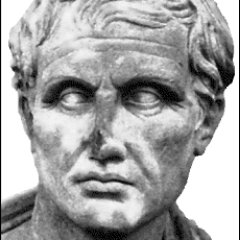
This gentleman wrote the most precisely accurate and well-reasoned legal argument regarding Trump's recent EO on voting that I have seen ANYWHERE, and here is what Wikipedia has to say about him:
"David Clements is a former American lawyer and a former assistant professor at New Mexico State University. He is known for his advocacy of election conspiracy theories in the United States."
Read that twice.
"Advocacy of election conspiracy theories."
Bastards.
If a website can get haunted by a ghost, Josef Goebbels is living in the Wikipedia HTML code somewhere.
David Clements@theprofsrecord
Wrong. The Elections Clause gives states the initial role to set time, place and manner, but expressly authorizes Congress to enact nationwide rules for federal elections (House and Senate races), including voter registration, list maintenance, fraud prevention, and ballot procedures. The Supreme Court has interpreted “manner” broadly to include “notices, registration, supervision of voting, protection of voters, prevention of fraud and corrupt practices,” etc. The Help America Vote Act imposes mandatory minimum federal standards on states (e.g., statewide computerized voter registration lists, provisional ballots, and election administration improvements) and provides federal grants (“requirements payments”) explicitly conditioned on compliance. States must submit plans showing how they meet these standards to receive funding. The National Voter Registration was also enacted under the Elections Clause. It mandates that states maintain accurate voter rolls (“list maintenance”), offer registration at certain agencies, and accept a federal mail-registration form. Courts have upheld NVRA provisions as valid under the Elections Clause precisely because they target voter eligibility verification and roll accuracy. Trump’s EO explicitly cites both HAVA and NVRA as authority. It does not create new substantive rules from scratch; it directs federal agencies to implement and enhance existing federal statutory requirements using federal databases (SSA records, DHS’s SAVE program). Moreover, Congress’s power under Article I, Section 8 to tax and spend for the general welfare includes the ability to attach conditions to federal grants to states. This is classic conditional spending, upheld in South Dakota v. Dole (1987): conditions must be unambiguous, related to the federal interest (here, integrity of federal elections), and not coercive. - HAVA already does exactly this—grants are withheld or conditioned on states meeting federal election-administration standards. - The EO (Section 5) authorizes withholding “federal funds from noncompliant states/localities where authorized by law.” This is not a new commandeering of state legislatures; states can decline the funds (and the attached conditions) if they wish. Precedent confirms Congress (and the executive administering congressional appropriations) can use the purse to encourage compliance without directly dictating state election codes. Finally, Trump’s EO’s core mechanisms operate through federal entities like the post office, not state legislatures: - USPS rulemaking directs the Postmaster General to require barcoded, trackable “Official Election Mail” envelopes and to transmit ballots only to voters on the federal/state-verified Mail-In/Absentee Participation Lists. USPS is a federal agency; the President may direct its operations via executive order. States are not forced to change their own mailing processes—they simply cannot use federal postal service for non-compliant ballots if they want the service. This avoids the anti-commandeering doctrine (Printz v. United States, 1997), which prohibits the federal government from forcing state officials to enforce federal law. Here, the federal government is regulating its own property (mail) and funds. Once Congress has acted (via HAVA/NVRA), federal requirements preempt conflicting state practices for federal elections. The democrats are toast.
English
Debit 리트윗함

I want to say something about politicians in your area. I see lots of posts encouraging voting for native or long time residents only.
I saw that on my recent post about a debate of candidates for Rep. Byron Donalds' seat.
I have seen it on posts regarding Steve Hilton in California.
I have no place that I call home. I always get stumped when someone asks me where I'm from. I was raised in a military family, married a military man, and have moved around all my life. I see it as providing a different perspective.
A native in your community is just as apt to not be a good candidate as a transplant. My husband saw it when we lived in North Carolina. He was chairman of the planning and zoning boards in Mills River, and the good ole' boy network was a corrupt group who wanted laws passed so they could sell their land for top dollar.
And vice versa, a transplant may bring detrimental ideas, but it's not a given.
Vote for the candidate who most closely aligns with your values. And do not vote for a RINO. Vet them! It isn't only transplants destroying your community!
English
@JoeLombardoNV
You’re on this list.
We need secure elections!
We need the SAVE ACT in Nevada!
🇺🇸RealRobert🇺🇸@Real_RobN
•Alabama — Kay Ivey — Where are you? •Alaska — Mike Dunleavy — Where are you? •Arkansas — Sarah Huckabee Sanders — Where are you? •Florida — Ron DeSantis — his right here 👇👇 •Georgia — Brian Kemp — Where the fuck are you? •Idaho — Brad Little — Where are you? •Indiana — Mike Braun — Where are you? •Iowa — Kim Reynolds — Where are you? •Mississippi — Tate Reeves — Where are you? •Missouri — Mike Kehoe — Where are you? •Montana — Greg Gianforte — Where are you? •Nebraska — Jim Pillen — Where are you? •Nevada — Joe Lombardo — Where are you? •New Hampshire — Kelly Ayotte — Where are you? •North Dakota — Kelly Armstrong — Where are you? •Ohio — Mike DeWine — Where the fuck are you loser? •Oklahoma — Kevin Stitt — Where are you? •South Carolina — Henry McMaster — Where are you? •South Dakota — Larry Rhoden — Where are you? •Tennessee — Bill Lee — Where are you? •Texas — Greg Abbott — Where are you? •Utah — Spencer Cox — Where are you? •Vermont — Phil Scott — Where are you? •West Virginia — Patrick Morrisey — Where are you? •Wyoming — Mark Gordon — Where are you?
English
Debit 리트윗함

The value of your citizenship is diminished when your government either:
(A) gives citizenship away too freely, or
(B) allows others to enjoy the benefits of citizenship—like voting in U.S. elections—without having to become citizens
We need real limits on birthright citizenship
And we need to pass the SAVE America Act
English
Debit 리트윗함

After today’s arguments at the Supreme Court of the United States, one thing is crystal clear: Congress can’t keep sitting on its hands.
When justices are openly grappling with questions that could reshape the rights, safety, and future of Americans, lawmakers don’t get the luxury of waiting to “see what happens.” Their job is to act, decisively and immediately, to protect the people they represent.
If there was ever a moment for urgency, this is it. Every Republican member of Congress should be back in D.C. right now, working to pass laws that safeguard American citizens and prevent irreversible damage.
History won’t judge hesitation kindly. It will remember who stepped up — and who stayed silent.
English
Debit 리트윗함

Wait until @AGPamBondi and @HarmeetKDhillon drop the bomb on the cheaters:
If you HAVEN'T given your voter rolls to the DOJ Civ. Rights Div. for verification yet, your STATE is not ELIGIBLE to have mail-in ballots counted in the next FEDERAL elections.
Mail-in ballots for the 2026 midterms - what few there are going to be - WILL have a bar code that makes them trackable.
Your 'election' NGOs are now shit-out-of-luck.
Mail-in ballots are ONLY gonna count towards federal elections for President, Senator or House Rep in DC only IF that mail-in ballot was sent to a verified voter at at a verified address.
Your 'election' NGOs like the ones Stacy Abrams got $2 billion for can sit out there in the ether frantically submitting requests that thousands of mail-in ballots get sent to vacant lots or an abandoned building until the cows come home.
NO VERIFIED VOTER FROM THE VOTER ROLLS? NO VERIFIED ADDRESS? THEN **NO**, YOU CAN'T F**KING HAVE A MAIL-IN BALLOT WITH A BAR CODE SENT TO YOU. Losers!
If you **pay attention** to the moves Trump is making, as he LITERALLY forces the GOP UniParty in our Congress to CONTINUE EXPOSING WHO IT REALLY WORKS FOR, you can SEE what's coming.
CHECKMATE.

TheDebriefing17@TheDebriefing17
🤔THE ONE BIG THING MOST PEOPLE WILL MISS The mail-in ballot barcode provision is the spine of this EO. It sounds technical and boring "Intelligent Mail barcodes" but what it actually creates is a closed-loop pre-authorization system for mail voting. 👉You don't get a ballot mailed to you unless you're on a list the federal government has already verified. 👉That's a structural change to how American mail voting has ever worked. Every prior system sent ballots based on state voter rolls. This one requires federal pre-clearance.
English
Debit 리트윗함
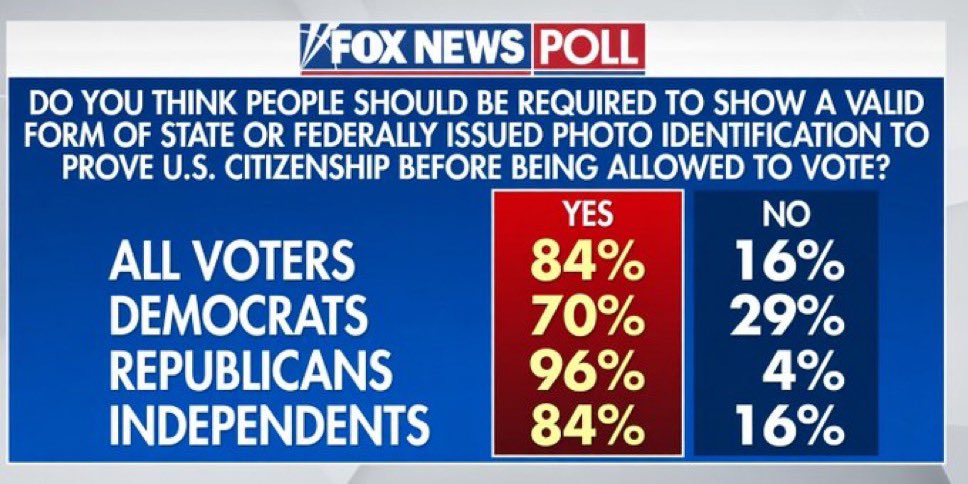
The SAVE AMERICA ACT is uniquely popular with all Americans.
Voter ID is off the charts popular.
When was the last time 84% of Americans agreed on anything?
All Americans: 84%
GOP: 96%
Indies: 84%
Dems: 70%
A corrupt Congress is the only explanation for it not passing.
English
Debit 리트윗함
HOLY COW!
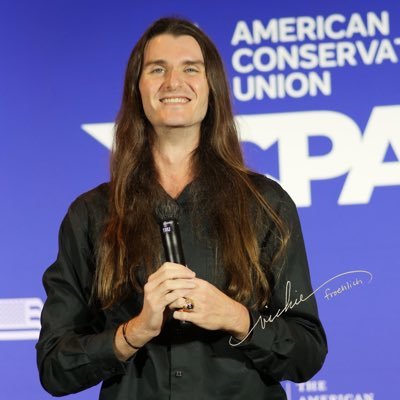
A PACKED house in Virginia Beach, VA,
joined by Congresswoman @JenKiggans.
This crowd is fired up to vote 👉NO👈 on Tuesday, April 21st.
The overwhelming majority of these voters have yet to vote!
English
Debit 리트윗함
I wonder if Senate Majority Leader Thune realizes that he’s going to lose several allies in the Senate this November
b/c of his inability to pass the SAVE America Act.
Peacefully.
CC: @LeaderJohnThune
English