General Election Watch UK
1.2K posts

General Election Watch UK
@GElectionWatch
All the latest news, stories and gossip in the run up to the UK General Election.

London, England 가입일 Nisan 2023
217 팔로잉1.1K 팔로워
General Election Watch UK 리트윗함

In answer to accusations of austerity CX says: Day-to-day spending reduced by £6.1bn by 2029-30. & will now grow by an av of 1.2%/yr above inflation…against 1.3% in autumn. "Day-to-day spending will increase in real terms, above inflation, in every single year of forecast. And in the Spending Review Period, apart from the reduction in ODA…day-to-day spending across government has been fully protected" > we get the details of the spending cuts in June at Spend Review
English


Shame on @bbcnickrobinson and #r4today for hanging on the word of bottom feeder Rupert Soames and his evidence-free proclamations. Both CBI and Serco have such damaged reputations yet treated like Moses. Awful.
English

Nick Robinson is humiliating Robert Jenerick by exposing his hypocrisy #r4today
English

@elonmusk Been waiting for a tweet like this. Some takes will see this as reactionary, and that Farage now has a problem. That would be to misunderstand what is a deliberate attempt to replicate the US model here. Who is sneering at @carolecadwalla now?
English
General Election Watch UK 리트윗함

The 1,475 silhouettes represent fatalities under British command on June 6th, 1944.
They include two nurses, Sister Mollie Evershed and Sister Dorothy Field, who died while helping to save 75 men from the hospital ship SS Amsterdam.
#LestWeForget
📷 Polly Stock


English
General Election Watch UK 리트윗함

@Peston Robert why not mention that Hunt was clearly setting that as a trap? But no, mention 'markets could react' instead. Can't under analyse the politics of fiscal rules. As you know.
English

By targetting the "snuffle", Rachel Reeves is creating "headroom" to borrow an additional £50bn to £60bn every year - which is more than the unfunded borrowing that spooked investors in Liz Truss's mini budget and led to a fiscal crisis.
So whether the chancellor is being sensible or reckless by changing the debt target in next week's budget will be all about the associated "guard rails" or constraints she puts in place.
I assume the reaction of many of you to all that is "you what?".
So this is why the snuffle shuffle matters. It is about whether Reeves is creating space for the government to borrow to fund productive investment that will boost economic growth that makes us richer, or whether she is recklessly robbing Peter to pay Paul at a time when the national debt and interest payments are high.
Now for some definitions.
The "snuffle" is "public sector net financial liabilities", or PSNFL ("snuffle" with a silent "p", as in "Psmith").
Overnight in Washington, at the IMF meetings, the Chancellor signalled she would be targetting PSNFL in her duality of fiscal rules, in place of the inherited target, which is public sector net debt excluding the Bank of England.
The simple way to understand the difference is that public sector net debt is gross debt minus some super liquid investments whereas PSNFL subtracts a greater range and larger stock of assets.
PSNFL is not a brand new concept. It is already measured by the Office for National Statistics. And like all these accounting or social constructs, its importance lies in whether it helps to keep the government honest or is a tool for dodgy ministerial cover ups.
The problem with the target Reeves inherited from her predecessor Jeremy Hunt is that it gives her almost no "headroom" to borrow to fund investment.
PSNFL creates this headroom - as if by miracle - in two ways.
1) It includes the £20bn annual flow of loans to students as both an asset and a liability, whereas in PSND ex Bank those loans are treated only as a liability.
2) It excludes government losses on the Bank of England's sales of government debt known as gilt-edged stock.
The impact of including the value of the student loan book is the more important of these two.
Together they represent the biggest share of an increase in the capacity of the Treasury to borrow every year to the tune of between £50bn and £60bn, according to the Resolution Foundation and the Institute of Fiscal Studies.
These are big bucks. And what matters is that this is quite literally magic money. It is a different way of seeing the government's liabilities, but the liabilities are in all economic reality unchanged.
The question is whether seeing the liabilities as a snuffle is more rational than the current picture.
I would say yes, to an extent.
On the positive side, adoption of PSNFL will allow Reeves to invest billions of pounds every year - in transport, and power generation and electricity networks - through her National Wealth Fund and GB Energy, and in partnership with the private sector, relatively unconstrained by her debt target.
The reason is that under the PSNFL definitions, the value of equity investments in private companies is deducted from debt.
However if the government were to own 100% of an investment project, in the way it typically does, then the value of that investment would not be netted off PSNFL. Or to put it another way, adopting PSNFL does not allow for an unlimited investment bonanza.
It creates space for investment, but constrained space. As I said at the start, moving to snuffle gives the chancellor the means to begin the reversal of decades of too-low public sector investment. But the recovery won't happen overnight.
She won't have a bottomless purse, and - because of her second fiscal constraint, that current spending must in time only be funded by taxation (probably by the fifth year of the fiscal forecast) - there will be nothing like a glut for public services. 1/2
English

Don't get angry often but the water companies' PR man is an insufferable prick. Water companies have been creaming dividends and ruining our rivers. #r4today
English

The big questions.
Only one answer, though - got to go early before the scones run out.
National Trust@nationaltrust
Half-term is here, the perfect time to catch autumn at a National Trust property. But the big question is do you hit the café at the start or the end of your visit?
English

You won’t bee-lieve the stunning image from Greys Court @southeastNT in today’s Guardian 👀🐝👇
Think you’ve got a better nature pic from a visit? Tag us!📸
brnw.ch/21wNTvV
English

The cabinet being in open revolt this morning is the price Labour pay for their election strategy. @Jeremy_Hunt will be feeling pleased with himself.
English
General Election Watch UK 리트윗함

The Chancellor of the Exchequer has just told my colleague Joel that if - as expected - she increases what employers pay to the government in national insurance that would be consistent with the Labour Party's manifesto promise not to "increase national insurance".
Rachel Reeves's argument is that the party meant only the national insurance paid directly by employees, not the national insurance that employers are obliged to pay on behalf of their staff.
She implies that we should all have been prepared for a possible rise in employers' NI because the manifesto qualifies its pledge not to increase this tax on income with the caveat that a Labour goverrnment "would not increase taxes on working people".
In other words, Reeves is insisting that we should all have known that increasing employers’ NI could be on its way under a Labour government because - on her definition - employers' NI is not a tax on working people.
She seems to believe that a rise in employers' NI would hurt only the owners of the business.
Reeves ignores that many employers would attempt to recoup this increased employment cost by limiting pay rises.
Alternatively if Reeves' goes her seemingly preferred route of levying NI on the pension contributions made by employers for their employees, employers are bound to respond by freezing those pension contributions, or cutting them where they are above the statutory minimum.
Any such response would hurt working people. It would have a clear and harmful impact on their future pensions, their income in retirement.
In economic terms, putting up employers' NI is unambiguously the quacking duck of an attack on working people. It only quacks slightly less loudly in politics if most voters expect all politicians to play fast and loose with the commonsense meaning of manifesto commitments.
Reeves and Starmer desperately need the many billions of pounds that would be raised from this NI rise to help fix public services. But if on 30 October they announce it, as I expect, they won't achieve their aim of restoring trust in what ministers say.
English

@RobertJenrick Political opportunism only works when it's not so blatantly obvious.
English

It’s leave or remain. I’m for leave.
The Sun@TheSun
'The ECHR isn't working - ALL Tories will have to back leaving under my leadership,' Robert Jenrick reveals on #NeverMindTheBallots. Watch the full show, hosted by @MrHarryCole, on The Sun's YouTube channel: @thesun/videos" target="_blank" rel="nofollow noopener">youtube.com/@thesun/videos

English

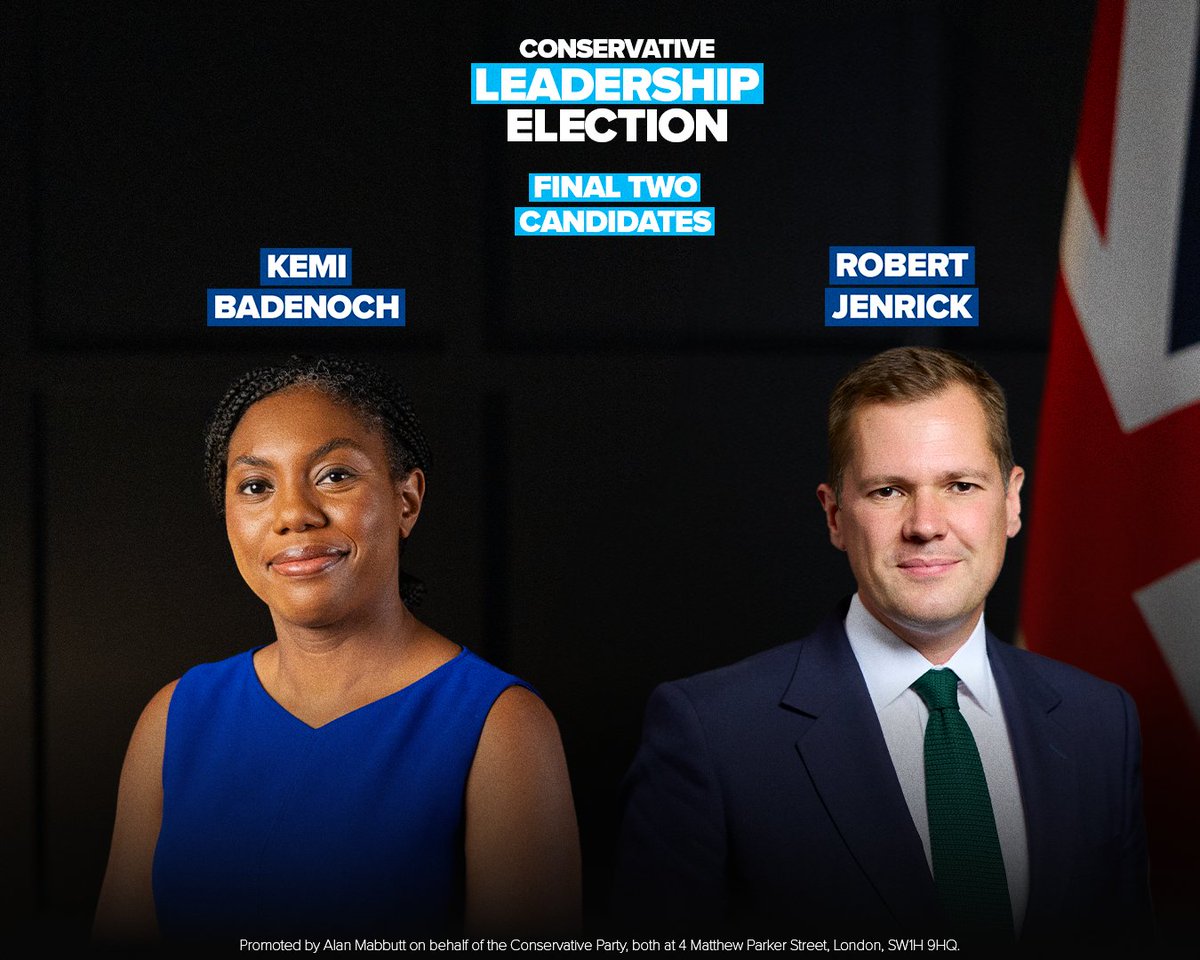
The final two candidates for the Conservative Party Leadership contest have been confirmed as @KemiBadenoch and @RobertJenrick 👇

English