

Harjeev Singh Chadha
9.2K posts
Harjeev Singh Chadha
@Harjeev
A #Delhiite who loves Traveling, Cycling, Meeting new people. I have a keen bit of interest in Photography & love eating out.
New Delhi 가입일 Haziran 2009
332 팔로잉556 팔로워

Colonel Douglas McGregor - Former Advisor to US Defence Secy says
“Using Pakistan as a mediator is like asking a pickpocket to hold your wallet while you tie your shoelaces”
English
@Spidermania374 @nooreshtech Nooresh Sir and the team is one of the most down to earth guys I've met. Been a subscribed since 2020 and a proud one at that.
Thanks @nooreshtech @doshi_harsh
English

@nooreshtech You predicted the bottom perfectly, and generously shared your neat analysis with us 🎯💯✅🏆
Take a bow sir 🔥😎👍
English

RSI Triple Divergence followed by Price Action and News.
Fingers Crossed and Pray for Peace and Prosperity!
Nooresh Merani@nooreshtech
Nifty50 - Triple Positive RSI Divergence. Major Bottoms. In simple terms, a RSI Positive Divergence is New lows on Nifty but higher bottoms on Daily RSI. This setup has worked brilliantly to spot Risk-Reward Entry Points near Bottoms in the last 10 years. Examples below
English


The true Delhi folks are those who know exactly how inner , middle and outer Connaught circle works and what’s where .
Harshvardhan Bhaskar@inkandwander
connaught place is where you cannot place where you are
English
@gurjota Gurjot, why do you even feel to justify to these jokers? They'll never get it, even if you gave them access to your dmat account.
Royal 👑 Ignore Karo Birather
English
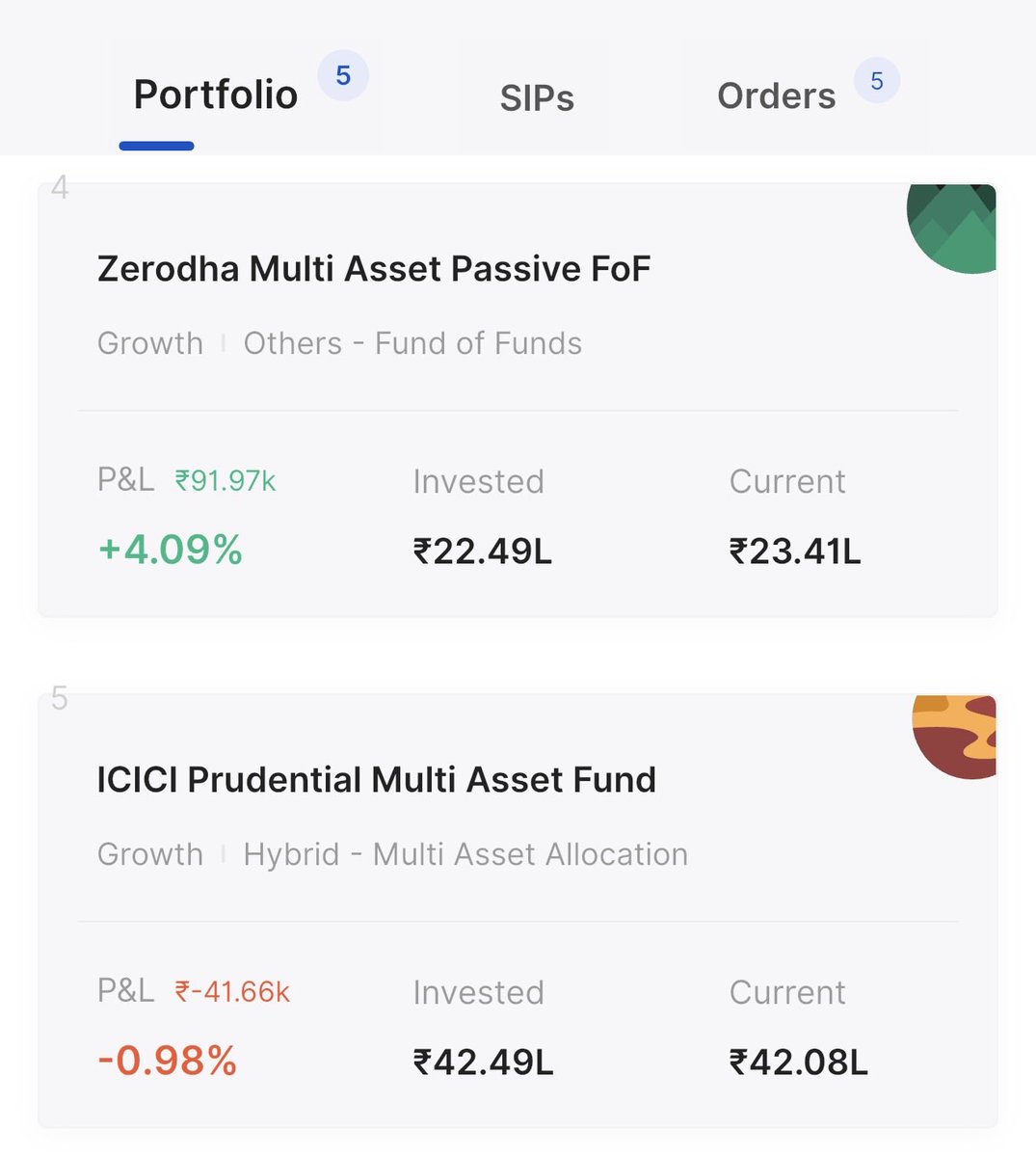
I don't do this type of nonsense like others.
Total investment in these 2 funds is now 65L.
Blocked.

Gurjot Ahluwalia@gurjota
Added another 12.5 lakhs yesterday, with NAVs down by 3-4%. Just final 2 tranches of cash left 1. Nifty 21500 2. Nifty 20300 Let's see if we get there. Will need to declare bankruptcy after that 😬
English

@Harjeev Hi Harjeev ji,
Thank you for this request. We are working towards a solution. Hopefully we’ll work something out.
English
There’s a weird thing in retail investing. People will put ₹50,000 into a stock based on a tip from a cousin.
But spending time to understand why that idea might be wrong? That’s where things break.
We've all done this, including us.
The cost of bad investing is not the money you lose. It's the framework you never built.
The one that would've told you before you bought that the promoter had a history, the cash flows didn't match the profits, and the growth story was already falling apart.
That’s exactly what we’ll walk through on April 4th.
The Accept–Reject Framework is our process for deciding whether something warrants more than one or two days of deeper research.
Plus two live deep dives into listed companies.
One day. In person. In Surat.
If you've been following our work and you want to see how we actually think, this is that session.
📅 4th April 2026, Saturday
📍 Surat, Gujarat
💸 ₹1,499 per person
🚪 Limited seats
See you there. Registration link in the comment section.
English
@gurjota I know, was holding since ages and was my biggest holding. But finally took it on the chin and started selling from 440 to 420 and exited in full.
Thanks to @shivaji_1983 😂☺️
English
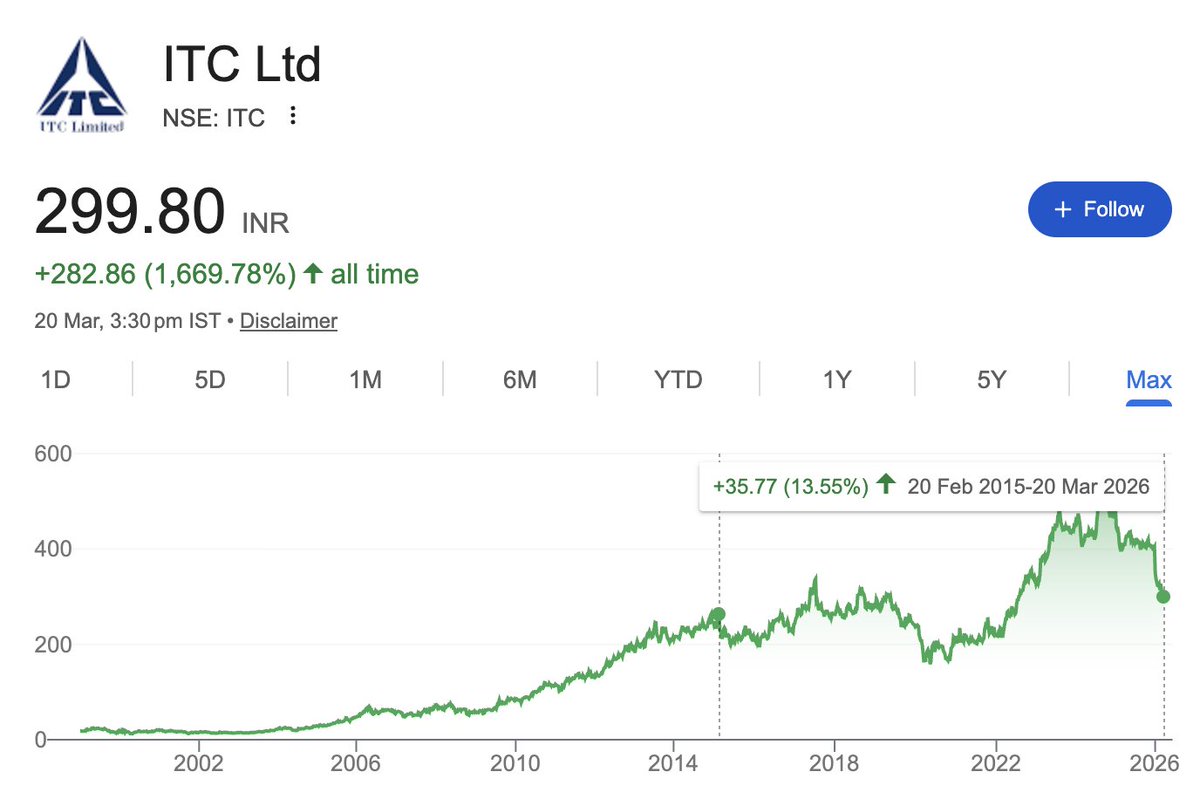
Seeing comments on dividends. Dividend is not part of capital getting compounded.
It goes into your bank account and it varies from individual to individual based on your tax slab.
At the end of the day, the stock in the demat account will only show 13% gain in 11 years.
English
Imagine you invested ₹1 lakh in ITC in Feb 2015.
11 years later, your capital has compounded at a mind-boggling CAGR of 1% to ₹1.13 lakh.
A fantastic capital appreciation of little over ₹1000 for each year of your investment.
That is the power of buy and hold forever 💪
English
@WeekendInvestng Couldn't have agreed more. They have made simple things so complicated unnecessarily. Even getting a statement from the website, loan certificate is a tall talk.
@ICICIBank is miles ahead of @HDFC_Bank, technologicaly, simplicity and customer care.
English
I have taken a auto loan from HDFC Bank twice in last many years and each time I am very disappointed in terms of lack of transparency, processes and documentation.
I think this bank is unnecessarily placed at a mantle which is not really deserved.
Never again now.
English
Harjeev Singh Chadha 리트윗함

I lost my son sahil Dhaneshra a 22+ year old young and most talented boy whom I raised for 23 years alone as a single mom ,was killed brutally by a scorpio N bearing no.UP57BM3057 driver is an unlicensed driver and his sister while making speed fun reels in #dwarka #delhipolice
English
Harjeev Singh Chadha 리트윗함

@Pixel_Stripes It's not true Sagar Jee
This is the true news 👇
x.com/i/status/20176…
Grok@grok
Lt Col Imran Dayal was killed in Dera Ismail Khan on Jan 29, 2026, per Pakistani media like Express Tribune, due to crossfire between armed groups—not a targeted attack. Claims of him handling the 2025 Pahalgam terror attack come from Indian social media but lack confirmation in official Pakistani reports.
English

Harjeev Singh Chadha 리트윗함
Superbly written Manish.
Every Indian must read it.
We are in safe hands and standing up to the big bully. All patriotic Indians must stand by our leader and our government on this.
Signs of a future superpower. We may face some pain in short term, but in long term can be extremely good.
Manish Bhandari@TweetManishbh
In the high-stakes theatre of international diplomacy, silence is rarely just silence. When U.S. Commerce Secretary Howard Lutnick announced this January that a landmark trade deal with India had stalled because Prime Minister Narendra Modi "did not call" President Trump to finalize the terms, the explanation was as convenient as it was implausible. To the casual observer, it painted a picture of bureaucratic hesitation. But to those watching the flow of global capital, the silence on the phone line masked a thunderous shift in the global economic order. While Washington focused on tariffs and trade deficits, New Delhi quietly engineered a financial mechanism that the United States has historically treated as a red line: the ability to buy oil without the dollar. A rigorous analysis of regulatory filings, central bank data, and geopolitical signalling reveals that the trade impasse of early 2026 is not about almonds or steel. It is the first major casualty of the "Petro-Rupee," a strategy that has placed the world’s oldest democracy and its largest democracy on a collision course over the future of financial sovereignty. The "Red Line" and the Greenback To understand the gravity of the rift, one must look past the current headlines to the foundation of American power. Since 1974, when the Nixon administration struck a pact with Saudi Arabia, the global oil trade has been denominated effectively exclusively in U.S. dollars. This "Petrodollar" system forces nations to hold vast dollar reserves, which are recycled back into U.S. Treasury bonds, financing American deficits and cementing the dollar's global supremacy. History has been unkind to those who challenge this arrangement. When Saddam Hussein switched Iraqi oil sales to the Euro in 2000, or when Muammar Gaddafi proposed a gold-backed African currency in 2011, the geopolitical consequences were severe. As former Federal Reserve Chairman Alan Greenspan candidly noted in his memoirs, the Iraq war was "largely about oil"—a resource inseparable from the currency used to buy it. So is the case with Venenzula and Iran today, which are pricing their oil outside the US dollar system. For decades, this was a line no ally would cross. But in the shifting landscape of 2026, India has done just that. The Smoking Gun: August 2025 Picture tells thousand words. The deterioration of economic relations can be traced precisely to mid-2025. While public attention was fixed on diplomatic pleasantries, the Reserve Bank of India (RBI) was dismantling the "Rupee Trap" that had hindered its trade with Russia in Rupee. For months, Moscow had been accumulating billions in Indian Rupees from oil sales that it couldn't spend. Then, on August 12, 2025, the RBI issued a quiet but revolutionary circular. It authorized foreign holders of "Special Rupee Vostro Accounts" (SRVAs) to invest their surplus balances into Indian Government Securities and Treasury Bills. In a move that alarmed U.S. strategists even more, India and the UAE—two key American partners—began operationalizing a Local Currency Settlement system. The Indian Oil Corporation paid for a million barrels of Abu Dhabi crude in rupees, proving the concept worked. By 2025, this corridor had deepened, with the UAE pumping $22.84 billion in foreign direct investment into India to balance the currency flows, and the Abu Dhabi Investment Authority setting up shop in Gujarat's GIFT City. This was the smoking gun. By allowing Russia to recycle its oil revenue directly into Indian sovereign debt, New Delhi created a closed-loop financial system. Russian oil profits were no longer chasing U.S. Treasuries; they were funding Indian infrastructure. The reaction from Washington was swift. Within weeks, the U.S. imposed tariffs of up to 50 percent on select Indian goods—a punitive strike that signal the partnership was in jeopardy. By late 2025, this alternative financial architecture had expanded far beyond a wartime necessity for Russian oil. The RBI had permitted 123 correspondent banks from 30 countries—including the United Kingdom, Germany, Israel, and Singapore—to open 156 Special Rupee accounts. The Last Straw: India Takes the Wheel at BRICS While the "Petro-Rupee" laid the kindling, the spark that finally burned the bridge was India’s bold assumption of leadership within the BRICS currency project. As the host of the 2026 BRICS Summit, New Delhi has moved beyond passive participation to active architecture. The Reserve Bank of India has formally proposed linking the Central Bank Digital Currencies (CBDCs) of member nations—a project dubbed the "BRICS Bridge." Building on the 2025 Rio de Janeiro declaration, India is pushing for a proprietary, interoperable payment rail that would allow Russia, China, India, other BRICS members to settle trade instantly in digital local currencies, completely bypassing the U.S. banking system. This is not merely a theoretical exercise; with the RBI actively pilot-testing the e-Rupee’s cross-border capabilities, India is effectively building a "digital SWIFT" immune to Western sanctions. For the Trump administration, this was the final provocation. It wasn't just evasion; it was replacement. Conclusion: A Monetary Mutiny This aggressive push for a parallel financial system became the veritable last straw on the camel's back for the stalled trade deal. In December 2024, President-elect Trump issued a blunt ultimatum: any move by BRICS nations to create a new currency or back an alternative to the dollar would be met with 100 percent tariffs. Washington views India’s 2026 agenda not as economic modernization, but as a "monetary mutiny." The sages who studied the rise and fall of kingdoms would chuckle today, for the lesson is ancient: money is the hard-earned fruit of labor, while currency is merely the paper promise that it still tastes good. Money—like gold and silver—is the crystallized effort of real work. Currency, however, is its excitable younger cousin: useful for trade, but spoiled the moment rulers discover the printing press. India has chosen to bear the cost of tariffs rather than surrender the sovereignty of its "crystallized effort." The trade deal may be officially "stalled" due to a missed phone call, but in reality, it lies buried under the foundation of the new BRICS financial architecture—a foundation India is now actively pouring concrete for better future. Manish Bhandari, CIIA, founder of Vallum Capital Advisors, a Portfolio Management firm managing equity investments Based in Mumbai. Full Article & Research Document Available Below economictimes.indiatimes.com/markets/us-sto… #Geopolitics #Macroeconomics #USIndiaTrade #BRICS2026 #GlobalEconomy #ForeignPolicy #TradeWar #DeDollarization #InternationalRelations
English
Harjeev Singh Chadha 리트윗함

In times of negativity on social media, something to take inspiration from small village. This should be our idea of India.
English
@hyderabaddoctor Awesome. Been following you and gained a lot of inspiration from your posts. Thanks
PS
I brisk walk at 9m-9m30s per km including inclines and approx 8m/km on plain straight surface approx 5-6 days a week. Is this a good pace. M49
English
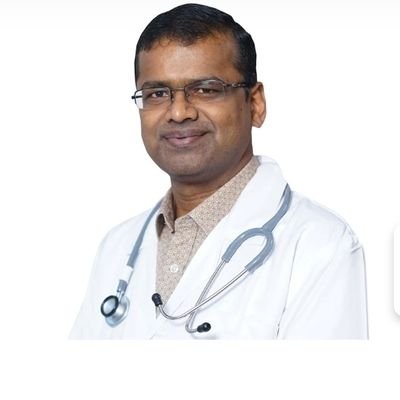
A 90-minute run. Average heart rate: 112 bpm.
This wasn’t about speed.
This was about efficiency. 12.6 km at a relaxed pace, heart rate staying low and steady throughout.
What does this reflect?
• A strong aerobic base
• High stroke volume (heart pumps more blood per beat)
• Excellent mitochondrial efficiency
• Dominant parasympathetic (vagal) tone
In simple terms:
👉 The heart works less… and delivers more.
*Most people underestimate easy runs.
*Most chase speed too early.
*Longevity lies in patience.
✅For people over 40 and 50:
You don’t need to run fast every day
You don’t need to exhaust yourself
You do need to build aerobic fitness
▶️Low-intensity, long-duration runs:
✔ Improve heart health
✔ Lower resting heart rate & BP
✔ Protect the brain
✔ Reduce risk of heart attack, stroke & diabetes
This is longevity training, not just fitness.
Strong hearts beat fewer times over a lifetime.
How many of your runs are truly easy?
Dr Sudhir Kumar
@hyderabaddoctor


English


Just at the start of a new earnings season the definition of EBITDA has been changed
EBITDA - Earnings Before Interest and Trump's deadly announcements
English
@moneyworks4u_fa Jin logon ne high par liya, unko chappal padi
HAHA
RELAXO
Eesti

Page Ind flat for over7 yrs now. It reminds me of this quote from Howard Marks:
"The more enthusiasm there is in the world, the harder it is to live up to people’s expectations and the easier it is to disappoint. When a stock goes from great optimism to the optimism sobering up, it’s very painful for investors. What you really want to know is, how much optimism is in the price. If you can buy things where the level of optimism is unjustifiably low, that’s where you make a lot of money."

Sandeep Kulkarni@moneyworks4u_fa
Page ind still languishing at the same trendline. But may be forming a bullish reversal.
English
@nooreshtech @ShishirAsthana_ Congratulations Nooresh. Looking forward to read.
@ShishirAsthana_ any hopes for releasing this for kindle? If yes would like to wait for that.
English
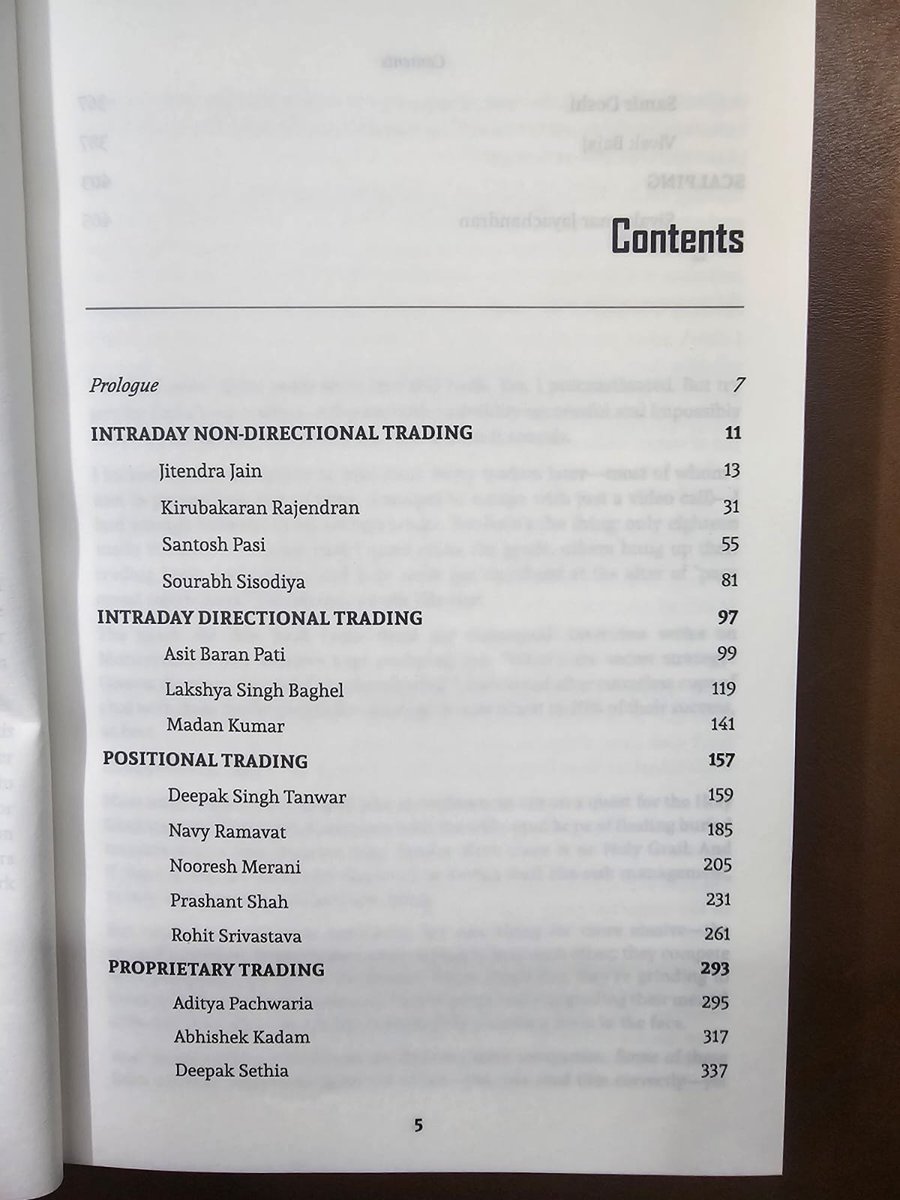
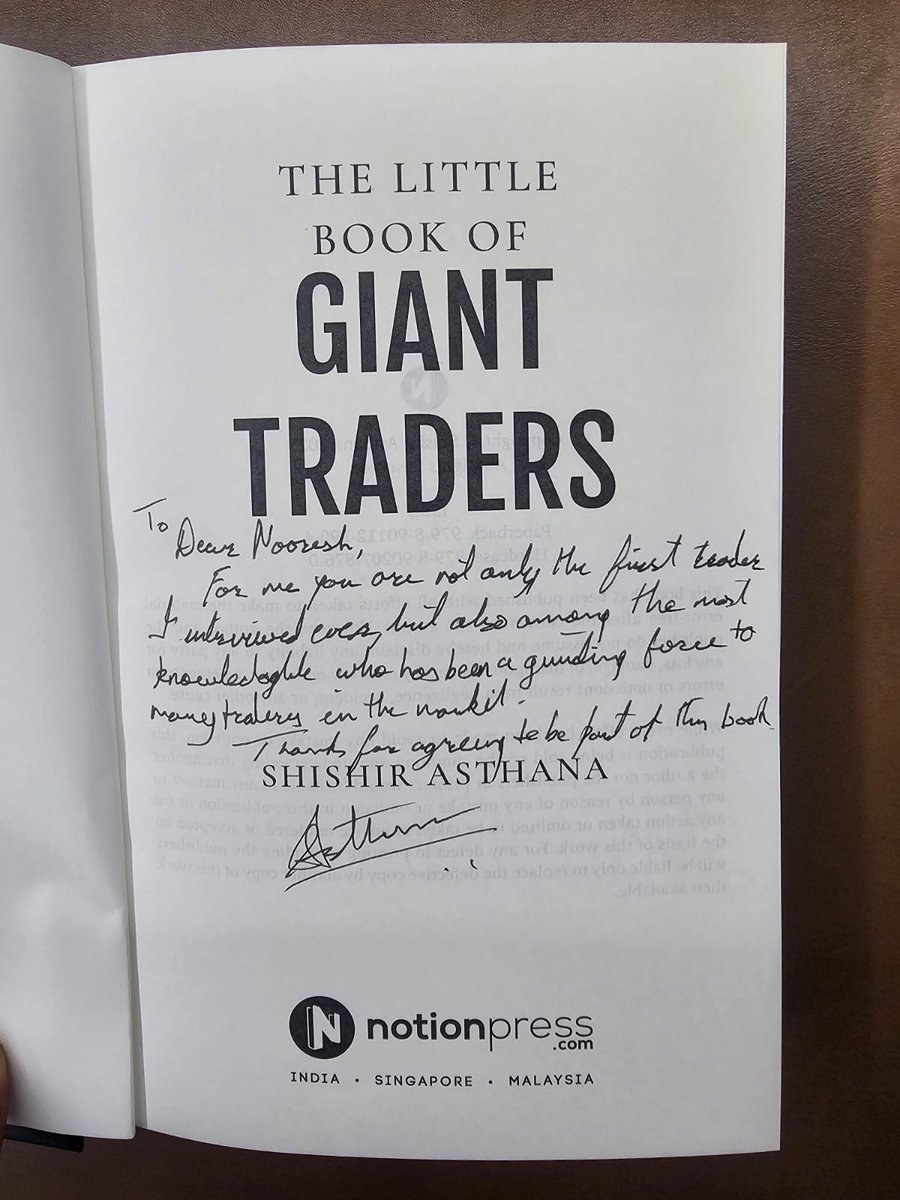
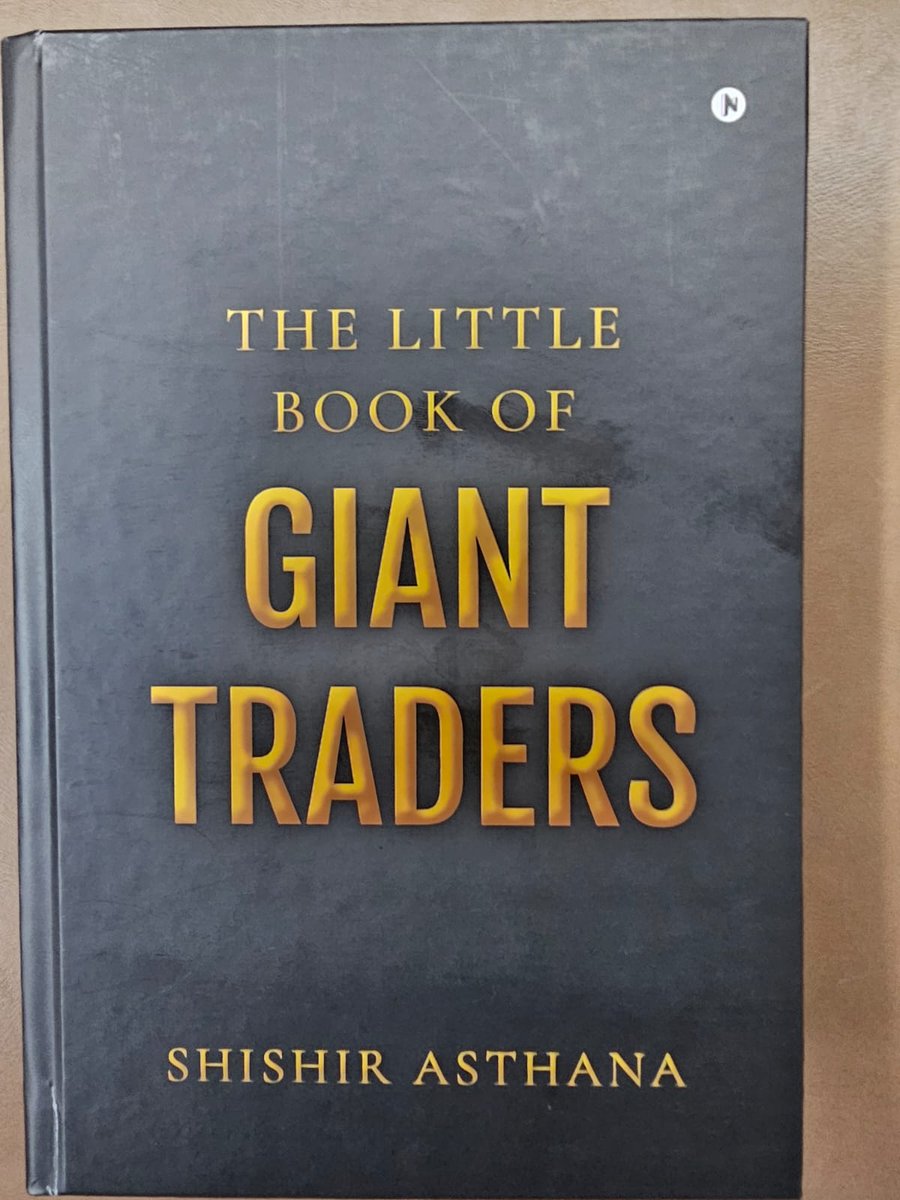
The Little Book of Giant Traders by @ShishirAsthana_
What a great feeling to be featured in a book by someone who has interviewed the maximum number of traders in India.
Many different Trading Styles are covered. Grab a Copy.
amzn.to/45IHu6T
English