Waka

67 posts

Waka banner
Waka

Waka

@HelloWaka_

Hello it's Waka 😊 Building in public the trade settlement platform for Africa trade. Follow to stay in touch! 🔔

가입일 Kasım 2025
26 팔로잉12 팔로워
Waka
Waka@HelloWaka_·
Congrats on the fast growth of direct China-Africa port-to-port routes! The shipping side is being rebuilt. That naturally makes you think about the other side of the trade: payments.Most of these transactions still go through old correspondent banking routes via New York or London: multiple conversions, delays, and fees.Ships are now going direct. Money hasn’t caught up yet. Waka is working to close this gap using stablecoins for local-to-local settlement. We're curious to hear thoughts from trade, logistics, and finance folks — how do you see settlement rails evolving in the coming years? Leave your comments👇
Carlos Lopes@LopesInsights

Fast growth of direct port-to-port routes between China and Africa, after the introduction by China of total zero-tariff for African imports. The increase in air links between the 2 is led by African carriers while the new maritime surge is led by Chinese shipping companies. africa.businessinsider.com/local/markets/…

English
0
0
0
9
Waka
Waka@HelloWaka_·
The "stablecoins are just a crypto thing" narrative is getting harder to hold. @Visa just hit $ 7B annualized stablecoin settlement volume across 9 chains and 50+ countries. This isn't hype. 🚀
Jack Forestell@jackforestell

Stablecoins are moving from idea to infrastructure—powering real settlement. Visa has hit a $7B annualized run rate, + 50% QoQ. We have expanded our global stablecoin settlement program to @Arc, @Base, @CantonNetwork, @0xPolygon and @Tempo, bringing us to nine chains. Stablecoins are multi‑chain. Settlement has to be seamless across it.

English
0
0
2
30
Waka
Waka@HelloWaka_·
China just dropped tariffs for 53 African nations. Trade is getting easier. Payments should too. Happy Monday.
English
0
0
2
13
Waka
Waka@HelloWaka_·
Cross-border trade never clocks out. Neither do the people behind it. To every seller, operator, and builder moving money and goods across borders: happy Labor Day!
Waka tweet media
English
0
0
2
18
Waka
Waka@HelloWaka_·
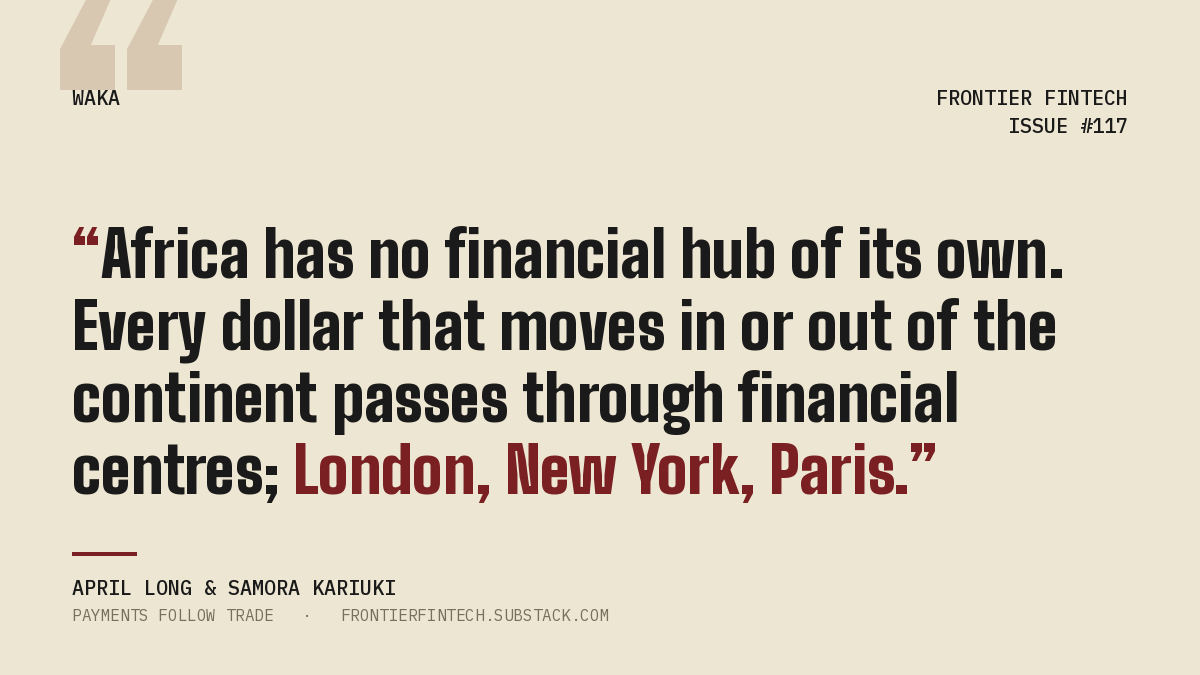
Africa does not have a dollar problem. The dollars are already there — but fragmented across offshore accounts and routed through financial centres not built for Africa–Asia trade. Stablecoins change this by aggregating offshore dollar liquidity onto public blockchain rails. More in the article co-authored by our CEO April Long and @SamoraKariuki 👇
Waka tweet media
Samora Kariuki@SamoraKariuki

Every year, African businesses move billions of dollars to pay their Asian supply chain partners. Electronics, machinery, solar panels, construction equipment. They pay slowly, expensively, and through infrastructure designed for entirely different corridors. The correspondent banking system was built to serve trade flows that ran west. Africa's trade increasingly runs east. In 2024, Africa ran a $62 billion trade deficit with China while running surpluses with Europe and the United States. The dollars earned in London and Brussels must eventually reach Shenzhen and Guangzhou. The infrastructure connecting those two realities was never designed for the job. Stablecoins are changing part of this picture; less as a new currency, more as a mechanism for making existing dollar liquidity move at the speed trade actually requires. But the rail is only one layer. Settling into China carries compliance requirements that have no equivalent in Western payment systems. The data that travels with the payment is what makes the payment legitimate. Our latest piece on Frontier Fintech examines what it takes to build infrastructure that fits this reality and profiles Waka, the company April Long built after a decade managing the Africa-Asia corridor from inside Standard Chartered Kenya. Link in Comments. Subscribe to Frontier Fintech.

English
0
1
3
97
Waka
Waka@HelloWaka_·
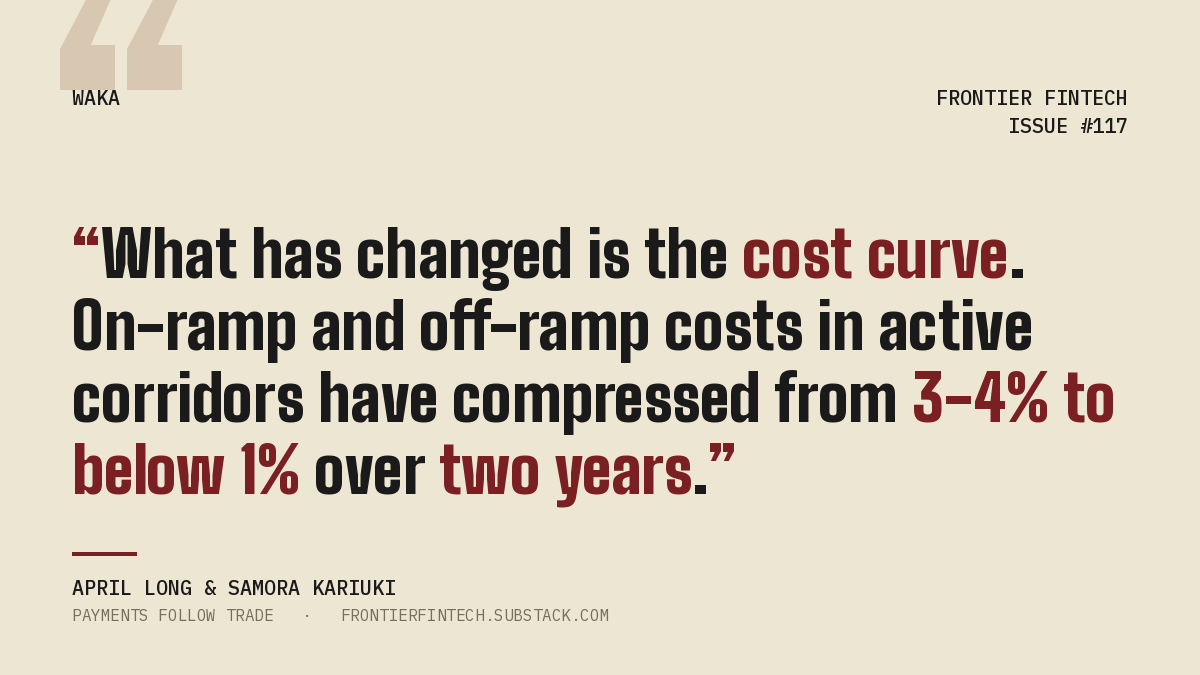
Waka didn’t choose stablecoins because they became the narrative of the year. We chose them because the economics changed. On/off-ramp costs in active Africa–Asia corridors fell from 3–4% to below 1% in two years. The real story is the cost curve.
Waka tweet mediaWaka tweet media
English
0
2
2
17
Waka
Waka@HelloWaka_·
Wire transfers invented the word "eventually". Happy Monday.
English
0
0
2
23
Waka
Waka@HelloWaka_·
Why we keep saying trade finance and stablecoins are converging. Look at what’s happening lately: → MoneyGram + NALA: stablecoin payouts in Africa & Asia → Tether debuts tether.wallet, self-custodial → SocGen lists its MiCA stablecoin on MetaMask → Visa, Stripe, Zodia join Tempo as first external validators ... And this is just one week of headlines. What Waka is building sits inside this great shift. Keep moving and shipping. 🚀
GIF
English
0
0
1
69
Waka
Waka@HelloWaka_·
Kenya just closed public consultation on its draft VASP Regulations 2026, and the details are worth a closer look. The regulations operationalize the VASP Act that took effect in November 2025. What stands out is how specific they are: 🏛️ Dual-regulator model: Central Bank of Kenya for payments + stablecoins, Capital Markets Authority for exchanges, brokers, and tokenization 💰 Stablecoin issuers face a KSh 500M (~$3.86M) paid-up capital requirement, with other VASP categories at different thresholds 🏦 Licensing applicants must disclose principal bankers and account details. Stablecoin issuers face explicit Kenya-based banking requirements, with at least 30% of reserves in segregated local accounts 🗣️ Public participation forums held across 11 cities, from Mombasa to Garissa Kenya is writing sector-specific rules with real numbers, at a pace ahead of many larger economies still stuck in consultation loops. A fast-growing African economy treating digital settlement as part of its financial architecture from day one. The region is strategic for our growth; it serves as an important gateway to Africa and functions as a primary financial innovation hub.
The National Treasury@KeTreasury

VIRTUAL ASSETS Kenya moves closer to regulating virtual assets as public participation on the Draft Virtual Asset Service Providers (VASP) Regulations, 2026 concludes. The Regulations operationalize the Virtual Asset Service Providers Act, 2025, providing a clear legal framework for licensing, regulating, and supervising virtual asset businesses in and from Kenya. Virtual assets such as cryptocurrencies, tokenized assets, and stablecoins are reshaping global finance. Kenya is positioning itself to harness innovation while safeguarding financial stability, protecting consumers, and managing emerging risks. Public value: The framework establishes a fair, transparent, and competitive market,supporting innovation, strengthening investor confidence, and unlocking new economic opportunities. Strong safeguards introduced include: • Fit & proper ownership requirements • Adequate capital thresholds • Strong governance frameworks • Robust risk management and AML/CFT compliance Consumer protection remains central: • Clear risk disclosures • Transparent pricing structures • Effective complaints handling mechanisms • Strict segregation and protection of customer assets Market integrity measures include: • Fair and orderly trading rules • Due diligence before listing virtual assets • Continuous monitoring of markets • Zero tolerance for manipulation, insider trading, and false trading Enhanced oversight and resilience measures include: • Continuous reporting and disclosures • Onsite and offsite supervision • Strong cybersecurity and incident reporting frameworks • Mandatory audits, insurance, and prudential requirements A whole of government approach anchors implementation, bringing together The National Treasury, Central Bank of Kenya (@CBKKenya), and Capital Markets Authority (@CMAKenya) for coordinated oversight. Kenya is building a trusted framework that balances innovation with financial stability. Next step: review and consolidation of stakeholder submissions ahead of finalization of the Regulations. Stakeholders are encouraged to follow updates as Kenya advances this regulatory framework.

English
1
0
2
40
Waka
Waka@HelloWaka_·
We're honored to be profiled in @SamoraKariuki ’s latest piece in Frontier Fintech! Payments follow trade, and Africa’s trade is going east fast. The real bottleneck isn’t just cost or rails, it’s making dollar liquidity move at trade speed while handling China’s compliance realities. 🔗 in the comments 👇
Samora Kariuki@SamoraKariuki

Every year, African businesses move billions of dollars to pay their Asian supply chain partners. Electronics, machinery, solar panels, construction equipment. They pay slowly, expensively, and through infrastructure designed for entirely different corridors. The correspondent banking system was built to serve trade flows that ran west. Africa's trade increasingly runs east. In 2024, Africa ran a $62 billion trade deficit with China while running surpluses with Europe and the United States. The dollars earned in London and Brussels must eventually reach Shenzhen and Guangzhou. The infrastructure connecting those two realities was never designed for the job. Stablecoins are changing part of this picture; less as a new currency, more as a mechanism for making existing dollar liquidity move at the speed trade actually requires. But the rail is only one layer. Settling into China carries compliance requirements that have no equivalent in Western payment systems. The data that travels with the payment is what makes the payment legitimate. Our latest piece on Frontier Fintech examines what it takes to build infrastructure that fits this reality and profiles Waka, the company April Long built after a decade managing the Africa-Asia corridor from inside Standard Chartered Kenya. Link in Comments. Subscribe to Frontier Fintech.

English
1
1
2
63
Waka
Waka@HelloWaka_·
Appreciate the read Lex, but worth zooming out on how the African cross-border space has evolved. It started with inbound remittance (Wave era) while the inbound TAM is capped. The pivot to outbound was inevitable: trade flows are 10x+ remittance, and outbound trade goes east. That's the actual prize. The gap between Asian capital and Asian customer coverage in this space is still surprisingly thin. That's the whitespace.
English
0
0
1
19
Lex Sokolin | Generative Ventures
@SamoraKariuki This is the corridor stablecoins were built for. Africa to Asia trade has grown past what the legacy correspondent network can price properly. Bridge, ChipperCash, and a few onchain players are already routing real volume here. The financial press hasn't caught up.
English
1
0
1
86
Samora Kariuki
Samora Kariuki@SamoraKariuki·
Every year, African businesses move billions of dollars to pay their Asian supply chain partners. Electronics, machinery, solar panels, construction equipment. They pay slowly, expensively, and through infrastructure designed for entirely different corridors. The correspondent banking system was built to serve trade flows that ran west. Africa's trade increasingly runs east. In 2024, Africa ran a $62 billion trade deficit with China while running surpluses with Europe and the United States. The dollars earned in London and Brussels must eventually reach Shenzhen and Guangzhou. The infrastructure connecting those two realities was never designed for the job. Stablecoins are changing part of this picture; less as a new currency, more as a mechanism for making existing dollar liquidity move at the speed trade actually requires. But the rail is only one layer. Settling into China carries compliance requirements that have no equivalent in Western payment systems. The data that travels with the payment is what makes the payment legitimate. Our latest piece on Frontier Fintech examines what it takes to build infrastructure that fits this reality and profiles Waka, the company April Long built after a decade managing the Africa-Asia corridor from inside Standard Chartered Kenya. Link in Comments. Subscribe to Frontier Fintech.
Samora Kariuki tweet media
English
4
1
3
415
Waka
Waka@HelloWaka_·
The best payment infrastructure is the one you don't notice. Happy Monday.
English
0
1
2
65
Waka
Waka@HelloWaka_·
Cross-border settlement in emerging markets is split into two worlds: FX liquidity scattered across OTC desks and fragmented banks on one side, Asian payment companies focused only on compliant fiat rails on the other. The trade is there. The connecting infrastructure isn't. We build it end-to-end. All connected. Not split. That's Waka!🤝
Waka tweet media
English
0
0
2
37
Waka
Waka@HelloWaka_·
For stablecoins, the most important use case may not begin with consumers. It may begin with businesses. In cross-border trade, the value is easier to measure: lower cost, faster settlement, and capital that can be put back to work sooner. #stablecoins #B2B #Web3 #Crossborder #Trade #Business
English
0
0
1
84